
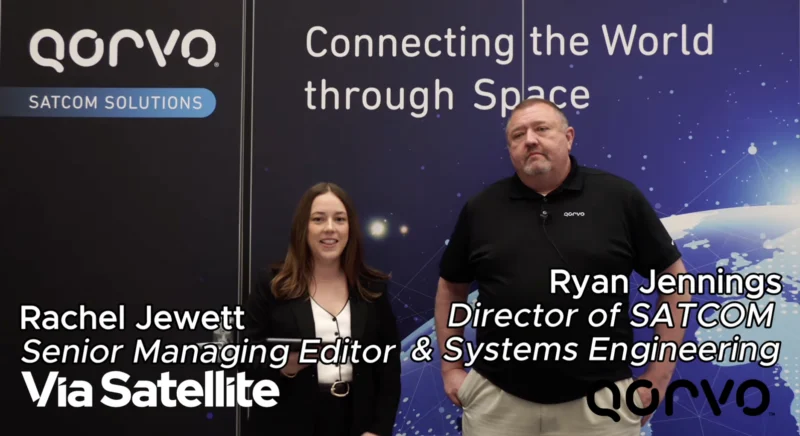

The rapid evolution of the satellite communications (SATCOM) landscape has reached a critical juncture where the distinction between orbital altitudes is becoming increasingly transparent to the end-user. During the SATELLITE 2026 conference in Washington, D.C., Ryan Jennings, Qorvo’s Director of Satcom & Systems Engineering, emphasized that the modern consumer’s primary demand is seamless, high-speed connectivity, regardless of the underlying technical architecture. This shift toward a "connectivity-agnostic" user base is driving a massive technological transformation within the radio frequency (RF) industry, pushing manufacturers like Qorvo to develop more integrated, efficient, and versatile components that can bridge the gap between Low Earth Orbit (LEO), Medium Earth Orbit (MEO), and Geostationary Orbit (GEO) systems.
The interview, conducted during one of the industry’s most significant annual gatherings, highlighted Qorvo’s strategic focus on phased array technology. These systems are no longer confined to high-budget military applications but are becoming the backbone of consumer-grade satellite terminals and the massive constellations of LEO satellites currently being deployed. According to Jennings, the industry is moving toward a multi-orbit evolution, necessitating terminals that can support multiple satellite systems simultaneously to ensure reliability and low latency.
The Technological Shift to Phased Array Systems
At the core of Qorvo’s presentation at SATELLITE 2026 is the advancement of phased array antennas. Unlike traditional parabolic dishes, which require mechanical motors to track satellites as they move across the sky, phased array antennas use a grid of small elements to steer the beam electronically. This allows for instantaneous switching between satellites, a feature that is essential for maintaining a stable connection with LEO constellations where satellites pass overhead in minutes.
Jennings detailed how Qorvo is applying its expertise in RF solutions to both ends of the link. On the space side, Qorvo provides high-reliability components designed to withstand the harsh environment of LEO while maintaining the power efficiency required for small-satellite form factors. On the ground side, the focus has shifted toward reducing the cost and complexity of consumer phased array terminals. For SATCOM to achieve true mass-market penetration, the hardware must be affordable, easy to install, and capable of operating across various frequency bands, including Ku and Ka-band.
The integration of Gallium Nitride (GaN) and Silicon Germanium (SiGe) technologies has been instrumental in this progress. GaN, in particular, offers superior power density and efficiency, which allows for smaller, lighter terminals that generate less heat. By optimizing these semiconductor materials, Qorvo is enabling the production of flat-panel antennas that can be integrated into vehicles, aircraft, and even portable devices, fulfilling the vision of "connectivity anywhere."
Chronology of the SATCOM Evolution (2020–2026)
The current state of the industry as discussed at SATELLITE 2026 is the result of a decade of rapid acceleration in space access and hardware innovation.
- 2020–2021: The initial "LEO Gold Rush" begins, with companies like SpaceX (Starlink) and OneWeb launching hundreds of satellites. The industry relies heavily on first-generation, high-cost phased array terminals.
- 2022–2023: Standardization efforts for Non-Terrestrial Networks (NTN) begin under the 3GPP Release 17 and 18 frameworks. Qorvo and other RF leaders start prioritizing multi-band support to accommodate diverse orbital fleets.
- 2024: A significant shift occurs as GEO operators (such as SES and Intelsat) begin integrating LEO services into their portfolios to offer hybrid "multi-orbit" solutions for enterprise and government clients.
- 2025: The "User Terminal Breakthrough" year. Manufacturing scales up, and the cost of phased array components drops by approximately 30%, making consumer-facing satellite broadband more competitive with terrestrial fiber in rural areas.
- 2026: SATELLITE 2026 marks the era of the "Invisible Network." As Ryan Jennings noted, the focus has shifted from the "how" of the technology to the "utility" of the connection, with Qorvo delivering the RF engines that make this seamless transition possible.
Market Data and Supporting Industry Trends
The move toward multi-orbit terminals is supported by robust market data. According to industry analysts, the global SATCOM market is projected to reach an estimated $120 billion by 2030, with a Compound Annual Growth Rate (CAGR) of over 12% between 2024 and 2030. A significant portion of this growth is attributed to the "Ground Segment," which includes the user terminals and gateways that Qorvo services.
Data presented at the conference suggests that by the end of 2026, the number of active LEO satellites will exceed 12,000, a fourfold increase from 2022 levels. This density of satellites requires a sophisticated ground infrastructure capable of high-speed handover. Furthermore, the demand for In-Flight Connectivity (IFC) and maritime broadband has surged, with a 45% increase in bandwidth consumption reported by major airlines over the last 24 months. These sectors are the primary early adopters of the multi-orbit terminals Jennings described, as they require the wide-area coverage of GEO satellites combined with the low latency of LEO systems for real-time applications.
Official Responses and Industry Reactions
The sentiments expressed by Jennings resonate with broader industry trends observed during SATShow Week. Satellite operators have increasingly voiced the need for "open-architecture" terminals. In a panel discussion following Jennings’ interview, representatives from several major satellite fleet operators noted that proprietary hardware has historically been a bottleneck for growth.
"The hardware must be as flexible as the software defined-satellites we are putting into orbit," stated one senior executive from a leading GEO operator. "Qorvo’s focus on RF solutions that can span different architectures is exactly what the service providers need to reduce churn and offer more resilient packages."
Furthermore, government and defense sectors have reacted positively to the move toward consumer-scale phased arrays. The U.S. Department of Defense has long sought "Proliferated LEO" (pLEO) capabilities, and the ability to leverage commercial-off-the-shelf (COTS) RF technology from companies like Qorvo allows for faster deployment of secure communications for tactical units in the field.
Technical Analysis of Multi-Orbit Implications
The transition to multi-orbit connectivity is not merely a marketing pivot; it is a technical necessity driven by the laws of physics and economics. GEO satellites, located 35,786 kilometers above the Earth, provide massive broadcast capacity and consistent coverage but suffer from a latency of approximately 500-700 milliseconds. This is unsuitable for modern applications like video conferencing, online gaming, or autonomous vehicle coordination. LEO satellites, orbiting at 500-1,200 kilometers, offer latencies as low as 20-40 milliseconds but require a constant "handshake" between moving satellites.
By utilizing Qorvo’s advanced RF front-ends, a single terminal can now manage the high-power requirements of a GEO link while simultaneously maintaining the rapid-switching beamforming required for LEO. This hybrid approach ensures that if a LEO satellite is obstructed by terrain or weather, the terminal can failover to a GEO or MEO link without the user experiencing a drop in service.
This "always-on" capability is the cornerstone of the 6G vision, where satellite and terrestrial networks are fully integrated. Jennings’ assertion that "people want connectivity, and they really don’t care how" highlights the industry’s ultimate goal: making the satellite link as reliable and unremarkable as a standard Wi-Fi connection.
Broader Impact and Future Outlook
The implications of Qorvo’s RF innovations extend far beyond the technical sphere. By lowering the barriers to entry for high-quality satellite hardware, the industry is poised to address the global digital divide more effectively than ever before. In 2026, it is estimated that nearly 2.5 billion people still lack reliable high-speed internet. The mass production of affordable phased array terminals could bring millions of these individuals online, fostering economic growth in developing regions.
Moreover, the commercialization of these technologies is driving down costs for the aviation and maritime industries. We are likely to see a shift where high-speed internet becomes a standard, complimentary feature on all commercial flights, rather than a premium luxury. This is made possible by the power-efficient RF components that allow for smaller, more aerodynamic antennas that reduce fuel drag on aircraft.
As SATELLITE 2026 concludes, the message from Qorvo and the wider SATCOM community is clear: the hardware is no longer the bottleneck. The focus has shifted to scaling production and refining the integration of multi-orbit fleets. With leaders like Ryan Jennings steering the technical direction of RF solutions, the industry is moving toward a future where the sky is no longer a limit, but a seamless extension of the global communications grid. The "connectivity-agnostic" future is not just a prediction; it is a reality being built one phased array at a time.