
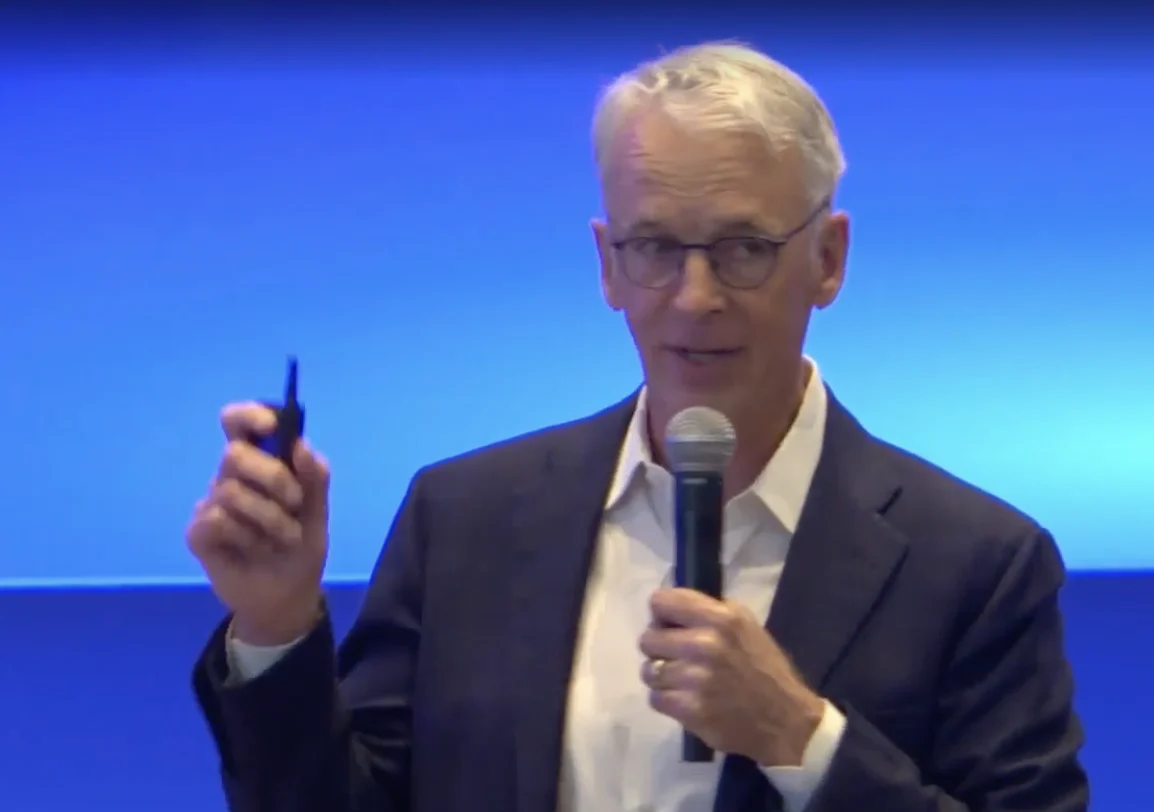

The traditional architecture of enterprise software is undergoing a fundamental shift as Salesforce, the global leader in Customer Relationship Management (CRM), pivots toward a future where its primary user interface may no longer be the primary point of entry for employees. Parker Harris, the co-founder of Salesforce and the principal architect behind the company’s product evolution for nearly three decades, recently proposed a provocative thesis: the "dis-intermediation" of the Salesforce platform in favor of Slack. Speaking at a recent launch event in San Francisco, Harris suggested that the necessity of logging directly into the Salesforce interface is diminishing as Slack evolves into the "engagement layer" for the modern enterprise, particularly as artificial intelligence (AI) becomes the driving force of corporate productivity.
This strategic evolution marks a significant departure for a company that spent years developing and refining its "Lightning" user interface. Harris, who was instrumental in the creation of Lightning, now argues that the conversational interface provided by Slack represents a more natural and efficient environment for both human workers and AI agents. By positioning Slack as the "front door" to what the company calls the "Agentic Enterprise," Salesforce is betting that the future of work lies in a unified, AI-powered communication hub rather than a fragmented landscape of specialized software applications.
The Strategic Evolution of Slack within Salesforce
The current trajectory of Slack must be viewed through the lens of its $27.7 billion acquisition by Salesforce, which closed in July 2021. At the time, the acquisition was the largest in Salesforce’s history, signaling a massive bet on the future of remote and hybrid work. Since the merger, Salesforce has worked to integrate its deep repository of customer data with Slack’s real-time messaging capabilities.
According to CEO Marc Benioff, the financial performance of Slack since the acquisition has validated this strategy. Benioff noted that Slack has already delivered two-and-a-half times revenue growth in the five years since the deal was initiated, with projections suggesting that growth will reach three times by the end of the current fiscal year. Currently, approximately one million businesses utilize Slack, including major industry leaders such as Amazon, Verizon, and Target.
The integration has moved beyond simple messaging to become a platform for "vibe-coding" and rapid development. Harris pointed out that the world’s leading AI companies—the very organizations defining the current technological epoch—do not build their own internal collaboration tools but instead "live in Slack." This concentration of high-tech talent within the Slack ecosystem has accelerated the development of custom AI tools and integrations, transforming the platform from a chat app into a sophisticated environment for technical orchestration.
Bridging the Agentic Divide with Agentforce
The pivot toward Slack is intrinsically tied to Salesforce’s broader AI strategy, specifically the rollout of "Agentforce." This platform allows companies to build and deploy autonomous AI agents capable of handling complex tasks in sales, service, marketing, and commerce. However, the adoption of these advanced tools has faced a hurdle that Benioff describes as the "agentic divide."
Similar to the "digital divide" of previous decades, the agentic divide refers to the gap between companies that have successfully integrated autonomous AI into their workflows and those that remain stuck in manual or purely reactive modes of operation. Salesforce views Slack as the bridge across this chasm. Because employees are already active within Slack, introducing AI agents into that existing conversational flow reduces the friction of adoption.
Harris emphasized that the complexity of managing multiple specialized AI agents could potentially overwhelm users. Instead of requiring an employee to navigate various interfaces to find a specific sales or HR agent, the "Slackbot" acts as an orchestrator. This "super-agent" understands the user’s context and can automatically hand off tasks to the appropriate specialized agent within the Salesforce ecosystem. This orchestration layer ensures that the power of Agentforce is accessible through a single, familiar text-based interface.
Technical Milestones and the Growth of the AI Marketplace
The technical foundation for this shift was solidified in February 2024, when Salesforce opened its real-time search APIs and moved the Model Context Protocol (MCP) server to general availability. These updates allowed developers to build more sophisticated, data-aware agents that could operate within Slack with unprecedented speed and accuracy.
The result was a 300% growth in custom AI agents built on the platform in just a few months. This "rocket ship" growth, as Harris described it, indicates a massive appetite for agentic workflows. To support this demand, Salesforce introduced an AI makeover for Slack, featuring 30 new capabilities designed to enhance productivity. These features include:
- Expanded Slackbot Skills: Slackbot can now integrate directly with third-party partner applications such as Dropbox, DocuSign, and Linear, allowing users to execute tasks across different platforms without leaving the chat window.
- Agent Orchestration: The ability for Slackbot to act as a directory and manager for all other Agentforce agents deployed within an organization.
- Enhanced Real-Time Search: Leveraging Salesforce’s Data Cloud to provide agents with up-to-the-minute information on customer interactions and internal documents.
By opening the platform to third-party developers, Salesforce is positioning Slack not just as a tool for its own CRM, but as a universal interface for the entire enterprise software stack.
Industry Implications: Rejecting the SaaSpocalypse
The rise of generative AI and autonomous agents has led some industry analysts to predict a "SaaSpocalypse"—a scenario where traditional Software-as-a-Service (SaaS) applications become obsolete as AI models begin to handle data management and task execution directly. Critics argue that if an AI can answer any question or perform any update via a simple prompt, the need for complex UI-based applications like CRMs or ERPs will vanish.
Parker Harris firmly rejected this narrative. He argued that the underlying "systems of record"—the structured databases and workflows that companies have spent decades building—are more valuable than ever. In the era of the "system of agency," the AI requires the context, security, and structure provided by traditional SaaS applications to function reliably.
"Everybody needs their Sales, their Service, their Marketing," Harris stated. "All the applications, all the workflows, everything our customers have invested in, is incredibly valuable today because it’s now powered by the system of agency."
In this view, the "SaaSpocalypse" is avoided by a change in the delivery mechanism. While the traditional Salesforce "tabs and tables" interface might recede into the background, the underlying logic and data remain the essential engine driving the AI agents. Slack provides the "front-end" that makes this engine usable for the average employee.
Internal Cultural Shifts and the Future of the Lightning UI
The declaration that users may never need to log into Salesforce again has significant implications for the company’s internal product development teams. Marc Benioff acknowledged that this vision requires a shift in how the company prioritizes its various platforms. While the Lightning UI will continue to exist and serve a purpose for heavy-duty data administration and complex configuration, its role is being redefined.
Benioff expressed a commitment to making Slackbot a "highly-composable object" that can be embedded not just in Slack, but across the entire Salesforce suite, including Tableau and various industry clouds. Furthermore, Salesforce is pursuing a "deeply collaborative" approach with other ecosystem players, such as Microsoft (Teams) and Google (Workspace), ensuring that Salesforce’s agentic capabilities can function wherever the user chooses to work.
However, the internal transition is still a work in progress. Benioff’s humorous remark—asking if the vision of a "fading" traditional interface had been communicated to his own product people—highlights the magnitude of the cultural shift required. For a company built on the success of a web-based CRM interface, moving toward a "headless" or "conversational-first" model represents a bold reimagining of its identity.
Conclusion: A New Frontier for Enterprise Productivity
As Salesforce enters the 2026 fiscal year, the company’s focus is clear: the democratization of AI through Slack. By leveraging Slack as the primary engagement layer, Salesforce aims to make the "Agentic Enterprise" a reality for its million-plus business customers.
The strategy hinges on the belief that productivity is maximized when the tools of work are invisible, integrated, and intelligent. If Harris’s vision holds true, the next generation of workers may view Salesforce not as a website or an app they "visit," but as an omnipresent intelligence that assists them through their daily conversations in Slack. This transition from a destination-based software model to an ambient, agentic model marks the beginning of a new chapter in the history of enterprise technology, where the interface is no longer the product—the outcome is.