
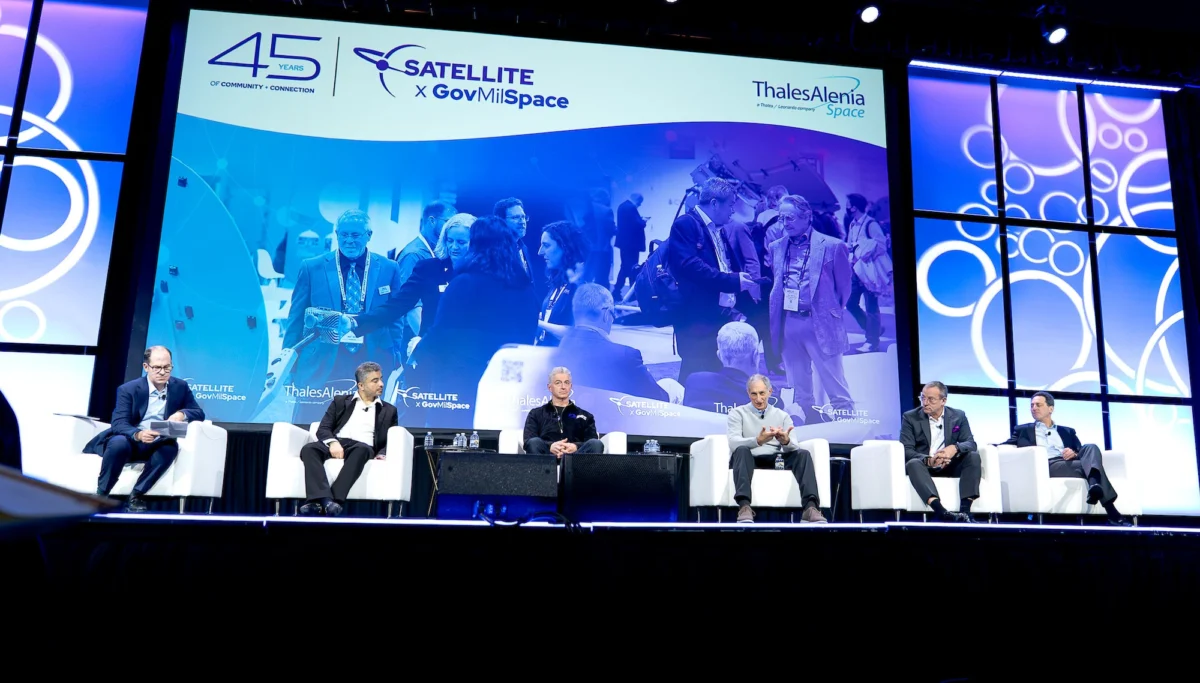

The global satellite communications landscape is undergoing a fundamental transformation driven by intensifying geopolitical volatility, a surge in national defense spending, and a radical acceleration in the pace of technological innovation. At the Opening General Session of SATShow Week on March 24, 2026, the chief executives of the world’s leading satellite operators—Telesat, Viasat, SES, Space42, and Eutelsat—delivered a unified message: the industry must move beyond traditional business models to address a world defined by conflict and the urgent need for technological sovereignty.
The convergence of multiple active conflicts and rising regional tensions has shifted the perception of satellite infrastructure from a commercial utility to a critical pillar of national security. As commercial satellite leaders gathered in Washington, D.C., the discourse focused on the industry’s responsibility to deliver resilient, high-capacity, and sovereign capabilities in an era where space has become a contested domain.
Geopolitical Drivers and the Defense Pivot
Dan Goldberg, CEO of Telesat, highlighted that current geopolitical developments are not merely challenges but are creating some of the most significant commercial opportunities in the history of the industry. Goldberg pointed specifically to the increased defense expenditures among NATO member states and the "consequential" role that Low-Earth Orbit (LEO) constellations have played in the ongoing conflict in Ukraine. The war has demonstrated that high-speed, low-latency connectivity is no longer an optional asset for modern warfare; it is the backbone of command, control, and intelligence.
In response to these shifting requirements, Telesat recently announced a strategic pivot for its Lightspeed LEO constellation. The company is integrating military Ka-band (Mil-Ka) spectrum into 156 of its satellites. This modification effectively dedicates 25% of the constellation’s total capacity to defense and sovereignty programs. This move reflects a broader trend where commercial operators are "stepping up" to provide the specialized capabilities required by government actors who find traditional, slow-moving procurement cycles insufficient for modern threats.
The integration of Mil-Ka spectrum allows for secure, jam-resistant communications that are interoperable with existing military hardware, bridging the gap between commercial efficiency and the rigorous demands of the battlefield. Goldberg’s assessment underscores a reality where the "ruptures" seen globally are forcing a rethink of how satellite capacity is allocated and designed from the ground up.
Sovereignty and the Rise of Regional Powerhouses
The concept of "space sovereignty" has moved to the forefront of the Middle Eastern market, particularly for the United Arab Emirates (UAE). Ali Al Hashemi, CEO of Space Services for Space42, detailed how the formation of Space42—a merger of the UAE’s satellite giant Yahsat and the geospatial AI firm Bayanat—was a proactive response to regional instability. With the UAE facing persistent threats from Iranian-backed actors, the need for an integrated, domestic space powerhouse has never been more acute.
Space42 represents a new breed of operator that combines traditional satellite communications with geospatial intelligence and artificial intelligence. Al Hashemi noted that the geopolitical situation validated the decision to consolidate these capabilities, as it enhanced the nation’s resilience and its ability to deliver sovereign applications without relying solely on external providers.
A key component of this strategy is Equatys, a joint venture between Space42 and Viasat focused on direct-to-device (D2D) services. By sharing infrastructure and spectrum, the venture aims to provide a seamless, independent platform that prioritizes regional independence. Al Hashemi argued that the industry needs to "rethink everything," moving away from isolated systems toward shared, flexible architectures that can adapt to rapid shifts in the security environment.
Cybersecurity and the Lessons of the KA-SAT Attack
The vulnerability of satellite networks was a primary theme for Viasat CEO Mark Dankberg, who referenced the 2022 KA-SAT cyberattack in Europe as a watershed moment for the industry. That attack, which occurred on the eve of the Russian invasion of Ukraine, disabled thousands of satellite modems across Europe, highlighting that commercial systems are now primary targets in geopolitical conflicts.
Dankberg warned that the industry is only seeing the "very beginnings" of such threats. He emphasized that in geopolitical hotspots, the distinction between military and commercial infrastructure is blurring in the eyes of adversaries. This reality is forcing operators to rethink satellite security not as a feature, but as a core architectural requirement.
The current environment, according to Dankberg, has triggered "capital investment wars." Satellite communications remains one of the most capital-intensive sectors globally, and operators are now competing against entities—often state-backed or vertically integrated giants—with nearly unlimited access to capital. For regional operators like Space42, the opportunity lies in their deep ties to local governments, allowing them to provide tailored sovereign solutions that global, one-size-fits-all operators may struggle to match.
Accelerating Innovation and the Death of the Seven-Year Cycle
One of the most significant shifts discussed at SATShow Week 2026 is the compression of development timelines. Adel Al Saleh, CEO of SES, stated that the industry can no longer afford the traditional five-to-seven-year development cycles for new satellite systems. With technology advancing at an exponential rate, a satellite designed today could be obsolete by the time it reaches orbit if it lacks flexibility.
To combat this, SES is championing software-defined payloads that allow for in-orbit upgrades. On the first day of the conference, SES unveiled more details regarding its "meoSphere" constellation, a next-generation Medium-Earth Orbit (MEO) network. In a move that highlights the industry’s shift toward agile partnerships, SES has placed an initial order of 28 satellites from K2 Space, a high-growth startup.
The meoSphere strategy involves a series of "pathfinder" missions launching over the next three years, with full operational status targeted for 2030. By utilizing K2 Space’s high-power satellite platforms and integrating SES’s proprietary software-defined payloads, the operator aims to create a network that can evolve alongside market demands. This modular approach is a direct departure from the "bent-pipe" satellites of the past, which offered little flexibility once launched.
The Push for Open Standards and Vertical Integration Challenges
As the industry matures, the lack of interoperability has become a point of contention. Jean-François Fallacher, CEO of Eutelsat, drew on his 30 years of experience in the telecommunications sector to advocate for open standards. He noted that the satellite industry remains fragmented compared to the mobile industry, where 3GPP standards allow for global roaming and hardware interoperability.
Fallacher argued that open standards would facilitate greater cooperation between the major operators, allowing them to better compete against vertically integrated players like SpaceX’s Starlink and Amazon’s Project Kuiper. These "New Space" giants control everything from launch and satellite manufacturing to user terminals, giving them a significant speed and cost advantage.
Dan Goldberg of Telesat echoed these concerns, admitting that being a service provider that procures technology from third parties puts operators at a potential competitive disadvantage. He called for an alignment of interests within the traditional ecosystem to ensure that non-vertically integrated players can remain competitive through shared innovation and standardized technology.
Top Markets for Growth: 2026 and Beyond
During a rapid-fire round, the CEOs identified the specific sectors they believe will drive revenue growth over the next decade:
- Commercial Mobility and Autonomy: Mark Dankberg (Viasat) identified the rise of autonomous land and air vehicles as a massive opportunity. As vehicles become increasingly reliant on real-time data for navigation and safety, the demand for ubiquitous, high-reliability connectivity will skyrocket.
- Aviation and Maritime: Jean-François Fallacher (Eutelsat) and Adel Al Saleh (SES) both pointed to the continued strength of the "Aero" market, including commercial airlines and private jets. Despite the decline of traditional linear television, Al Saleh noted that the demand for real-time media distribution—such as the Super Bowl, Olympics, and Formula 1—remains a highly cash-generative business for satellite operators.
- Direct-to-Device (D2D): Ali Al Hashemi (Space42) described D2D as a "big promise," envisioning a future where standard smartphones can connect directly to satellite networks without the need for specialized hardware. This technology has the potential to eliminate "dead zones" globally and tap into the multi-billion-user mobile market.
- Space-to-Space Communications: Dan Goldberg (Telesat) highlighted an emerging niche: the development of "systems of systems." As more constellations enter orbit, the need for satellites to communicate with one another to relay data efficiently will become a critical component of space architecture.
Analysis of Broader Implications
The discussions at SATShow Week 2026 signal a definitive end to the era of the "isolated satellite." The industry is moving toward an integrated, multi-orbit future where LEO, MEO, and GEO (Geostationary) satellites work in tandem to provide a "layered" connectivity experience.
The emphasis on sovereignty also suggests a "re-globalization" of the space industry. While the early 2020s were characterized by a push for global constellations, the mid-2020s are seeing a return to regionalism, as nations seek to protect their data and communications from foreign interference. This creates a complex landscape where operators must navigate varying regulatory environments while maintaining the technical ability to operate globally.
Financially, the industry is at a crossroads. The "capital investment wars" mentioned by Dankberg suggest that consolidation may continue as smaller players struggle to keep pace with the massive R&D budgets of tech-titan-backed competitors. However, the pivot toward software-defined systems and partnerships with agile startups like K2 Space offers a roadmap for legacy operators to remain relevant.
Ultimately, the 2026 summit established that the satellite industry is no longer just about "providing bandwidth." It is now a critical gear in the machinery of global geopolitics, a frontline in the battle for cybersecurity, and a rapidly evolving field where speed of innovation is the only true competitive advantage. As these CEOs return to their respective headquarters, the pressure to deliver on these "consequential" capabilities has never been higher.