
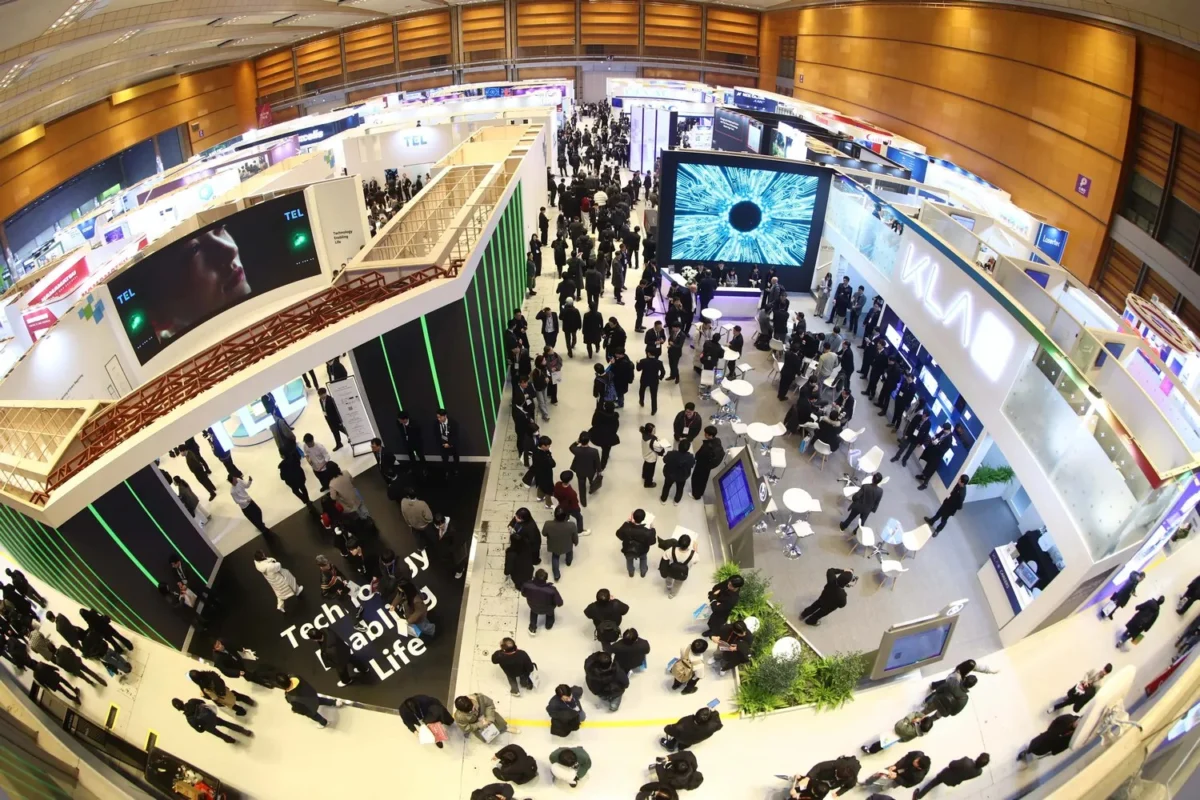

The global semiconductor ecosystem convened in Seoul from February 11 to 13, 2026, for SEMICON Korea, an event that marked a definitive shift in the industry’s strategic focus toward the "virtuous cycle" of artificial intelligence. As the sector moves toward a projected $1 trillion annual market value by 2030, the three-day exhibition and conference served as a critical nexus for over 550 exhibiting companies and thousands of global delegates. The central theme of the event centered on two symbiotic pillars: the deployment of AI to revolutionize semiconductor manufacturing operations and the advancement of hardware innovation to facilitate the next generation of generative and physical AI systems.
The scale of the 2026 event underscored South Korea’s pivotal role in the global supply chain. With more than 2,400 booths spanning the COEX exhibition center, SEMICON Korea demonstrated that the era of isolated breakthroughs has ended, replaced by a requirement for deep, cross-functional collaboration. Hyun Cha, President of SEMI Korea, noted during the opening press conference that progress now depends on a seamless integration of materials, equipment, design, manufacturing, and advanced packaging. This integrated approach is seen as the only viable path to overcoming the physical and economic limitations of traditional transistor scaling.
Strategic Chronology: A Three-Day Roadmap for the AI Era
The event’s schedule was designed to mirror the complexities of the modern semiconductor value chain, moving from high-level strategic visions to granular technical implementation.

On the opening day, February 11, leadership from SEMI and the South Korean government established the economic and geopolitical framework for the week. Ajit Manocha, President and CEO of SEMI, delivered an opening address that framed AI as the primary engine driving the industry’s trajectory toward unprecedented growth. However, he cautioned that this growth is contingent upon the industry’s ability to navigate an increasingly complex ecosystem where design and manufacturing can no longer function in silos. This sentiment was echoed by YH Lee, Chairman of Wonik, who advocated for "side-to-side" alignment, urging companies to collaborate with adjacent partners in the value chain rather than merely focusing on their immediate customers.
From a policy perspective, Shinhak Moon, Vice Minister of Korea’s Ministry of Trade, Industry & Resources (MOTIE), highlighted the government’s commitment to fostering a resilient ecosystem. He emphasized that while AI provides a massive tailwind, the industry must remain vigilant against the inherent volatility of global economic cycles by strengthening the domestic supply of parts, materials, and equipment.
Samsung Electronics and the Architecture of AI Memory
The technical keynote program began with a deep dive into the hardware bottlenecks currently facing AI developers. Jaihyuk Song, Corporate President and CTO of Samsung Electronics, addressed the widening "memory wall"—the gap between the processing power of modern GPUs and the bandwidth of the memory systems that support them.
Song outlined Samsung’s roadmap for next-generation memory, focusing on High Bandwidth Memory (HBM) and Compute-in-Memory (CiM) technologies. As AI models grow to trillions of parameters, Samsung is pivoting beyond traditional Moore’s Law scaling. The company’s strategy for 2026 and beyond involves a transition toward vertical and stacked architectures, utilizing 3D IC (integrated circuit) structures to pack more capacity and speed into smaller footprints. The CTO emphasized that sustaining AI performance gains will require a "holistic optimization" involving the tight integration of process technology and system architecture.

Advanced Packaging: The New Frontier of System Performance
As the industry moves toward chiplet-based designs, the role of the Outsourced Semiconductor Assembly and Test (OSAT) sector has shifted from a back-end service to a primary driver of innovation. Tien Wu, CEO of ASE, argued during his keynote that advanced packaging is now the defining factor in system-level efficiency.
Wu detailed the shift toward heterogeneous integration, where different types of silicon—such as logic, memory, and analog—are combined into a single package. He highlighted the increasing importance of 2.5D and 3D architectures, as well as the emergence of co-packaged optics (CPO) to solve the power and thermal challenges of high-speed data transmission. According to ASE’s analysis, as AI packages become larger and more complex, the industry’s competitiveness will increasingly be measured by yield and throughput in the packaging phase, making collaboration between foundries and OSATs essential.
AI-Driven Design and Manufacturing Velocity
The second day of the event shifted focus toward the tools and processes that enable chip production. Boyd Phelps, Senior Vice President at Cadence Design Systems, illustrated how AI is being used to design the very chips that will eventually run AI software. With the cost per transistor rising at advanced nodes (3nm and below), Phelps noted that AI-driven electronic design automation (EDA) tools are now a necessity. These tools allow engineers to explore thousands of design permutations to optimize for power, performance, and area (PPA) in a fraction of the time required by traditional methods.
In the realm of physical manufacturing, Tim Archer, President and CEO of Lam Research, introduced the concept of "velocity" as the industry’s new imperative. Archer argued that as product cycles shorten, equipment must become more intelligent. Lam Research showcased its progress in "autonomous fabs," where AI and digital twins—virtual replicas of physical equipment—are used to predict maintenance needs and accelerate process development. This digital-first approach allows manufacturers to reduce variability and bring new nodes to high-volume manufacturing faster than ever before.

SK hynix and the Integration of AI in R&D
SK hynix, a leader in the HBM market, provided a forward-looking perspective on material science. Sunghoon Lee, Senior Vice President and Head of R&D Process, addressed the escalating difficulty of sustaining memory technology cadences. He described a shift toward AI-based R&D models, where machine learning algorithms are used to simulate and discover new materials for stacking and bonding.
By integrating AI into the earliest stages of material exploration, SK hynix has reported significant reductions in development cycles. Lee emphasized that the future of memory depends on data sharing across the ecosystem, suggesting that a more transparent exchange of process data between partners could further accelerate the industry’s virtuous cycle.
NVIDIA: The Transformation to AI Infrastructure
The keynote series concluded with Soyoung Jeong, Head of Korea Business at NVIDIA, who detailed the company’s evolution from a GPU manufacturer to a provider of full-stack AI infrastructure. Jeong described "AI factories"—data centers designed specifically to produce intelligence—as the new unit of industrial production.
NVIDIA’s approach involves "physical AI," where AI is used to simulate and optimize the manufacturing and design of the chips themselves. This feedback loop ensures that the hardware is perfectly tuned for the software it will run. Jeong’s presentation reinforced the event’s core message: semiconductors and AI are now inseparable, with each technological leap in one field directly catalyzing a leap in the other.

Specialized Forums and Ecosystem Support
Beyond the main stage, SEMICON Korea 2026 featured specialized programs that addressed the broader needs of the semiconductor industry:
- AI Summit: Co-hosted by SEMI and KAIST, this summit brought together academic researchers and industry leaders to align future roadmaps. The discussions focused on embedding AI capabilities directly into manufacturing tools to unlock value beyond mere software applications.
- Smart Manufacturing Forum: This forum focused on the practical application of real-time data and analytics in the fab. Speakers shared success stories of how AI-driven decision-making has improved operational agility and yield in 300mm manufacturing facilities.
- Startup Summit: To ensure a pipeline of new ideas, the Startup Summit connected emerging companies with venture arms from Applied Materials, Intel, Samsung, and SK hynix. The focus was on startups applying AI to energy efficiency and novel manufacturing processes.
- Cybersecurity Forum: As fabs become more connected and data-dependent, the risk of intellectual property theft and operational disruption increases. Global experts at this forum discussed the implementation of "zero-trust" architectures and robust data governance to protect the industry’s most sensitive assets.
Analysis of Broader Impacts and Industry Implications
The insights gathered from SEMICON Korea 2026 suggest several critical trends that will define the industry through the end of the decade. First, the transition from "Moore’s Law" to "System-Level Scaling" is complete. The focus is no longer just on how many transistors can fit on a die, but on how efficiently those transistors can communicate within a complex system.
Second, the "Virtuous Cycle" of AI is creating a significant barrier to entry. Companies that do not integrate AI into their manufacturing and design processes will find it increasingly difficult to compete on speed and cost. This is leading to a consolidation of expertise among a few global hubs, with South Korea solidifying its position as the world’s memory and advanced manufacturing center.
Finally, the event highlighted the urgent need for workforce development. As fabs become more autonomous and design becomes more AI-reliant, the industry requires a new class of engineers who are proficient in both semiconductor physics and data science. The collaborative efforts seen in Seoul suggest that while the technical challenges are immense, the ecosystem is aligning its resources to meet the demands of the trillion-dollar AI era.

In conclusion, SEMICON Korea 2026 served as a powerful reminder that the semiconductor industry is the foundation of the modern world. By fostering a culture of collaboration and embracing the transformative power of artificial intelligence, the global value chain is positioning itself for a period of sustained and accelerated innovation.