
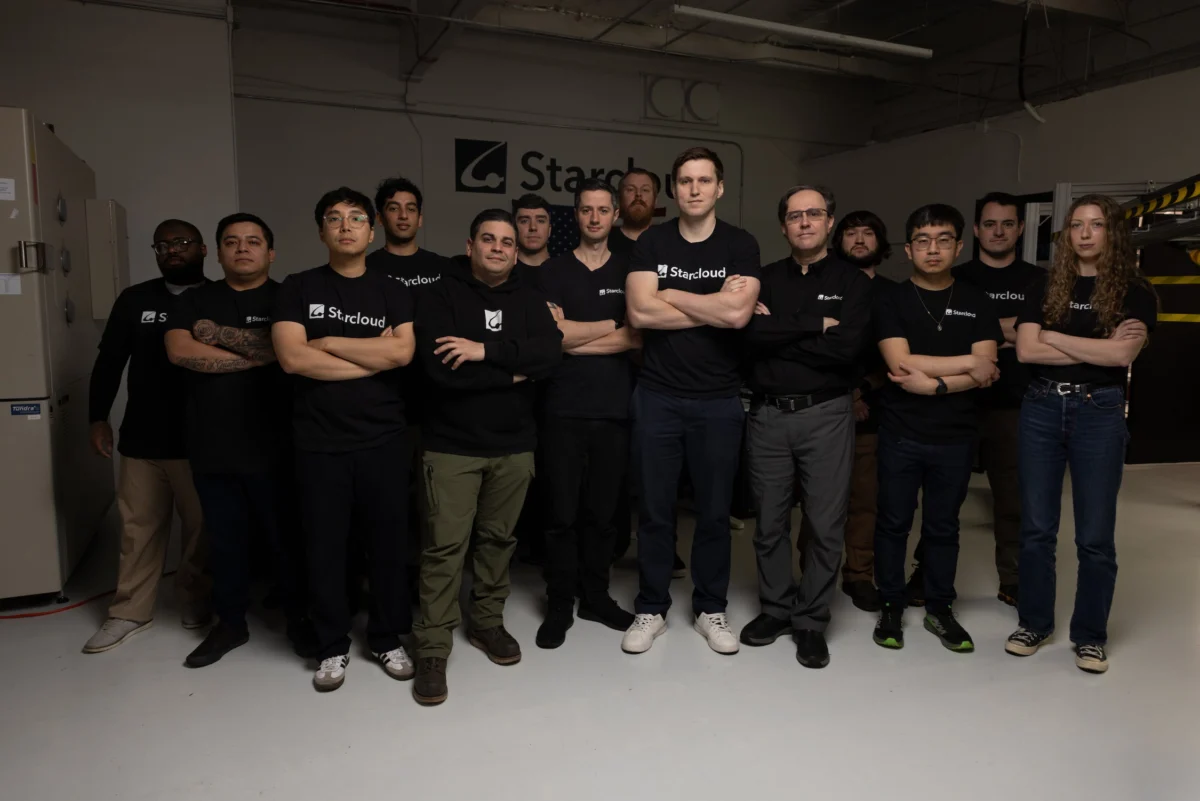

The global infrastructure for artificial intelligence has reached a critical juncture, prompting a shift from terrestrial foundations to the vacuum of space. Starcloud, a Redmond-based aerospace startup, announced on Monday that it has successfully closed a $170 million Series A funding round, catapulting the company to a $1.1 billion valuation. This milestone marks Starcloud as the fastest graduate of the prestigious Y Combinator accelerator program to achieve "unicorn" status, a feat accomplished less than two years after its 2024 founding. The capital infusion is earmarked for the aggressive expansion of an orbital network designed to serve as a distributed, high-performance data center, circumventing the growing energy and environmental constraints facing land-based facilities.
The funding round was structured in two distinct tranches to accommodate high investor demand. Benchmark, a venture capital firm known for its early-stage bets on era-defining tech companies, led the initial round with significant participation from EQT Ventures. Both firms co-led a subsequent extension round as the company’s valuation surged. The diverse investor syndicate also includes Macquarie Capital, NFX, Nebular, Y Combinator, Adjacent, 776 Ventures, Fuse Ventures, Manhattan West, and Monolith Power Systems. Notable individual backing came from angel investors such as Dennis Muilenburg, the former CEO of Boeing, whose involvement signals high-level confidence in Starcloud’s aerospace engineering capabilities.
The Shift to Orbital Compute: Addressing the Terrestrial Energy Bottleneck
The primary catalyst for Starcloud’s rapid ascent is the escalating crisis in the terrestrial data center market. As generative AI models require exponentially more processing power, the demand for electricity has begun to outpace the capacity of local power grids in major tech hubs. Northern Virginia, Dublin, and Singapore have all faced regulatory hurdles or moratoriums on new data center construction due to energy shortages.
Starcloud’s strategic pivot involves relocating the most energy-intensive AI workloads—specifically model training and high-capacity inference—to Low Earth Orbit (LEO). By operating in space, Starcloud can tap into virtually unlimited solar energy, which is roughly 30% more intense outside the Earth’s atmosphere and available nearly 24/7 in certain orbital planes. This eliminates the reliance on fossil-fuel-heavy terrestrial grids and provides a sustainable path for the continued growth of AI.
"The AI revolution is colliding with the physical limits of our terrestrial energy grid," stated Philip Johnston, CEO and co-founder of Starcloud. "We are quickly running out of places to build new energy projects for data centers on Earth. By moving AI compute to space, we unlock access to unlimited solar power and completely remove the energy bottleneck. This funding allows us to rapidly scale our orbital infrastructure and meet the massive commercial demand for sustainable AI compute."
A Record-Breaking Chronology of Growth
Starcloud’s trajectory from a startup concept to a billion-dollar enterprise has been remarkably compressed. Founded in early 2024, the company quickly moved through the Y Combinator program, focusing on the convergence of satellite bus technology and high-density server hardware. By November 2025, the company had already achieved its first major technical milestone with the successful launch and deployment of Starcloud-1.
Starcloud-1 served as a proof-of-concept mission, validating the company’s proprietary thermal management systems and radiation-shielding protocols. Unlike traditional communications satellites, which prioritize signal throughput, Starcloud’s hardware must manage the significant heat generated by high-performance GPUs in a vacuum where convection cooling is impossible. The success of Starcloud-1 demonstrated that these thermal challenges could be mitigated using advanced liquid-to-radiator cooling systems, paving the way for commercial-scale operations.
The company has now raised a total of more than $200 million since its inception. The speed of its valuation growth reflects a broader market trend where investors are seeking "hard tech" solutions to the infrastructure demands of the AI era. Industry analysts note that reaching a $1.1 billion valuation within two years is a testament to the perceived necessity of Starcloud’s service in the global supply chain.
Technological Roadmap and the Nvidia Partnership
The $170 million in new capital is already being deployed toward the next phase of the company’s hardware evolution. Starcloud is currently preparing for the launch of Starcloud-2 later this year. While the first satellite was a testbed, Starcloud-2 is designed to be a fully operational commercial unit. It will be capable of running real-world edge and cloud workloads for early-access customers, including financial institutions requiring low-latency localized processing and research organizations performing complex simulations.
A critical component of this technological edge is Starcloud’s collaboration with Nvidia. The startup was recently identified as a key partner for Nvidia’s specialized space-grade chips. These processors are designed to withstand the harsh radiation environment of LEO while maintaining the high TFLOPS (Tera Floating Point Operations Per Second) required for modern AI applications. By integrating these chips into the Starcloud-3 architecture—the development of which is a primary focus of the Series A funding—Starcloud aims to offer compute power in orbit that is competitive with high-end terrestrial server farms.
The Starcloud-3 iteration will also see the company move toward mass production. A portion of the funding will be used to establish a dedicated manufacturing facility in the Redmond area, allowing the company to move away from bespoke satellite assembly toward a standardized, high-volume production line. This shift is essential to meet the company’s ambitious constellation targets.
Regulatory Ambitions and the 88,000-Satellite Filing
Starcloud’s vision extends far beyond a handful of experimental satellites. The company recently filed an application with the Federal Communications Commission (FCC) for a constellation of up to 88,000 satellites. This scale is unprecedented, even when compared to massive telecommunications projects like SpaceX’s Starlink.
The proposed "distributed data center" would operate as a mesh network in LEO. By distributing compute tasks across thousands of nodes, Starcloud can ensure redundancy and high availability. If one satellite enters a period of orbital shadow or experiences a hardware fault, the workload can be seamlessly transitioned to another node in the network. Furthermore, a large-scale constellation allows for "orbital edge computing," where data can be processed in space as soon as it is collected by other Earth-observation satellites, significantly reducing the bandwidth required to downlink raw data to the ground.
However, the scale of the FCC filing has also drawn attention to the challenges of space traffic management and orbital debris. Starcloud has stated that its satellites will be equipped with automated collision-avoidance systems and will be designed for full atmospheric reentry and demise at the end of their operational lifespans. The company is working closely with regulatory bodies to ensure that its massive footprint does not interfere with existing space operations or contribute to the long-term sustainability issues facing LEO.
Strategic Implications for the Global Tech Economy
The rise of Starcloud represents a fundamental shift in how the tech industry views the "cloud." Historically, the cloud was a metaphor for terrestrial servers located in remote warehouses. Starcloud is making the metaphor literal, moving the core of the digital economy into the exosphere.
For the aerospace sector, Starcloud’s success suggests a new revenue model. For decades, the satellite industry was dominated by telecommunications, broadcasting, and government surveillance. The emergence of "Compute-as-a-Service" (CaaS) from orbit opens a multi-billion dollar market that links the aerospace industry directly to the silicon-valley AI boom.
For the environmental and energy sectors, Starcloud offers a potential "safety valve." By offloading the most power-hungry processes to space, the pressure on terrestrial green energy transitions may be eased. Terrestrial grids can focus on powering homes, transportation, and light industry, while the heavy lifting of the digital age is performed using the raw energy of the sun.
Future Outlook and Hiring Expansion
With the Series A funding secured, Starcloud is embarking on a massive recruitment drive. The company plans to significantly increase its headcount in Redmond, seeking experts in thermal dynamics, radiation hardening, distributed software systems, and satellite manufacturing. The goal is to build a multidisciplinary team capable of bridging the gap between high-performance computing and aerospace engineering.
As Starcloud-2 nears its launch date, the industry will be watching closely to see if the company can deliver on its promise of commercial-grade reliability. If successful, Starcloud will not only have set a record for financial growth but will have also pioneered a new frontier for human infrastructure. The transition from Starcloud-1’s experimental success to the Starcloud-3 mass-production phase will likely be the defining period for the company, determining whether orbital data centers become a standard component of the global AI ecosystem or remain a high-tech niche.
In the short term, the company remains focused on its immediate engineering hurdles. The upcoming months will see rigorous testing of the Starcloud-2 flight hardware and the finalization of the manufacturing workflows that will support the first 1,000 satellites of the proposed constellation. With $170 million in the bank and the backing of some of the most influential names in venture capital and aerospace, Starcloud is well-positioned to lead the next evolution of the digital age.