
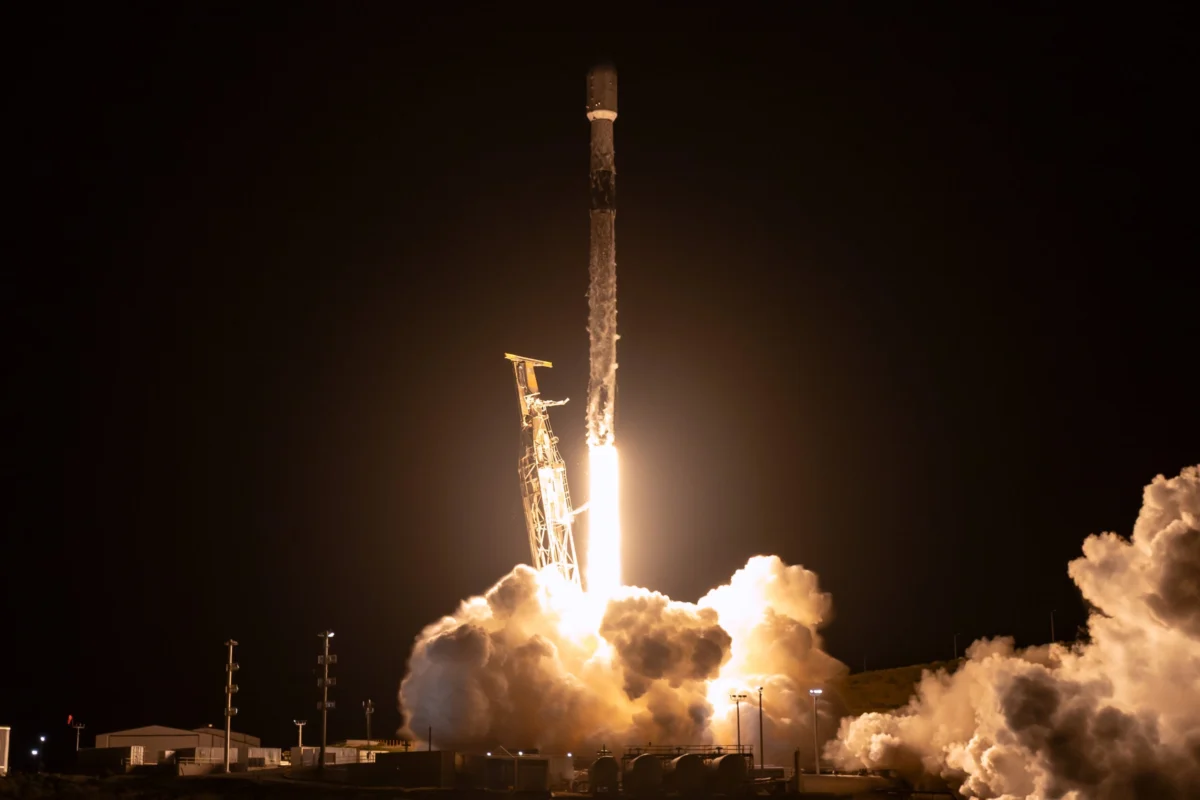

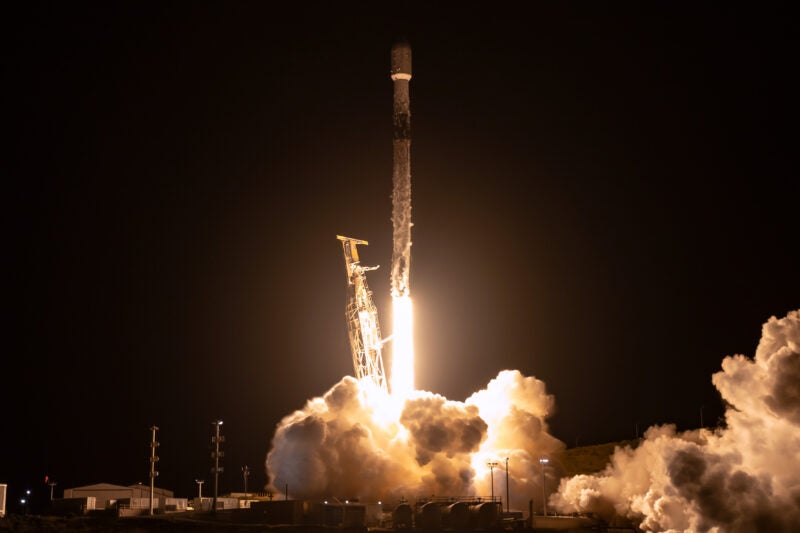
SpaceX successfully executed its Transporter-16 mission on Monday morning, lifting 119 diverse payloads into Low-Earth Orbit (LEO) and further cementing its dominance in the dedicated smallsat rideshare market. The Falcon 9 rocket ignited its Merlin engines at 4:02 a.m. PT at Vandenberg Space Force Base in California, piercing the early morning fog to deliver a complex array of satellites for commercial, governmental, and academic institutions from around the globe. This launch marks a significant milestone in the aerospace industry, pushing the total number of payloads delivered through SpaceX’s dedicated rideshare program to over 1,600 since its inception.
The mission utilized a flight-proven first-stage booster making its 12th successful flight. Following the stage separation, the booster performed a controlled descent, landing vertically on a SpaceX droneship stationed in the Pacific Ocean. This high level of reusability remains a cornerstone of the SpaceX business model, allowing for the frequent and cost-effective launch cadences that the Transporter program requires. As the second stage continued its ascent, it began a complex deployment sequence designed to insert each of the 119 payloads into their respective precise orbits, a process that involves multiple burns and timed releases over several hours.
The Architecture of a Massive Rideshare
The Transporter-16 mission highlights the critical role of third-party launch integrators, companies that act as intermediaries between satellite operators and the launch provider. Leading the manifest for this mission was the German-based integrator Exolaunch, which managed the integration and deployment for 57 individual spacecraft. This "bumper crop" for Exolaunch included 26 microsatellites and 31 cubesats representing more than 25 different clients.
To manage such a diverse manifest, Exolaunch utilized its proprietary deployment technologies, including the CarboNIX microsatellite separation rings. These rings are designed to provide a low-shock separation for satellites weighing up to 1,000 kg, ensuring that sensitive onboard instruments are not damaged during the deployment phase. Additionally, the company employed its EXOpod Nova deployers, which are specifically engineered to accommodate both standard and larger-format cubesats, providing the flexibility needed for modern modular satellite designs.
Other major integrators on the mission included Texas-based SEOPS, which prepared 19 spacecraft for 13 different countries, and D-Orbit, an Italian firm specializing in orbital transportation. SEOPS’s manifest included five PocketQubes from Alba Orbital and 14 cubesats of various dimensions, serving clients such as FOSSA Systems, ISISPACE, and Sandia National Laboratories. D-Orbit provided support for payloads from LusoSpace, Qubitrium, and the German Aerospace Center (DLR), showcasing the international and collaborative nature of the modern space economy.
Advancing National Space Capabilities
Transporter-16 served as a primary vehicle for several nations to expand their sovereign space capabilities. Greece, in particular, made significant strides with the launch of the ERMIS constellation. Developed as the first phase of the Greek National Small Satellite Programme, the ERMIS-1, ERMIS-2, and ERMIS-3 cubesats were built in part by OQ Technology Hellas. These satellites are designed to integrate with OQ Technology’s existing fleet to provide 5G non-terrestrial network (NTN) Internet of Things (IoT) services. Furthermore, the constellation will test direct-to-device (D2D) emergency broadcast messaging, a technology that allows smartphones to receive critical alerts directly from space without the need for terrestrial cell towers.
Poland also utilized the mission to bolster its national security and Earth observation infrastructure. Included in the Exolaunch manifest were two ICEYE radar satellites destined for the Polish military. These assets will form part of POLSARIS, Poland’s sovereign Synthetic Aperture Radar (SAR) constellation. Unlike optical satellites, SAR technology allows for high-resolution imaging through clouds and in total darkness, providing the Polish Armed Forces with persistent, all-weather surveillance capabilities.
Taiwan continued its aggressive expansion into the space sector with several satellites manifested via Exolaunch. These included the TORO3 for Pyras, the 8U RIoT-2 for Rapidtek, and the T.MicroSat-2, a collaborative effort between Tron Future Tech and the Taiwan Space Agency. These missions reflect Taiwan’s strategic focus on developing its domestic space industry and fostering innovation in satellite communications and remote sensing.
Commercial Innovation and Climate Monitoring
The commercial sector was well-represented on Transporter-16, with several established players adding to their existing constellations. Iceye, the Finnish leader in SAR technology, launched a total of six satellites on this mission. Spire, a provider of space-based data and analytics, added 10 new satellites to its massive constellation, which monitors maritime traffic, aviation, and weather patterns.
Climate science and environmental monitoring remain primary drivers for smallsat deployment. AAC Clyde Space launched the first two satellites for its VIREON Earth Observation constellation. The company confirmed that it will begin a period of testing and calibration before these satellites become fully operational. In Denmark, university students collaborated with Space Inventor to launch DISCO-2, a satellite dedicated to monitoring glacier activity and sea temperature changes near Greenland. This mission underscores the growing role of academic institutions in providing valuable climate data through low-cost satellite platforms.
SatVu, a British company, launched HotSat-2, the second satellite in its planned thermal imaging constellation. Using mid-wave infrared sensing, SatVu’s satellites can detect heat loss from buildings, monitor industrial activity, and provide data for climate applications. The ability to measure the "thermal footprint" of human activity from orbit is expected to become a vital tool for both government regulators and private companies looking to improve energy efficiency.
High-Power Platforms and In-Space Services
One of the most technically ambitious payloads on Transporter-16 was Gravitas, a two-ton satellite developed by K2 Space. Unlike the majority of smallsats, which operate on limited power budgets, Gravitas is capable of generating a staggering 20 kilowatts of electricity. This massive power capacity allows the satellite to host high-performance computing modules and advanced sensors that were previously only possible on much larger, more expensive traditional satellites. According to K2 Space CEO Karan Kunjur, the mission includes 12 undisclosed modules for various customers, including the U.S. Department of Defense and the global satellite operator SES. This shift toward high-power smallsats represents a new frontier in the industry, enabling "edge computing" in space and more sophisticated data processing before information is even transmitted back to Earth.
The mission also served as a laboratory for in-space services and manufacturing. Momentus launched its Vigoride 7 orbital service vehicle (OSV), which is designed to act as a "last-mile" delivery service in space. Vigoride 7 will host 10 government and commercial payloads to demonstrate autonomous rendezvous and proximity operations (RPO), in-space assembly, and advanced communication systems. These capabilities are essential for the future of space logistics, including the refueling and repair of existing satellites.
Varda Space Industries also utilized Transporter-16 to further its goals in off-earth manufacturing. The company’s W-6 vehicle carried samples of thermal protection materials and an autonomous navigation system. Varda is focused on leveraging the microgravity environment of LEO to produce high-value materials, such as pharmaceuticals and specialized fiber optics, that cannot be manufactured effectively on Earth. The data collected by NASA sensors aboard the W-6 will assist in refining reentry technologies for future manufacturing missions.
Implications for the Global Space Economy
The success of Transporter-16 reflects a broader trend in the aerospace sector: the "democratization of space." By providing a reliable and relatively affordable "bus service" to orbit, SpaceX has lowered the barrier to entry for smaller nations, startups, and research institutions. The presence of payloads from countries as diverse as India (Bellatrix Aerospace), South Korea (Cosmoworks), and Turkey (TurkSat) illustrates the global appetite for orbital access.
However, the sheer volume of satellites launched—119 in a single mission—also brings the issue of space situational awareness and orbital debris to the forefront. As LEO becomes increasingly crowded, the role of companies like LeoLabs and the regulatory frameworks of the Federal Communications Commission (FCC) and the Office of Space Commerce will become even more critical. The industry is currently balancing the rapid pace of innovation with the need for sustainable orbital management.
The Transporter-16 mission is a testament to the maturity of the smallsat ecosystem. It is no longer just about getting a "box" into space; it is about the sophisticated integration of high-power computing, sovereign security needs, and critical climate data collection. As SpaceX continues to refine its rideshare program, the frequency and complexity of these missions are expected to grow, further accelerating the development of the multi-billion-dollar LEO economy. With over 1,600 payloads now orbited through this program, the "rideshare revolution" is no longer a future prospect—it is the current standard for space exploration and commercialization.