

The landscape of Linux distributions is diverse, offering users a spectrum of choices from immutable systems to bleeding-edge rolling releases. While names like Arch Linux, openSUSE Tumbleweed, and Manjaro often dominate discussions around the latter, the Debian ecosystem, traditionally known for its stability and measured release cycles, is also home to a notable rolling release contender: Sparky Linux. The latest iteration, Sparky Linux 9.0, codenamed "Tiamat," continues this unique approach, aiming to provide users with the agility of a rolling release built upon the robust foundation of Debian. This fusion presents an intriguing proposition for users seeking the latest software without compromising the predictability and reliability that has cemented Debian’s reputation as a cornerstone of the Linux world.
Sparky Linux, which first emerged in May 2012, has carved out a niche for itself by offering a fast, resource-efficient, and highly customizable rolling release experience. Unlike its Arch-based counterparts that often require extensive manual configuration, Sparky Linux aims for a more accessible entry point while retaining a high degree of flexibility. The distribution boasts its own dedicated repositories, ensuring a consistent stream of updates and the availability of specialized tools and configurations developed by the Sparky team. This commitment to maintaining a distinct identity within the Debian-derived space is a key factor in its appeal.
The release of Sparky Linux 9.0 "Tiamat" underscores the distribution’s core philosophy. On the surface, Sparky Linux, much like its Debian parent, can appear understated. This perceived "boring" aesthetic, however, is a deliberate design choice, reflecting the emphasis on stability and predictability that defines Debian. For many users, this lack of ostentation translates directly into a more dependable and less disruptive computing experience. The core benefit of this approach lies in its ability to provide a stable platform for the latest software, a balancing act that many rolling releases struggle to achieve.
Sparky Linux offers a commendable array of desktop environment choices, catering to a wide range of user preferences and hardware capabilities. The available editions include LXQt, MATE, Xfce, KDE Plasma, a Minimal GUI option, and a command-line interface (CLI) version. This flexibility allows users to tailor their installation to their specific needs, whether they prioritize lightweight performance, a feature-rich desktop, or a minimalist command-line environment. For the purposes of this review, the KDE Plasma edition was selected to explore the developers’ implementation of this popular desktop environment within the Sparky Linux framework.
Sparky’s KDE Plasma Implementation
The Sparky Linux team’s approach to KDE Plasma in version 9.0 is, as anticipated, a relatively unadorned one. The developers have opted for a largely vanilla experience, closely mirroring the default look and feel of KDE Plasma as it is often experienced in its pure form. This "Debian-esque" rendition of KDE Plasma is characterized by a clean and functional interface, with the default wallpaper subtly evoking the understated aesthetic associated with Debian.
A particularly welcome choice for many users, including this reviewer, is the default selection of a light theme. In an era where dark themes have become prevalent, the decision to prioritize a light interface from the outset is a refreshing departure. This choice eliminates the immediate need for users to navigate system settings to adjust color schemes, providing a more pleasant out-of-the-box experience. Furthermore, Sparky Linux incorporates a subtle hint of transparency within its KDE Plasma implementation, adding a touch of visual polish without being overly distracting. This minimalist yet tasteful integration of visual elements contributes to a refined user experience.
For users who wish to customize the appearance further, the system settings provide straightforward access to theme adjustments. Navigating to System Settings > Appearance > Colors & Themes > Global Theme allows users to select from a variety of pre-installed themes or to download new ones from the online theme repositories. However, it is worth noting that, as with many Linux distributions, the experience with online theme installation can be variable, with some themes potentially encountering errors during the installation process. Users should be prepared for the possibility that their chosen themes may not always install seamlessly.

An observation that might surprise some, particularly given Sparky Linux’s rolling release nature, is the specific version of KDE Plasma included in Sparky Linux 9.0. The distribution ships with KDE Plasma 6.5.4. In a rolling release model, one might typically expect to find a more recent version, such as 6.6.3, or even newer. While this minor discrepancy does not detract from the overall functionality, it does highlight the careful consideration the Sparky team likely gives to stability, perhaps opting for a slightly more seasoned version of the desktop environment to ensure its integration with the underlying Debian system is as robust as possible. This pragmatic approach to software versions is a hallmark of distributions that prioritize reliability.
Preinstalled Software Suite
Sparky Linux 9.0 "Tiamat" distinguishes itself by adopting a lean approach to preinstalled software, eschewing bloatware in favor of essential applications that provide a functional and productive environment from the moment of installation. This curated selection ensures that users are not burdened by unnecessary programs, allowing for a cleaner system and more efficient resource utilization.
The included software package offers a comprehensive set of tools for everyday computing and more specialized tasks. Users will find Firefox ESR (Extended Support Release) for web browsing, Elisa as a default music player, and Gufw for straightforward graphical firewall configuration. The inclusion of GDebi Package Installer simplifies the process of installing local .deb packages, while GIMP and GParted provide powerful image editing and disk partitioning capabilities, respectively. For optical media management, K3b is provided.
In a move that bridges the gap between desktop and mobile, KDE Connect is integrated, enabling seamless interaction between the user’s desktop and their smartphone. The ubiquitous LibreOffice suite is present for office productivity, and a notable inclusion is Noi, a sophisticated application designed to aggregate various AI services. Raspberry Pi Imager and USB Imager cater to users working with embedded systems and bootable media. For privacy and security, Riseup-VPN is included, alongside the Synaptic Package Manager for advanced package management and Thunderbird for email communication.
Timeshift, a system restore utility, offers a crucial safety net for users, allowing them to revert their system to a previous state in case of unforeseen issues. VokoscreenNG provides a desktop recording solution, while VLC media player ensures broad media playback compatibility. Rounding out the selection are various essential KDE utilities, ensuring a cohesive and fully functional desktop experience.
Spotlight on Noi: An AI Integration Hub
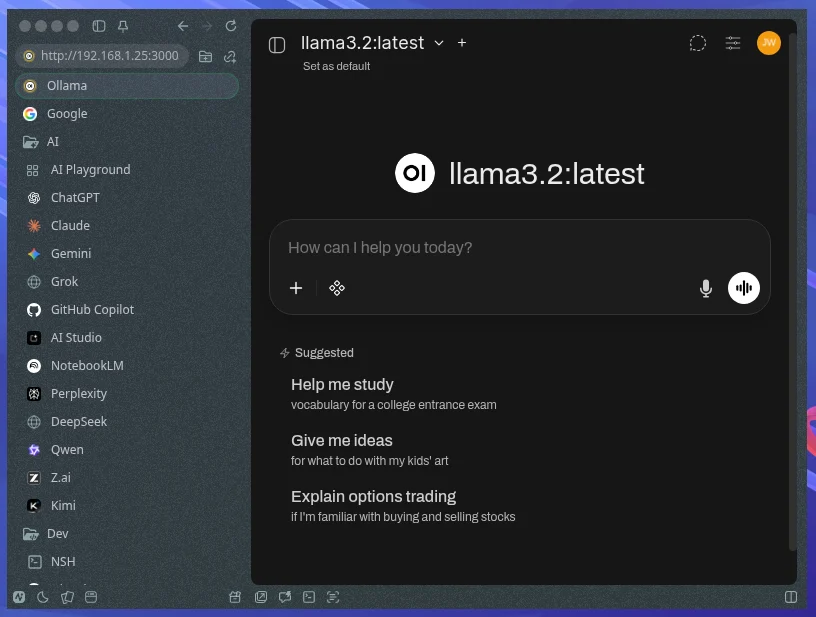
A particularly noteworthy application preinstalled with Sparky Linux 9.0 is Noi. This GUI application represents a significant step forward in simplifying access to a wide array of artificial intelligence services. Noi acts as a unified interface, bringing together popular platforms such as ChatGPT, Claude, Gemini, GitHub Copilot, AI Studio, NotebookLM, Perplexity, DeepSeek, Qwen, Z.ai, Kimi, Dev, GitHub, Hugging Face, VS Code, and DeepWiki, among others.
The integration capabilities of Noi are impressive. It allows users to connect not only to cloud-based AI services but also to locally installed instances of AI models. This reviewer can confirm the ease with which a locally hosted Ollama instance, running on a server within the local area network (LAN), was successfully integrated into Noi. This feature is particularly valuable for developers and power users who prefer to run AI models on their own hardware for reasons of privacy, cost, or customization.
Noi’s functionality extends to the creation of "Spaces," which enable users to curate and organize the AI services they utilize most frequently. This feature fosters a cleaner, more efficient user interface, allowing users to tailor their AI interaction environment to their specific workflows. The application’s design and capabilities suggest it will appeal to a broad audience, from everyday users exploring the potential of AI to seasoned developers leveraging these advanced tools for complex projects. The inclusion of Noi in Sparky Linux positions the distribution as a forward-thinking platform for users interested in the burgeoning field of artificial intelligence.

Performance Benchmarks and Real-World Testing
To assess the performance characteristics of Sparky Linux 9.0 "Tiamat," a series of real-world tests were conducted, focusing on the system’s responsiveness and resource management, particularly under demanding conditions. The primary testing methodology involved the use of Ollama, a platform for running large language models locally.
The performance testing involved two key queries: a factual question designed to gauge the speed of information retrieval and a creative writing task intended to evaluate the system’s ability to handle more computationally intensive generative processes. In both scenarios, Sparky Linux demonstrated exceptional performance. The responses to the factual query were immediate, with no discernible lag. Similarly, the creative writing task was completed with remarkable speed and fluidity.
Crucially, during the execution of these AI-driven queries, other applications were opened and utilized to simulate a typical user workload. These applications, including web browsers and document editors, opened and functioned flawlessly, even while the system was engaged in the resource-intensive task of running local AI models. This indicates that Sparky Linux, even when pushing its limits, maintains a high level of system stability and responsiveness. The efficient resource management of the KDE Plasma desktop environment, combined with the underlying optimizations of the Sparky Linux system, contributes significantly to this impressive performance.
Target Audience and Overall Assessment
Sparky Linux 9.0 "Tiamat" is an compelling choice for a specific segment of the Linux user base. Its primary appeal lies in its ability to deliver the benefits of a rolling release – access to the latest software and updates – while retaining the inherent stability and reliability synonymous with Debian. This dual characteristic makes it an attractive option for users who have previously been hesitant to adopt a rolling release model due to concerns about potential system instability.
The distribution is particularly well-suited for individuals who desire a constantly updated system without the frequent need for major version upgrades or the potential for disruptive changes that can sometimes accompany less rigorously tested rolling releases. The Sparky team’s commitment to a stable rolling release, built upon the bedrock of Debian’s extensive testing infrastructure, provides a reassuring foundation for everyday use, development, and experimentation.
For users who appreciate the performance advantages of a lightweight distribution but also require the latest software packages, Sparky Linux offers a harmonious balance. While the specific version of KDE Plasma included might not be the absolute bleeding edge, it represents a well-tested and stable iteration that integrates seamlessly with the rest of the system. This pragmatic approach ensures that users can enjoy the benefits of recent software advancements without exposing themselves to the potential pitfalls of unproven code.
For those intrigued by Sparky Linux’s unique proposition, the distribution is readily accessible. Interested users are encouraged to visit the official Sparky Linux download page for the rolling release branch. From there, they can select an ISO image corresponding to their preferred desktop environment and install it either in a virtual machine or on a dedicated spare machine for evaluation. Based on its performance, stability, and thoughtful software selection, particularly the innovative Noi application, Sparky Linux 9.0 "Tiamat" represents a solid and rewarding choice for users seeking a dependable and up-to-date Linux experience.