

The global semiconductor landscape is undergoing a fundamental shift where security is no longer viewed as a supplementary software layer but as an intrinsic property of the physical silicon. As semiconductor chips become the bedrock of cloud infrastructure, autonomous vehicle controllers, industrial robotics, and edge AI processors, the stakes for hardware integrity have reached unprecedented levels. Engineers are now tasked with a monumental responsibility: ensuring that silicon can defend against sophisticated attacks, protect embedded cryptographic secrets, and comply with an increasingly complex web of global security standards. With the implementation of mandates such as ISO/SAE 21434 for automotive systems and the European Union’s Cyber Resilience Act (CRA) for digital products, the industry is moving toward a "security-by-design" mandate that requires rigorous proof of protection long before the first wafer is produced.
In this high-stakes environment, every transistor carries a "burden of trust." Regulators, hyperscale data center operators, and end-product developers now demand verifiable evidence that security was integrated during the initial architecture phase rather than patched after fabrication. To meet these demands, the industry is adopting a systematic approach to security throughout the pre-silicon development cycle. This transition relies heavily on advanced verification methodologies to uncover architectural weaknesses and evaluate the effectiveness of security controls in a measurable, structured way.
The Regulatory and Industrial Catalyst for Hardware Security
The push for hardware-level security is driven by both technical necessity and a rapidly evolving regulatory environment. Historically, hardware was often assumed to be a "root of trust" that was inherently secure, with most vulnerabilities addressed at the software or firmware levels. However, the emergence of microarchitectural attacks—such as Spectre and Meltdown—demonstrated that even if software is perfectly written, flaws in the underlying hardware logic can lead to catastrophic data leakage.
In response, global standards have emerged to codify the requirements for hardware integrity. ISO/SAE 21434, specifically tailored for the automotive sector, requires manufacturers to demonstrate rigorous cybersecurity engineering throughout the product lifecycle. Similarly, the EU Cyber Resilience Act introduces mandatory cybersecurity requirements for hardware and software products placed on the European market, with significant penalties for non-compliance. These regulations have forced a "shift left" in the semiconductor industry, moving security verification to the earliest stages of the Design-for-Trust (DfT) process.
Market data underscores the urgency of this shift. According to recent industry reports, the cost of a hardware "re-spin"—the process of fixing a flaw after the chip has been sent for manufacturing—can range from $2 million to over $10 million depending on the process node. When security vulnerabilities are discovered post-silicon, the costs are even higher, involving potential recalls, brand damage, and legal liabilities. Consequently, the ability to verify security pre-silicon has become an economic imperative as much as a technical one.
The Two Necessary Pillars: Functional and Protection Verification
Hardware security verification is built upon two core pillars that serve distinct but complementary roles: Functional Security Verification and Security Protection Verification. Understanding the distinction between these two is critical for any engineering team aiming to achieve comprehensive security coverage.
Pillar One: Functional Security Verification
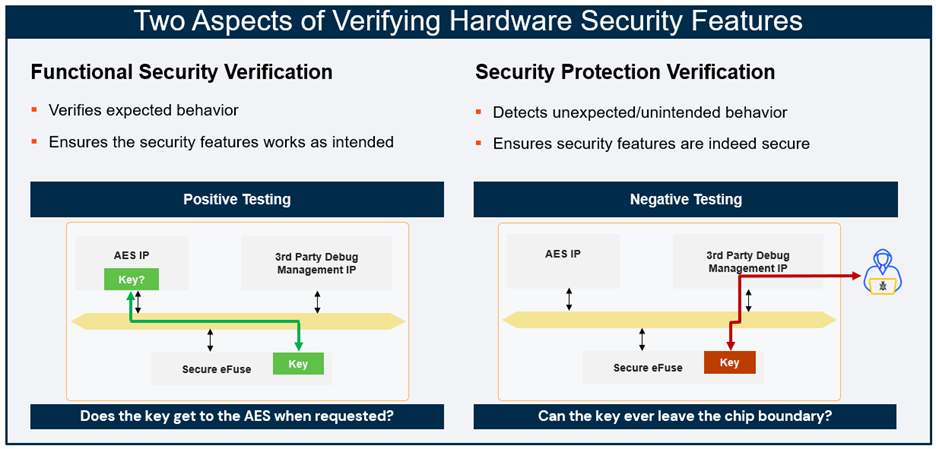
Functional security verification is concerned with correctness. It ensures that the security features designed into the chip behave exactly as specified under defined operating conditions. This pillar answers the question: "Does the security logic work as intended?"

Engineers utilize established verification methods such as simulation, hardware assertions, and formal analysis to validate these functions. For instance, if a System-on-Chip (SoC) includes a cryptographic block, functional verification will confirm that the block retrieves a key only when an authorized agent requests it and only within the specific timing constraints defined by the architecture. It ensures that restricted resources remain inaccessible to unauthorized entities during normal operations.
While functional verification is essential, it is inherently bounded. It operates within known interfaces and specified behaviors. It provides high confidence that the logic performs its intended tasks, but it is often blind to unintended data flows or "side-channel" behaviors that occur outside the primary specification.
Pillar Two: Security Protection Verification
The second pillar, security protection verification, focuses on robustness. It assesses how well security controls hold up under operational stress, unexpected system behavior, or active exploitation. This pillar asks the question: "Can the security logic be bypassed or subverted?"
Protection verification is broader in scope and significantly more complex. It requires engineers to determine if sensitive data—such as a root key or user biometric data—can reach an interface that was never intended to be exposed. This involves analyzing the system under conditions such as reset sequences, debug access modes, and test feature activations.
A classic example involves a cryptographic key stored in a secure register. While functional verification confirms the key is used correctly during a standard transaction, protection verification explores whether that key could propagate to an internal bus or a debug port during a specific combination of system states. If an unintended path exists, the protection has failed. This type of verification accounts for the "unknown unknowns"—interactions across IP blocks and subsystems that were not explicitly defined in the initial specification.
Establishing a Measurable Process Through Security Coverage
The bridge between these two pillars is "security coverage." Much like traditional functional coverage in EDA (Electronic Design Automation), security coverage provides a structured, measurable method for evaluating the thoroughness of the verification process. Rather than relying on a binary "pass/fail" outcome, security coverage quantifies how much of the security-relevant design has been explored.
This measurement is vital because a design that passes all functional tests can still be inherently insecure. By implementing security coverage, engineering teams can identify "dark corners" in the logic where data leakage might occur. This allows for an iterative refinement process:
- Identification: Locate gaps where security controls have not been sufficiently exercised.
- Analysis: Evaluate whether these gaps represent a theoretical risk or a practical vulnerability.
- Refinement: Add targeted tests or expand formal analysis to explore these specific data flows.
- Validation: Re-measure coverage to ensure the design meets the required security thresholds before tapeout.
Chronology of the Shift-Left Movement in Hardware Security
The evolution of hardware security verification can be viewed through a decade-long timeline of industry shifts:

- 2014-2017 (The Reactive Era): Security was largely treated as a perimeter issue. Verification focused on ensuring that basic access control lists (ACLs) worked.
- 2018 (The Meltdown/Spectre Inflection Point): The industry realized that hardware performance features (like speculative execution) could create security holes. This sparked the first major push for "hardware security researchers" within semiconductor companies.
- 2020-2022 (The Standardization Era): The finalization of ISO/SAE 21434 and the proposal of the EU CRA signaled that voluntary security measures were no longer sufficient.
- 2023-Present (The Integration Era): Security verification is being integrated into the standard EDA flow. Companies like Arteris have acquired specialized security verification firms (such as Cycuity) to embed these capabilities directly into the data movement fabric of the SoC.
Arteris and the Integration of the Radix Platform
A significant development in this field is the acquisition of Cycuity by Arteris, a leader in Network-on-Chip (NoC) interconnect technology. This move highlights a growing trend: security is increasingly being managed at the interconnect level, where data moves between different IP blocks.
The Radix platform, now part of the Arteris portfolio, serves as a dedicated solution for hardware security verification and coverage analysis. By integrating Radix with NoC technology, engineers can analyze security as a system-level property. Since the NoC acts as the "central nervous system" of a chip, it is the ideal place to monitor and enforce data flow protections. The Radix platform enables teams to systematically identify unintended data flows and measure the effectiveness of protections across the entire design, providing the "proof of security" that modern regulators and customers demand.
Broader Impact and Industry Implications
The implications of robust pre-silicon security verification extend far beyond the engineering lab. For hyperscalers like Amazon Web Services or Google Cloud, hardware-level security is the foundation of multi-tenancy. If one customer can access another customer’s data through a hardware flaw, the entire cloud business model is at risk.
In the automotive sector, the transition to Software-Defined Vehicles (SDVs) means that cars are essentially "data centers on wheels." A failure in hardware security could lead to unauthorized control over braking or steering systems, making silicon verification a matter of public safety.
Furthermore, the rise of AI-specific processors has introduced new assets that require protection: proprietary model weights and sensitive training data. As these AI chips are deployed at the edge, they are physically accessible to attackers, making protection verification against side-channel attacks and physical probing more critical than ever.
Conclusion
As hardware systems grow in complexity and the global regulatory environment tightens, the semiconductor industry can no longer rely on assumptions of trust. The integration of functional and protection verification, underpinned by rigorous security coverage metrics, represents the new standard for silicon development. By identifying weaknesses early and addressing them before the manufacturing stage, engineering teams not only ensure compliance with global standards but also build the foundational trust required for the next generation of digital infrastructure. The transition to measurable, pre-silicon security is not merely a technical upgrade; it is a fundamental requirement for the future of the global technology market.