
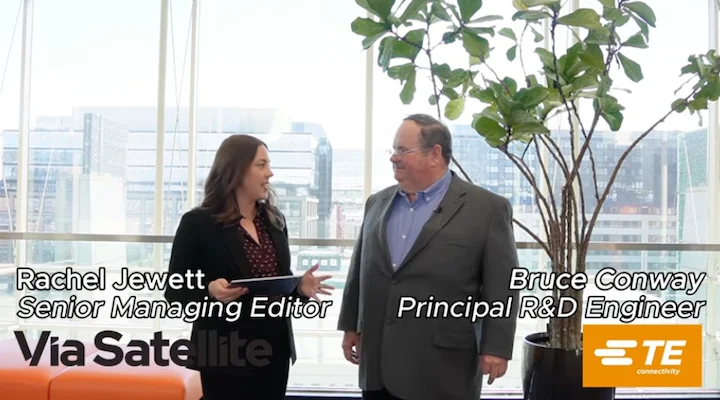

The opening of the annual SATELLITE 2026 conference in Washington, D.C., served as a critical platform for industry leaders to address the escalating technical demands of the modern space economy. Among the most prominent voices was Bruce Conway, Principal Engineer at TE Connectivity, who detailed the company’s pivotal role in bridging the gap between legacy space exploration and the burgeoning commercial satellite market. In an extensive interview marking the commencement of SATShow Week, Conway highlighted the sophisticated interconnect solutions that have become the backbone of both NASA-led deep space missions and the high-density Low Earth Orbit (LEO) constellations currently reshaping global communications. The discussion underscored a transition period in aerospace engineering, where the reliability of traditional "Old Space" components must now be integrated with the rapid innovation and scalability required by "New Space" ventures.
The Evolution of Interconnect Technology in Orbital Environments
As the satellite industry moves toward more complex architectures, the hardware responsible for power and data transmission has undergone a radical transformation. Conway emphasized that TE Connectivity’s focus remains on the critical interconnects that link satellite subsystems, with a particular emphasis on solar array connectivity. In the vacuum of space, these components are subjected to extreme thermal cycling, where temperatures can swing hundreds of degrees in minutes as a spacecraft moves from direct sunlight into the Earth’s shadow.
According to Conway, the engineering challenge lies not just in maintaining a connection, but in ensuring that the materials used do not succumb to "outgassing"—the release of volatile compounds that can condense on sensitive optical equipment or solar cells, degrading mission performance. TE Connectivity has leveraged decades of material science research to develop connectors that meet the stringent outgassing requirements of NASA and the European Space Agency (ESA) while remaining lightweight enough to reduce launch costs. The "Size, Weight, and Power" (SWaP) optimization remains the primary driver of innovation in this sector, as every additional gram of weight can add thousands of dollars to the cost of a launch.
A Legacy of Discovery: From the Moon to Mars
A significant portion of Conway’s address focused on TE Connectivity’s deep space heritage. The company’s components have been integral to some of humanity’s most ambitious scientific endeavors, including the Mars Rover missions and the Artemis program. This "heritage" is more than a point of corporate pride; it serves as a rigorous testing ground for commercial applications.
"When we design for a mission like the James Webb Space Telescope or a Mars lander, the failure of a single connector can result in the loss of a multi-billion dollar asset and years of scientific research," Conway noted during the interview. This zero-failure mentality is now being applied to the commercial sector. As companies like SpaceX, Amazon (Project Kuiper), and OneWeb deploy thousands of satellites, they require the reliability of deep space missions but at a commercial scale and price point. Conway explained that TE Connectivity acts as a strategic partner, helping these customers navigate the "ruggedization" process—ensuring that commercial-off-the-shelf (COTS) technologies are sufficiently hardened to survive the vibrations of launch and the radiation environment of space.
Technical Innovation in Space-Based Power Supply
One of the most pressing topics discussed at SATELLITE 2026 was the shift in power requirements for modern spacecraft. Historically, satellites operated on relatively low-voltage systems. However, the advent of high-throughput satellites (HTS) and the increased use of electric propulsion have necessitated a move toward higher voltage and higher current power distribution.
Conway revealed that TE Connectivity is currently at the forefront of developing next-generation power supply interconnects capable of handling these increased loads. This involves the use of advanced alloys and specialized plating techniques to prevent "tin whiskering"—a phenomenon where microscopic, conductive filaments grow from metal surfaces in a vacuum, potentially causing short circuits. Furthermore, the move toward modular satellite buses requires interconnects that can support "plug-and-play" architectures, allowing manufacturers to assemble satellites more quickly and with greater flexibility.
Supporting data from industry analysts suggests that the global satellite bus market is expected to grow at a Compound Annual Growth Rate (CAGR) of over 7% through 2030. A significant portion of this growth is driven by the power subsystem, which accounts for approximately 20% to 30% of a satellite’s total mass and cost. Conway’s insights into solar panel interconnects are particularly relevant here, as the industry seeks to improve the efficiency of power transfer from solar wings to the central battery and distribution units.
SATELLITE 2026: A Context of Rapid Growth
The SATELLITE 2026 conference itself reflects a broader industry in the midst of an unprecedented boom. Ten years ago, the event was dominated by a few major geostationary (GEO) satellite operators and government agencies. Today, the floor is crowded with startups, launch providers, and software-defined radio specialists. The "SATShow Week" has become the primary venue for announcing multi-year procurement contracts and technological breakthroughs.
The 2026 event highlights a specific trend: the convergence of terrestrial 5G/6G networks with non-terrestrial networks (NTN). This convergence places immense pressure on the physical layer of satellite technology. Interconnects must now handle data rates that were previously only seen in terrestrial fiber-optic networks. Conway addressed this by discussing TE’s high-speed data connectors, which are designed to maintain signal integrity in the high-radiation environment of space—a task far more difficult than in a protected terrestrial data center.
Strategic Problem Solving and Customer Collaboration
A recurring theme in Conway’s interview was the collaborative nature of aerospace engineering. TE Connectivity does not merely provide parts; they provide engineering solutions to specific environmental challenges. Conway described a process where TE engineers work alongside satellite bus manufacturers from the earliest design phases.
"Our customers come to us with challenges related to extreme vibration during the launch phase or the need for ultra-miniaturized connectors that don’t sacrifice power throughput," Conway stated. By utilizing advanced simulation tools and rapid prototyping, TE can iterate on designs that meet these unique specifications. This collaborative approach is essential as the industry moves toward "standardization." While customization was once the norm in the space industry, the sheer volume of satellites being produced today requires a more standardized set of components to keep production lines moving.
Broader Implications for the Global Space Economy
The implications of the technology discussed by Conway extend far beyond the technical specifications of a connector. The reliability of these components is a prerequisite for the continued expansion of the global space economy, which is projected to reach $1 trillion by 2040.
- Global Connectivity: The success of LEO constellations depends on the long-term durability of satellites. If interconnects fail prematurely, the resulting space debris and service interruptions could stifle the growth of global satellite internet.
- National Security: As defense agencies increasingly rely on "proliferated" satellite architectures for surveillance and communication, the need for radiation-hardened, high-reliability components becomes a matter of national importance.
- Scientific Exploration: The technologies developed for the Artemis program’s lunar Gateway and future Mars missions will eventually trickle down to the commercial sector, driving further innovation in materials science and power management.
Chronology of Innovation and Future Outlook
The timeline of TE Connectivity’s involvement in space mirrors the history of the space age itself. From the early days of the Apollo program to the modern era of reusable rockets and mega-constellations, the company has consistently adapted its portfolio. Looking toward the late 2020s, Conway pointed to several key areas of development:
- 2024-2025: Focus on the miniaturization of connectors for CubeSats and NanoSats, enabling smaller platforms to carry more sophisticated sensors.
- 2026 (Current): Emphasis on high-voltage power distribution for electric propulsion and the integration of high-speed data links for 5G/6G satellite backhaul.
- 2027 and Beyond: Development of interconnects for in-orbit servicing, assembly, and manufacturing (ISAM). This will require connectors that can be mated and unmated by robotic arms in the harsh environment of space.
As SATShow Week 2026 continues, the insights provided by Bruce Conway serve as a reminder that while the "big ideas" of space—launching rockets and exploring planets—capture the headlines, the success of these missions depends on the microscopic reliability of the components that hold them together. TE Connectivity’s role as an "invisible" but essential partner in the space industry remains a cornerstone of the sector’s technical progress.
The interview concluded with a forward-looking statement on the importance of sustainability in space. Conway noted that by creating more efficient and durable interconnects, the industry can extend the lifespan of satellites, thereby reducing the rate at which new hardware must be launched and mitigating the growing concern over orbital congestion. As the conference progresses, the themes of reliability, power innovation, and heritage will likely remain at the center of the dialogue between the engineers and visionaries shaping the future of the final frontier.