
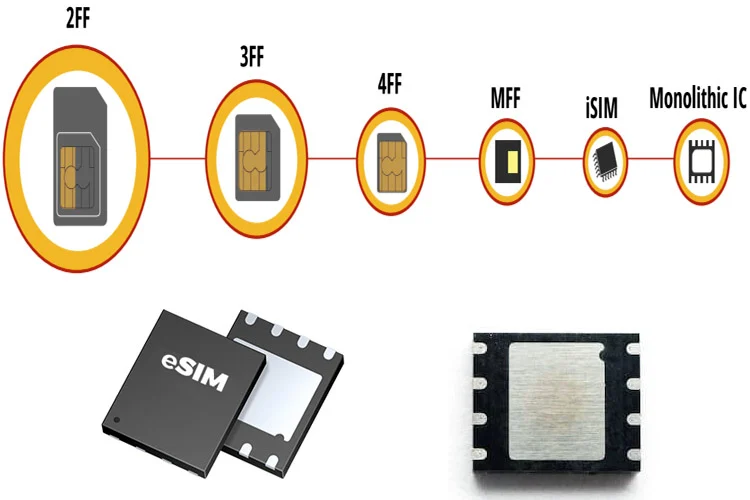

The telecommunications landscape is currently undergoing its most significant architectural shift since the transition from analog to digital cellular networks. At the heart of this transformation is the embedded SIM, or eSIM, a technology that replaces the traditional, removable plastic Subscriber Identity Module (SIM) with a permanent, programmable chip integrated directly into a device’s motherboard. This innovation is not merely a change in form factor; it represents a fundamental decoupling of the hardware from the service provider, enabling a more flexible, secure, and digitally-driven user experience. As the industry moves toward a "cloud-first" connectivity model, understanding the mechanics, advantages, and deployment strategies of eSIM technology is essential for consumers and industry stakeholders alike.
The Technical Foundation: What is an eSIM?
An eSIM is a hardware component known technically as an eUICC (Embedded Universal Integrated Circuit Card). Unlike the traditional SIM card, which has evolved through various sizes—from the original credit-card-sized ID-1 to the Mini, Micro, and Nano-SIM—the eSIM is a vacuum-sealed chip measuring approximately 5mm by 6mm. It is soldered directly onto the device’s printed circuit board during the manufacturing process.
The primary function of an eSIM is to store the International Mobile Subscriber Identity (IMSI) and the related key used to identify and authenticate subscribers on mobile telephony devices. However, the revolutionary aspect of the eUICC is its ability to be programmed remotely. Through a process known as Remote SIM Provisioning (RSP), a user can download a "profile"—a digital version of the data found on a physical SIM—over-the-air (OTA). This capability allows a single eSIM chip to store multiple profiles, enabling users to switch between different carriers or data plans via software settings rather than physical hardware swaps.
A Chronology of SIM Evolution and eSIM Adoption
The path to the eSIM has been defined by a continuous drive toward miniaturization and digital integration.
- 1991: The first SIM card was developed by Munich smart-card maker Giesecke & Devrient, initially the size of a standard credit card.
- 1996 – 2012: The industry saw the introduction of the Mini-SIM, followed by the Micro-SIM (popularized by the iPhone 4), and eventually the Nano-SIM (iPhone 5). Each iteration sought to save internal device space for larger batteries and more complex sensors.
- 2010: The GSMA (Global System for Mobile Communications Association) began exploring the possibility of a software-based SIM to facilitate the burgeoning Internet of Things (IoT) market.
- 2016: The first consumer device to feature eSIM technology, the Samsung Gear S2 Classic 3G smartwatch, was launched, demonstrating the utility of eSIMs in small-form-factor wearables.
- 2017: Google introduced the Pixel 2, the first major smartphone to incorporate eSIM technology, primarily to support its "Project Fi" (now Google Fi) network.
- 2018: Apple integrated eSIM technology into the iPhone XS, XS Max, and XR, marking the beginning of mass-market adoption.
- 2022: In a landmark move, Apple released the iPhone 14 in the United States as an eSIM-only device, removing the physical SIM tray entirely and forcing a rapid acceleration in carrier support.
Strategic Advantages: Why the Industry is Moving Toward eSIM
The transition to eSIM offers a trifecta of benefits affecting manufacturers, consumers, and network operators.
For Manufacturers and Hardware Design
The removal of the physical SIM tray is a major win for industrial design. By eliminating the mechanical slot and the internal reader assembly, manufacturers regain valuable cubic millimeters of space. This space can be repurposed for increased battery capacity, improved thermal management systems, or additional sensors. Furthermore, removing the SIM tray helps in achieving better ingress protection (IP) ratings for water and dust resistance, as it eliminates one of the few remaining physical openings in a device’s chassis.
For Consumers and Travelers
For the end-user, the most immediate benefit is convenience. Activating a new line of service no longer requires a trip to a retail store or waiting for a physical card to arrive in the mail. For international travelers, eSIMs are transformative. Instead of searching for a local kiosk upon arrival in a foreign country, travelers can download a local data plan before they even land. Moreover, the ability to maintain multiple profiles allows users to have a business line and a personal line on a single device, or a primary voice line and a secondary "data-only" line for roaming.
For Enhanced Security
Security is significantly bolstered with eSIM technology. A physical SIM card can be easily removed if a device is stolen, preventing the owner from tracking the device via "Find My" services. An eSIM, however, cannot be removed. To deactivate it, a thief would need the device’s passcode. Additionally, the digital nature of the provisioning process reduces the risk of SIM swapping—a form of identity theft where hackers trick carriers into porting a number to a new physical card—provided that carriers implement robust multi-factor authentication for eSIM downloads.
Technical Mechanics: How Remote SIM Provisioning Works
The activation of an eSIM relies on a sophisticated infrastructure involving the Subscription Manager Data Preparation (SM-DP+) server. When a user purchases a plan, the carrier generates a unique digital profile. This profile is encrypted and stored on the SM-DP+ server.
To retrieve this profile, the device requires an "activation code," which is typically delivered via a QR code. When the device’s camera scans the QR code, it reaches out to the server, authenticates the request, and downloads the profile over a secure Wi-Fi or cellular connection. This process is governed by strict GSMA standards to ensure interoperability between different device manufacturers and global carriers.
Current Market Landscape: Device and Carrier Support
While the technology is standardized, adoption varies by region and provider. Currently, most flagship devices from major manufacturers support eSIM:
- Apple: All iPhone models from the XS/XR series onward, as well as cellular-enabled iPads and all Apple Watches.
- Samsung: The Galaxy S20 series and newer, the Galaxy Z Fold and Flip series, and Galaxy Watch models.
- Google: Every Pixel smartphone since the Pixel 2.
- Other Manufacturers: Brands like Motorola (notably the Razr), Huawei, and Sony have also integrated eSIM into their premium lineups.
From a carrier perspective, the "Big Three" in the United States (AT&T, T-Mobile, and Verizon) provide full eSIM support. Globally, over 800 mobile operators in nearly 200 countries have launched eSIM services for consumer devices, according to GSMA Intelligence. However, some prepaid brands and smaller regional carriers are still in the process of updating their back-end systems to support digital provisioning.
Activation Procedures: A Step-by-Step Guide
The process for activating an eSIM is designed to be intuitive, though it differs slightly between operating systems.
Activating on Apple iOS
- Preparation: Ensure the device is connected to a Wi-Fi network.
- Initiation: Go to Settings > Cellular.
- Add Plan: Tap "Add eSIM" or "Set Up Cellular."
- Transfer or Scan: Users may be given the option to transfer a SIM from a nearby iPhone or use a QR code. If using a QR code, point the camera at the code provided by the carrier.
- Labeling: Once downloaded, users can label the plans (e.g., "Primary" and "Travel") to manage how data and voice calls are routed.
Activating on Android (Samsung/Pixel)
- Preparation: Connect to a stable Wi-Fi network.
- Settings: Navigate to Settings > Network & Internet (or Connections on Samsung).
- SIM Manager: Select "SIM Manager" or the "+" icon next to "SIMs."
- Download: Choose "Download a SIM instead?" or "Add eSIM."
- Scan: Scan the carrier-provided QR code.
- Confirmation: Confirm the activation. The device may take a few minutes to register on the new network.
Critical Analysis: eSIM vs. Traditional SIM
While the advantages are numerous, the transition is not without friction. A primary drawback of the eSIM is the difficulty of "emergency swapping." With a physical SIM, if a phone’s screen breaks or the battery dies, a user can simply pop the card into a backup device and be reachable within seconds. With an eSIM, moving a profile to a new device usually requires an active internet connection and, in some cases, a call to the carrier’s customer service or a visit to their app to generate a new QR code.
| Feature | Physical SIM Card | eSIM (Embedded SIM) |
|---|---|---|
| Form Factor | Removable plastic card | Integrated chip |
| Swapping | Easy to move between devices manually | Requires digital re-provisioning |
| Multi-SIM | Limited by physical slots (usually 1 or 2) | Can store multiple profiles (typically 5-10) |
| Space | Occupies significant internal space | Minimal footprint |
| Security | Can be stolen or removed | Permanent; cannot be physically removed |
| Activation | Requires physical delivery/pickup | Instantaneous over-the-air |
The Broader Impact: IoT and the Future of Connectivity
The implications of eSIM extend far beyond the smartphone market. The technology is a cornerstone of the Internet of Things (IoT) and Industrial IoT (IIoT). For example, in the automotive industry, manufacturers can solder an eSIM into a vehicle during production. This allows the car to stay connected for navigation and safety features across borders, with the ability to switch service providers via software if the vehicle is sold in a different country.
Furthermore, the rise of the iSIM (Integrated SIM) is already on the horizon. While an eSIM is a separate chip on the motherboard, an iSIM integrates the SIM functionality directly into the device’s main processor (SoC). This further reduces space and power consumption, paving the way for even smaller connected devices like smart glasses and medical implants.
Conclusion: Navigating the Transition
The shift to eSIM technology is an inevitable progression in the digitization of global infrastructure. While the transition phase requires consumers to adapt to new activation workflows and carriers to modernize their provisioning systems, the long-term benefits of enhanced security, design flexibility, and consumer choice are undeniable.
As of 2024, the industry is reaching a tipping point. With major markets like the U.S. moving toward eSIM-only hardware, the global supply chain is rapidly adjusting. For the consumer, the choice between a physical SIM and an eSIM will soon become a moot point as the physical slot follows the 3.5mm headphone jack into obsolescence. For now, users are encouraged to verify carrier compatibility and embrace the digital profile system, which offers a more streamlined and secure way to stay connected in an increasingly mobile world.