

The landscape of software development is undergoing a profound transformation, driven by the rapid advancement of artificial intelligence. As Large Language Models (LLMs) become increasingly adept at understanding and generating code, fundamental questions are emerging about the future of programming languages themselves. Will AI necessitate entirely new languages optimized for machine comprehension, or will it instead elevate the prominence of existing, human-friendly ones? This evolving dynamic is sparking debate among developers, language designers, and industry observers, exploring a spectrum of possibilities from AI-native syntax to the potential obsolescence of traditional source code.
The initial stirrings of this conversation can be traced back to early 2024, when a developer in Spain highlighted a critical challenge: the inherent verbosity and complexity of human-readable programming languages consume a disproportionate number of tokens, thus increasing costs and limiting the scope of programs that can fit within the contextual windows of current AI models. In response, this developer tasked Claude, an AI model, with designing a programming language exclusively for LLM efficiency, disregarding human developer usability. The resulting "AI-first native language," documented on GitHub, represented a novel approach to the human-computer interaction paradigm in software creation. This was not an isolated incident. More recently, another developer announced plans for a new language specifically addressing the needs of autonomous AI agents, emphasizing deterministic syntax to clarify intent and a minimal language surface to reduce potential edge cases.
However, the widespread adoption of such AI-centric languages remains a distant prospect, according to industry veterans. Andrea Griffiths, a senior developer advocate at GitHub and a writer for the Main Branch newsletter, notes that while experiments with "AI-first" languages are occurring, none have yet achieved significant traction. Griffiths attributes this to the immense gravitational pull of established programming ecosystems. "The gravitational pull of existing ecosystems is enormous—libraries, tooling, community knowledge, production infrastructure," Griffiths stated in an interview with The New Stack. "A new language doesn’t just need to be better for AI. It needs to justify abandoning everything developers already have, and that shift is not going to happen overnight." This sentiment underscores the significant inertia within the developer community, where familiarity, robust tooling, and vast existing codebases present formidable barriers to entry for any nascent language.
The core of the debate revolves around two diverging paths: the creation of languages explicitly designed for AI processing, potentially sacrificing human readability, versus the augmentation of existing languages, particularly strongly typed ones, through AI assistance. This latter scenario posits that AI coding agents could simplify the use of complex, safety-conscious languages, thereby enhancing developer productivity without necessitating a complete overhaul of language syntax. The implications are far-reaching, prompting developers, language designers, and advocates to ponder a future where AI could generate compiler-ready modules directly from prompts, potentially bypassing traditional source code altogether.
Chris Lattner’s Mojo: A New Frontier for AI Hardware
The question of how programming languages should evolve in the age of AI is multifaceted, with no single answer emerging as dominant. During a recent episode of The Hanselminutes Podcast, hosted by Scott Hanselman, Chris Lattner, co-founder and CEO of Modular AI and a renowned figure in programming language development (known for his work on Swift and LLVM), discussed the implications of evolving hardware for AI. Lattner highlighted the underutilization of modern computing infrastructure, stating, "We have all these crazy GPUs and all this compute out there that nobody knows how to program!" This observation points to a significant gap between hardware capabilities, particularly AI-optimized chips, and the tools available to developers to harness their full potential.
In response to this challenge, Lattner’s company, Modular AI, is developing Mojo, a new programming language designed to bridge this gap. Lattner describes Mojo as "LLVM but for AI chips, basically… a way to program it that scales across all the silicon." This ambitious project aims to provide a unified and efficient programming model for the diverse and powerful hardware emerging for AI workloads. The podcast episode itself was aptly subtitled "Creating a Programming Language for an AI World," signaling the growing recognition of this critical need.
Rust and Typed Languages: AI as a Catalyst for Safety and Efficiency
While Lattner’s work focuses on a new language tailored for AI hardware, an alternative perspective suggests that AI’s influence will primarily drive developers towards existing programming languages, particularly those offering robust memory safety and strong typing. Peter Jiang, founding engineer at Datacurve, articulated this viewpoint in a recent Forbes article, describing Rust as "the unlikely engine of the vibe coding era." Jiang argues that in an AI-assisted development environment, Rust’s inherent strictness, often perceived as a barrier by human developers, transforms into a significant advantage. "When AI writes the code, Rust’s strictness stops being a hurdle and becomes free quality assurance," Jiang noted, with the Rust compiler acting as a "guardrail that forces the LLM to prove its logic is sound."
Cassidy Williams, senior director for developer advocacy at GitHub, echoes this sentiment. She points to a 2025 academic study revealing that a staggering 94% of compilation errors in LLM-generated code were due to type-check failures. This data strongly suggests that AI models benefit from the explicit constraints and predictability offered by typed languages. Consequently, Williams observed a notable trend: TypeScript has become the most used language on GitHub as of August 2025, surpassing both Python and JavaScript. This surge is partly attributed to the boost from AI-assisted development, with TypeScript experiencing significant growth in contributor numbers. This trend extends beyond TypeScript, with other typed languages also demonstrating increased adoption, as evidenced by GitHub’s Octoverse data.
Griffiths further elaborates on this subtle but significant shift: "What actually happens is more subtle: languages that are already structured, strongly typed, and explicit become more attractive because AI tools work better with them. TypeScript over JavaScript. Rust over C. Python’s type hints are becoming standard practice. The change isn’t a new language. It’s a shift in which existing languages win." This perspective suggests that AI’s impact on language choice is not about creating entirely new languages, but rather about elevating the status of languages that align well with AI’s strengths and limitations.

The appeal of typed languages is amplified by the fact that AI can mitigate the perceived complexity and verbosity associated with them. Griffiths explains that AI can absorb the "friction" that previously made certain languages or tasks, like shell scripting, less appealing. "AI absorbed the friction that made shell scripting painful," she noted. "So now we use the right tool for the job without the usual cost." This effectively democratizes the use of powerful, albeit complex, languages by abstracting away the syntactical challenges, allowing developers to focus on higher-level problem-solving and architectural design.
The Specter of Code-Free Programming
As AI’s capabilities in code generation continue to advance, some experts are contemplating a more radical future: one where traditional programming languages might become less relevant, or even obsolete. Stephen Cass, special projects editor at IEEE Spectrum, has been closely monitoring this evolution. In a September analysis for IEEE Spectrum, Cass questioned whether the popularity rankings of current programming languages might become static in an AI-driven world. He raised concerns that LLMs, which thrive on large, established codebases, might inadvertently stifle the development of new languages by training primarily on existing ones.
Furthermore, Cass pondered the very necessity of high-level languages in a future where AI can translate prompts directly into executable code. "Languages basically create human-friendly abstractions (and safety precautions)," Cass’s essay argued, "but how much abstraction and anti-foot-shooting structure will a sufficiently advanced coding AI really need?" He posed the provocative question: "Could we get our AIs to go straight from prompt to an intermediate language that could be fed into the interpreter or compiler of our choice? Do we need high-level languages at all in that future?"
While acknowledging that such a scenario could lead to "inscrutable black boxes," Cass suggested that programs could still be modular and testable. In this paradigm, programmers would shift from maintaining source code to refining prompts and regenerating software as needed. This raises profound questions about the role of the programmer in a world potentially devoid of traditional source code. Cass announced an "emergency interactive session" in October to delve into whether AI signals the end of distinct programming languages as currently understood.
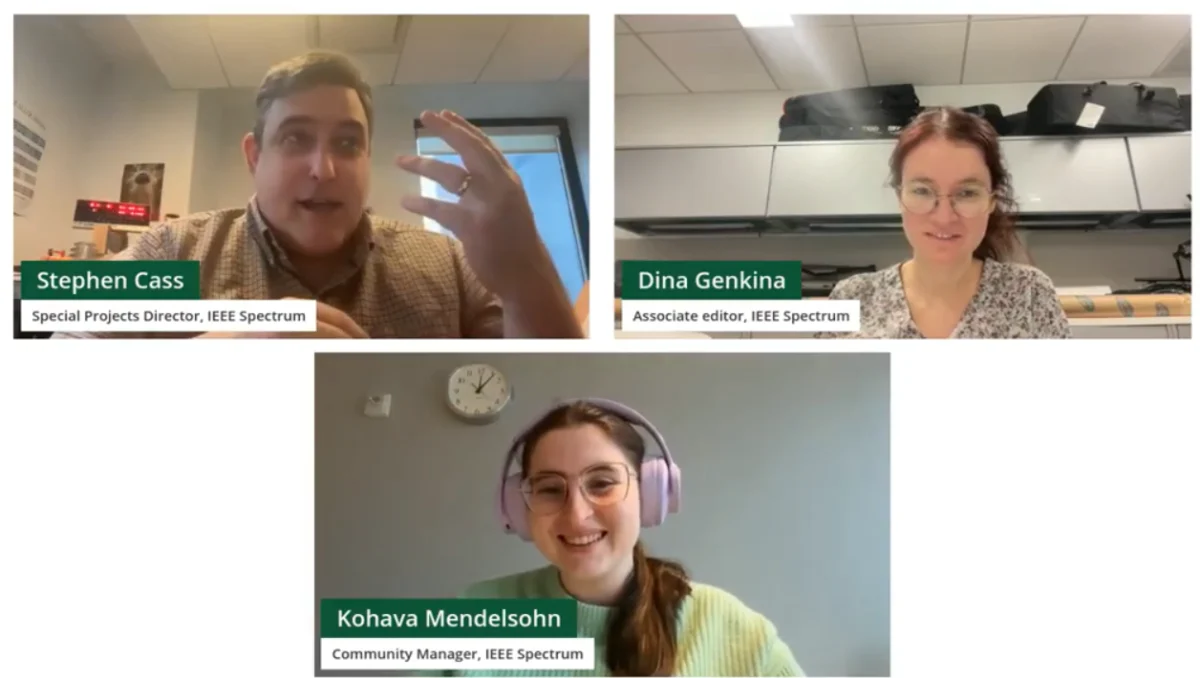
The webinar, titled "Will AI End Distinct Programming Languages?", explored these hypotheticals further. Cass envisioned future programmers focusing on interface design, algorithm selection, and architectural decisions, with AI handling the implementation details. The resulting code would still need to pass tests and be explainable. However, the discussion also touched upon the potential loss of certain human-centric abstractions. Cass mused, "What happens when we really let AIs off the hook on this? When we stop bothering to have them code in high-level languages. Since, after all, high-level languages are a tool for human beings."
The idea of machines directly generating intermediate code, bypassing high-level languages entirely, was met with skepticism by co-host Dina Genkina, an associate editor at IEEE Spectrum. Genkina agreed that current programming languages act as crucial "guard rails for the human to not do dumb stuff." While acknowledging the possibility of AI-friendly micro-optimizations in new languages, she expressed uncertainty about the path forward. "I feel like it’s an open question whether the AI will need more guard rails or [fewer] guard rails… I’m not saying it’s not possible, but I don’t quite see a path to there… from where we are right now."
Code-Free Programming: A Speculative Frontier
The concept of code-free programming, where AI generates software directly from natural language prompts, remains largely speculative. Dina Genkina, when contacted by The New Stack, reiterated her skepticism: "To my knowledge, code-free programming is still speculative." Similarly, Andrea Griffiths maintains a pragmatic stance. "Will we see languages optimized for AI readers, not human maintainers? I’d push back on that," she stated. "Code still needs to be debugged, audited, and understood by humans, especially when things go wrong in production. No engineering team is going to deploy code they can’t inspect."
Instead, Griffiths predicts a more nuanced evolution: AI will "change what humans need to read." The future, she suggests, will involve programmers spending "less time reading boilerplate—and more time reviewing architecture decisions, edge cases, and security boundaries!" This implies a shift in the programmer’s role from meticulous code writing to high-level oversight and strategic decision-making, with AI acting as an incredibly powerful and efficient implementation engine.
The ongoing discourse, fueled by rapid AI advancements, highlights a critical juncture in software development. While the creation of purely AI-optimized languages remains a theoretical possibility, the immediate impact appears to be an increased reliance on, and refinement of, existing strongly typed and structured languages. The ultimate trajectory will likely involve a complex interplay between human oversight, AI capabilities, and the evolving nature of hardware, shaping how we conceive, write, and deploy software for generations to come. The journey from prompt to production is being redefined, and the programming languages of the future will be forged in this dynamic crucible of human ingenuity and artificial intelligence.