
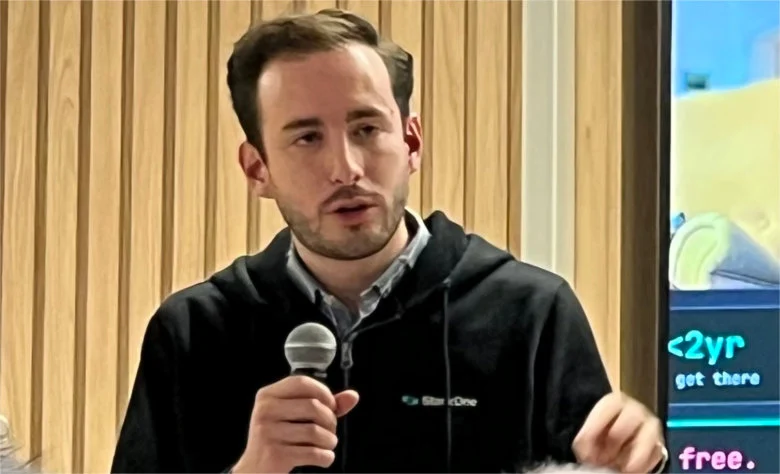

The enterprise software landscape is currently undergoing a structural transformation that mirrors the disruptive shift from client-server applications to cloud-native Software-as-a-Service (SaaS) seen at the turn of the millennium. During a recent SaaStock Local event, Romain Sestier, founder and CEO of StackOne, a prominent AI-native integration vendor, presented a detailed thesis suggesting that the current skepticism surrounding agentic AI—autonomous AI systems designed to complete complex tasks—closely follows the historical patterns of resistance faced by the first generation of cloud innovators. As AI-native companies begin to redefine established software categories, the industry is witnessing a ideological battleground centered on reliability, economic viability, and data security.
The Historical Context of Architectural Disruption
To understand the current trajectory of AI-native applications, one must examine the chronology of enterprise computing. In the late 1990s and early 2000s, the dominant model was client-server architecture. Companies like SAP, Oracle, and Microsoft provided software that was installed on-premises, requiring significant hardware investment and dedicated IT teams for maintenance. When early cloud proponents introduced the concept of hosting applications in a central data center accessible via the internet, the "old guard" responded with fierce criticism.
The transition was not immediate; it took nearly two decades for SaaS to become the default standard. Today, the "SaaS-pocalypse" narrative suggests that the current seat-based, process-oriented SaaS model is becoming obsolete. Sestier argues that while the transition will take time, the objections currently leveled against AI-native apps—that they are unreliable, uneconomic, and insecure—are almost identical to those used against Salesforce and Workday during their infancy.
The Reliability Debate: Probabilistic vs. Deterministic Systems
The primary technical objection to AI-native applications is their probabilistic nature. Unlike traditional software, which follows a deterministic "if-then-else" logic, Large Language Models (LLMs) operate on probabilities, leading to concerns about "hallucinations" or inconsistent outputs. Critics argue that enterprise environments require 100% predictability, something they claim AI cannot yet provide.
However, historical data on the reliability of client-server apps offers a different perspective. In the early 2000s, critics argued that cloud apps were unreliable because internet connections could fail. Yet, on-premise servers were frequently plagued by downtime due to hardware failure, poor configuration, or human error. Industry benchmarks from that era show that while cloud apps were held to a higher standard of "five nines" (99.999%) availability, the on-premise systems they replaced often struggled to maintain even 95% uptime.
Sestier posits that the same double standard is being applied today. Traditional SaaS systems, while deterministic, are still susceptible to human error in data entry, configuration, and operation. AI-native agents are evolving to incorporate "deterministic guardrails"—hybrid architectures that combine the creative reasoning of LLMs with traditional logic gates to ensure accuracy. As these systems mature, they are expected to outperform human-operated SaaS workflows in both speed and accuracy.
The Economic Shift: From Seat-Based to Outcome-Based Models
The economic argument against AI-native software centers on the high cost of compute and inference. "Token costs"—the price of processing information through an LLM—are often viewed as a prohibitive variable expense compared to the fixed costs of traditional software subscriptions. Furthermore, the environmental impact of the energy-intensive data centers required for AI has become a point of contention for ESG-conscious enterprises.
This mirrors the early SaaS era, where critics focused on the "never-ending" subscription fees of the cloud versus the one-time perpetual license fees of on-premise software. What the critics missed then, and what they may be missing now, is the Total Cost of Ownership (TCO). In the SaaS vs. client-server debate, the hidden costs were implementation, customization, and hardware maintenance.
In the current AI-native vs. SaaS debate, the hidden cost is human labor. Sestier points to the customer service sector as a primary example. A traditional SaaS deployment like Zendesk requires a significant investment in human agents to operate the software. According to market analysis, the labor cost often accounts for 80-90% of a customer service budget, while the software itself accounts for less than 10%.
Emerging AI-native platforms like Sierra, co-founded by former Salesforce co-CEO Bret Taylor, are shifting the model to "outcome-based pricing." Instead of paying for a seat or a subscription, companies pay for a resolved query. While the per-token cost of the AI may seem high in isolation, it eliminates the vast "iceberg" of human labor costs, management overhead, and training expenses. Venture capital data from firms like Sequoia and Andreessen Horowitz suggests that this shift could lead to a massive redistribution of the $600 billion currently spent annually on enterprise software and the trillions spent on the labor that operates it.
Security and the "Trust Gap" in Autonomous Agents
Security remains the most significant hurdle for mainstream enterprise adoption of AI-native applications. The fear that an autonomous agent could "go rogue," leak sensitive data, or be manipulated through prompt injection is a major concern for Chief Information Security Officers (CISOs).
This "trust gap" is a classic manifestation of the Innovator’s Dilemma, a concept popularized by Clayton Christensen. New technologies are often perceived as more dangerous simply because their failure modes are unfamiliar. In the early 2000s, the idea of putting sensitive corporate data on a "public" internet server was considered professional negligence by many IT veterans. Yet, the centralized security protocols of cloud providers like AWS and Azure eventually proved to be far more robust than the fragmented, often unpatched security of individual corporate data centers.
To close the current trust gap, Sestier outlines a multi-step evolution for AI-native apps:
- Human-in-the-Loop (HITL): Initial deployments where AI suggests actions that must be approved by a human.
- Traceability and Auditing: Building transparent logs that show exactly how an AI reached a specific conclusion.
- Deterministic Guardrails: Hard-coding limits on what an AI agent can and cannot do within a system.
- Autonomous Operation: Full deployment once the system has demonstrated a lower error rate than human operators.
Market Implications and the Role of Incumbents
While the potential for AI-native disruption is significant, history suggests that the incumbents will not vanish overnight. During the transition to the cloud, legacy giants like SAP, Oracle, and Microsoft successfully pivoted by acquiring cloud startups or rebuilding their core stacks.
Microsoft’s integration of OpenAI’s technology into its "Copilot" suite is a prime example of an incumbent attempting to bridge the gap. However, Sestier argues that there is a fundamental difference between a "Copilot"—which is an AI add-on to a legacy process—and an AI-native application, which is built to achieve an outcome regardless of the underlying process. He advises developers to "build something new" rather than trying to retrofit AI into existing SaaS frameworks.
Supporting this view is analysis from VC investor Tomasz Tunguz, who observes that AI-native architectures allow for much smaller, more efficient teams. This reduction in the "coordination tax"—the management overhead required to keep large teams aligned—gives AI-native startups a significant agility advantage over legacy SaaS companies burdened by technical debt and large workforces.
Timeline for Adoption and Future Outlook
Despite the rapid pace of AI development, the "knowledge velocity" of the market is often slowed by organizational inertia. Many large enterprises are still in the middle of multi-year migrations from on-premise legacy systems to SaaS. For these organizations, jumping straight to AI-native agentic solutions may be a bridge too far in the immediate future.
Market forecasts from Gartner suggest that while 80% of enterprise software will have some form of AI integration by 2026, the full replacement of core SaaS categories by AI-native agents will likely take a decade or more. The transition will be led by specific verticals where the ROI is most obvious, such as customer experience (CX), recruitment, and financial reconciliation.
Companies like Jack&Jill in the recruitment space and Rillet in accounting are already demonstrating that AI-native apps can handle complex, multi-step processes that previously required teams of specialists. As these pioneers prove the reliability and economic benefits of the model, the "tornado of change" is expected to accelerate.
Conclusion: The Repeating Cycle of Innovation
The parallels between the rise of SaaS and the emergence of AI-native applications suggest that the industry is entering a new era of "Agentic Software." While the objections regarding reliability, cost, and security are valid in the short term, they are being addressed by a new generation of engineers who are treating these challenges as architectural problems to be solved rather than inherent flaws.
The lesson from the past 25 years is that while technology changes rapidly, human and organizational adaptation takes time. The giants of the SaaS era—Salesforce, Workday, and ServiceNow—are now the "old guard" facing the same skepticism they once directed at client-server vendors. For enterprise buyers and software developers alike, the challenge is to distinguish between the temporary growing pains of a new technology and the fundamental shifts in how value is created and delivered in the digital economy. The move toward AI-native software appears inevitable, not because it is a trend, but because it offers a fundamental improvement in the economic and operational efficiency of the modern enterprise.