
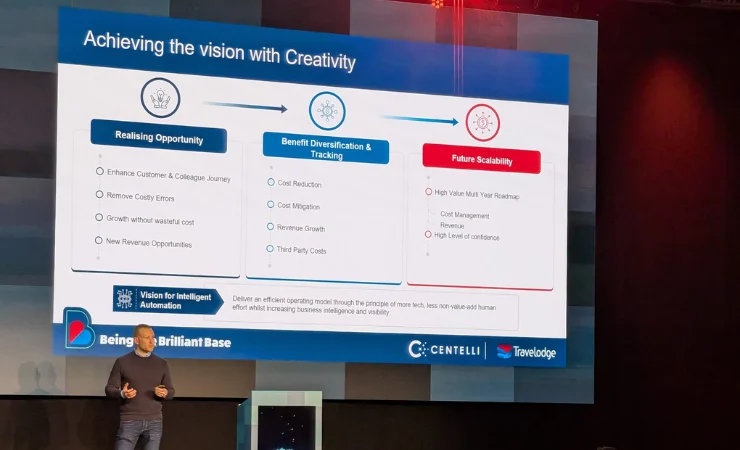

The United Kingdom’s budget hospitality sector is witnessing a significant shift in operational strategy as Travelodge, one of the nation’s largest hotel chains, aggressively scales its intelligent automation program. Speaking at the UiPath Fusion event in London, Martin Oswald, Travelodge’s Head of Operational Transformation, detailed a roadmap that transitions the company from foundational robotic process automation (RPA) to a sophisticated ecosystem of AI-driven digital agents. With an estate spanning nearly 600 hotels and a workforce of over 12,000, the organization is leveraging technology to manage the complexities of a high-volume, low-margin industry where efficiency is the primary driver of competitive advantage.
Since initiating its partnership with automation leader UiPath two years ago, Travelodge has moved from experimental pilots to a robust production environment. By the close of the previous fiscal year, the company had successfully deployed over 20 live automations, handling hundreds of thousands of transactions that were previously managed manually by staff. The momentum is set to more than double in the current year, with a target of 50 live automations by December. Oswald highlighted a compounding value trajectory, projecting that the financial and operational benefits delivered by the end of this year will be 20 times greater than those realized in the program’s first month.
A Methodical Framework for Enterprise Scaling
The success of Travelodge’s automation journey is rooted in a structured, "head office first" strategy. Rather than deploying technology directly into hotel lobbies or housekeeping departments—where operational variables are high—the transformation team focused on the back-office environment. Through a series of structured workshops, the team mapped out legacy systems that lacked interoperability, identifying manual bottlenecks in finance, human resources, and procurement.
To manage this pipeline, Travelodge developed a prioritization matrix. This framework evaluates potential automation projects based on four distinct criteria: direct financial benefit, secondary qualitative benefits (such as employee satisfaction), ease of technical delivery, and the "belief threshold." This final criterion requires business leaders to articulate the specific conditions under which an automation would be considered a success, ensuring that the technology serves a strategic purpose rather than being implemented for its own sake.
This methodology revealed a "thread" of connectivity between back-office efficiency and front-line service. By automating administrative tasks at the corporate level, the company found it could reduce friction for hotel-based teams, allowing them to focus on guest-facing interactions. This realization has paved the way for the program’s current phase: the expansion of automation across Travelodge’s extensive and geographically diverse hotel portfolio.
The Accountability Model: Governance Through Contracts
One of the most distinctive aspects of the Travelodge approach is the implementation of what Oswald terms "the contract." In many enterprise technology projects, a gap often emerges between the technical delivery of a tool and the realization of its intended business value. Travelodge mitigates this risk by requiring business owners to sign a formal document before any development begins.
This contract outlines the expected deliverables, the specific layers of benefit (financial, temporal, or accuracy-based), and the precise metrics that will be used for measurement. Once the automation is live and passes a stabilization period, the accountability for delivering those benefits shifts entirely from the transformation team to the business owner. By involving the finance department in this loop from the outset, Travelodge ensures that the program speaks the language of the boardroom. The focus remains steadfastly on business outcomes rather than technical metrics like "uptime" or "bot utilization."
Operational Breakthroughs: From Minutes to Seconds
The impact of this rigorous approach is most evident in the company’s transaction processing. Oswald cited a specific use case involving high-volume data entry that historically required 20 minutes of manual effort per transaction. By integrating UiPath’s automation platform with an Application Programming Interface (API), the processing time was reduced to just three seconds.
This specific automation operates 24 hours a day, seven days a week, eliminating backlogs that previously plagued the department. Beyond the immediate efficiency gain, the project served as a "proof of concept" that shifted the internal perception of technology. When employees witnessed a 20-minute task vanish into a three-second background process, the skepticism often associated with digital transformation began to dissolve, replaced by a demand for further innovation.
Addressing the Human Element and the Labor Market
The hospitality industry in the UK has faced chronic labor shortages following the dual impacts of the pandemic and shifting immigration policies. In this context, automation is not merely a cost-saving measure but a necessary tool for operational resilience. Travelodge has been transparent with its workforce regarding the intent of the program, framing automation as a means of "plugging the leaky bucket" of manual errors.
Oswald emphasized that the goal is to remove "manual and boring" tasks that lead to employee burnout and revenue leakage. By automating these repetitive processes, staff are freed to engage in higher-value activities, such as guest relations and complex problem-solving. This strategy has created a self-perpetuating cycle: as employees become comfortable with the technology and see it as a supportive tool rather than a threat, they have begun to submit their own ideas for the automation pipeline. This grassroots contribution ensures that the roadmap is informed by those closest to the operational challenges.
Strategic Partnerships and the Move Toward AI
Travelodge’s transformation is supported by Centelli, an implementation partner that operates as an integrated extension of the Travelodge team. This partnership model emphasizes transparency and a "three-way hyper-care" period following the launch of any new automation. During this phase, the transformation team, the partner, and the end-users collaborate closely to refine the process before it enters a steady state of maintenance.
Looking ahead, Travelodge is beginning to incorporate Artificial Intelligence and agentic capabilities into its workflow. Agentic AI refers to systems that can not only follow predefined rules but can also make reasoned decisions and interact with other software components to complete complex goals. However, the company maintains a pragmatic stance on AI adoption. Following the themes discussed at the UiPath Fusion event, Travelodge’s philosophy is to "start with the problem, not the technology." AI is deployed only when it is the most effective tool to solve a specific business challenge, particularly in scenarios involving unstructured data or "human-in-the-loop" decision-making.
Industry Implications and Factual Analysis
The trajectory of Travelodge provides a blueprint for the broader hospitality industry, which has traditionally been slower to adopt deep-tech solutions compared to the financial or manufacturing sectors. According to market data, the UK budget hotel sector is highly consolidated, with Travelodge and its primary competitor, Premier Inn (owned by Whitbread PLC), holding a significant market share. In such a competitive landscape, the ability to scale operations without a linear increase in administrative headcount is critical.
Analysts note that the "contract model" of governance used by Travelodge addresses the "automation paradox"—the tendency for automation to create new layers of management and complexity. By anchoring every bot in a signed business agreement and a finance-backed benefit realization plan, Travelodge avoids the common pitfall of "zombie automations" that run without contributing to the bottom line.
As Travelodge moves toward its goal of 50 live automations, the broader implications for the UK workforce are significant. The shift suggests a future where hospitality roles are increasingly "tech-augmented." The successful upskilling of hotel staff to work alongside digital agents could provide a partial solution to the industry’s recruitment challenges, making hospitality roles more attractive by removing the drudgery of administrative data entry.
In conclusion, Travelodge’s intelligent automation journey represents a shift from tactical fixes to a comprehensive digital-first operating model. By combining rigorous governance, strategic partnerships, and a human-centric approach to change management, the company is positioning itself to navigate the economic pressures of the modern hospitality market. The transition from 20 to 50 automations in a single year marks a pivotal moment in the company’s history, signaling a commitment to a future where technology and human service are inextricably linked.