

All digital data and systems, from cloud-based platforms and personal online accounts to corporate websites and mobile applications, are ultimately hosted on real-world machines. The distinction between "virtual server" and "physical server" is not about their existence as tangible or intangible entities, but rather about their architectural design and resource allocation. This article delves into the foundational aspects of each, their key features, use cases, and the critical differences that inform their selection for various business needs.
The Foundation: What is a Physical Server?
A physical server, often referred to as bare metal, is a complete, self-contained computing machine. It comprises all the essential hardware components necessary for operation: a central processing unit (CPU), graphics processing unit (GPU) if applicable, random-access memory (RAM), storage drives, a power supply unit, a network interface, and the operating system. Unlike a typical desktop computer, physical servers are engineered for continuous, 24/7 operation and are dedicated to running specific applications and services that cater to other computers. This includes critical functions such as web hosting, database management, file sharing, and application serving.
The physical form factor of a server can vary significantly, from compact desktop units to large, rack-mounted systems. Regardless of its size or location, if it is a singular, dedicated hardware unit, it is classified as a physical server. Organizations can either own and manage these servers on their own premises (on-premises infrastructure) or lease dedicated hardware from third-party providers, including major cloud vendors.
Key Features of Physical Servers
The defining characteristic of a physical server is its exclusive control over all its hardware resources. This direct access and allocation lead to several significant advantages:
- Dedicated Resources: Every component, from CPU cycles to memory, is solely allocated to the tasks running on the server. This prevents resource contention with other systems and ensures predictable performance.
- Enhanced Performance: For highly demanding workloads that require maximum processing power and low latency, physical servers often offer superior performance due to the absence of virtualization overhead.
- Uncompromised Security: The isolation of a physical server can be a significant security advantage. With no shared hardware or hypervisor layer, the attack surface can be more contained, especially for highly sensitive data or critical applications.
- Full Control and Customization: Administrators have complete control over the hardware, operating system, and software stack, allowing for deep customization and optimization tailored to specific needs.
- Predictable Costs: While the initial investment can be higher, the operational costs for a dedicated physical server are often more predictable over its lifecycle, especially when amortized over several years.
Historical Context and Evolving Use Cases
In the early 2000s, the vast majority of the world’s digital infrastructure was powered by physical servers. Businesses typically maintained their own server rooms, housing individual machines for each IT system. This decentralized approach was the standard for delivering digital services.
While the landscape has dramatically shifted with the rise of virtualization and cloud computing, physical servers remain indispensable for certain demanding workloads. They continue to be crucial in scenarios where absolute performance, granular control, and heightened security are paramount.
Popular use cases for physical servers include:
- High-Performance Computing (HPC): Complex simulations, scientific research, and advanced data analytics often require the raw processing power and dedicated resources that only bare metal can reliably provide.
- Mission-Critical Databases: For financial institutions or large enterprises with extremely sensitive and high-transaction databases, the performance guarantees and isolation of a physical server are often preferred.
- Intensive Gaming Servers: Hosting large-scale multiplayer online games often necessitates the low latency and consistent performance of physical hardware.
- Big Data Processing: Workloads involving massive datasets and complex processing pipelines benefit from the dedicated resources and I/O performance of physical servers.
- Legacy Applications: Some older applications are not compatible with virtualization environments and require direct access to hardware, making physical servers the only viable option.
- Security-Sensitive Environments: Government agencies, defense contractors, and organizations handling highly classified information often opt for physical servers to maintain complete control over their security posture and data isolation.
Industries that commonly leverage physical servers include financial services, healthcare, government and defense, aerospace, logistics, public utilities, manufacturing, and media and entertainment. These sectors prioritize the inherent reliability, peak performance, stringent security, complete isolation, and direct ownership that physical servers offer.
The Modern Paradigm: What is a Virtual Server?
A virtual server, or virtual machine (VM), is a software-based emulation of a physical server. It is created by partitioning a single physical server’s resources—CPU, RAM, storage, and network bandwidth—into multiple isolated virtual environments. This process is enabled by virtualization software, commonly known as a hypervisor. The hypervisor acts as an intermediary layer, managing the physical hardware and allocating portions of its resources to each VM.
The core concept of virtualization allows a single powerful physical machine to host numerous independent virtual servers, each running its own operating system and applications as if it were a distinct physical entity. This technological leap is the bedrock of cloud computing, enabling providers to efficiently scale resources, maximize hardware utilization, and offer flexible, on-demand services to a global customer base.
Consider a scenario with a state-of-the-art, rack-mounted physical server brimming with computing power, vast storage, and exceptional speed. Instead of dedicating this entire machine to a single client, virtualization allows it to be divided. If one client needs to host a website and two others require platforms for database management, the physical server can be transformed into multiple virtual servers, with each VM sharing the underlying hardware resources. Each VM is then assigned a dedicated slice of the physical server’s resources, functioning as an independent, isolated system. This scalable model is precisely what drives the massive growth and reach of modern cloud computing.
Key Features of Virtual Servers
Virtual servers offer a distinct set of advantages driven by the principles of virtualization:
- Resource Efficiency and Consolidation: Virtualization allows multiple workloads to run on a single physical server, significantly reducing hardware acquisition costs, power consumption, and physical space requirements.
- Scalability and Flexibility: VMs can be rapidly provisioned, scaled up or down, and de-provisioned in minutes, providing unparalleled agility to adapt to changing business demands.
- Cost-Effectiveness: While initial virtualization software investment exists, the ability to consolidate hardware and optimize resource usage often leads to substantial cost savings, especially at scale.
- Rapid Deployment and Provisioning: New virtual servers can be created and deployed in a fraction of the time it takes to procure and set up a physical server.
- Disaster Recovery and Business Continuity: VMs can be easily backed up, replicated, and migrated to different physical hosts, simplifying disaster recovery strategies and ensuring business continuity.
- Isolation and Sandboxing: Each VM operates in an isolated environment, preventing issues on one VM from affecting others on the same physical hardware. This is also useful for testing new software or configurations in a safe, sandboxed environment.
Broad Spectrum of Use Cases
The versatility of virtual servers makes their use cases virtually limitless, touching almost every aspect of modern digital operations. They are fundamental to the operation of cloud services, powering everything from simple websites to complex enterprise applications.

Some popular use cases for virtual servers include:
- Web Hosting: Providing the infrastructure for websites and web applications of all sizes.
- Application Development and Testing: Creating isolated environments for developers to build, test, and deploy applications without impacting production systems.
- Database Hosting: Managing databases for various applications, offering flexibility in scaling and resource allocation.
- Email Servers: Hosting email services for organizations.
- File Servers: Centralizing and managing file storage and access.
- Development and Staging Environments: Creating intermediate environments for refining applications before they are deployed to production.
- Virtual Desktops (VDI): Providing users with desktop environments hosted on servers, accessible from various devices.
- Cloud Computing Infrastructure: Serving as the fundamental building blocks for public, private, and hybrid cloud solutions.
- High-Performance Computing (HPC) Clusters: While physical servers are often preferred for the absolute highest demands, virtualized HPC environments offer scalability and cost-efficiency for many scientific and engineering tasks.
- Disaster Recovery Sites: Hosting replicated systems that can be activated in the event of a primary site failure.
Beyond these common applications, virtual servers are integral to advanced computing paradigms such as High-Performance Computing (HPC), virtual desktop infrastructure (VDI), and the very fabric of the cloud.
Virtual Servers vs. Physical Servers: A Comparative Analysis
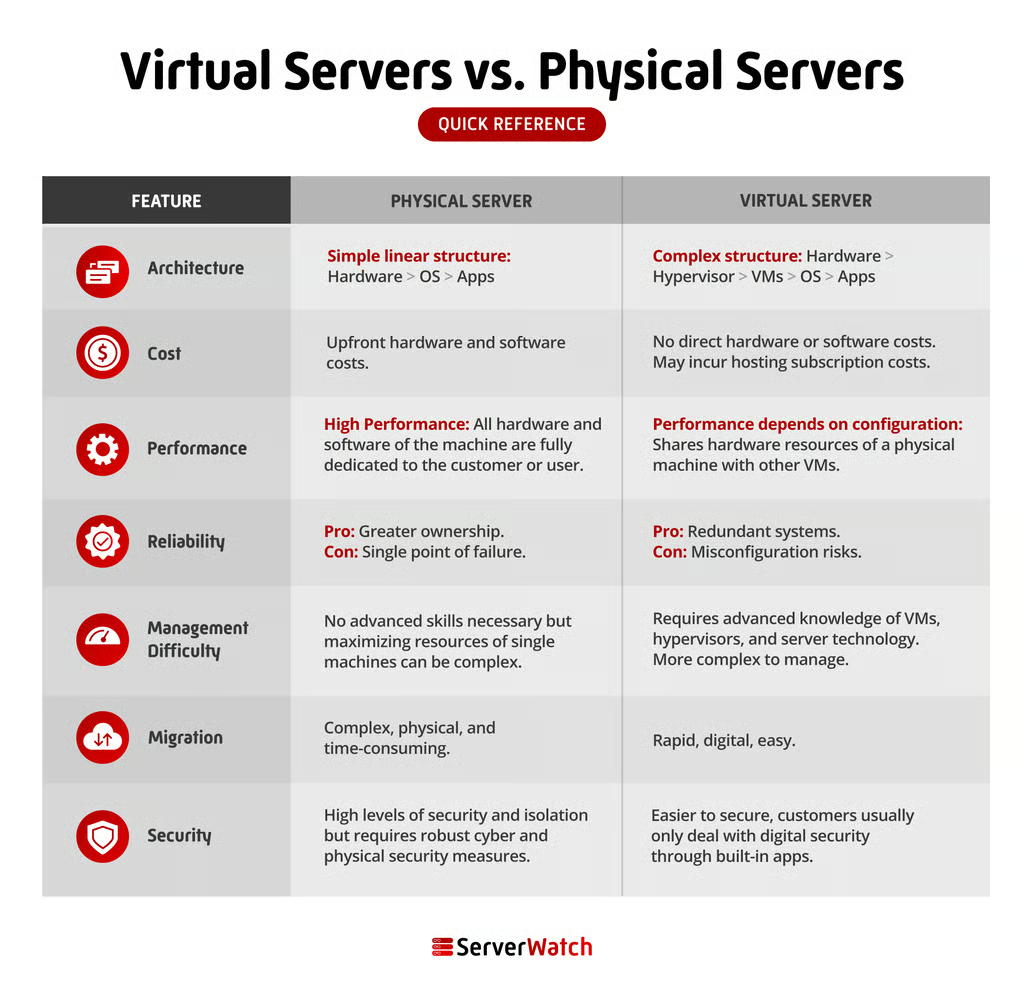
Understanding the nuanced differences between virtual and physical servers is crucial for making informed IT infrastructure decisions. The choice hinges on specific operational requirements, performance demands, security mandates, and budgetary considerations.
Architecture
The fundamental architectural divergence lies in their composition. A physical server is a singular, dedicated hardware unit with direct access to all its components. A virtual server, conversely, is a software construct that shares the resources of an underlying physical server, managed by a hypervisor. This sharing introduces a layer of abstraction that provides flexibility but can also introduce overhead.
Cost
The cost dynamics present a significant point of differentiation. While the initial acquisition of a physical server can represent a substantial capital expenditure, its operational costs are generally straightforward. Virtualization technology, though complex and advanced, often proves more cost-efficient when implemented at scale. The ability to consolidate multiple workloads onto fewer physical machines drastically reduces hardware, power, and cooling expenses. Furthermore, when opting for cloud-based virtual servers, businesses offload the responsibilities and costs associated with hardware maintenance, physical security, energy consumption, and even the risks of natural disasters, as these are managed by the cloud provider.
Performance
The performance comparison between physical and virtual servers is a closely contested area, heavily influenced by various factors. The configuration of the hardware, the specifications of the CPU, RAM, and storage, the efficiency of the network, and the optimization of the software stack all play critical roles. For workloads that demand absolute maximum throughput, minimal latency, and consistent resource availability, a well-configured physical server often holds an edge due to the absence of virtualization overhead. However, modern virtualization technologies have significantly closed this gap, and for many applications, the performance difference is negligible, especially when considering the agility and scalability that virtual servers offer.
Reliability
Similar to performance, the reliability of both physical and virtual servers is contingent on the quality of the hardware, the robustness of the software, the stability of the network, and the meticulousness of the configuration. Both architectures can be engineered for exceptional reliability. Physical servers offer inherent stability through dedicated components. Virtual servers, when part of a well-managed virtualized environment with features like high-availability clustering and live migration, can achieve remarkable levels of uptime and resilience. The ease with which virtual machines can be moved to healthy hardware in the event of a failure can contribute to superior overall system uptime.
Management Difficulty
Managing servers, whether physical or virtual, can be a complex undertaking. However, the burden of management can be significantly alleviated with virtual servers, particularly when hosted by a third-party cloud provider. In such scenarios, the provider assumes responsibility for hardware maintenance, infrastructure updates, and many of the routine operational tasks. For on-premises virtualized environments, management still requires specialized skills, but the ability to manage multiple VMs from a centralized console offers efficiencies over managing numerous individual physical machines. Physical server management, especially in large data centers, demands extensive expertise in hardware, networking, and system administration.
Migration
Migration is a key area where virtual servers demonstrably outperform their physical counterparts. Virtual machines can be easily copied, moved, and redeployed across different physical hosts or even to different data centers with relative ease, often with just a few clicks. This process is significantly streamlined by virtualization platforms. Migrating a physical server, on the other hand, is a more arduous process. It typically involves physically moving the hardware, reconfiguring network settings, and meticulously backing up and restoring the entire system to the new location or machine, which is time-consuming and prone to error.
Security
Both virtual and physical servers can achieve high levels of security, but they require diligent configuration and ongoing management. Physical servers offer inherent isolation, meaning an attack on one physical machine generally does not impact others. However, they can be vulnerable to physical breaches or hardware-level exploits. Virtual servers benefit from the isolation provided by the hypervisor, which prevents VMs from directly interfering with each other. However, the hypervisor itself can be a target, and misconfigurations in the virtualization environment can create security risks. Cloud providers invest heavily in physical and network security for their data centers, but users must still ensure the security of their operating systems, applications, and data within their virtual environments.
The Bottom Line: Choosing the Right Server for Your Business
The decision between virtual and physical servers is not a one-size-fits-all proposition. Each technology offers a distinct set of advantages and disadvantages, and the optimal choice is dictated by a business’s unique operational needs, strategic goals, and financial constraints.
Generally, virtual servers are an excellent choice for the majority of modern businesses. They provide a compelling blend of affordability, remarkable reliability, access to cutting-edge technology, and unparalleled scalability. Their agility allows businesses to adapt quickly to market changes and growth opportunities.
However, physical servers remain a superior option for organizations that require the utmost in dedicated performance, absolute control over hardware resources, and the highest levels of security and isolation. This is particularly true for workloads that are exceptionally resource-intensive, latency-sensitive, or involve highly sensitive data governed by strict regulatory compliance.
For businesses looking to harness the power of virtualization, exploring the landscape of virtualization software is a critical next step. Understanding the leading solutions available can empower organizations to build robust, efficient, and scalable IT infrastructures that align with their long-term vision.