
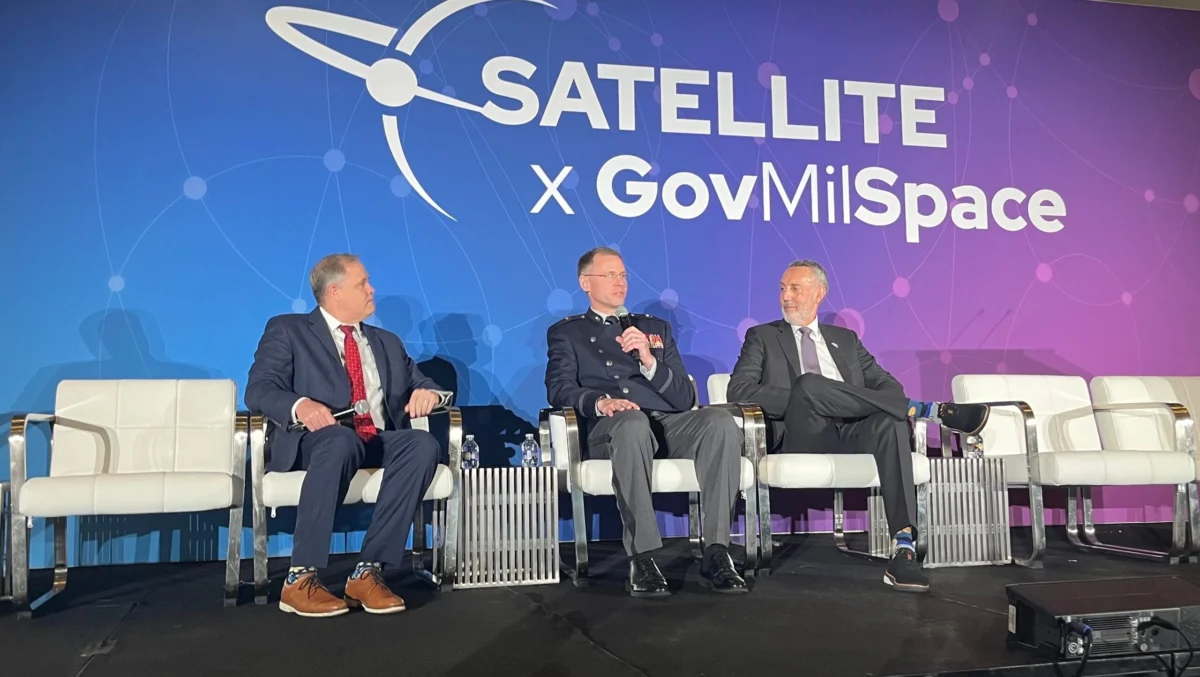

The United States Space Force is currently navigating a pivotal transition from a service focused on orbital monitoring to one capable of sophisticated space domain awareness and proactive defense. During a high-level panel discussion at GovMilSpace, held as part of the annual SATShow Week, prominent military leaders and industry pioneers gathered to address the critical intelligence gaps that currently hinder U.S. operations in the extraterrestrial theater. Moderated by former NASA Administrator Jim Bridenstine, the session featured Brigadier General Nick Hague, the Space Force Assistant Deputy Chief of Space Operations for Operations, and Lee Rosen, a retired U.S. Air Force Colonel and the current President of ThinkOrbital. The consensus among the participants was clear: while the U.S. possesses a robust network of ground-based radars and geostationary spy satellites, it remains significantly limited in its ability to discern the true intent and internal capabilities of adversary assets.
The Challenge of Orbital Transparency
Despite the sophisticated "kaleidoscope" of tracking technology at the Space Force’s disposal, Lee Rosen offered a blunt assessment of the current state of space intelligence, suggesting that the United States is "essentially flying blind" when it comes to the specific functions of foreign satellites. While the U.S. can track the trajectory of objects with high precision, knowing that an object is in a specific orbit is fundamentally different from understanding its mission profile or its potential for offensive action.
Rosen, who spent over two decades in the Air Force and served as a vice president at SpaceX before co-founding ThinkOrbital in 2022, emphasized that the "toughest problem" facing the Space Force today is the ambiguity surrounding adversary intent. In the current geopolitical climate, space has become a "gray zone" where traditional norms of transparency are frequently ignored. Rosen pointed to recent observations of Russian and Chinese activities as evidence of this growing opacity. Reports of Russia potentially positioning nuclear-capable assets in orbit and Chinese satellites engaging in "dogfighting" maneuvers—high-speed, close-proximity operations—have raised alarms within the Department of Defense. However, without the ability to "see inside" these assets, the U.S. is often left to speculate on whether a maneuver is a peaceful technology demonstration or a rehearsal for an anti-satellite (ASAT) strike.
Advancing Space Domain Awareness Through X-Ray Technology
To bridge this intelligence gap, ThinkOrbital is developing revolutionary sensing capabilities. Rosen revealed that the company is working toward releasing the world’s first X-ray image of a satellite captured from a distance of over 10 kilometers. This technology represents a paradigm shift in Space Domain Awareness (SDA). Currently, electro-optical telescopes provide external imagery that can show the physical shape and orientation of a satellite, but they cannot reveal its internal components or its payload.
Using the analogy of a medical diagnosis, Rosen noted that while a photograph can show a "busted knee," only an X-ray can reveal the internal structural damage or the presence of foreign objects. By applying this logic to orbital assets, the Space Force could potentially identify hidden weapons systems, electronic warfare modules, or sophisticated sensors housed within seemingly benign commercial or scientific satellites. This capability would provide the tactical "attribution" necessary to hold adversaries accountable for their actions in space and would allow for more informed decision-making by the National Command Authority.
The Rise of Large-Scale Orbital Infrastructure
The discussion also shifted toward the physical requirements of a modern space force. Rosen argued that the future of U.S. space superiority lies in the ability to construct and deploy large-scale infrastructure rapidly. ThinkOrbital has already entered into contracts with Space Systems Command to explore the "forward basing" of space infrastructure. This concept involves pre-positioning materials and manufacturing hubs in orbit that can be activated at a moment’s notice to support military or commercial needs.
One of the most ambitious goals discussed was the use of microgravity welding. By leveraging the unique environment of space, ThinkOrbital aims to enable the construction of orbital structures four times the size of the International Space Station (ISS) in a matter of weeks, rather than the decades required for traditional assembly. This would be achieved through a single launch of raw materials and robotic assembly units. Rosen addressed concerns that such large structures would become "big, fat, juicy targets" for adversary missiles. He compared the future of large space stations to modern aircraft carriers: while they are high-value targets, they are protected by layered defenses, including escort satellites, jamming capabilities, and kinetic interceptors. The shift toward larger, more capable platforms is seen as a necessary evolution to support long-term presence and logistics in the cislunar domain.
Strategic Resilience and the "First Mover" Advantage
Brigadier General Nick Hague provided the institutional perspective of the Space Force, detailing how the branch is evolving to meet these multifaceted threats. Hague, a veteran astronaut with significant experience aboard the ISS, was promoted to brigadier general in 2025 and has been a key figure in shaping the Space Force’s operational doctrine. He noted that the service currently tracks over 10,000 active satellites and more than 50,000 pieces of orbital debris, but he echoed Rosen’s sentiment that tracking is only the first step toward true space superiority.
A primary focus for the Space Force moving forward is the concept of "resilience." Hague explained that the goal is to build an orbital architecture so robust and distributed that the "cost of trying to take that first step" by an adversary is prohibitively high. In military strategy, the "first mover advantage" often dictates that the party who strikes first in space could potentially blind their opponent. By diversifying constellations—moving from a few large, expensive satellites to hundreds of smaller, interconnected nodes—the Space Force aims to mitigate this risk. If an adversary destroys one or two satellites, the network remains operational, thereby removing the incentive for a surprise attack.
Human Capital and the 24/7 Warfighting Mindset
Beyond technology and hardware, General Hague emphasized the importance of the "Guardians"—the personnel who make up the Space Force. Despite the service’s relatively small size compared to the Army or Navy, Hague reported that the Space Force is consistently meeting its recruitment targets. The challenge, however, lies in the rapid training and integration of these new recruits into a high-stakes operational environment.
Hague stressed that space must be viewed as a "warfighting domain 24/7." This mindset is a departure from the historical view of space as a peaceful sanctuary or a mere support function for terrestrial forces. About one year ago, the Space Force released its first "Space Warfighting Framework," which outlines the tactical and strategic principles for conducting operations in a contested environment. Hague noted that for 95% of Guardians, their daily mission—providing missile warnings, satellite communications (SATCOM), and Positioning, Navigation, and Timing (PNT) data—is already a wartime mission. These capabilities underpin the entire Joint Force and the global economy.
Economic and Global Implications of Space Security
The implications of the Space Force’s evolution extend far beyond military strategy. The modern global economy is fundamentally dependent on space-based assets. The PNT data provided by the GPS constellation, maintained by the Space Force, is essential for everything from precision agriculture and global shipping to the synchronization of cellular networks and financial transactions. A disruption in these services would result in billions of dollars in economic losses daily.
Furthermore, the "shenanigans" mentioned by Rosen—such as China’s SJ-21 satellite, which successfully "tugged" a dead satellite out of geostationary orbit in 2022—demonstrate that the technology for space debris removal is indistinguishable from the technology needed to forcibly remove an active U.S. satellite. As more nations and private companies enter the space domain, the potential for accidental collisions or intentional interference increases, making the Space Force’s mission of maintaining order and safety more critical than ever.
Chronology of Space Force Milestones (2019–2026)
The discussion at GovMilSpace took place against a backdrop of rapid institutional growth for the Space Force. To understand the current trajectory, a brief chronology of recent milestones is essential:
- December 2019: The U.S. Space Force is officially established as the sixth branch of the U.S. Armed Forces.
- 2021-2022: The service focuses on "SDA" (Space Domain Awareness), moving away from the older "SSA" (Space Situational Awareness) model to emphasize active intelligence over passive tracking.
- April 2025: The Space Force releases its comprehensive "Space Warfighting Framework," formalizing the doctrine for orbital combat and defense.
- 2025-2026: Significant budget increases are directed toward "proliferated warfighter space architecture," shifting focus to small-satellite constellations and rapid launch capabilities.
- March 2026: The GovMilSpace panel highlights the transition toward in-space manufacturing and advanced sensing (X-ray) to counter near-peer adversaries.
Conclusion: The Road Ahead for Orbital Defense
As the panel concluded, the message to the industry leaders and military contractors in the room was one of urgency. The "gap" between seeing an object and understanding its purpose is the primary vulnerability that the U.S. must close to maintain its lead in the new space race. With the advent of technologies like ThinkOrbital’s X-ray imaging and the Space Force’s move toward a resilient, distributed architecture, the United States is attempting to redefine the rules of engagement in orbit.
The future of the Space Force will be defined by its ability to integrate commercial innovation with military discipline. As General Hague noted, the capabilities provided by space assets "underpin our way of life," and the mission to protect them must happen "every day, without fail." The transition from a "blind" monitoring service to a fully aware, defensive warfighting branch is no longer a theoretical goal; it is a strategic necessity in an increasingly crowded and contested high ground.