

The telecommunications landscape is currently undergoing its most significant structural shift since the transition from analog to digital cellular networks. At the heart of this evolution is the embedded SIM, or eSIM, a technology that is systematically dismantling the decades-old reliance on physical plastic cards. As of 2024, the global adoption of eSIM technology has reached a critical mass, driven by hardware manufacturers like Apple and Samsung, and supported by a global infrastructure of mobile network operators (MNOs) eager to streamline the subscriber onboarding process.
Understanding the Technical Architecture of eSIM
An eSIM, technically known as an Embedded Universal Integrated Circuit Card (eUICC), is a specialized hardware component soldered directly onto a device’s motherboard during the manufacturing process. Unlike the traditional SIM (Subscriber Identity Module), which requires a physical tray and a removable card, the eSIM is a rewritable chip that measures approximately 5mm by 5mm.
The architecture of an eSIM allows it to function as a secure vault for subscriber credentials. It stores the International Mobile Subscriber Identity (IMSI) and the related key used to identify and authenticate subscribers on mobile telephony devices. Because the chip is rewritable, it can be programmed "Over-the-Air" (OTA). This means a user can download a "profile"—the digital equivalent of a physical SIM card—directly onto the device without ever visiting a retail store or waiting for a piece of plastic to arrive in the mail.
A Chronological Evolution of SIM Technology
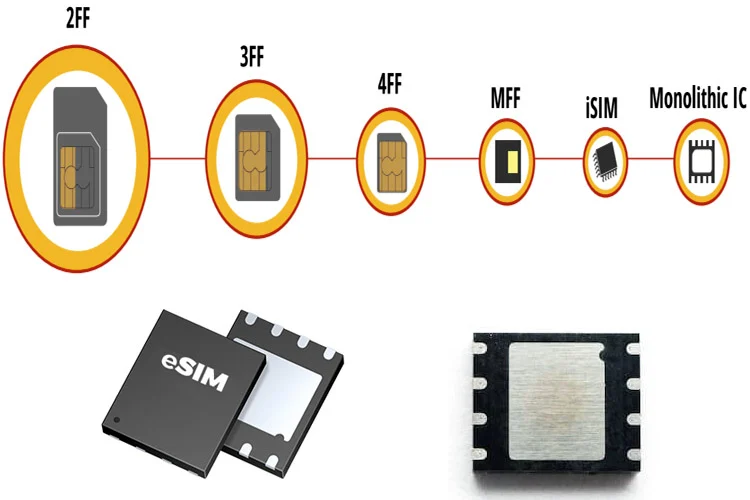
To understand the impact of the eSIM, one must look at the trajectory of SIM technology over the last three decades. The evolution has been characterized by a consistent reduction in size and an increase in digital flexibility.
- 1991: The Full-Size SIM (1FF): Roughly the size of a credit card, these were used in the earliest "brick" phones.
- 1996: The Mini-SIM (2FF): This became the industry standard for nearly two decades, featuring the familiar "clipped corner" design.
- 2003: The Micro-SIM (3FF): Introduced to save space, it saw mainstream adoption with the release of the iPhone 4 in 2010.
- 2012: The Nano-SIM (4FF): Currently the most common physical SIM, it stripped away almost all plastic, leaving only the gold contact chip.
- 2016: The Consumer eSIM: Samsung launched the first consumer-facing eSIM device with the Gear S2 Classic 3G smartwatch.
- 2018: Mainstream Integration: Apple introduced eSIM support in the iPhone XS and XR, allowing for dual-SIM functionality (one physical, one digital).
- 2022: The eSIM-Only Era: Apple released the iPhone 14 in the United States without a physical SIM tray, signaling a definitive end to the plastic era for premium devices.
Market Data and Global Adoption Trends
According to research from GSMA Intelligence, the number of eSIM-capable smartphone models has grown by over 150% since 2020. Market analysts project that by 2025, there will be more than 2.4 billion eSIM smartphone connections globally, representing roughly 33% of the total smartphone market.
The push toward eSIM is not merely a consumer convenience but a financial and environmental imperative for the industry. Annually, the telecommunications industry produces approximately 4.5 billion plastic SIM cards, contributing to significant plastic waste and carbon emissions through manufacturing and global logistics. The transition to digital profiles eliminates this waste stream and reduces the "cost per acquisition" for carriers by removing the need for physical inventory management.
The Operational Workflow: How eSIM Functions
The functional magic of an eSIM happens through a protocol known as Remote SIM Provisioning (RSP). When a user signs up for a mobile plan, the carrier generates a unique digital profile. This profile is hosted on a secure server known as the Subscription Manager Data Preparation (SM-DP+).
The activation process typically follows this sequence:
- Request: The device sends a request to the carrier’s server using a unique identifier called the EID (eUICC Identifier).
- Authentication: The server verifies the user’s subscription status.
- Download: The digital profile is encrypted and sent to the device over a cellular or Wi-Fi connection.
- Installation: The eUICC chip decrypts the profile and installs it into a secure partition.
- Activation: The device registers with the network, and the service becomes active.
This entire process can be completed in under sixty seconds, providing a level of "instant gratification" that physical SIM cards cannot match.
Comparative Analysis: eSIM vs. Physical SIM
The debate between eSIM and traditional SIM cards centers on several key factors: security, hardware design, and user autonomy.
Security and Theft Prevention
From a security standpoint, the eSIM offers a significant advantage. In the event of device theft, a physical SIM card can be easily removed, allowing the thief to disable the phone’s tracking capabilities or use the SIM in another device to bypass two-factor authentication (2FA). An eSIM cannot be removed. To deactivate or change the eSIM, a thief would need the device’s passcode, making the phone easier to track via services like "Find My iPhone" or "Find My Device" even after it has been stolen.
Hardware Innovation
For manufacturers, the removal of the SIM tray is a major design victory. The tray mechanism takes up valuable internal "real estate" that can instead be used for larger batteries, improved haptic engines, or enhanced cooling systems. Furthermore, removing the SIM slot eliminates one of the primary entry points for water and dust, making it easier for devices to achieve higher IP68 ingress protection ratings.
Travel and Multi-Profile Management
For international travelers, eSIM technology is transformative. Traditionally, travelers had to find a local kiosk, provide identification, and swap their home SIM for a local one. With eSIM, travelers can purchase and install a local data plan before they even land at their destination. Most modern eSIM chips can store between five and ten unique profiles, though only one or two can be active simultaneously.
Step-by-Step Activation Procedures
While the technology is standardized, the user interface for activation differs slightly between the two major mobile operating systems.
Activating on Apple iOS
- Navigate to Settings > Cellular.
- Tap Add eSIM.
- Select Use QR Code and scan the code provided by the carrier.
- Follow the on-screen prompts to label the new plan (e.g., "Travel" or "Business").
- If using an iPhone 14 or later (US model), the device may prompt a "SIM Transfer" during initial setup, which moves the number from an old iPhone digitally.
Activating on Android Devices
- Open Settings > Network & Internet.
- Tap the + or Add icon next to SIMs or Mobile Network.
- Select Download a SIM instead?
- Scan the carrier-provided QR code.
- Once the download is complete, select the plan and tap Activate.
Industry Responses and Potential Drawbacks
The reception of eSIM technology among carriers was initially lukewarm. Major MNOs expressed concerns that eSIM would make it "too easy" for customers to switch providers (churn), leading to price wars. However, the efficiency gains have largely silenced these concerns.
"The shift to eSIM is inevitable," noted a senior analyst at a major European telecom consultancy. "While it lowers the barrier for a customer to leave, it also lowers the barrier for a new customer to join. It moves the competition from retail availability to service quality and digital experience."
Despite the benefits, some challenges remain:
- Device Transfer: While physical SIMs can be moved between phones instantly, transferring an eSIM sometimes requires a "handshake" between the old and new device or a new QR code from the carrier, which can be cumbersome if the old device is broken.
- Carrier Support: While major national carriers support eSIM, many smaller prepaid or regional carriers are still catching up with the necessary backend infrastructure.
- Emergency Limitations: In rare cases of complete hardware failure, a physical SIM can be pulled out to access contacts or make calls from a different device. With an eSIM, if the motherboard dies, the SIM credentials die with it until the carrier reissues the profile.
The Broader Impact and Future Implications
The implications of eSIM extend far beyond smartphones. The technology is a cornerstone of the Internet of Things (IoT) revolution. For smart cities, industrial sensors, and connected vehicles, physical SIM cards are impractical. An autonomous vehicle fleet, for example, can have its connectivity provider updated globally via a software push rather than manually replacing thousands of chips.
Furthermore, the industry is already looking toward the iSIM (Integrated SIM). While the eSIM is a separate chip on the motherboard, the iSIM integrates the SIM functionality directly into the device’s main processor (SoC). This will further reduce power consumption and save even more space, paving the way for ultra-small wearables and medical implants.
Conclusion
The transition from physical SIM cards to eSIM technology represents the "dematerialization" of mobile connectivity. By converting a physical object into a secure software profile, the telecommunications industry is becoming more agile, secure, and environmentally conscious. While the transition period requires users to adapt to new activation workflows, the long-term benefits of design flexibility and global roaming ease position the eSIM as the definitive standard for the next decade of mobile communication. As carrier support becomes universal and physical SIM trays disappear from mid-range and budget devices, the plastic SIM card will soon be viewed as a relic of a less connected era.