


Most Americans know Xiaomi, if they know it at all, as that affordable smartphone brand from China. This perception, however, represents a significant underestimation of the technology giant’s expansive reach and growing influence. Xiaomi is not merely a budget phone manufacturer; it stands as the third-largest smartphone producer globally, trailing only Apple and Samsung, with an estimated 170 million phones shipped in 2025. Its product portfolio extends far beyond mobile devices, encompassing televisions, air purifiers, fitness trackers, electric scooters, apparel, and now, automobiles. The company’s SU7 Ultra recently set a Nürburgring record for the fastest mass-produced electric vehicle, outperforming established luxury brands like Rimac and Porsche. Furthermore, Xiaomi has strategically integrated cryptocurrency into its ecosystem, partnering with the Sei blockchain to preinstall crypto wallets on its devices across key international markets, including Europe, Latin America, and Southeast Asia. With a current market capitalization hovering around $137 billion, Xiaomi is a formidable player across multiple technology sectors. Therefore, when the company announces a new artificial intelligence model, it warrants significant attention.
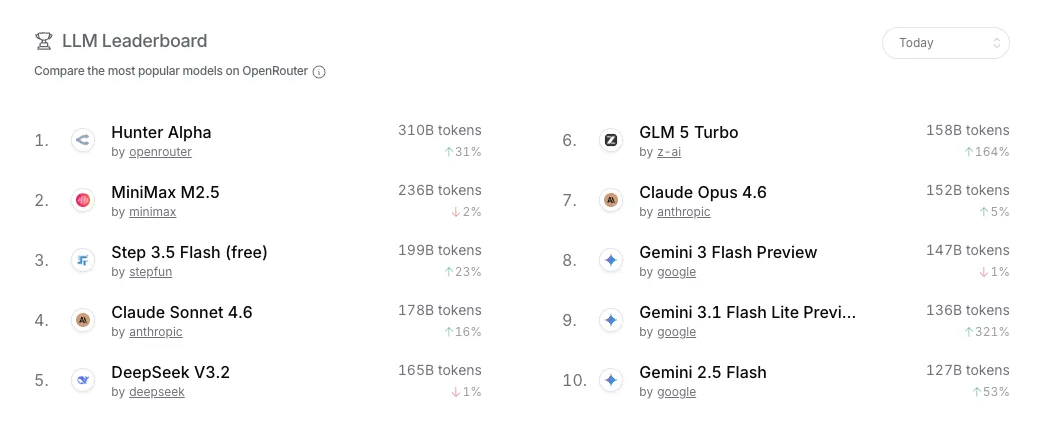
The company’s dedicated AI research division, on March 18, 2026, quietly unveiled a trio of new AI models: MiMo-V2-Pro, MiMo-V2-Omni, and a sophisticated text-to-speech model. This release follows the December 2025 debut of MiMo-V2-Flash, a capable 309 billion parameter mixture-of-experts model, which largely went unnoticed by the Western tech press, garnering attention primarily within China’s AI community. The subsequent emergence of "Hunter Alpha," an anonymous, trillion-parameter model on the OpenRouter platform on March 11, 2026, ignited widespread speculation within the AI research landscape. The model rapidly ascended to the top of OpenRouter’s leaderboard, surpassing one trillion tokens in total usage. This rapid ascent and the model’s impressive performance, particularly its claimed superiority in coding tasks over established benchmarks like Claude and ChatGPT, fueled conjecture that it was the unreleased V4 iteration of DeepSeek’s advanced AI.

The narrative surrounding "Hunter Alpha" took a dramatic turn on March 18, 2026, when Luo Fuli, the head of Xiaomi’s MiMo division and a former researcher at DeepSeek, revealed that "Hunter Alpha" was, in fact, an early internal testing build of Xiaomi’s MiMo-V2-Pro. This revelation, shared on X (formerly Twitter), was described by Luo as a "quiet ambush." The announcement had an immediate positive impact on Xiaomi’s stock, which saw a 5.8% increase following the disclosure. This strategic unveiling positioned Xiaomi’s AI capabilities directly against major global players, leveraging the anticipation built around the mysterious "Hunter Alpha."
MiMo-V2 Generation: Architectural Innovations and Performance Metrics
The MiMo-V2 generation represents a significant leap forward in large language model architecture, designed with the evolving demands of the AI agent era in mind. MiMo-V2-Pro boasts an aggregate parameter count exceeding one trillion. However, it employs a sophisticated mixture-of-experts (MoE) approach, activating approximately 42 billion parameters per request. This dynamic activation mechanism allows for efficient scaling of computational resources while maintaining high performance.
A key innovation in MiMo-V2-Pro is its hybrid attention mechanism, operating at a 7:1 ratio. This is complemented by an exceptionally large context window, extending up to one million tokens. Such an extensive context window is crucial for processing and understanding complex, long-form content, enabling more nuanced and coherent AI responses. Furthermore, the model incorporates a built-in multi-token prediction layer, designed to accelerate text generation by predicting multiple tokens in a single step, rather than sequentially. This optimization significantly enhances the speed of output generation. Currently, MiMo-V2-Pro is a closed-source model, though Xiaomi has indicated the possibility of a future release.
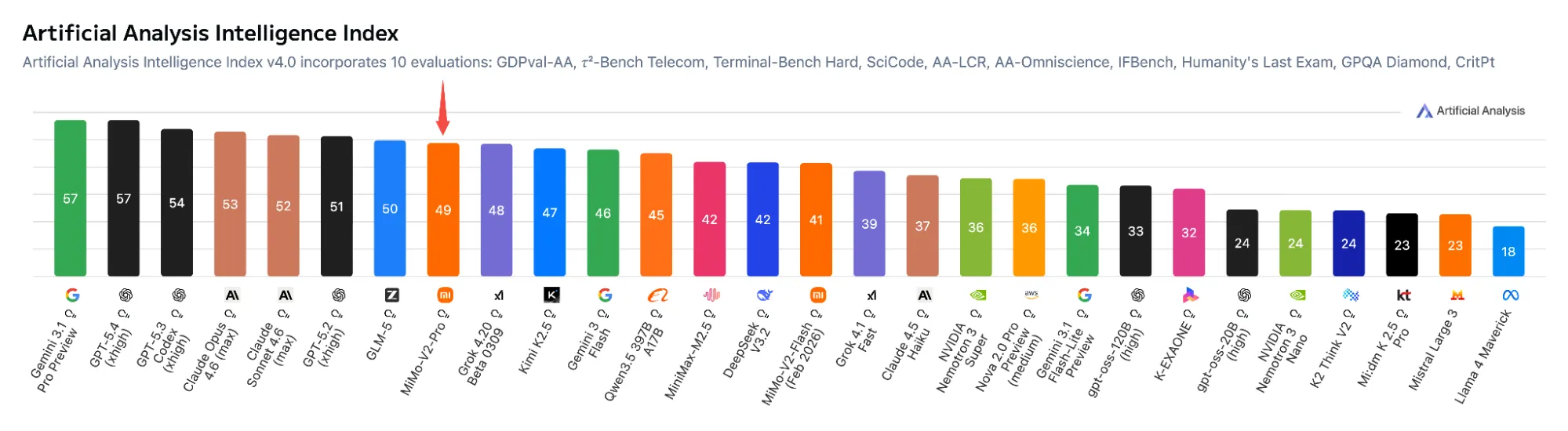
Performance benchmarks place MiMo-V2-Pro in a competitive position within the global AI landscape. According to the Artificial Analysis Intelligence Index, it ranks eighth overall and second among Chinese AI models, only trailing GLM-5. In practical software engineering tasks, as measured by SWE-bench Verified, MiMo-V2-Pro achieved a score of 78%. This performance is remarkably close to leading models such as Claude Opus 4.6 (80.8%) and Claude Sonnet 4.6 (79.6%), underscoring its strong capabilities in code-related applications.
On agentic benchmarks, MiMo-V2-Pro continues to impress. It scores 61.5 on ClawEval, a benchmark tied to the OpenClaw framework, nearing the performance of Claude 4.6 Opus (66.3). In PinchBench, another critical evaluation metric, MiMo-V2-Pro secured third place globally with a score of 81.0, closely followed by its sibling model, MiMo-V2-Omni (81.2), and ahead of Claude 4.6 Opus (81.5).
Cost-Effectiveness and Multimodal Capabilities
A significant factor for developers and businesses integrating AI models is cost. MiMo-V2-Pro offers a highly competitive pricing structure, with input tokens priced at $1 per million and output tokens at $3 per million, supporting a context window of up to 256,000 tokens. This contrasts sharply with models like Claude Sonnet 4.6, which costs $3 per million input tokens and $15 per million output tokens, and Claude Opus 4.6 at $5 and $25 respectively. For organizations developing agentic systems at scale, these cost differences are not merely marginal but represent a substantial economic advantage.
The MiMo-V2-Omni sibling model distinguishes itself through its native multimodal capabilities. Unlike many models that rely on integrated modules for different data types, Omni is trained end-to-end as a unified perceptual system, handling vision, audio, and video natively. A compelling demonstration showcased Omni’s ability to analyze dashcam footage and function as a real-time autonomous driving brain, highlighting its genuine multimodal integration and potential for advanced applications in autonomous systems and real-time data processing.
Hands-On Testing: Creative Writing, Coding, and Reasoning
To assess the practical performance of MiMo-V2-Pro, a series of tests were conducted, covering creative writing, coding, logic, and mathematical reasoning. The results are documented in a GitHub repository for public access.
Creative Writing Prowess
In a creative writing test, MiMo-V2-Pro was tasked with generating a time travel story rooted in Mesoamerican history, incorporating specific character and cultural elements, and exploring a philosophical paradox about the immutability of time. The model produced an extensive narrative exceeding 3,000 words, complete with a title, five chapters, an epilogue, and a structural coherence typically found in an edited draft. This output stands as one of the longest and richest pieces of creative prose generated by an AI model, rivaling specialized long-form generation models and significantly surpassing the capabilities of general-purpose LLMs in length and depth.
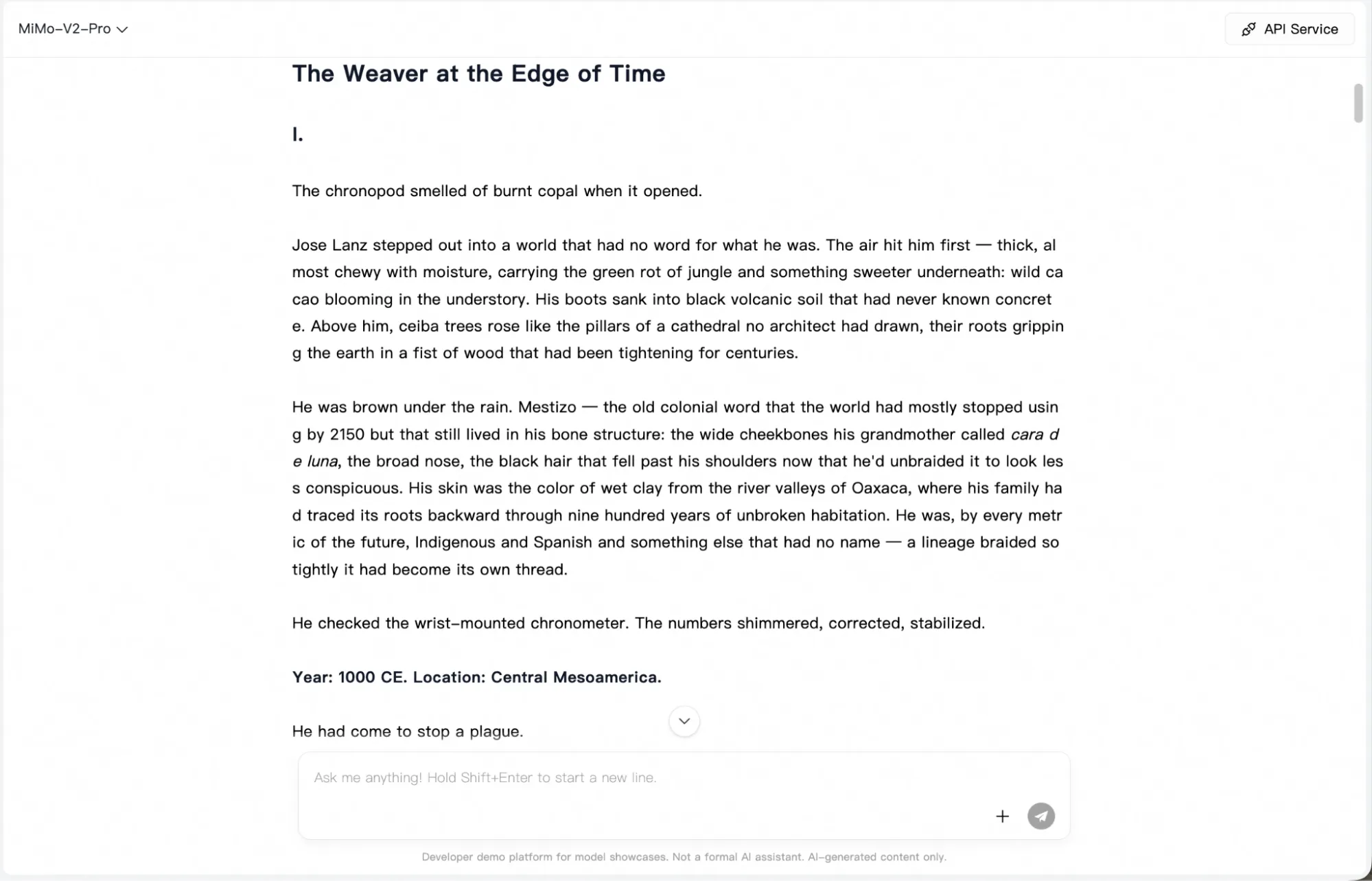
The prose itself was lauded for its richness, descriptive detail, and vivid imagery. The opening paragraph effectively established the scene, and the model demonstrated a strong capacity for embedding realism to enhance believability. Unlike models that might merely set a scene geographically, MiMo-V2-Pro captured the sensory details of ancient Mesoamerica, building atmosphere through indigenous terminology, authentic descriptions, and contextual cues. Dialogue was integrated seamlessly into the narrative, adhering to literary fiction conventions rather than the paragraph-embedded style common in many current models.
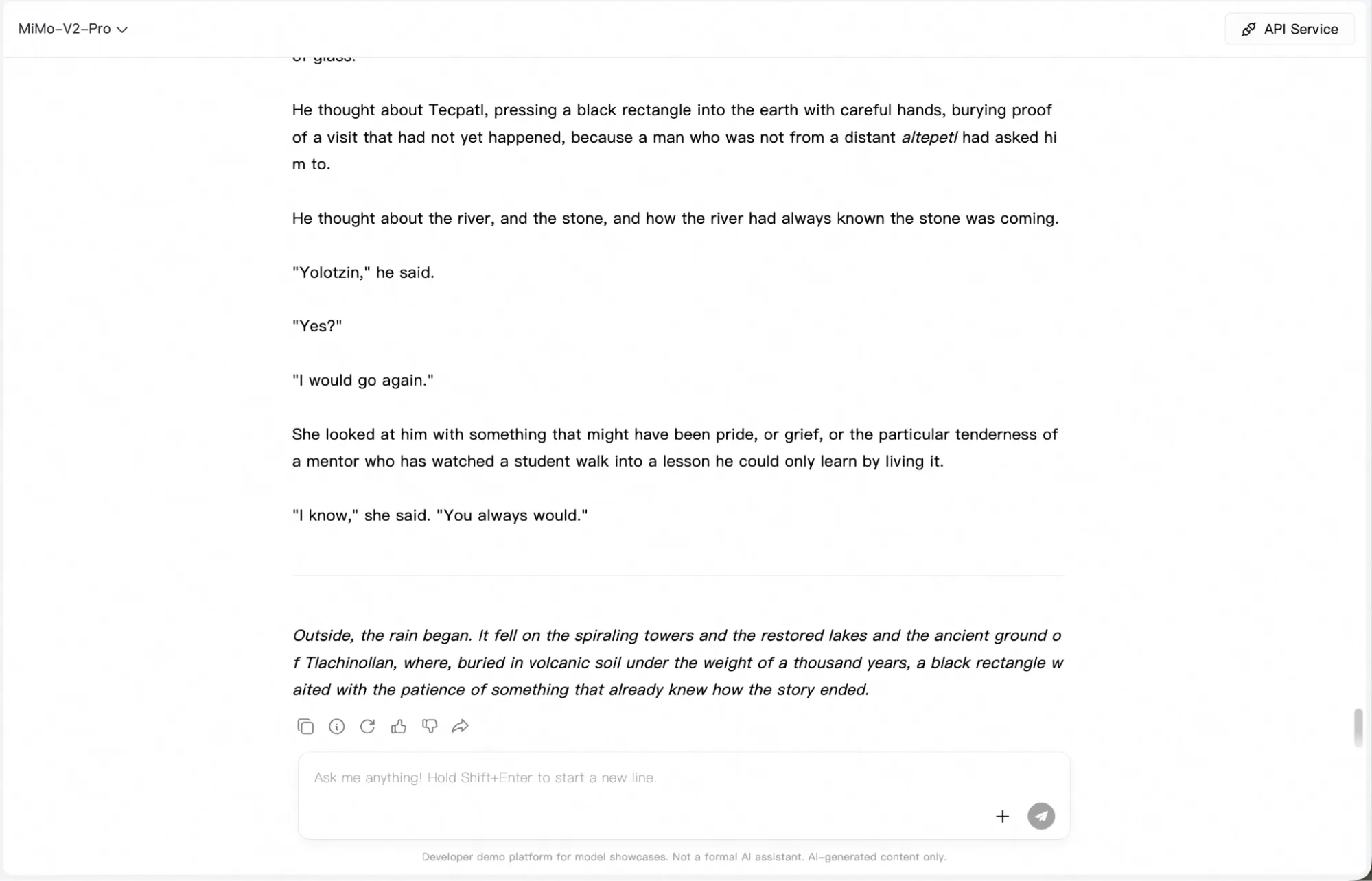
The story’s central paradox was not treated as a purely intellectual concept but was woven into an emotional arc, resolved without didactic exposition. The concluding lines resonated with narrative finesse, allowing the reader to feel the theme rather than being told it. The example provided—"Outside, the rain began. It fell on the spiraling towers and the restored lakes and the ancient ground of Tlachinollan, where, buried in volcanic soil under the weight of a thousand years, a black rectangle waited with the patience of something that already knew how the story ended"—illustrates the model’s evocative writing style.
Cultural specificity, including references to "cara de luna," maguey fiber, the temazcal tradition, and Nahuatl names, was consistently and authentically integrated. The time travel paradox was explored with intellectual rigor. For creative writing applications, MiMo-V2-Pro has positioned itself as a top-tier contender, arguably surpassing even advanced models like Claude 4.6 Opus in terms of output quality and richness for this category of task.
Coding Excellence
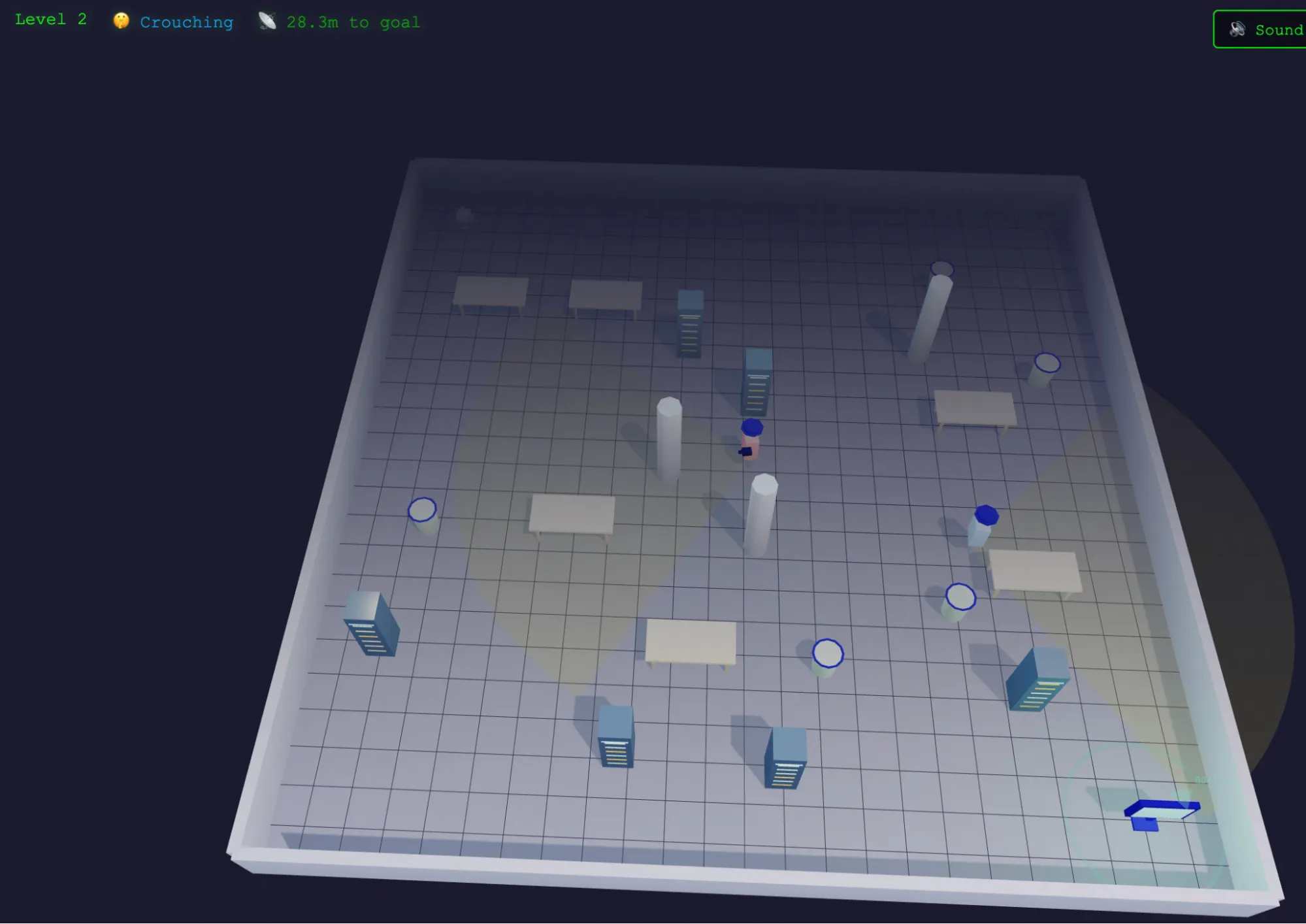
Benchmark data indicated that coding is a significant strength for MiMo-V2-Pro, a claim validated by hands-on testing. When prompted to generate a stealth game from a single instruction, the model successfully delivered a functional game on its first attempt. The functionality extended beyond mere technical execution; the game’s logic was sound, its interfaces were coherent, and its visual design was notably effective. This combination of correctness and aesthetic appeal is a rare feat for AI models, which often excel in one aspect at the expense of the other.
Interestingly, MiMo-V2-Pro opted for a 2.5D aesthetic, a design choice that enhanced the game’s visual appeal without compromising its core gameplay proposition. The model also demonstrated advanced capabilities in handling iterative improvements. Adding sound and MIDI music to a running 3D game, a task that has previously caused mid-generation freezes or incoherence in other models due to codebase complexity, was handled adeptly by MiMo-V2-Pro. The model integrated both elements cohesively, ensuring the music matched the game’s tone and the visual elements aligned with its overall aesthetic. While the game’s difficulty scaled primarily with the number of opponents rather than level design complexity, presenting a consistent challenge, its overall performance as a zero-iteration, single-prompt output was highly impressive. The generated game is accessible via a provided link for users to experience.
Logic and Common Sense Reasoning
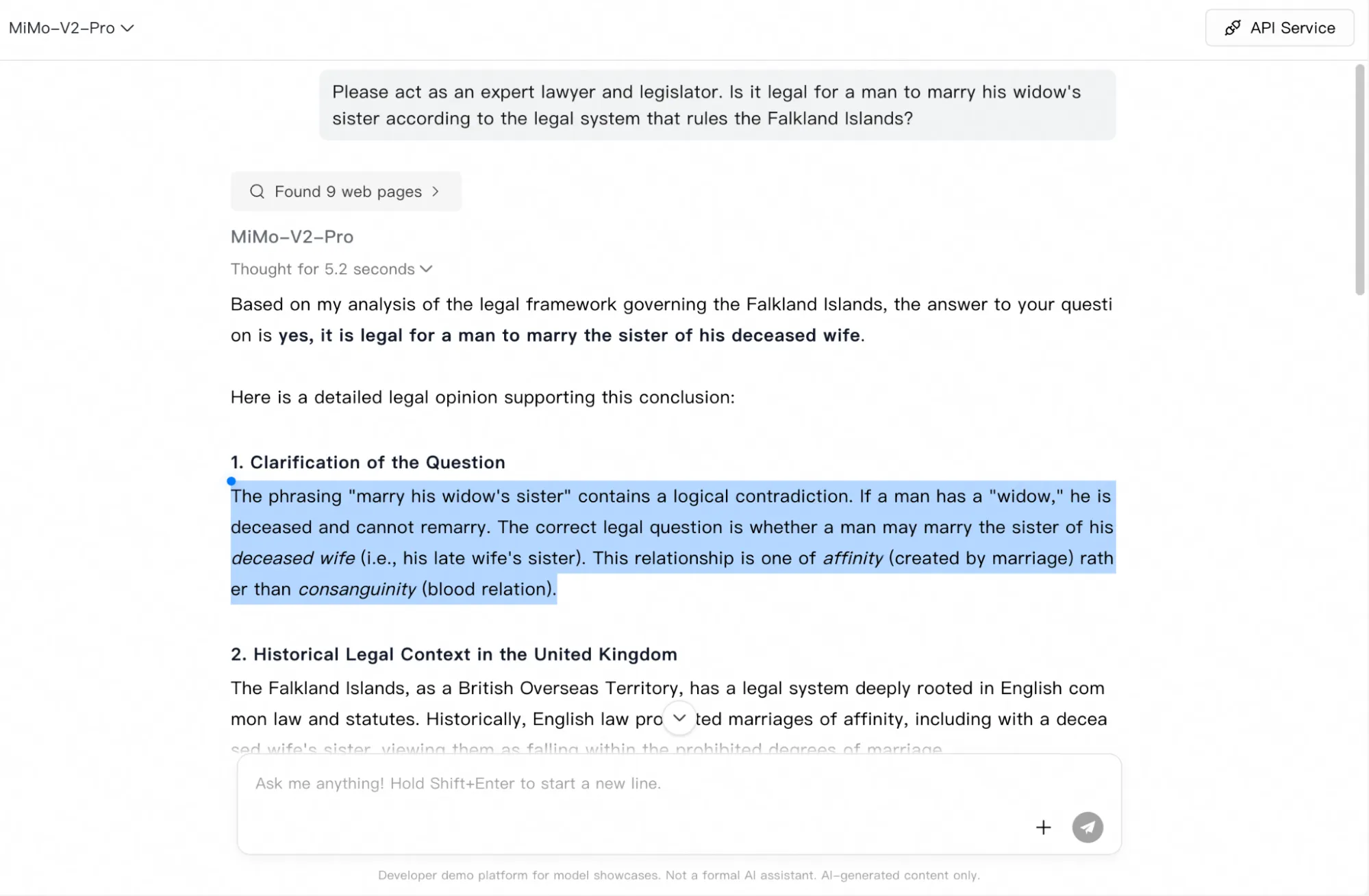
An evaluation of MiMo-V2-Pro’s logical reasoning involved presenting a legal query: whether it is lawful for a man to marry his widow’s sister under Falkland Islands law. This question is designed to test a model’s ability to identify subtle logical inconsistencies. MiMo-V2-Pro correctly identified the inherent contradiction in the prompt: a man with a widow must be deceased, rendering remarriage impossible.
The model’s chain of thought articulated this flaw, stating, "if a man has a widow, that means he’s deceased." However, instead of flagging the question as unanswerable due to the logical paradox, the model proceeded to infer that the user likely intended to ask about marrying his "deceased wife’s sister." It then provided an answer to this reframed question. While the reasoning behind identifying the contradiction was sound, the decision to implicitly alter the premise of the question rather than directly address its nonsensical nature represents a limitation in its ability to strictly adhere to the original prompt. This highlights the importance of transparency in AI reasoning outputs. Unlike models with hidden reasoning chains, Xiaomi’s approach allows for the identification of such deviations, enabling developers to understand where the model might misinterpret or overstep its instructions.
Mathematical Capabilities
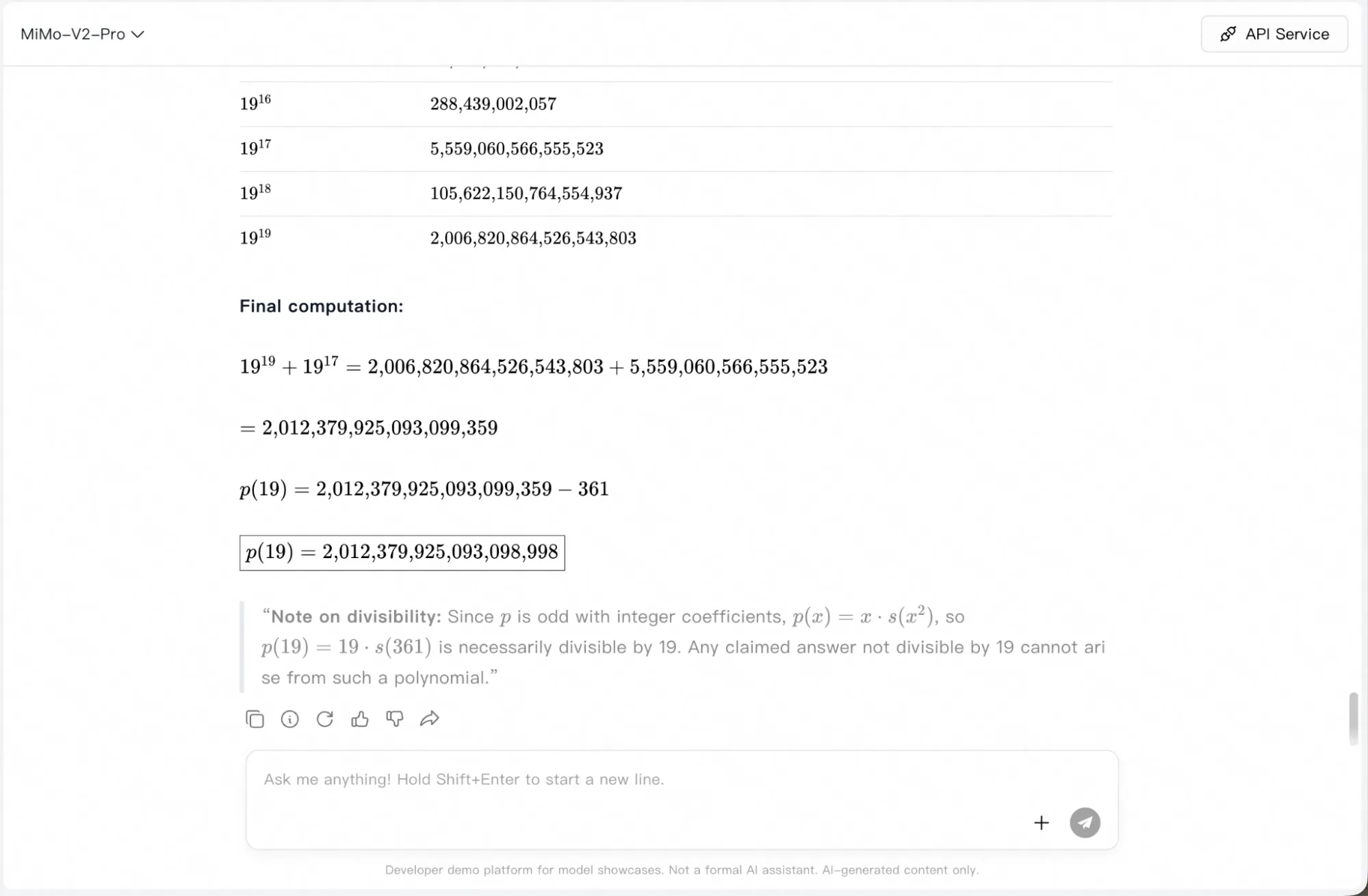
Mathematics emerged as an area where MiMo-V2-Pro demonstrated its current limitations. When presented with a complex benchmark question from FrontierMath, involving the construction of a degree 19 polynomial with specific constraints and the calculation of its value at a given point, the model experienced two complete freezes and consumed a significant token budget without producing a response.
On a subsequent attempt, MiMo-V2-Pro provided a step-by-step reasoning process but ultimately arrived at an incorrect answer. Even after being prompted to self-correct, the model failed to produce the accurate result. While MiMo-V2-Pro appears capable of handling standard and even moderately difficult mathematical problems, advanced or "frontier" mathematics remains a challenge. The article suggests that leveraging its agentic features might yield improved results in such complex scenarios.
Agentic Features and Developer Onboarding
Xiaomi is adopting a strategy similar to other AI leaders like MiniMax and Kimi by integrating its models with agentic frameworks. The company offers a one-click integration with OpenClaw, enabling users to spin up a preconfigured cloud instance powered by MiMo-V2-Pro. This approach bypasses the often complex setup processes involving API configurations, virtual private servers, and skill management, providing a streamlined entry point for developers into agentic AI development.
The provided demo environment operates for a limited 30-minute session before self-destructing. While this presents a constraint, it also ensures an honest representation of the model’s capabilities within a controlled, temporary setting. For experienced developers already immersed in agentic infrastructure, this integration may offer little novelty. However, for newcomers, it represents one of the most frictionless pathways to experimenting with and deploying agentic AI applications.
Conclusion: A Formidable New Entrant in the AI Arena
In summation, Xiaomi’s MiMo-V2-Pro stands out as a significant advancement in the field of artificial intelligence. The model demonstrates exceptional proficiency in creative writing, delivering lengthy, rich, and contextually aware narratives that rival and, in some aspects, surpass leading models. Its coding capabilities are equally impressive, producing functional and aesthetically pleasing applications from single prompts. The model’s competitive pricing, particularly for output tokens and its extensive context window, makes it an economically attractive option for large-scale deployments.
However, MiMo-V2-Pro is not without its limitations. Its performance in advanced mathematical reasoning remains a challenge, and its current closed-source nature limits broader accessibility. The subtle deviation in its logical reasoning, while surfaced by its transparent output, indicates areas where further refinement in strict adherence to prompt logic may be necessary.
Despite these areas for improvement, MiMo-V2-Pro’s overall performance, particularly its cost-effectiveness and its strengths in creative and agentic tasks, positions it as a serious contender in the global AI market. For creative professionals and developers building complex agentic systems, MiMo-V2-Pro offers a compelling alternative, potentially outperforming established leaders in key areas. The company’s strategic approach to AI development and deployment suggests that Xiaomi is poised to become an increasingly influential force in the artificial intelligence landscape, moving far beyond its perception as merely a budget smartphone manufacturer.