
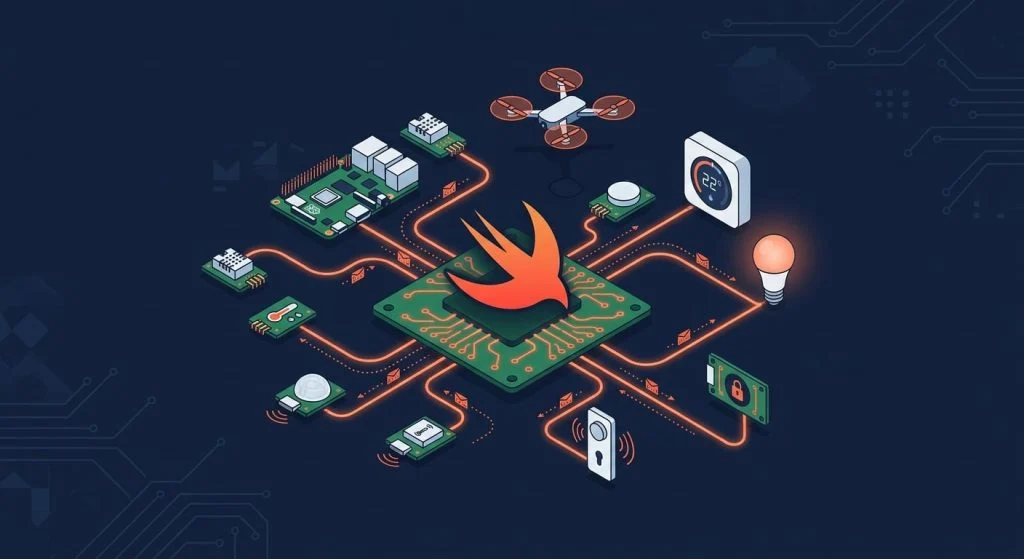

Amazon Web Services (AWS) has announced a significant expansion of its offerings, marked by the general availability of the AWS IoT Device SDK for Swift, a move poised to bolster the development of edge computing applications. This latest release, alongside crucial updates to Amazon RDS for SQL Server, Amazon Cognito, and the integration of advanced OpenAI models into Amazon Bedrock, underscores AWS’s commitment to providing comprehensive and robust solutions for cloud, edge, and artificial intelligence workloads. The advancements collectively address critical enterprise needs, ranging from cost-effective database migrations and enhanced application resilience to the burgeoning demand for sophisticated AI capabilities and streamlined development across diverse platforms.
AWS IoT Device SDK for Swift: Ushering in a New Era for Edge Development
The general availability of the AWS IoT Device SDK for Swift marks a pivotal moment for developers within the Apple ecosystem and beyond, extending Swift’s reach into the rapidly expanding domain of Internet of Things (IoT) and edge computing. As a testament to Swift’s growing versatility, particularly its maturation on server-side platforms over recent years, this SDK now brings production-ready capabilities to macOS, iOS, tvOS, and Linux environments. The announcement resonates particularly with members of the Swift Server Workgroup (SSWG), who have championed the language’s expansion beyond its traditional mobile and desktop strongholds.
The SDK is engineered to provide robust connectivity and management features essential for modern IoT applications. Key capabilities include MQTT 5 connectivity, offering enhanced messaging features, improved session management, and better error handling compared to its predecessor, MQTT 3.1.1. This ensures more reliable and efficient communication between IoT devices and the AWS cloud, critical for applications requiring low latency and high message throughput. Furthermore, the SDK integrates support for Device Shadow, a crucial service that maintains a persistent, virtual representation of each device, allowing applications to interact with devices even when they are offline. This feature simplifies device state management and ensures data consistency across the fleet.
Beyond connectivity and state management, the SDK also facilitates IoT Jobs, enabling remote operations such as firmware updates, security patching, and configuration changes across a fleet of devices. This capability is vital for maintaining the security and functionality of large-scale IoT deployments. Fleet provisioning, another cornerstone feature, streamlines the process of securely onboarding and configuring new devices at scale, addressing a common challenge in IoT deployments where device numbers can range from hundreds to millions.
The strategic importance of Swift’s expansion into IoT and edge computing cannot be overstated. With the global IoT market projected to exceed trillions of dollars in the coming years and edge computing becoming increasingly vital for real-time data processing and decision-making, languages optimized for performance, memory safety, and developer experience are in high demand. Swift, known for its performance characteristics, modern syntax, and strong type safety, is well-positioned to meet these requirements. The emergence of projects like WendyOS, an open-source operating system for physical AI with first-class Swift support for hardware like NVIDIA Jetson and Raspberry Pi, further exemplifies this broader trend. This indicates a growing appetite for deploying Swift in scenarios that would have been unconventional just a few years ago, leveraging its efficiency for resource-constrained edge devices and its developer-friendly nature for complex AI applications. The move by AWS effectively lowers the barrier for millions of Swift developers to engage with IoT and edge technologies, fostering innovation and expanding the ecosystem significantly.
Amazon RDS for SQL Server: Enhancing Enterprise Migration Flexibility with Bring Your Own Media (BYOM)
In a move designed to further empower enterprises with flexible and cost-effective cloud migration strategies, Amazon RDS for SQL Server now supports Bring Your Own Media (BYOM). This new capability is particularly beneficial for organizations transitioning existing Microsoft SQL Server applications from on-premises environments to the AWS cloud. Through BYOM, customers can reuse their current Microsoft SQL Server licenses, including those with Software Assurance, by leveraging Microsoft’s License Mobility program on Amazon RDS.
Historically, license management has been a complex and often costly aspect of migrating proprietary software to the cloud. The BYOM feature on RDS for SQL Server directly addresses this challenge, allowing businesses to maximize their existing software investments and reduce the financial burden associated with cloud adoption. This flexibility is crucial for large enterprises with substantial investments in Microsoft licensing. The integration with AWS License Manager further enhances this offering by providing a centralized service for tracking license usage and ensuring compliance across various AWS services. This automated tracking mechanism helps organizations maintain regulatory adherence and avoid potential penalties, while also optimizing their license portfolio.
The introduction of BYOM is expected to accelerate the migration of mission-critical SQL Server workloads to Amazon RDS, a managed relational database service that simplifies database administration tasks such as patching, backup, recovery, and scaling. By eliminating the need to acquire new licenses for cloud deployments, AWS removes a significant hurdle for enterprises contemplating a shift from on-premises infrastructure. This not only translates into direct cost savings but also allows IT departments to reallocate resources from license procurement and management to more strategic initiatives. Industry analysts project that such license flexibility will become a key differentiator for cloud providers as enterprises continue their journey towards hybrid and multi-cloud architectures, valuing options that protect their existing software assets. The initiative reinforces AWS’s commitment to meeting the diverse needs of its enterprise customers, offering them greater control and economic advantages in their cloud journey.
Amazon Cognito: Bolstering Application Resilience with Multi-Region Replication
Recognizing the paramount importance of application resilience and business continuity in today’s global digital landscape, Amazon Cognito now supports multi-Region replication. This enhancement allows organizations to synchronize user and machine identity data, including credentials, user pool configurations, and federation setups, to a secondary user pool in a standby AWS Region in near real-time. This capability is a game-changer for applications requiring high availability and disaster recovery, particularly those with a global user base.
In the event of a disruption or outage in the primary AWS Region, signed-in users can seamlessly continue accessing their applications without the need for re-authentication. Furthermore, registered users can sign in with their existing credentials to the application’s instance running in the standby Region. This seamless failover mechanism is critical for maintaining user trust and ensuring uninterrupted service, minimizing the potential impact of regional outages on user experience and business operations. The economic implications of downtime are substantial, with estimates often running into hundreds of thousands or even millions of dollars per hour for large enterprises. Cognito’s multi-Region replication directly mitigates this risk.
Multi-Region replication is available as an add-on for user pools in Essentials or Plus feature tiers and is supported across 16 AWS Regions. This broad regional availability enables enterprises to architect highly resilient identity solutions tailored to their specific geographic distribution of users and compliance requirements. For global applications, such as e-commerce platforms, financial services, and SaaS offerings, ensuring that user authentication and authorization remain operational regardless of localized outages is non-negotiable. This feature significantly simplifies the design and implementation of disaster recovery strategies for identity management, which is often a complex component to replicate manually. By automating and managing this replication, AWS Cognito empowers developers to build more robust and fault-tolerant applications, aligning with the highest standards of operational excellence and customer satisfaction. The move reflects an industry-wide trend towards building inherently resilient systems that can withstand unforeseen disruptions, a core tenet of modern cloud architecture.
OpenAI Models on Amazon Bedrock: Democratizing Advanced AI for Enterprise Workloads
In a significant advancement for artificial intelligence development, Amazon Bedrock has announced the general availability of advanced models from OpenAI, including GPT-5.5, GPT-5.4, and Codex. This integration allows enterprises to leverage these powerful generative AI models for production workloads directly on Amazon Bedrock, benefiting from the same stringent security, governance, and operational controls already established across AWS. This move underscores AWS’s strategy to provide a diverse selection of leading foundation models (FMs) through a fully managed service, democratizing access to cutting-edge AI for a broad range of businesses.
GPT-5.5, highlighted as OpenAI’s most capable model, excels in sophisticated tasks such as agentic coding, data analysis, and multi-step autonomous processes. Its advanced reasoning and problem-solving capabilities make it ideal for complex enterprise applications, from automating software development workflows to sophisticated business intelligence and data-driven decision-making. The availability of such a powerful model on Bedrock allows developers to experiment with and deploy highly intelligent agents that can perform intricate tasks with minimal human intervention, unlocking new levels of productivity and innovation.
Codex, designed for AI-powered software development, is available through various interfaces including the Codex App, the Codex CLI, and direct integrations with popular Integrated Development Environments (IDEs) such as Visual Studio Code, JetBrains, and Xcode. This empowers developers to accelerate coding, generate documentation, and automate testing, significantly enhancing developer velocity and reducing time-to-market for new applications. The integration of these models into familiar development environments through Bedrock simplifies the adoption of AI-assisted coding practices across enterprise development teams.
A key advantage of accessing these OpenAI models through Amazon Bedrock is the inherent security, privacy, and compliance features of the AWS ecosystem. Enterprises can develop and deploy AI applications with confidence, knowing that their data remains private and secure within their AWS environment, and that they can apply their existing governance policies. This addresses critical concerns for businesses hesitant to adopt generative AI due to data security and regulatory compliance issues. Furthermore, pricing for these models on Bedrock matches OpenAI’s first-party rates, and usage counts towards existing AWS commitments, offering cost predictability and optimization for customers already invested in the AWS cloud. This strategic partnership and integration exemplify the broader industry trend of cloud providers offering curated access to a marketplace of foundation models, enabling enterprises to select the best-fit AI capabilities for their specific needs while maintaining an enterprise-grade operational framework. The growth of the generative AI market is exponential, and AWS’s offering through Bedrock positions it as a central hub for businesses looking to harness this transformative technology responsibly and at scale.

Broader Implications and AWS’s Strategic Vision
These announcements collectively reflect AWS’s ongoing strategy to provide a comprehensive and integrated cloud platform that caters to the evolving demands of modern enterprises and developers. The expansion of Swift into IoT and edge computing signifies a strategic investment in emerging paradigms where data processing increasingly occurs closer to the source, reducing latency and bandwidth costs. This aligns with the burgeoning market for intelligent edge devices and real-time analytics.
The enhancements to Amazon RDS for SQL Server and Amazon Cognito, on the other hand, reinforce AWS’s commitment to core enterprise cloud migration and operational excellence. By addressing critical concerns such as license cost optimization and application resilience, AWS aims to lower barriers to cloud adoption and ensure that mission-critical workloads can operate with the highest levels of availability and security. These updates are crucial for enterprises navigating complex IT landscapes and seeking to modernize their infrastructure without incurring prohibitive costs or compromising on reliability.
Finally, the integration of OpenAI’s advanced models into Amazon Bedrock positions AWS at the forefront of the generative AI revolution, offering enterprises a secure, scalable, and governed environment to experiment with and deploy leading-edge AI capabilities. This not only democratizes access to sophisticated AI tools but also enables businesses to innovate faster, automate complex processes, and derive deeper insights from their data. The careful consideration of security, governance, and cost-effectiveness in these AI offerings demonstrates AWS’s understanding of enterprise requirements beyond mere technological capability.
As the digital transformation continues to accelerate, these strategic announcements from AWS provide a clear roadmap for how developers and enterprises can leverage cloud, edge, and AI technologies to build the next generation of applications, driving efficiency, resilience, and innovation across industries. The interconnectedness of these services — from robust identity management to flexible database solutions and powerful AI models — creates a cohesive ecosystem designed to support complex, global digital operations.
Upcoming Events and Continuous Innovation
AWS continues to foster its developer and customer communities through a wide array of events. These include AWS-led in-person and virtual events, dedicated startup events, and developer-focused gatherings. Prominent events like AWS Summits and AWS Community Days serve as crucial platforms for knowledge sharing, networking, and showcasing new innovations. The AWS Builder Center further strengthens this community by connecting builders, facilitating solution sharing, and providing access to valuable development content. These initiatives underscore AWS’s commitment to not only delivering cutting-edge services but also supporting the ecosystem of users who bring these technologies to life.
For a comprehensive overview of all new releases and updates, developers and IT professionals are encouraged to regularly consult the "What’s New with AWS" page, which serves as the authoritative source for the latest announcements from the cloud provider. The continuous stream of innovations ensures that the AWS platform remains dynamic and responsive to the rapidly evolving technological landscape.
