
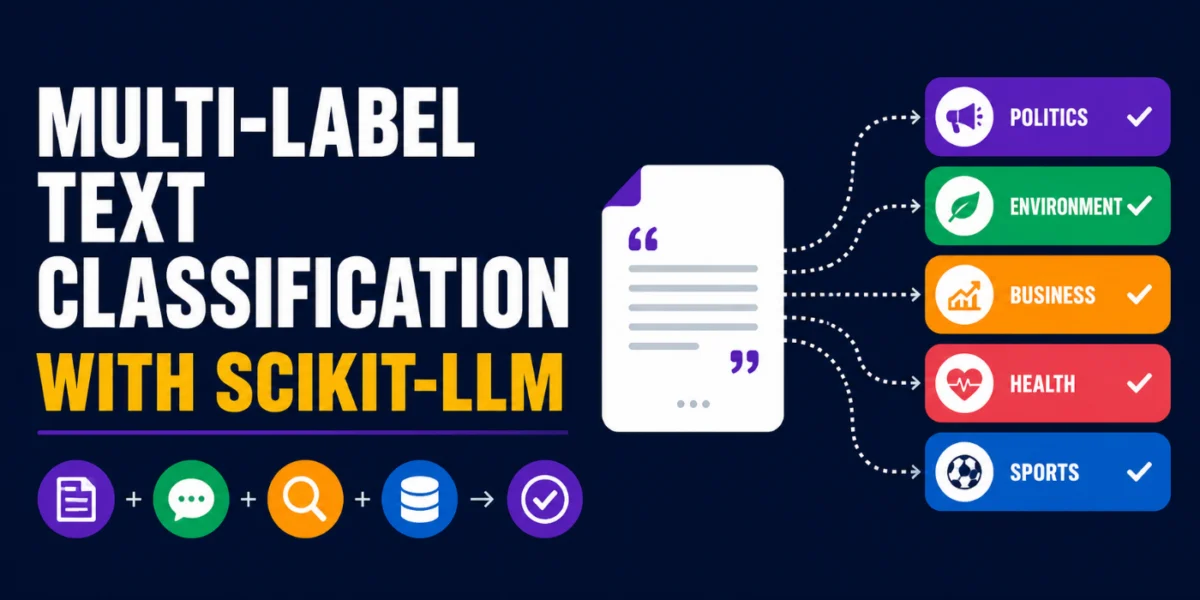

The landscape of natural language processing (NLP) is undergoing a significant transformation with the advent of large language models (LLMs), enabling sophisticated tasks like multi-label text classification without the traditional hurdles of extensive labeled training data or complex model architectures. This paradigm shift is particularly evident with the emergence of libraries such as scikit-LLM, which seamlessly integrate the power of LLMs into familiar machine learning workflows, offering a streamlined approach to assigning multiple categories to textual content simultaneously. This article delves into the methodology of performing such advanced classification using cutting-edge LLMs and the scikit-LLM library, highlighting its efficiency and practical application in real-world scenarios.
The Evolution and Challenge of Text Classification
Traditionally, text classification often simplified the nuanced complexities of human expression into binary or single-category outputs. For instance, a product review might be classified solely as "positive" or "negative," or a customer inquiry assigned to a singular department. However, human communication rarely fits neatly into such restrictive bins. A single sentence can convey a spectrum of emotions or address multiple distinct topics simultaneously, such as, "I absolutely love the enhanced battery life, but the new design is incredibly awful." This example clearly demonstrates both positive sentiment towards one feature and negative sentiment towards another, necessitating a system capable of multi-label classification.
Multi-label classification, therefore, represents an advanced form of categorization, empowering systems to assign one or more relevant categories to a given piece of text. Its applications are vast and critical across numerous industries: from discerning multiple underlying issues in a customer support ticket (e.g., "billing inquiry" and "technical fault") to identifying diverse themes in news articles (e.g., "politics," "economy," and "international relations") or pinpointing varied emotional responses in social media comments. According to industry analyses, over 80% of enterprise data exists in unstructured text formats, underscoring the escalating demand for sophisticated tools that can accurately interpret and categorize this data at scale. Traditional methods for building multi-label classifiers, typically involving complex neural network architectures, have historically demanded vast quantities of meticulously labeled training data. This data preparation process is notoriously time-consuming, expensive, and often requires specialized human annotators, posing a significant barrier to entry for many organizations.
The Paradigm Shift: Large Language Models and Zero-Shot Learning
The emergence of Large Language Models (LLMs) has fundamentally reshaped the landscape of NLP, offering a compelling solution to the challenges of traditional text classification. Built upon transformer architectures, LLMs are pre-trained on colossal datasets of text and code, endowing them with an unparalleled understanding of language, context, and semantic relationships. This extensive pre-training enables LLMs to perform various NLP tasks, including classification, with remarkable accuracy and, crucially, with minimal or no task-specific training data – a capability known as zero-shot reasoning.
Zero-shot learning allows an LLM to classify new data points into categories it has not explicitly seen during fine-tuning, based solely on its general understanding of the categories and the input text. Instead of requiring thousands of labeled examples for each category, the model can infer the correct labels by leveraging its vast internal knowledge base. This eliminates the most resource-intensive phase of traditional machine learning model development: the creation of large, labeled datasets. For multi-label classification, this means an LLM can be presented with a text and a list of potential labels, and it can then identify all applicable labels without ever having been explicitly "trained" on examples of those labels. This represents a monumental leap in efficiency and accessibility for advanced text analysis.
Scikit-LLM: Bridging the Gap Between LLMs and Traditional ML Workflows
While LLMs offer immense power, integrating them into existing machine learning pipelines or developing new applications can still present engineering challenges. This is where libraries like scikit-LLM become indispensable. Scikit-LLM acts as a robust wrapper, seamlessly integrating the sophisticated capabilities of LLMs with the familiar and widely adopted scikit-learn API. This design choice democratizes access to cutting-edge LLMs, making their power available to a broader audience of data scientists and developers who are already proficient with scikit-learn’s intuitive fit() and predict() methods.
The library’s core strength lies in its ability to abstract away the complexities of LLM API interactions, prompt engineering, and model management. It allows users to leverage pre-trained LLMs for inference without the need for intensive training, treating them much like any other scikit-learn estimator. A significant advantage of scikit-LLM is its support for various LLM providers, including both commercial APIs and, crucially, free, open-source LLMs accessible via custom endpoints, thus providing flexibility and mitigating potential quota limitations or cost concerns. This adaptability makes it an ideal tool for rapid prototyping and deployment of advanced NLP solutions.
A Practical Demonstration: Multi-Label Sentiment Analysis with Groq and Hugging Face
To illustrate the practical application of scikit-LLM for multi-label text classification, let’s walk through a concrete example involving sentiment analysis using a real-world dataset and a high-performance LLM hosted on Groq.
1. Environment Setup and Library Installation
The initial step involves setting up the development environment by installing the necessary Python libraries: scikit-llm for LLM integration and datasets for convenient access to public datasets.
pip install scikit-llm datasets2. Configuring the LLM Endpoint
For this demonstration, we utilize a free LLM from Groq, a specialized inference engine known for its remarkably fast processing capabilities thanks to its custom Language Processing Units (LPUs). Users need to register on the Groq website and obtain an API key, which is crucial for authenticating requests.
from skllm.config import SKLLMConfig
from skllm.models.gpt.classification.zero_shot import MultiLabelZeroShotGPTClassifier

# 1. Setting your API key (replace "YOUR_FREE_API_KEY" with your actual key)
SKLLMConfig.set_openai_key("YOUR_FREE_API_KEY")

# 2. Setting the custom endpoint URL for Groq
SKLLMConfig.set_gpt_url("https://api.groq.com/openai/v1/")

# 3. Initializing the classifier.
# The "custom_url::" prefix tells the GPT module to route to the specified URL.
clf = MultiLabelZeroShotGPTClassifier(model="custom_url::llama-3.3-70b-versatile", max_labels=3)
In this configuration, the MultiLabelZeroShotGPTClassifier is instantiated, pointing to Groq’s llama-3.3-70b-versatile model. The max_labels=3 parameter instructs the classifier to predict up to three labels for each text, providing a balance between comprehensive labeling and avoiding excessive, potentially less relevant, assignments. This setup allows for harnessing the power of a sophisticated LLM through a simple, scikit-learn-like interface.
3. Data Acquisition and Preparation
For our multi-label sentiment analysis task, the go_emotions dataset from Hugging Face’s extensive repository is an ideal choice. Originally published by Google Research, this dataset is renowned for its fine-grained emotional annotations of Reddit comments, making it perfectly suited for exploring the nuances of human sentiment. The full go_emotions dataset comprises over 58,000 Reddit comments, each potentially annotated with one or more of 27 emotion labels. For the purpose of this practical demonstration, a smaller subset of 100 comments from the training split is loaded to showcase the rapid prototyping capabilities of the scikit-LLM approach.
from datasets import load_dataset
import pandas as pd

# 1. New explicit namespace/name to comply with new HF URI rules in the "datasets" library
dataset = load_dataset("google-research-datasets/go_emotions", split="train[:100]")
df = dataset.to_pandas()

# Extract the raw text comments
texts = df['text'].tolist()

print(f"Loaded len(texts) comments.")
print(f"Sample: 'texts[0]'")
The output confirms the successful loading of 100 comments, with a sample displayed to demonstrate the textual content:
Loaded 100 comments.
Sample: 'My favourite food is anything I didn't have to cook myself.'
4. Zero-Shot Model Adaptation (Defining the Label Space)
A crucial aspect of the zero-shot approach is that traditional "training" as understood in supervised machine learning is not performed. Instead, the pre-trained LLM is "adapted" by simply providing it with the domain-specific set of candidate labels relevant to the classification task. The LLM, leveraging its vast pre-existing knowledge, will then use these labels to classify unseen text. For our sentiment analysis, we define a focused set of ten emotion labels:
candidate_labels = [
    "admiration", "amusement", "anger", "annoyance",
    "approval", "curiosity", "disappointment", "joy",
    "sadness", "surprise"
]

# Fitting the model entirely zero-shot by passing X as None for no actual training,
# and providing our labels as a nested list
clf.fit(None, [candidate_labels])
The clf.fit(None, [candidate_labels]) call is central to the zero-shot methodology. By passing None for the input data X, we explicitly indicate that no actual training data is being used. The LLM simply processes the candidate_labels to understand the scope and definitions of the categories it needs to identify. This step configures the model to operate within the specified label space, enabling it to perform inference based on semantic understanding rather than memorized examples.
5. Making Predictions and Interpreting Results
With the LLM configured, we can now proceed to make predictions on the collected text samples. We will demonstrate the classification for the first five comments from our dataset:
# Run the predictions on our Reddit comments
predictions = clf.predict(texts)

# Display the results
for i in range(5):
    print(f"Comment: texts[i]")
    print(f"Predicted Sentiments: predictions[i]")
    print("-" * 50)
The output clearly illustrates the multi-label capability, assigning multiple sentiments where appropriate:
100%|██████████| 100/100 [03:01<00:00,   1.82s/it]
Comment: My favourite food is anything I didn't have to cook myself.
Predicted Sentiments: ['amusement' 'joy' '']
--------------------------------------------------
Comment: Now if he does off himself, everyone will think he's having a laugh screwing with people instead of actually dead
Predicted Sentiments: ['anger' 'annoyance' 'surprise']
--------------------------------------------------
... (other predictions)
As observed, a single comment can indeed receive multiple labels, such as "amusement" and "joy" for the first example, or "anger," "annoyance," and "surprise" for the second. This demonstrates the model’s ability to capture the complex, multifaceted nature of human emotions. It is important to note that the prediction process, particularly for larger datasets, can take a noticeable amount of time. This inference duration is a characteristic of leveraging powerful LLMs, which are computationally intensive even for zero-shot tasks, as the model performs complex reasoning for each input. Unlike traditional machine learning where "fitting" often entails intensive training, here the fit() method primarily configures the model with the label space, making inference the dominant computational step.
Broader Implications and Future Outlook
The integration of LLMs with libraries like scikit-LLM signifies a pivotal advancement in text classification, carrying profound implications across various sectors:
- Democratization of Advanced NLP: This approach dramatically lowers the barrier to entry for advanced text analytics. Developers and data scientists without specialized deep learning expertise or access to vast labeled datasets can now implement sophisticated multi-label classifiers, accelerating innovation across industries.
- Accelerated Prototyping and Deployment: The ability to perform zero-shot classification means that new classification tasks can be set up and tested in a fraction of the time traditionally required. This rapid prototyping capability allows businesses to quickly adapt to evolving data analysis needs.
- Cost and Resource Efficiency: By minimizing or eliminating the need for extensive manual data labeling, organizations can realize significant cost savings and reallocate human resources to more value-added tasks. The use of efficient inference platforms like Groq further optimizes computational expenditure.
- Enhanced Granularity in Data Analysis: Multi-label classification provides a richer, more nuanced understanding of textual data, enabling more precise insights into customer feedback, market trends, and content consumption patterns.
Despite these advantages, several considerations remain crucial for production-grade deployments. Reliance on third-party LLM APIs necessitates careful evaluation of data privacy and security policies, especially when dealing with sensitive information. While zero-shot learning is powerful, the quality of candidate_labels and potential future integration of a small number of few-shot examples (providing the LLM with a few labeled instances to guide its predictions) can further sharpen predictive accuracy. Furthermore, for any mission-critical application, establishing a robust evaluation framework that measures label-level precision, recall, and F1-score against a held-out, annotated validation set is indispensable to understand model performance and identify areas for improvement.
Looking ahead, developers can experiment with expanding the candidate label set to capture an even wider range of emotions or topics relevant to their specific domain. Swapping in different LLMs, perhaps other Groq-hosted models or those from alternative providers, can also yield varied prediction behaviors, allowing for comparative analysis and optimization. Scikit-LLM itself supports various zero-shot and few-shot classification strategies, offering flexibility for different task complexities. As AI researchers continue to push the boundaries of LLM capabilities, libraries like scikit-LLM will remain instrumental in translating these breakthroughs into accessible and impactful real-world applications.
In conclusion, scikit-LLM, by harnessing the immense power of pre-trained Large Language Models, is fundamentally transforming multi-label text classification. It offers an efficient, accessible, and scalable solution for nuanced text analysis, enabling organizations to extract richer insights from their unstructured data and drive informed decision-making in an increasingly data-rich world.
