
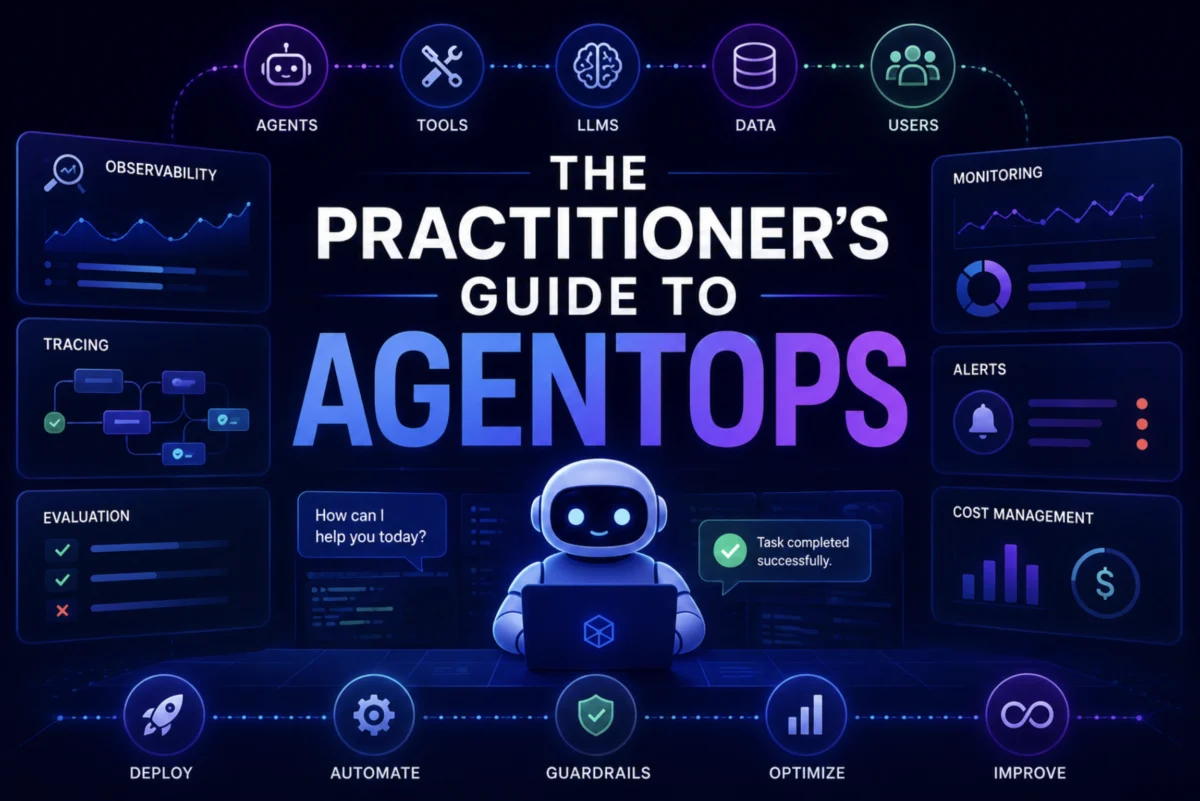

The escalating complexity of artificial intelligence (AI) agents, particularly those leveraging sophisticated large language models (LLMs) like Anthropic’s Claude, has underscored a critical need for advanced observability solutions. In 2026, AgentOps is at the forefront of addressing this challenge, offering comprehensive instrumentation that logs, replays, and cost-tracks every session of an AI agent, providing developers with unprecedented insight into their autonomous systems. This development marks a significant stride in transforming AI agent development from a black-box endeavor to a transparent, manageable, and optimizable process, laying the groundwork for more reliable and efficient deployments across various industries.
The Observability Imperative in the Age of AI Agents
The journey from simple LLM applications to fully autonomous AI agents has been rapid and transformative. These agents, designed to perform multi-step tasks, make decisions, and interact with external tools, represent a paradigm shift in how AI is integrated into workflows. However, this increased autonomy introduces a new layer of complexity, making traditional debugging and monitoring methods insufficient. Developers frequently grapple with non-deterministic behavior, unexpected tool interactions, and the opaque reasoning processes of LLMs, leading to challenges in identifying root causes of errors, optimizing performance, and accurately attributing costs.
In response to these burgeoning needs, the concept of "observability" for AI agents has emerged as a cornerstone of robust development. Unlike mere logging, observability for AI agents demands the ability to understand the internal state and actions of an agent at any given moment, reconstructing its decision-making process, tool invocations, and interactions with the environment. This holistic view is crucial for diagnosing issues, validating behavior against expectations, and ensuring agents operate within desired parameters. Without such capabilities, scaling AI agent deployments, especially in critical enterprise applications, becomes a formidable task fraught with risks.
AgentOps: A Pillar of Transparent AI Agent Development
AgentOps addresses this observability gap by providing a specialized platform designed specifically for the unique demands of AI agents. Its core offering centers around automatic instrumentation that integrates seamlessly into an agent’s lifecycle. When an agent is initialized with AgentOps, every subsequent LLM call—regardless of the underlying model—is automatically intercepted and captured. This includes detailed records of inputs, outputs, token usage, and associated costs, providing a granular financial oversight that is vital for managing LLM expenditures.
Beyond LLM interactions, AgentOps extends its reach to the agent’s internal logic and tool usage through its @record_function decorator. This feature allows developers to wrap any function or tool an agent might invoke, ensuring that its execution, input arguments, return values, and even any exceptions are meticulously logged. These individual function calls are then presented as "spans" within a comprehensive session replay timeline on the AgentOps dashboard. This visual representation of an agent’s execution path is invaluable for understanding how an agent navigates a task, which tools it chooses, and why certain decisions are made. For instance, in a research agent scenario, a developer can trace the precise moment search_topic was called, what parameters it received, and the exact information it returned, followed by the subsequent get_key_facts invocation and its output, all within a chronological flow.
The platform also supports the use of tags, allowing developers to categorize and filter agent sessions based on criteria such as "research-agent," "production," or specific version numbers like "v1.0." This organizational capability is critical for managing large-scale agent fleets, enabling targeted analysis of performance metrics, debugging specific agent types, or evaluating the impact of new model versions. Furthermore, AgentOps provides mechanisms for explicit session management, allowing developers to mark sessions as "Success" or "Fail," which is crucial for tracking agent performance over time and identifying patterns of failure. This structured approach to logging ensures that even in cases of unexpected termination, such as a KeyboardInterrupt or other exceptions, partial traces are preserved, offering vital diagnostic data.
The Research Agent: A Case Study in Observability
To illustrate its practical application, AgentOps frequently showcases a research agent, a common archetype in the burgeoning field of AI automation. This agent is designed to systematically gather information, extract key facts, and synthesize them into a structured summary. Its workflow is governed by a clear system prompt that directs it to first search_topic for an overview, then get_key_facts to distill essential information, and finally format_summary to structure the output.
The search_topic tool, while a stub in development examples, is designed to mimic interaction with a real search API, returning a comprehensive overview of a subject. The get_key_facts tool simulates the extraction of salient points from search results, providing data points that reflect current market trends and challenges. For example, it might report "42% year-over-year growth in adoption" for a particular technology, or that "leading organizations report 3-5x productivity improvements" from AI agent integration. It also flags critical technical challenges like "reliability, cost, and governance," and notes that "the market is projected to reach $4.9B by 2028," with "open-source tooling maturing significantly." Finally, format_summary ensures the output is consistently presented with a title, key points, and a concise conclusion.
Within this agent’s operational loop, AgentOps provides full visibility. Every call to Anthropic’s client.messages.create, which uses the advanced claude-sonnet-4-20250514 model, is logged. Each tool invocation (search_topic, get_key_facts, format_summary) is captured as a distinct span, detailing its inputs and outputs. This allows developers to trace the agent’s thought process: from receiving a user prompt, to deciding which tool to call, observing the tool’s execution and result, integrating that result into its context, and eventually formulating a final summary. If the agent enters an unexpected loop or fails to produce a coherent summary, the session replay on the AgentOps dashboard provides a step-by-step breakdown, allowing for precise identification of where the agent deviated from its intended path. This level of transparency is indispensable for iterative development and continuous improvement of AI agent performance.
Market Trends and Industry Commentary in 2026
The period between 2025 and 2026 has been marked by a significant acceleration in AI agent adoption and a parallel rise in the demand for sophisticated management and observability tools. According to recent market analyses, the AI agent market, fueled by advancements in LLMs and robust infrastructure, is indeed on track to reach a projected $4.9 billion by 2028. This growth is not merely theoretical; leading organizations that have successfully deployed AI agents are reporting tangible benefits, with many citing 3-5x improvements in productivity across various operational domains.
However, this rapid expansion has also brought to light persistent challenges. Industry reports from Q1 2026 indicate that reliability remains a primary concern for enterprises considering large-scale agent deployments. The inherent probabilistic nature of LLMs, coupled with the complexity of multi-tool interactions, means that ensuring consistent, error-free agent behavior is paramount. Cost management, particularly with high-volume LLM API calls, is another significant hurdle, making AgentOps’ cost-tracking features particularly relevant. Furthermore, governance and ethical considerations, including data privacy, bias mitigation, and compliance with emerging AI regulations, are increasingly becoming non-negotiable requirements for enterprise-grade AI agents.
An AgentOps spokesperson, commenting on the company’s role, stated, "Our mission is to bring clarity and control to AI agent development. The days of ‘fire and forget’ with autonomous systems are over. Developers need to understand why an agent made a particular decision, how it used its tools, and the exact cost of its operation. Our platform provides that granular visibility, fostering trust and accelerating the safe deployment of intelligent agents."
An Anthropic representative added, "As our Claude models become more capable, the ecosystems built around them, like AgentOps, are crucial. They empower developers to harness the full potential of our models in complex, multi-turn applications by providing the necessary tools for monitoring, debugging, and optimizing agent behavior. This synergy ensures that our advanced AI can be applied effectively and responsibly."
Developers actively utilizing such platforms have echoed these sentiments. Sarah Chen, a lead AI engineer at a major financial institution, remarked, "Before AgentOps, debugging our trading agents felt like searching for a needle in a haystack. Now, with session replays and detailed tool traces, we can pinpoint issues within minutes, not days. It’s fundamentally changed our development velocity and our confidence in deploying agents in a highly regulated environment." The maturation of open-source tooling in the past 18 months has also played a crucial role, providing a rich foundation upon which commercial solutions like AgentOps can build and integrate, further accelerating innovation in the agent ecosystem.
Broader Impact and Future Implications
The emergence and refinement of AI agent observability platforms like AgentOps are not just technical advancements; they carry profound implications for the broader adoption of AI within enterprises and the future of work itself. By demystifying agent behavior, these tools enhance trust, which is a critical factor for organizations hesitant to delegate significant tasks to autonomous systems. When developers and stakeholders can visually inspect an agent’s reasoning and actions, concerns about unpredictability and lack of control diminish.
This transparency also has significant implications for regulatory compliance and ethical AI development. As governments worldwide introduce frameworks for responsible AI, the ability to audit an agent’s decision-making process becomes essential. Observability tools provide the necessary audit trails, allowing organizations to demonstrate adherence to principles of fairness, accountability, and transparency. This capability is particularly vital in sensitive sectors such as healthcare, finance, and legal services.
Moreover, by optimizing costs and improving reliability, observability platforms enable the scaling of AI agent initiatives. What might start as a pilot project can confidently expand to hundreds or thousands of agents performing diverse tasks, from customer support and data analysis to complex research and strategic planning. This scaling will drive a fundamental shift in how businesses operate, augmenting human capabilities and automating routine or data-intensive tasks, thereby freeing human capital for more creative and strategic endeavors.
In conclusion, the landscape of AI agent development in 2026 is defined by a dual focus: on one hand, the continued advancement of powerful LLMs and sophisticated agent architectures; on the other, the critical need for robust tools that provide observability, control, and governance over these intelligent systems. AgentOps stands as a testament to this evolution, offering an indispensable suite of features that empower developers to build, deploy, and manage AI agents with confidence and precision. As the AI agent market matures, such platforms will not merely be beneficial; they will be foundational to realizing the full potential of autonomous AI and shaping a more intelligent, efficient, and transparent future.
