

Amazon Web Services (AWS) today announced the general availability of the next generation of Amazon OpenSearch Serverless, a significant advancement in its fully managed search and vector engine tailored specifically for the burgeoning field of AI agent development. This new iteration promises unparalleled scalability, efficiency, and integration, poised to revolutionize how developers build and deploy intelligent applications. The announcement, made on May 29, 2026, marks a pivotal moment in AWS’s strategy to empower the next wave of AI-driven innovation, offering a solution that can dynamically scale from zero to thousands of requests per second and back to zero when idle, leading to substantial cost savings of up to 60% compared to traditional OpenSearch Service clusters provisioned for peak capacity.
The introduction of the next generation OpenSearch Serverless is a direct response to the escalating demands of modern AI workloads, particularly those involving Retrieval Augmented Generation (RAG) and other forms of sophisticated AI agents. These applications require highly performant, low-latency search and vector capabilities that can handle unpredictable traffic patterns without incurring exorbitant infrastructure costs or operational overhead. The previous generation of OpenSearch Serverless, while offering serverless advantages, faced challenges in meeting the extreme agility and instant provisioning required by rapidly evolving AI projects. This new release addresses those gaps head-on, delivering resource creation in mere seconds and scaling capacity up to 20 times faster than its predecessor. Such rapid elasticity is critical for development cycles where experimentation and quick deployment are paramount.
The Evolution of Search: A Foundation for AI
To fully appreciate the significance of this release, it’s essential to understand the journey of OpenSearch within the AWS ecosystem. Amazon OpenSearch Service originated as a managed service simplifying the deployment, operation, and scaling of Elasticsearch clusters in the AWS cloud. Recognizing the growing need for more operational simplicity and cost efficiency for intermittent or unpredictable workloads, AWS introduced Amazon OpenSearch Serverless. This initial serverless offering provided an automatically scaling, pay-per-use model, abstracting away the complexities of cluster management.
However, the rapid acceleration of AI and machine learning, particularly the rise of large language models (LLMs) and the development of intelligent AI agents, presented new challenges. These agents often rely on vector databases to perform semantic search, allowing them to understand context and relationships in data rather than just keywords. This capability is fundamental for RAG architectures, where an AI model retrieves relevant information from a knowledge base before generating a response, thereby improving accuracy and reducing hallucinations. The classic serverless architecture, while efficient, needed a significant overhaul to provide the instantaneous scaling, ultra-low latency, and specialized vector processing capabilities that AI agents demand. The "next generation" designation underscores this complete architectural re-engineering to meet these advanced requirements.
Unpacking the Next-Generation Features: Speed, Efficiency, and Intelligence
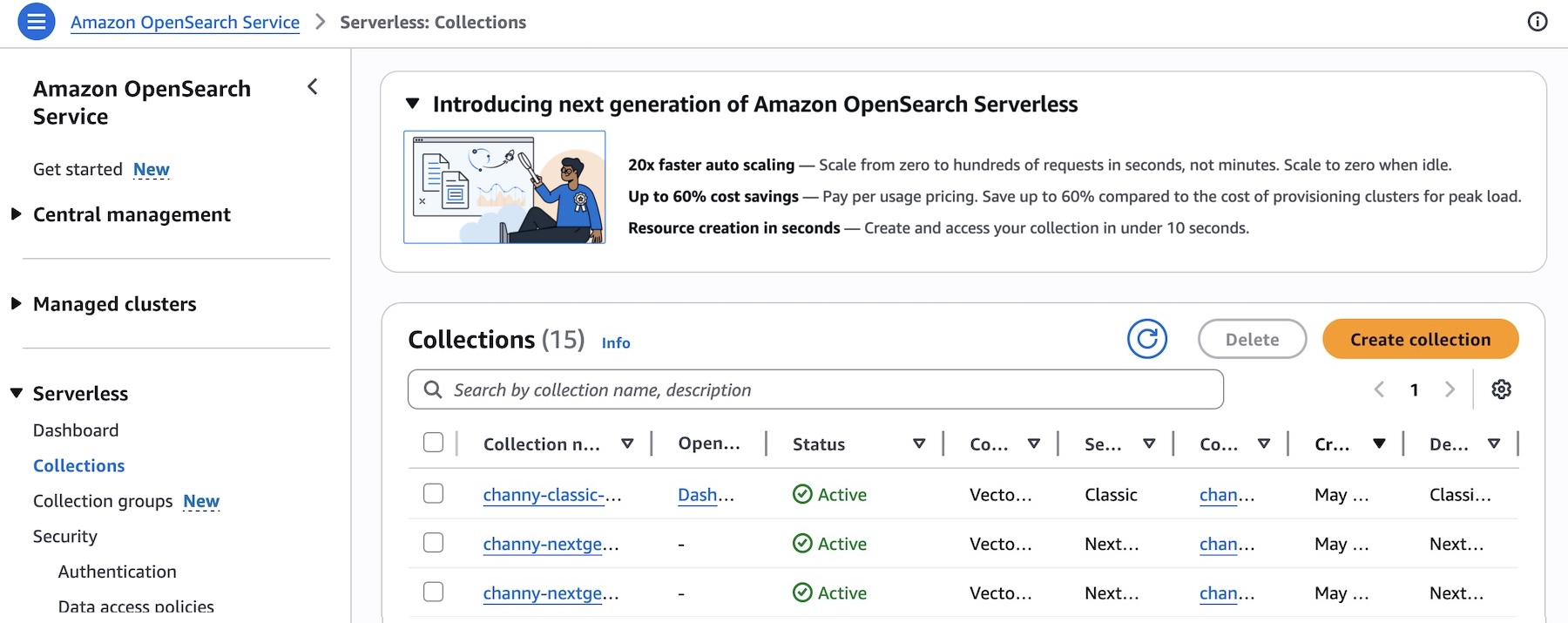
At the heart of the next generation of OpenSearch Serverless lies a re-engineered architecture designed for extreme agility and cost-effectiveness. The ability to scale from zero to thousands of requests per second and back to zero instantly is a game-changer for many AI applications. For instance, an AI agent might experience bursts of activity during business hours or specific events, followed by long periods of inactivity. With this new capability, customers only pay for the compute resources (OpenSearch Compute Units, or OCUs) actually consumed, leading to the advertised up to 60% cost savings compared to over-provisioning for peak loads. This is particularly attractive for startups and smaller development teams where budget constraints are a significant factor.

The performance enhancements are equally compelling. Resource creation, a process that could take minutes in previous iterations, now completes in seconds. Furthermore, the capacity scaling is up to 20 times faster, ensuring that AI agents can handle sudden spikes in query volume without performance degradation. This instant responsiveness is crucial for user-facing AI applications where latency directly impacts user experience. The next generation supports both full-text search and vector search, making it a versatile backbone for various AI agent functions, from retrieving documents to powering recommendation engines and conversational AI. The underlying infrastructure leverages advanced AWS technologies, including potentially specialized hardware for vector processing (like GPU acceleration, as mentioned in the pricing details), to achieve these performance gains.
Seamless Integrations: Accelerating AI Development Workflows
A key aspect of the new OpenSearch Serverless offering is its emphasis on developer experience and integration with popular AI development platforms. Recognizing that AI agent builders often work within integrated ecosystems, AWS has forged native partnerships that streamline deployment and management.
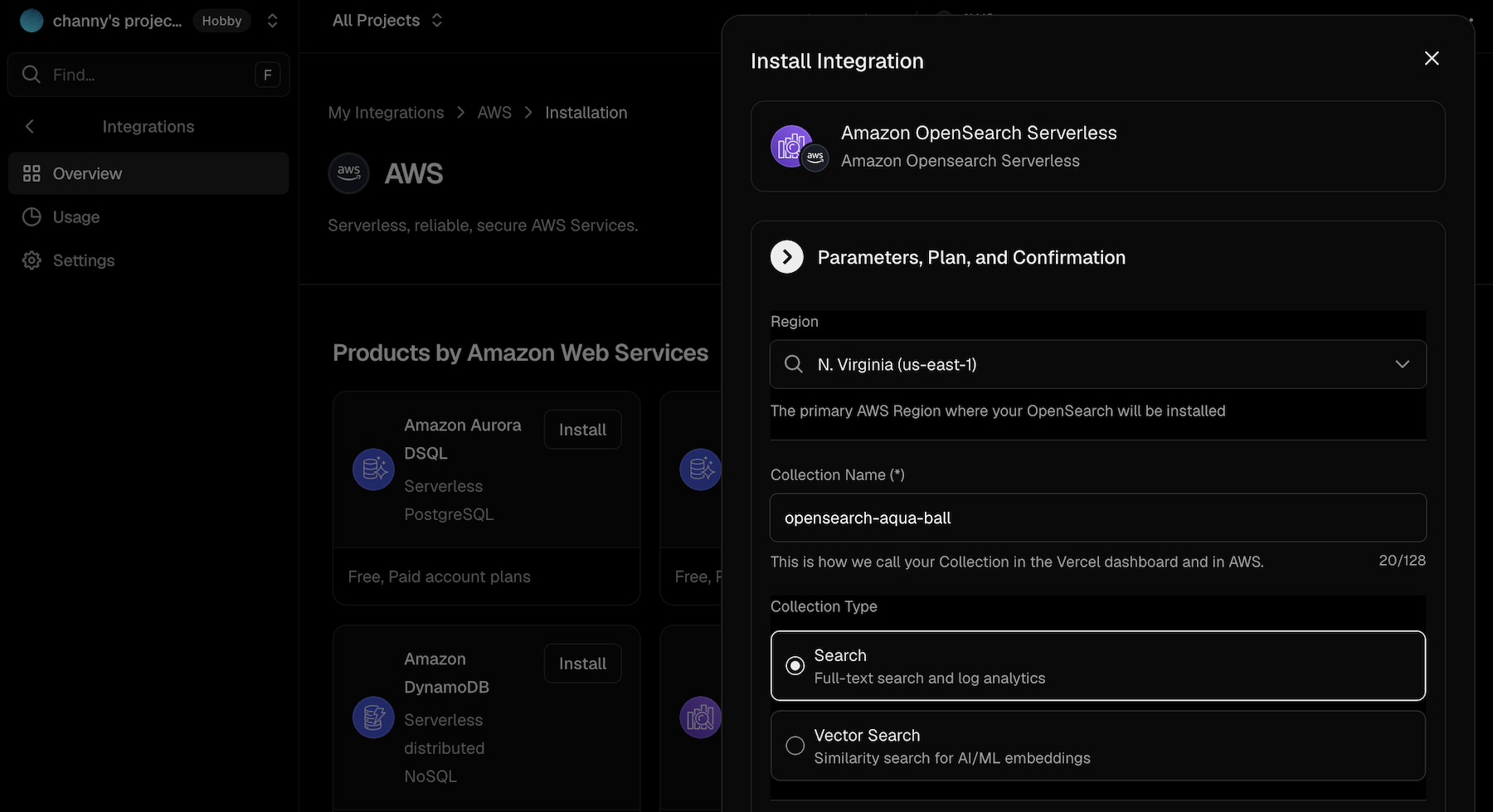
One notable integration is with Vercel, a leading platform for frontend developers. This partnership allows developers building production-ready agent applications on Vercel to create new OpenSearch collections or connect existing ones directly from the Vercel console. This significantly reduces the friction involved in setting up a robust search backend, enabling developers to go from concept to deployment in minutes. A spokesperson from Vercel might comment, "Our collaboration with AWS and the integration of the next-generation OpenSearch Serverless empowers our developers to build incredibly fast, scalable AI-driven experiences without ever having to worry about the underlying infrastructure. This accelerates innovation and time-to-market for intelligent applications."
Another critical integration is with Kiro, an AI development platform focused on accelerating the creation of AI-powered applications. Kiro, in conjunction with tools like Claude Code and Cursor, provides a streamlined workflow for building prototypes. The OpenSearch Agent Skills repository, a collection of pre-built skills, allows developers to infuse OpenSearch intelligence directly into their agents. These skills encapsulate domain knowledge, best practices, and multi-step execution logic, enabling agents not just to retrieve results but to understand the context and process behind them. Additionally, the OpenSearch Launchpad within Kiro Powers offers guided, end-to-end architecture planning, further simplifying the development of sophisticated search applications. A representative from Kiro could state, "The agility and vector capabilities of the new OpenSearch Serverless, coupled with OpenSearch Agent Skills and Launchpad in Kiro, provide an unparalleled environment for developers to rapidly iterate and deploy advanced AI agents. This synergy is a huge leap forward for the AI developer community."
Getting Started: Simplified Deployment
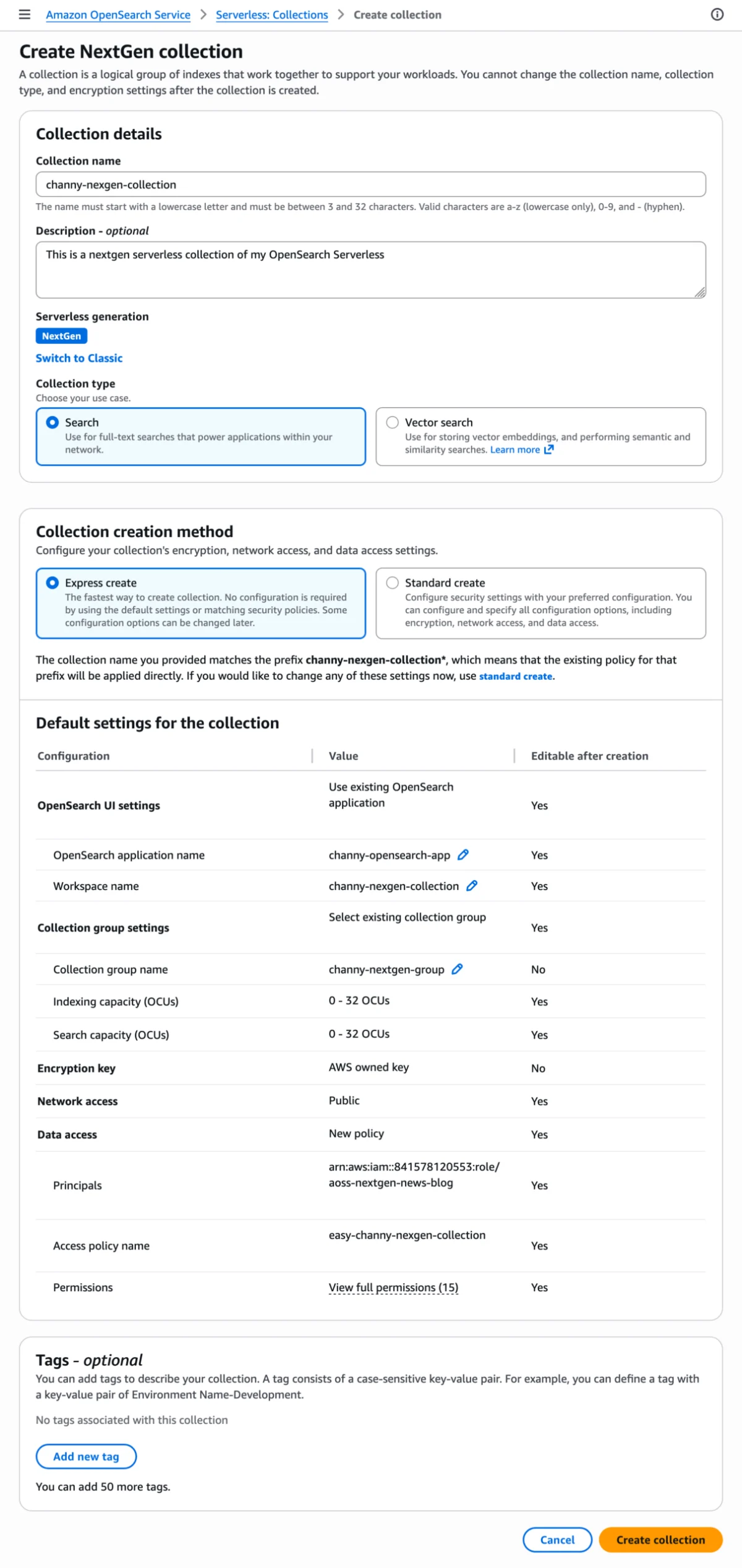
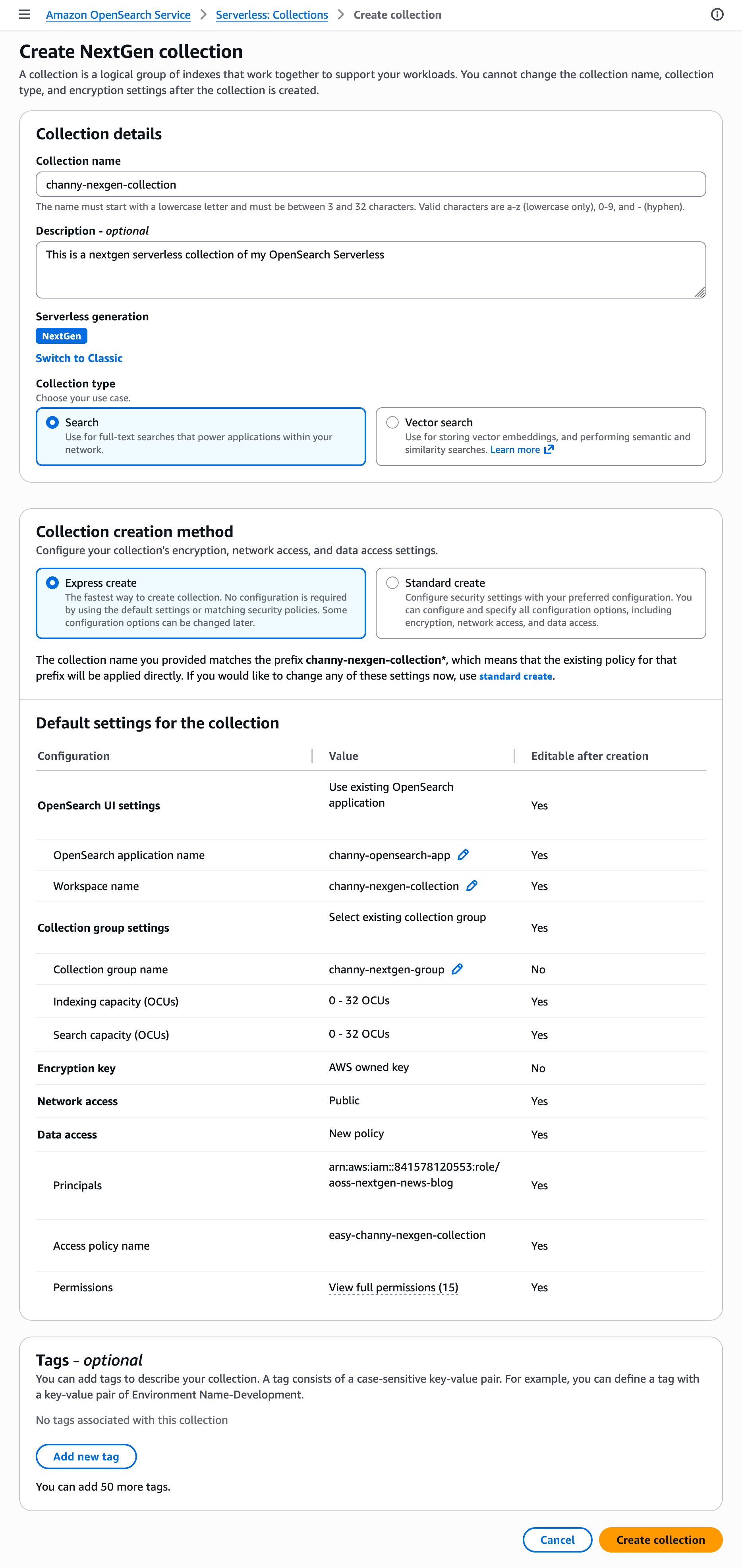
AWS has ensured that accessing these new capabilities is straightforward. Developers can initiate the creation of a next-generation OpenSearch Serverless collection directly through the Amazon OpenSearch Service console. Within the "Serverless" menu, selecting "Create collection" now offers the option for the "NextGen" collection type, which provides instant auto-scaling and scale-to-zero for cost optimization. At launch, this supports full-text search and vector search. For those who prefer a rapid setup, the "Express create" option applies default settings and security policies automatically, allowing for immediate deployment without extensive configuration.
For command-line enthusiasts and automation workflows, the AWS Command Line Interface (AWS CLI) and AWS SDKs also support the new generation. A sample CLI command demonstrates the simplicity of creating a collection group and a subsequent collection, specifying generation NEXTGEN and defining capacity limits. This flexibility ensures that developers can integrate OpenSearch Serverless into their existing CI/CD pipelines and infrastructure-as-code practices.
Broader Market Implications and Strategic Positioning
The release of the next generation of Amazon OpenSearch Serverless arrives at a time of intense competition and innovation in the AI infrastructure space. The global market for AI software and services is projected to grow exponentially, with AI agents and vector databases being critical components. This move by AWS solidifies its position as a leading provider of foundational services for AI development.
For enterprises, this means a lower barrier to entry for implementing sophisticated AI agents. The reduced operational burden and predictable cost model allow businesses to experiment more freely with AI applications, from enhanced customer service chatbots to internal knowledge management systems and sophisticated data analytics tools. The ability to quickly spin up and tear down search and vector backends without managing servers significantly de-risks AI projects and accelerates innovation cycles.
From a competitive standpoint, AWS is directly addressing the growing demand for specialized vector databases that often come with proprietary ecosystems. By enhancing OpenSearch Serverless with robust vector capabilities and deep integrations, AWS offers a comprehensive, managed, and open-source-compatible solution within its broader cloud ecosystem. This could attract developers who prefer the flexibility and community support of OpenSearch while benefiting from AWS’s operational excellence. Industry analysts might observe, "AWS’s investment in the next-generation OpenSearch Serverless demonstrates a clear understanding of the evolving needs of AI developers. By focusing on extreme scalability, cost efficiency, and seamless integrations, they are empowering a broader range of businesses to leverage advanced AI agents, further democratizing access to cutting-edge AI capabilities."
Pricing and Availability
The next generation of Amazon OpenSearch Serverless is generally available today, May 29, 2026, across all AWS commercial Regions where Amazon OpenSearch Serverless is currently offered. This broad availability ensures that customers worldwide can immediately benefit from these enhancements.
Pricing for the next generation of OpenSearch Serverless is structured to reflect its serverless nature. Customers are charged for the compute resources utilized, measured in OpenSearch Compute Units (OCUs), which encompass indexing, search, and GPU acceleration where applicable. Storage is charged separately in GB-month. This consumption-based model aligns costs directly with usage, reinforcing the promise of up to 60% savings for dynamic workloads. Detailed pricing information is available on the Amazon OpenSearch Service Pricing page.
This launch represents a strategic leap forward for AWS, offering a powerful, cost-effective, and developer-friendly solution for the rapidly expanding AI agent landscape. As AI continues to integrate into every facet of technology, services like the next generation of OpenSearch Serverless will be instrumental in enabling developers and enterprises to build the intelligent applications of tomorrow. AWS encourages users to explore the new capabilities and provide feedback via the AWS re:Post for Amazon OpenSearch Service or through their standard AWS Support channels, ensuring continuous improvement and adaptation to evolving customer needs.
