
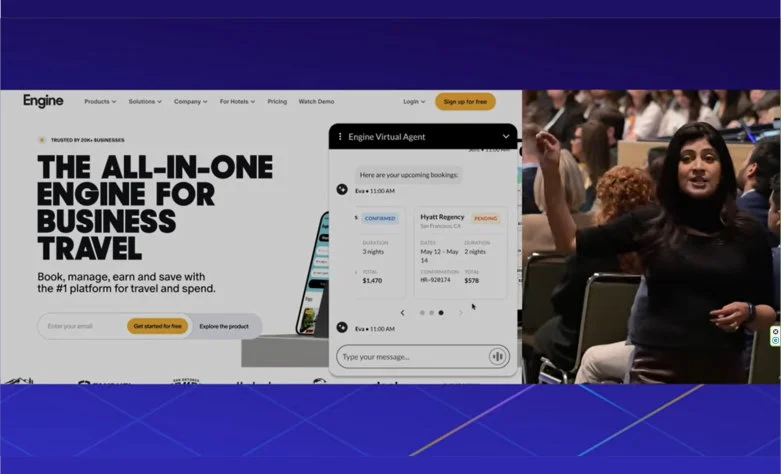

At the annual TDX 2026 conference in San Francisco, Salesforce leadership made an aggressive pivot, centering their entire ecosystem on the "Agentforce" platform. While the marketing surrounding autonomous AI agents has reached a fever pitch across the enterprise software sector, the volume of tangible, large-scale customer success stories has remained notably thin. However, the emergence of Engine, a mid-sized travel provider, provided the event with its most compelling evidence that autonomous agents can deliver substantial bottom-line results when deployed within the right organizational framework.
The case study, presented by Demetri Salvaggio, Vice President of Customer Experience and Operations, and Joshua Stern, Director of GTM Systems at Engine, detailed a transformation that has eluded many Fortune 500 entities. By utilizing Salesforce’s Agentforce to power their digital agent, "Ava," Engine reported a staggering $2 million in support savings, a marked reduction in average handling times, and a significant improvement in Customer Satisfaction (CSAT) scores. Most notably, the company revealed that 50% of all customer contacts are now handled autonomously by Ava, positioning Engine as a significant outlier in a market where many AI initiatives remain trapped in "pilot purgatory."
The Chronology of an Agentic Transformation
Engine’s journey with Salesforce’s AI capabilities did not begin with the general release of Agentforce. As an early adopter, the company participated in several closed pilot programs throughout 2024 and 2025, experimenting with the technology across both customer-facing and internal employee experience workflows. This iterative approach allowed the organization to move beyond the superficial application of generative AI—such as simple chatbots or text summarization—toward a model of "bounded autonomy."
By the time TDX 2026 commenced, Engine had transitioned from experimental use cases to a full production environment. The company’s trajectory followed a distinct four-phase evolution:
- Foundational Data Consolidation: Integrating disparate customer data into a unified Salesforce Data Cloud environment to ensure the AI had the necessary context.
- SOP Codification: Transforming "tribal knowledge" and informal procedures into structured Standard Operating Procedures (SOPs) that could be ingested by the agent.
- Human-in-the-Loop Testing: Deploying the agent in a supervised capacity where human representatives could observe, correct, and validate AI responses.
- Autonomous Deployment: Granting the agent "agency" to execute specific tasks, such as booking modifications and refund processing, within predefined limits.
The Architectural Secret: Bounded Autonomy and Flat Hierarchies
The primary takeaway from the TDX showcase was not necessarily the sophistication of the Salesforce software, but rather the unique organizational architecture of Engine itself. Industry analysts observing the presentation noted that Engine’s success appears rooted in its "Agentic Human OS"—a corporate culture designed for speed and distributed decision-making.
Salvaggio emphasized that Engine is "flat by design," a structural choice that allows for high-agency employees to make decisions without the traditional bottlenecks of multi-layered management. This philosophy is heavily influenced by the "two-way door" decision-making model popularized by Jeff Bezos. In this framework, most decisions are viewed as reversible; if a step through a door leads to an unfavorable outcome, the employee (or the agent) can simply step back through it.
This cultural predisposition toward delegated authority provided the perfect environment for Agentforce. In a traditional, hierarchical enterprise, an AI agent often faces "operating model debt," where every action requires approval from a human supervisor who may be several layers removed from the actual work. At Engine, because human employees already possessed the authority to act, the transition to granting that same "bounded agency" to a digital agent was a natural progression rather than a radical disruption.
Supporting Data: Measuring the Impact of Autonomous Agency
The metrics shared at TDX 2026 suggest that the value of AI agents scales proportionally with the degree of authority they are granted. Engine’s data highlights several key performance indicators that underscore the efficiency of the Agentforce implementation:
- Operational Savings: A direct $2 million reduction in support-related overhead, attributed to the deflection of high-volume, low-complexity queries.
- Resolution Velocity: A 50% autonomous resolution rate, meaning half of all customer interactions are completed without a human agent ever touching the ticket.
- Knowledge Accuracy: By keeping SOPs close to the front-line workers, Engine achieved a high "grounding" score, minimizing the hallucinations typically associated with large language models (LLMs).
- Employee Productivity: With Ava handling routine tasks, human representatives were able to focus on complex, high-value travel disruptions, leading to a qualitative increase in employee engagement.
Grounding AI in Localized Domain Knowledge
A recurring theme throughout the TDX sessions was the necessity of "grounding" agents in accurate, real-time data. Salvaggio was blunt in his assessment: "The agent is only as awesome as the data you can connect it to. That is it."
In many larger organizations, data hygiene and the maintenance of knowledge bases are often neglected or handled by centralized departments far removed from daily operations. Engine avoided this pitfall by empowering the people closest to the work to own the knowledge. At Engine, if an agent struggles with a specific type of customer request, the team members who handle those requests daily are responsible for updating the SOPs and adjusting the language the AI uses.
This localized ownership ensures that the agent’s instructions are not abstract corporate policies but practical, executable guidelines. This approach transforms SOPs from "dusty documentation" into dynamic boundary conditions that define what "good work" looks like for an autonomous system.
Observability as a Scaling Mechanism
As organizations move from small pilots to enterprise-wide deployments, the ability to monitor and govern AI behavior becomes the primary challenge. Engine’s success is partly attributed to its investment in deep observability.
"In the last year, observability became the biggest dial that we have," Salvaggio told the TDX audience. The company’s systems now allow them to analyze everything from technical latency to the specific reasoning behind a single turn in a conversation. This level of granularity is essential for managing the probabilistic nature of AI. Unlike traditional software, which follows a deterministic "if-then" logic, agents operate on probabilities.
Engine’s distributed agency model ensures that when the observability tools flag a "struggling" agent, there is a specific human owner ready to intervene. This creates a closed-loop system where feedback is immediately translated into system improvements.
Broader Impact and Industry Implications
The prominence of Engine at a major event like TDX 2026 signals a shift in the AI narrative. For Salesforce, highlighting a mid-sized company rather than a global conglomerate serves as both a proof of concept and a subtle critique of the modern enterprise. The implication is that the barrier to AI success is no longer the technology itself, but the "operating model debt" held by many large companies.
Industry analysts suggest that Salesforce may currently be "ahead of its customers." While the Agentforce platform provides the technical infrastructure for autonomous work, many organizations lack the internal trust and distributed authority required to let agents actually do that work. The "RTO" (Return to Office) mandates and increasing centralization seen in some sectors are viewed by experts as antithetical to the agentic future, as they suggest a lack of trust in delegated agency.
Conclusion: The "Agentic Human OS" Requirement
The lesson from Engine’s success at TDX 2026 is that AI agents do not inherently make an organization more efficient or "agentic." Instead, they act as a force multiplier for the agency that already exists within a company’s culture.
For the broader enterprise market, the path forward involves more than just purchasing software licenses. It requires a fundamental re-evaluation of how authority is distributed, how knowledge is captured, and how change is managed at the front lines. Organizations that continue to hoard decision-making power at the top will likely find their AI agents restricted to performing menial tasks, while companies like Engine, built on a foundation of bounded autonomy, will continue to extract disproportionate value from the technology.
As Salesforce continues to roll out Agentforce to its global customer base, the industry will be watching to see if larger enterprises can pay down their cultural debt and adopt the "Engine model," or if the gap between the "agentic" and the "hierarchical" will continue to widen. For now, Engine stands as the definitive blueprint for what is possible when the technology of the future meets the organizational structure of the future.
