

Amazon Web Services (AWS) today announced the preview release of AWS Transform – continuous modernization, a significant new capability within AWS Transform designed to provide continuous, autonomous analysis and remediation of technical debt at scale. This new offering aims to address a long-standing challenge for enterprises grappling with the costs and inefficiencies associated with maintaining complex, evolving software systems, promising to bring unprecedented visibility and automation to a critical area of software development.
The Mounting Challenge of Technical Debt in Modern Enterprises
Technical debt, analogous to financial debt, refers to the extra development work that arises when code is written quickly or with shortcuts, rather than using the best possible solution. While sometimes a necessary trade-off for speed to market, unchecked technical debt can accumulate rapidly, leading to significant long-term costs in maintenance, reduced agility, and hindered innovation. Industry reports consistently highlight the substantial burden technical debt places on organizations. Studies by organizations like Stripe and McKinsey have indicated that developers spend anywhere from 17% to 42% of their time on maintenance tasks, including fixing bugs, refactoring code, and updating legacy systems, rather than building new features. This translates to billions of dollars annually in lost productivity and delayed innovation across the global economy. For many engineering organizations, this "undifferentiated heavy lifting" can consume up to 30% of their total IT budgets, diverting critical resources from strategic initiatives.
Enterprises typically rely on a patchwork of disparate tools to manage this problem. One tool might detect dependency issues, another flags security vulnerabilities, and yet another assesses general code quality. However, the absence of a unified, continuous, and autonomous solution means that technical debt analysis and remediation often remain manual, application-by-application endeavors. This fragmented approach drains engineering capacity, leading to slow remediation cycles and a reactive posture. Furthermore, leadership often relies on self-reported team statuses, which frequently lag behind the reality of the codebase and can obscure regressions or newly introduced issues. The advent of AI-assisted development tools and coding agents, while accelerating the pace of code generation, paradoxically exacerbates this issue by potentially accelerating the accumulation of technical debt faster than human developers can manage. This creates an urgent need for a comprehensive capability that can detect, prioritize, and remediate technical debt continuously, autonomously, and at scale.
AWS Transform: A Broader Vision for Enterprise Modernization
The introduction of continuous modernization builds upon the existing foundation of AWS Transform, a service already assisting enterprises in complex migration and modernization efforts. AWS Transform has been instrumental in helping organizations migrate workloads from traditional data centers to the cloud, modernize mainframe and Windows applications, and manage routine software maintenance tasks. These tasks include upgrading Java versions, replacing deprecated frameworks, and updating AWS Lambda runtimes before they reach end-of-life—all critical activities that, while necessary, consume valuable developer time. With continuous modernization, AWS extends its commitment to streamlining these processes, offering customers complete visibility into the state of their codebases across thousands of repositories, prioritized findings, and automated pull requests for fixes. This holistic approach aims to empower enterprises to maintain a healthier, more agile software portfolio.
A Paradigm Shift: Continuous Analysis for Unprecedented Visibility
One of the core innovations of AWS Transform – continuous modernization lies in its ability to provide continuous analysis of an organization’s codebase. To tackle the pervasive challenge of visibility, this new capability automatically scans code repositories against configurable baselines. Unlike traditional, often laborious, manual audits that can take weeks, AWS Transform generates actionable findings in a matter of hours.
Out-of-the-box, the service includes robust policies designed to detect common sources of technical debt, such as end-of-life dependencies, deprecated frameworks, and outdated libraries. Beyond these standard policies, organizations can extend the system with their own custom remediation patterns. This flexibility allows for the enforcement of internal coding standards, the preference for approved libraries, or the adherence to specific technical debt policies already established by platform teams. For instance, if an organization has deprecated an internal library in favor of a new one, or mandates a particular logging pattern across all services, these preferences can be codified as policies and continuously applied across all connected repositories.
This continuous analysis offers a "ground truth" directly from the code itself, eliminating the need for periodic manual efforts and subjective status reports. When a repository deviates from the established baseline, platform teams are immediately notified, gaining precise information about which components are out of compliance and to what extent. This real-time insight streamlines compliance tracking and frees up engineering leadership from time-consuming status check-ins, providing an always-current view of their organization’s technical debt landscape.
Automating Remediation: The Path to Agility
Identifying technical debt is only half the battle; effective and timely remediation is equally crucial. AWS Transform – continuous modernization significantly accelerates this process by offering autonomous remediation at scale. Once findings have been identified and prioritized, the service can be configured to automatically generate pull requests (PRs) for affected repositories, streamlining the fix implementation.
The new capability provides a suite of out-of-the-box remediation transformations for common scenarios. These include routine yet critical tasks such as Java version upgrades, SDK migrations, and library updates. For organizations with unique requirements, the service also allows for the creation of custom transformations tailored to specific, organization-defined patterns.
When a remediation campaign is launched, AWS Transform – continuous modernization automatically creates pull requests for each affected repository. The owning team is then notified with a clear, concise message, such as: "This repository is behind on your organization’s baseline for this dependency. Here’s a PR that resolves it." This direct, actionable approach empowers development teams. They can review and merge the proposed PR, or, if they prefer, use the information to implement the fix using their own internal processes. Regardless of the method chosen, the continuous analysis feature detects when the fix is in place, providing concrete confirmation without requiring manual verification. This closes the loop, ensuring that identified debt is not only addressed but also confirmed as resolved, bringing true transparency to the remediation process.
Seamless Integration and Enhanced Security

Recognizing the critical intersection of technical debt and security, AWS Transform – continuous modernization integrates seamlessly with AWS Security Agent. This integration allows for the detection and remediation of security vulnerabilities directly at the source-code level. Security findings are then fed into the same prioritized list and pull-request workflow as other types of technical debt. This unified approach ensures that security issues are not siloed but are managed within the broader context of code quality and modernization, streamlining remediation efforts and bolstering the overall security posture of applications. By treating security vulnerabilities as a high-priority form of technical debt, organizations can achieve a more comprehensive and proactive defense strategy.
Customer Experience and Workflow: A Practical Walkthrough
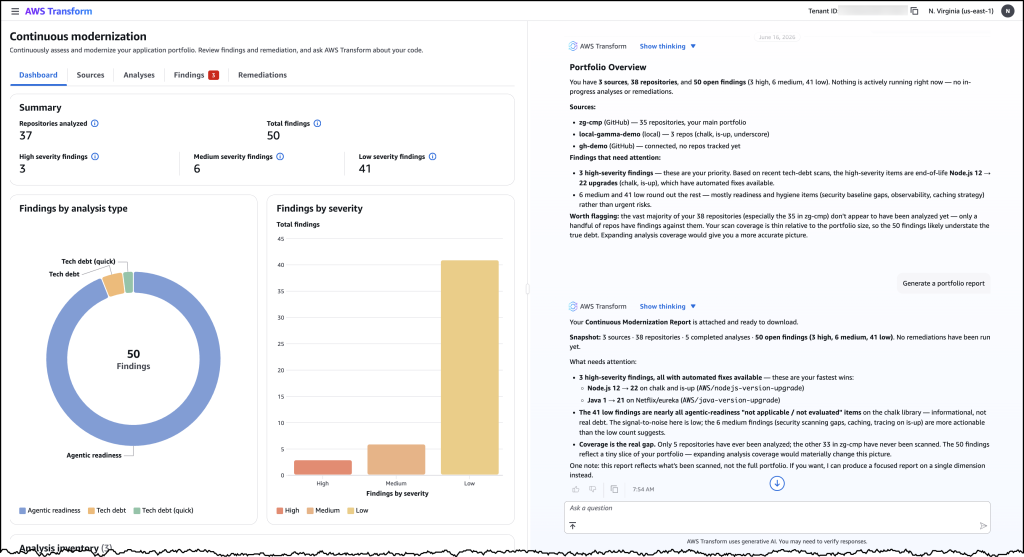
To illustrate the practical application of AWS Transform – continuous modernization, a typical user workflow would begin by navigating to the AWS Transform web application. The dashboard provides an immediate overview of the organization’s repositories and their current compliance status against configured baselines.
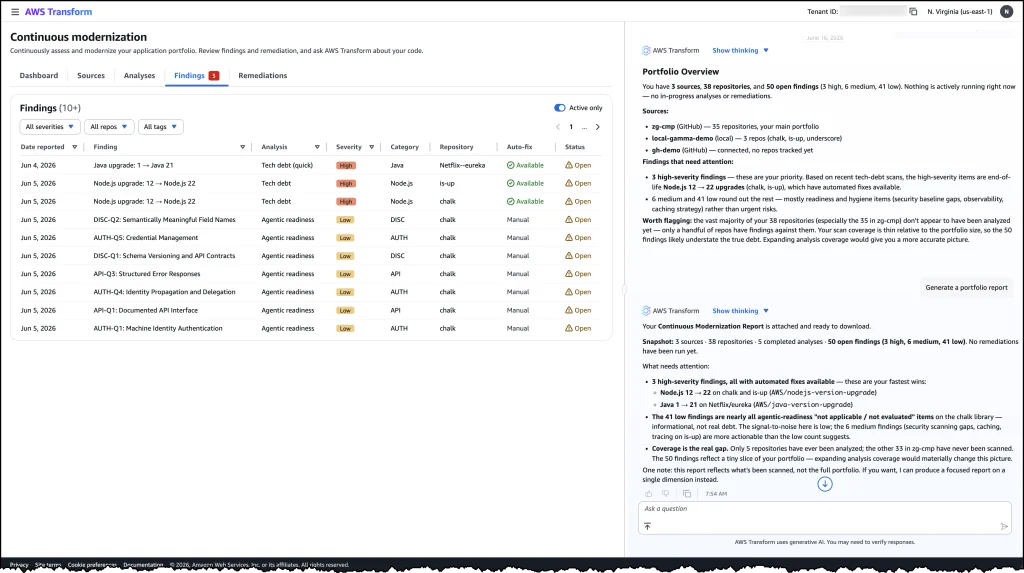
The first step involves connecting the organization’s source control system (e.g., GitHub, GitLab) and initiating an analysis against pre-defined or custom policies. Within hours, the analysis yields comprehensive findings across all connected repositories, indicating which ones are out of compliance with the baseline and by how much. The dashboard presents this information with details on severity, the number of affected files, and the specific technical debt patterns detected. This granular visibility allows platform teams and engineering leaders to quickly identify critical areas requiring attention.
From this detailed view, users can select a group of high-priority findings and launch a remediation campaign. AWS Transform – continuous modernization then automatically generates pull requests for each affected repository. The progress of these campaigns can be monitored in real-time through the dashboard, showing which PRs have been created, which have been merged by development teams, and which repositories have subsequently returned to a compliant state. This transparent, end-to-end workflow provides clear accountability and a verifiable path to reducing technical debt.
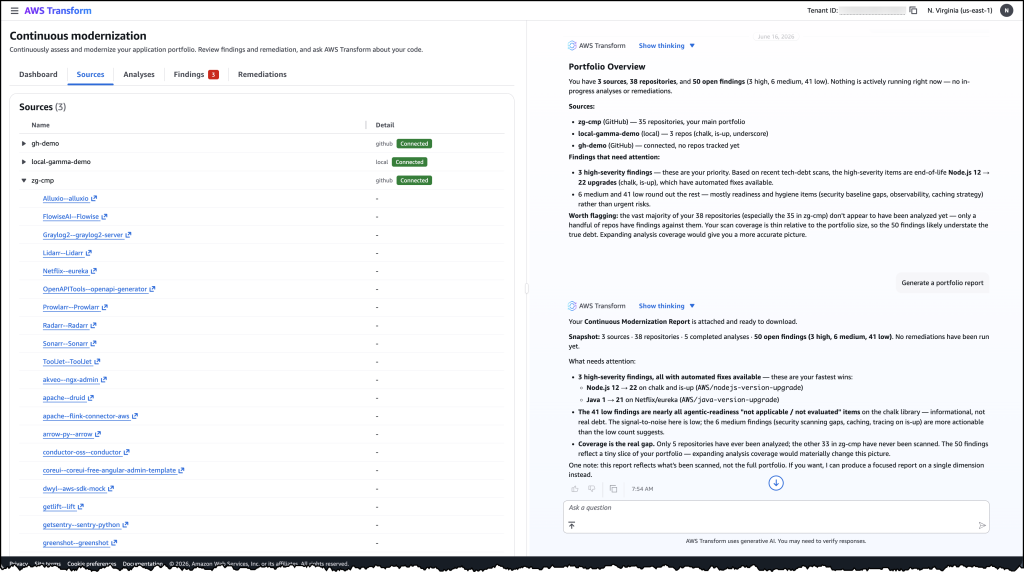
Visually, the dashboard presents a portfolio overview of technical debt findings across all connected repositories, offering a high-level summary. A detailed findings view lists individual technical debt items, categorized by severity, category, and repository, along with available remediation options. Furthermore, a "sources" view clearly shows all connected repositories from various environments that continuous modernization is actively tracking for analysis.
Strategic Modes: Continuous vs. Campaign Modernization
AWS Transform – continuous modernization supports two distinct, yet complementary, approaches to code modernization, catering to different organizational needs and project scales.
In continuous mode, the service is leveraged to keep codebases perpetually current as baselines evolve. This mode is designed for the routine, day-to-day work of software maintenance: upgrading libraries, applying security patches, and enforcing organizational coding standards across the entire development landscape. It addresses the constant drift that occurs in large codebases, ensuring that small issues are addressed before they snowball into significant technical debt. This proactive stance is essential for maintaining a healthy, agile development environment.
For larger, more complex modernization projects, such as migrating from one major framework to an entirely new one, or upgrading a critical runtime version across hundreds of applications simultaneously, campaign mode is employed. AWS Transform continues to provide flexible primitives for these larger, targeted, and project-based modernization efforts. While AWS Transform – continuous modernization is purpose-built for the recurring, high-volume work that platform teams manage every day, the broader AWS Transform service remains the tool of choice for strategic, deep modernization initiatives. This dual approach ensures that organizations have the right tools for both ongoing maintenance and transformative projects.
Industry Context and Expert Perspectives
The introduction of AWS Transform – continuous modernization comes at a crucial time for the software industry. With the increasing adoption of cloud-native architectures, microservices, and rapid development cycles, the volume and velocity of code generation have exploded. This environment, while fostering agility, also creates fertile ground for technical debt to proliferate. Analysts from firms like Gartner and Forrester have consistently highlighted the growing challenge of technical debt as a top concern for CIOs and CTOs, impacting innovation budgets and time-to-market.
"Automating the detection and remediation of technical debt is a logical next step in the evolution of DevOps and cloud-native practices," says a hypothetical industry analyst. "For too long, organizations have been playing whack-a-mole with code quality issues. A solution that provides continuous visibility and autonomous remediation at scale could significantly shift developer focus from maintenance to innovation. The ability to customize policies and integrate security findings is particularly powerful, offering a truly holistic approach."
A hypothetical AWS spokesperson, perhaps a VP of Engineering Services, might comment, "Our customers have consistently told us that managing technical debt is one of their biggest headaches. It drains engineering capacity and stifles innovation. With AWS Transform – continuous modernization, we’re providing the tooling to automate this critical, undifferentiated work, allowing developers to focus on what they do best: building amazing new features and solving customer problems. This isn’t just about fixing code; it’s about fundamentally changing how organizations manage their software lifecycle, making it more efficient, secure, and agile."
Implications for Enterprise IT and Development Teams
The implications of AWS Transform – continuous modernization are far-reaching. For enterprise IT leaders and CIOs, it promises enhanced operational efficiency and better allocation of valuable IT budgets. By automating the identification and remediation of routine technical debt, resources previously tied up in maintenance can be redirected towards strategic growth initiatives, new product development, and fostering innovation. It also provides a clear, data-driven view of code health, enabling more informed decision-making and risk management.
For development teams, the benefits are equally significant. Developers can spend less time on tedious, repetitive refactoring and dependency updates, and more time on high-value coding and problem-solving. The automated pull requests act as a productivity multiplier, allowing teams to quickly address issues without interrupting their flow. This can lead to higher developer satisfaction, reduced burnout, and a more positive engineering culture. Furthermore, the continuous feedback loop provided by the service ensures that code quality standards are maintained proactively, reducing the likelihood of large, daunting refactoring projects in the future.
The integration with AWS Security Agent is also a critical factor, as security vulnerabilities are a substantial component of technical debt. By unifying the remediation workflow for both code quality and security, organizations can improve their security posture more effectively and reduce the attack surface of their applications. This holistic approach helps bridge the gap between development and security teams, fostering a "security-by-design" mindset.
Availability and Next Steps
AWS Transform – continuous modernization (preview) is available starting today. Organizations interested in exploring this new capability can get started through the AWS Transform web application. Further integration options are provided via AWS Transform Kiro Power, or through MCP and skills for integration with existing coding agents, offering flexibility for various development environments. Detailed information and guidance are available in the AWS Transform documentation, providing a comprehensive resource for implementation and usage. This preview launch marks a significant step forward in AWS’s ongoing efforts to simplify and automate complex cloud operations and software modernization for its global customer base.
