
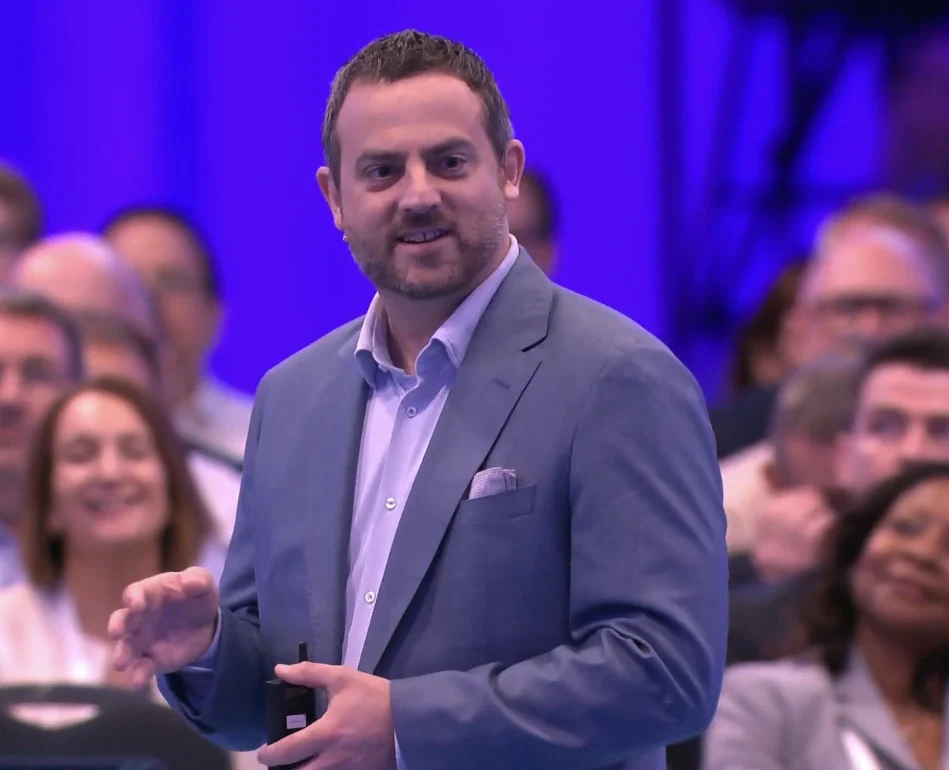

The enterprise software landscape is currently navigating a period of profound transition, driven by the rapid integration of generative artificial intelligence and a fundamental shift in how organizations perceive value from their technology stacks. Joe Inzerillo, Salesforce’s Executive Vice President for Enterprise and AI Technology, recently addressed several of the most contentious terms currently circulating within the tech industry: "SaaSpocalypse" and "tokenomics." In a detailed discussion regarding the future of the Software-as-a-Service (SaaS) model, Inzerillo characterized these industry anxieties not as threats, but as significant opportunities for a "renaissance" in enterprise computing. His insights come at a time when the global CRM market, valued at approximately $71 billion in 2023, is facing scrutiny over whether traditional vendors can maintain their dominance in an era where AI might allow companies to build bespoke, internal solutions more easily than ever before.
Challenging the SaaSpocalypse Thesis
The term "SaaSpocalypse" has gained traction among Wall Street analysts and industry skeptics who suggest that the rise of generative AI will lead to the obsolescence of traditional enterprise vendors. The core of this thesis is that AI-powered coding assistants and automated development platforms will enable organizations to build their own custom Customer Relationship Management (CRM) and Enterprise Resource Planning (ERP) tools. This "DIY" approach, theorists argue, would eliminate the need for high-priced licenses from established players like Salesforce, SAP, or Oracle.
Inzerillo firmly rejects this outlook, suggesting that the critics are misinterpreting the direction of the market. He argues that rather than an ending, the current era represents a rebirth of the SaaS value proposition. Central to this defense is Salesforce’s "Headless 360" strategy. In a headless architecture, the backend functionality—the data, logic, and processing power—is decoupled from the frontend user interface. This allows organizations to leverage Salesforce’s robust infrastructure while delivering services through any medium, whether it be a custom mobile app, a voice assistant, or an autonomous AI agent.
According to Inzerillo, companies that attempt to resist this shift by forcing customers into rigid, proprietary interfaces are the ones at risk. He noted that Salesforce’s approach is designed to "beat the market" by providing the flexibility that modern enterprises demand. He cited an example of a client that reduced its license count by half while tripling its overall spend with Salesforce. While seemingly paradoxical, this shift indicates a move away from "per-seat" pricing toward "per-value" or "per-outcome" models, where the customer is happier because the software is performing more high-value work despite having fewer human users interacting with the traditional interface.
The Economics of AI: Navigating the Realities of Tokenomics
As enterprises integrate Large Language Models (LLMs) into their workflows, the concept of "tokenomics"—the economic structure governing the cost of AI processing—has become a primary concern for Chief Information Officers (CIOs). AI models process data in "tokens," which are essentially fragments of words. Because these models require massive computational power, often running on expensive GPU clusters in hyperscale data centers, the cost of generating AI responses can escalate rapidly.
Inzerillo acknowledges that tokens represent the most "high-class" and expensive form of compute currently available. However, he argues that the fear surrounding these costs often stems from an inefficient application of the technology. The strategic advantage of a platform like Salesforce, he suggests, lies in "opinionation"—the ability of the platform to determine the most cost-effective way to solve a problem.
Not every task requires a massive, multi-billion parameter model. Inzerillo points out that Salesforce can perform repeatable, structured tasks much more reliably and inexpensively through its existing platform logic than by sending every query through an LLM. The "art" of modern enterprise technology is knowing when to use a simple database query, when to use a specialized algorithm, and when to invoke a high-cost AI agent. By balancing these resources, Salesforce aims to find an economic "sweet spot" that justifies the investment in tokens by ensuring they are only used for tasks that provide a high return on investment.
From Software Development to Digital Labor
A significant portion of Inzerillo’s analysis centers on a shift in mindset regarding the Software Development Lifecycle (SDLC). Historically, software was treated as a static tool: requirements were gathered, code was written, and the software was deployed to run indefinitely with minimal intervention. Inzerillo argues that AI should not be treated like traditional software, but rather as "Digital Labor."
This shift requires organizations to view AI agents as employees rather than tools. Using an analogy of a corporate intern, Inzerillo noted that an AI agent requires constant feedback, training, and "custodianship." If an intern is given initial instructions but never receives performance reviews or course corrections, their utility diminishes over time. Similarly, AI agents must be managed to prevent "drift"—a phenomenon where the model’s outputs become less accurate or relevant as public behavior and data environments evolve.
This perspective redefines the goal of AI in the workplace. Rather than wholesale replacement of human staff, the objective is to automate specific "functions" of a job. By alleviating the burden of repetitive tasks, agents allow human workers to focus on high-impact decision-making and creative problem-solving. Inzerillo observed that the most successful "early adopters" on the bell curve of AI implementation are those who have moved past anthropomorphizing AI and instead treat it as a controllable, brand-representative co-worker.
Identifying the Three Pillars of Adoption Paralysis
Despite the potential benefits, many organizations remain hesitant to fully commit to an agentic AI strategy. Inzerillo identifies three primary inhibitors: fear, the "replacement fallacy," and technical debt.
- Fear and Choice Paralysis: Many leaders are paralyzed by the rapid pace of model development. The fear of "betting on the wrong horse"—investing in a model that is leapfrogged by a competitor a month later—leads to inaction. Inzerillo’s counter-argument is that "time-to-value" is the only metric that matters. By using platforms that are model-agnostic, companies can mitigate the risk of obsolescence.
- The Replacement Fallacy: Inzerillo warns that attempting to replace an entire human role with an agent is often a recipe for failure. Human judgment is complex and difficult to encode. Organizations that succeed are those that break down jobs into specific tasks and automate those that are most burdensome, rather than attempting a total workforce overhaul.
- Technical Debt: The efficacy of AI is entirely dependent on the quality of the underlying data. Companies that have neglected their data lakes or documentation find themselves at a disadvantage. However, Inzerillo noted that AI itself is becoming a tool to "pay down" this debt, as models are increasingly capable of rationalizing and organizing messy legacy data at unprecedented speeds.
Organizational Transformation: The Executive Perspective
The technical insights provided by Inzerillo are complemented by the operational reality described by Robin Washington, Salesforce’s Chief Operating and Finance Officer. During a recent gathering of over 20 companies at various stages of AI adoption, Washington emphasized that while the tools are ready, the primary challenge remains organizational transformation.
Washington’s advice to enterprises mirrors the "fail fast" mentality of Silicon Valley. She advocates for an iterative approach: starting with simple use cases, avoiding over-engineering, and continuously evolving the solution as the organization grows. This marks a departure from the traditional enterprise software model, where a project might take 18 months to move from provision to solution. In the agentic era, the cycle of ideation and iteration happens in weeks or months, requiring a more agile go-to-market motion.
Market Implications and Future Outlook
The shift toward "Agentic AI" represents a pivotal moment for the technology sector. According to data from Gartner, by 2026, 80% of enterprises are expected to have used generative AI APIs or deployed generative AI-enabled applications. Salesforce’s move toward "Agentforce" and "Headless 360" is a direct response to this trend, aiming to cement its role as the foundational layer for "Digital Labor."
The implications for the global workforce are significant. As AI agents take over more administrative and analytical tasks, the demand for human "custodians" of AI—those who can train, monitor, and guide these digital workers—will likely increase. For the SaaS industry, the "SaaSpocalypse" may simply be a transition from selling software as a tool to selling software as a workforce.
Inzerillo’s and Washington’s comments suggest that Salesforce is positioning itself not just as a database for customer information, but as a management platform for the next generation of autonomous agents. By addressing the fears of token costs and DIY competition head-on, Salesforce is attempting to lead its client base through what it views as the most significant technological shift since the move to the cloud. The success of this strategy will depend on whether enterprises can overcome their internal fears and technical hurdles to embrace a future where software doesn’t just store data, but actively performs the work.
