
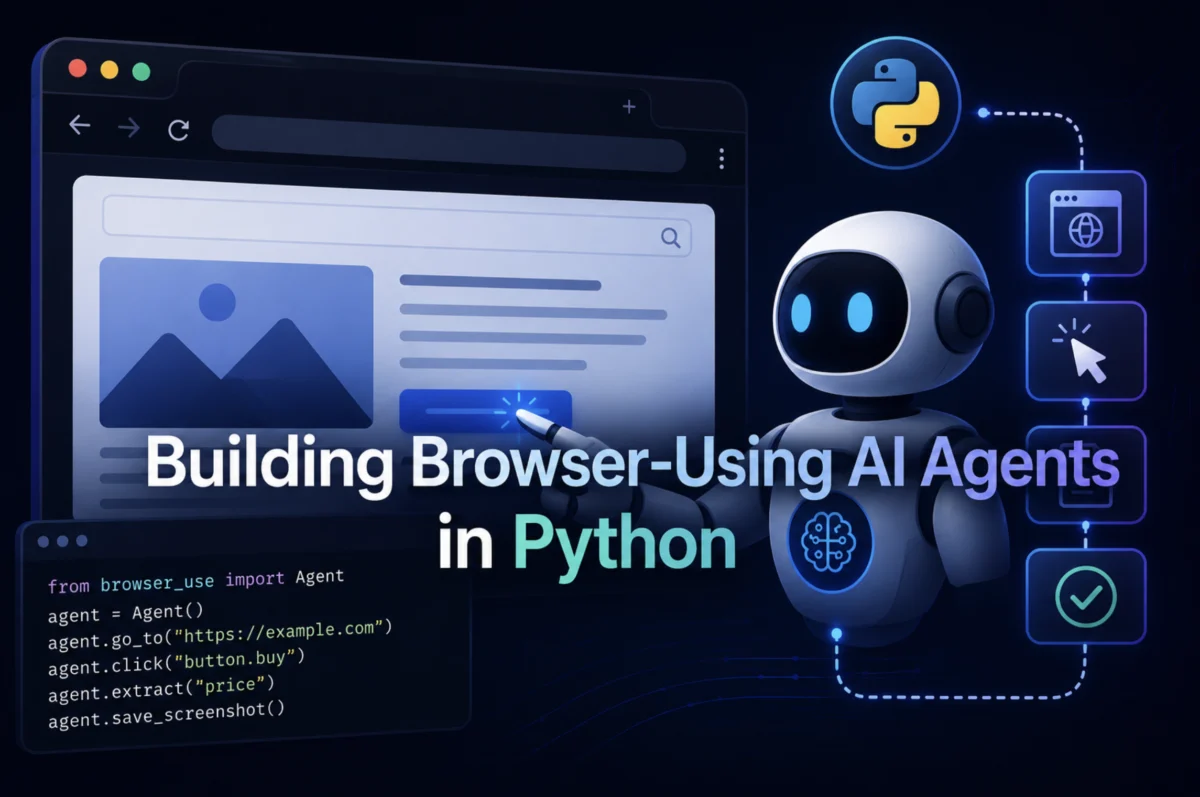

The landscape of artificial intelligence is undergoing a significant transformation, moving beyond API-centric operations to empower agents with the ability to navigate and interact with the vast expanse of the internet via web browsers. This pivotal shift, facilitated by robust tools like Playwright, the browser-use library, and the LangGraph orchestration framework, is unlocking unprecedented capabilities for AI agents, allowing them to perform complex tasks previously exclusive to human operators. This article delves into the technical underpinnings and strategic implications of building such browser-capable AI agents in Python, highlighting their growing importance in an increasingly digital world.
The Imperative for Browser-Capable AI Agents
Traditional AI agent tutorials often commence with interactions through structured Application Programming Interfaces (APIs), demonstrating how to fetch data from services like OpenWeather or process transactions via Stripe. While effective for specific, pre-defined tasks, this approach encounters severe limitations when confronted with the reality of the World Wide Web. Out of roughly 1.1 billion websites currently online, only a minuscule fraction offers public APIs for data access or functional interaction. The overwhelming majority of digital information and processes "speak browser" exclusively, meaning they require human-like navigation, reading, and interaction with web pages.
This fundamental disparity means that an AI agent confined to API calls can address perhaps only 5% of the daily tasks a human worker performs. Equipping an agent with browser capabilities, however, dramatically expands its coverage, bringing it closer to encompassing the full spectrum of human web-based activities, from completing government forms and monitoring competitor pricing to extracting nuanced research from JavaScript-rendered sites or logging into proprietary portals. This capability gap is precisely what modern browser-using AI agents aim to close.
The market reflects this growing necessity. Industry analyses project the global AI agents market, valued at $10.91 billion in 2026, to surge to $50.31 billion by 2030, with browser-capable agents serving as a central catalyst for this expansion. Notably, 27.7% of enterprises are already leveraging agentic browsers in production environments, a substantial increase from negligible adoption just two years prior. This rapid maturation of tooling and the establishment of reliable patterns underscore the readiness of this technology for widespread implementation. By mastering the techniques discussed, developers can build agents capable of real-world web navigation, form completion, structured data extraction, and intelligent decision-making, all within the Python ecosystem.
Playwright: The Modern Foundation for Browser Automation
For those familiar with browser automation, Selenium has historically been the go-to tool. While still widely deployed and functional, Playwright has emerged as the default choice for new projects in 2026, driven by practical advantages in performance, reliability, and anti-detection capabilities.
The core difference lies in their communication protocols. Selenium interacts with browsers by dispatching individual HTTP requests to a WebDriver for every action—a click, a type, a scroll. This incurs a per-action round-trip cost, slowing down complex sequences. Playwright, conversely, establishes a persistent WebSocket connection for the entire session, enabling commands to flow with minimal latency. Independent benchmarks consistently demonstrate Playwright outperforming Selenium, running 30-50% faster at the test-suite level and averaging approximately 290 milliseconds per action compared to Selenium’s ~536 milliseconds. For AI agents executing hundreds of actions, this performance gap compounds significantly.
Beyond speed, Playwright simplifies the development experience by bundling its own browser binaries (Chromium, Firefox, and WebKit). This eliminates common pain points such as WebDriver version mismatches and broken Continuous Integration (CI) pipelines caused by browser updates. Its built-in auto-waiting mechanism is another critical feature; before executing an action like a click, Playwright automatically verifies that the target element is visible, enabled, and not animating, negating the need for brittle time.sleep() calls and enhancing script robustness.
Crucially for AI agents, Playwright emulates genuine human interaction by firing real mouse and keyboard events. Many advanced websites employ detection mechanisms that identify synthetic DOM clicks or other non-human interaction patterns. Playwright’s interaction model makes its automated actions considerably harder to distinguish from authentic human input, thus improving stealth and success rates against anti-bot measures.
Enhancing Intelligence with LangChain and LangGraph
While raw Playwright scripts offer precise control, they are inherently rigid. They execute pre-defined sequences, breaking if a page’s structure changes or if the task requires unforeseen decisions. The true power of AI agents emerges when Playwright is integrated with Large Language Models (LLMs) via orchestration frameworks like LangChain and LangGraph. This integration transforms browser actions into intelligent tools that an LLM can invoke dynamically. The agent receives a task, reasons about the optimal sequence of actions, calls the appropriate browser tool, interprets the outcome, and then decides its next step. This iterative "observe-decide-act" loop provides a level of adaptability that fixed scripts cannot achieve, marking the transition from mere "browser automation script" to a sophisticated "AI agent."
LangChain’s @tool decorator allows developers to expose custom Playwright functions as callable tools for the LLM. Each tool is accompanied by a clear docstring, which serves as the LLM’s "job description," enabling it to understand the tool’s purpose and when to utilize it. LangGraph, built on LangChain, then orchestrates these tools within a reactive reasoning loop, allowing the agent to manage complex, multi-step browser interactions. A key design principle here is maintaining a single, persistent browser instance across multiple tool calls. Launching and closing a browser for each action is not only slow but also leads to the loss of session state (e.g., cookies, login status), making multi-page tasks impossible. By keeping the browser alive, the agent maintains context, mimicking a continuous human browsing session.
The Rise of High-Level Agent Abstractions: browser-use
For scenarios demanding even greater autonomy and resilience to web design changes, libraries like browser-use offer a higher level of abstraction. Instead of requiring developers to write brittle CSS selectors, browser-use empowers the LLM to interpret the current page state in natural language and decide how to proceed: which elements to click, what text to input, and when the task is complete. This means the agent dynamically adapts to page structure changes at runtime, significantly enhancing its robustness.
browser-use is particularly valuable when:
- The target website’s structure is highly dynamic or frequently updated.
- The task involves exploratory browsing where exact element selectors are unknown beforehand.
- The goal is to achieve a high-level objective rather than meticulously scripted steps.
By leveraging browser-use, an agent can be instructed, for example, to "Go to books.toscrape.com and find the 3 most expensive books on the first page. Return their titles and prices." The agent autonomously navigates, reads, identifies, and extracts the requested information without any hardcoded selectors. This approach ensures that if books.toscrape.com redesigns its price display tomorrow, the agent will likely still succeed, whereas a selector-based script would fail silently. Parameters like max_actions_per_step can be configured to control the agent’s interaction frequency, forcing it to re-evaluate the page state more often and mitigate potential runaway loops.
Navigating the Hard Parts: Production-Ready Agents
Deploying AI browser agents reliably in production environments presents several challenges, each requiring specific mitigation strategies.
-
Anti-Bot Detection: Many websites actively detect and block automated browser sessions. Common tactics include checking the
navigator.webdriverproperty, analyzing headless browser fingerprints in the JavaScript environment, and identifying unnaturally fast or uniform interaction patterns. Playwright offers powerful countermeasures:- Removing the
navigator.webdriverflag usingcontext.add_init_script()ensures this property is undefined before any page JavaScript executes. - Employing the
--disable-blink-features=AutomationControlledlaunch argument eliminates another browser-level automation flag. - Configuring a realistic viewport size, a standard user-agent string, and appropriate locale/timezone settings further mimics human browsing.
These measures effectively bypass most common detection methods. However, for highly aggressive anti-bot systems involving sophisticated fingerprinting or CAPTCHA challenges, specialized third-party services like Browserbase, Spidra, or Brightdata’s Scraping Browser provide managed infrastructure solutions, handling complexities such as CAPTCHA solving, residential IP rotation, and advanced browser fingerprint management.
- Removing the
-
Smart Waiting Strategies: A common pitfall in browser automation is relying on arbitrary
time.sleep()calls, which are either too short for slow connections or unnecessarily long for fast ones, making debugging opaque. Playwright offers precise, event-driven waiting strategies:page.wait_for_selector(): Waits for a specific DOM element to become visible, ensuring content has loaded.page.expect_response(): Waits for a particular API response, useful when content is dynamically loaded via XHR/fetch calls.page.wait_for_url(): Monitors for URL changes, ideal for verifying redirects after form submissions.page.wait_for_function(): Evaluates a JavaScript function in the browser context, waiting for a specific condition (e.g., a global variable being set) to become true.
These "smart waits" ensure the agent proceeds only when the required page state is genuinely ready, significantly improving robustness and efficiency.
-
Session and Cookie Persistence: Losing session state between agent runs is a critical failure point, particularly for authenticated interactions. Re-logging in for every task is inefficient and can trigger rate limits. The solution involves persisting browser cookies to disk. After a successful login,
context.cookies()can extract all session and authentication cookies, which are then saved to a JSON file. On subsequent runs, these cookies are loaded viacontext.add_cookies()before navigation, allowing the agent to start in an authenticated state. Implementing a fallback to a fresh login in case of expired sessions or redirects to login pages ensures continuous operation.
Deployment and Scalability Considerations
Transitioning a browser agent from a local development environment to a reliable cloud deployment introduces new considerations, primarily around system dependencies and concurrency.
Docker is the preferred solution for consistent deployment. A Dockerfile can encapsulate all necessary system libraries (e.g., libnss3, libatk1.0-0 for Chromium) and Python dependencies, along with Playwright’s browser binaries, ensuring the agent runs identically regardless of the underlying host environment. This eliminates "works on my machine" issues and streamlines Continuous Integration/Continuous Deployment (CI/CD) pipelines.
For concurrent workloads requiring multiple browser sessions in parallel, Playwright’s async API combined with asyncio.gather() and asyncio.Semaphore is crucial. While launching multiple browser contexts is relatively inexpensive, initiating multiple full browser processes can quickly exhaust system memory. By sharing a single browser process across several isolated contexts and capping concurrent operations with a semaphore, developers can achieve efficient parallel scraping or task execution without resource contention.
The cloud infrastructure landscape is also rapidly evolving to support these agents. Amazon Nova Act, launched in March 2025, provides a dedicated SDK for building browser agents on AWS, with native Playwright integration. Furthermore, Playwright’s own Model Context Protocol (MCP) server offers AI assistants enhanced browser control through structured accessibility snapshots rather than raw screenshots. This innovative approach allows LLMs to maintain a high understanding of the page’s semantic structure while keeping token costs low, optimizing both performance and cost-efficiency for complex agent interactions.
Conclusion: The Future of Web Interaction
The browser, far from being a specialized tool, is the universal interface for accessing the majority of the world’s digital information and executing critical business processes. AI agents capable of leveraging this interface do not rely on a complex web of API integrations; they can access anything a human can. This capability is not merely theoretical but intensely practical, driven by the maturity of modern tooling.
Playwright has solved the intricate challenges of reliable browser interaction. The browser-use library provides a natural language bridge for exploratory tasks, freeing agents from the constraints of static selectors. LangGraph offers the sophisticated reasoning and orchestration necessary for LLMs to make intelligent, adaptive decisions. These are not mere demonstration patterns; they represent the foundational architectures upon which a significant portion of enterprises are already building their production-grade AI agents.
For developers seeking to empower AI with expansive web capabilities, the path is clear: begin with Playwright for foundational scraping, integrate LangGraph for intelligent decision-making, consider browser-use for dynamic or exploratory tasks, and containerize deployments with Docker for robust cloud operation. The true challenge lies not in the code itself, but in understanding which tool best addresses the specific requirements at each layer of agent development. With these insights, the journey towards building highly effective, browser-using AI agents becomes significantly more accessible and impactful.
