


The artificial intelligence landscape is in constant flux, with rapid developments often born from the very controversies that surround leading models. Such is the case with the emergence of Qwable, an open-source language model that has quickly captured the attention of the AI community. Developed by an independent researcher, Qwable is a testament to the power of community-driven innovation, leveraging the reasoning capabilities of Anthropic’s Fable 5 model while offering enhanced accessibility and, in a later iteration, a significant reduction in content restrictions. This development follows a tumultuous period for Anthropic, marked by public apologies for undisclosed safeguards in Fable 5 and a subsequent government directive to restrict its availability to foreign nationals.
Anthropic’s Fable 5 Under Scrutiny and the Genesis of Qwable
The week preceding Qwable’s public debut was dominated by news surrounding Anthropic’s Fable 5 model. The company issued a public apology for what it termed "invisible safeguards" within Fable 5, a move that raised concerns about transparency in AI development and deployment. These undisclosed restrictions, designed to govern the model’s output, were found to be more pervasive than initially communicated, leading to user frustration and a questioning of Anthropic’s commitment to openness.
Compounding these issues, the U.S. government intervened shortly thereafter, ordering that Fable 5 be made unavailable to all foreign nationals. This drastic measure was reportedly prompted by a disputed finding related to a "jailbreak" attempt, a scenario where users attempt to bypass the model’s safety protocols to elicit restricted content. The government’s action highlighted the increasing scrutiny on advanced AI models and the potential national security implications associated with their unfettered access.
It was within this charged atmosphere that a developer, operating under the handle Mia-AiLab on the popular AI model repository Hugging Face, unveiled Qwable. The model’s name itself, a portmanteau of "Qwen" and "Fable," immediately signaled its lineage and ambition. Qwable is not a direct replication of Fable 5 but rather a sophisticated fine-tuning of Alibaba’s Qwen3.6-27B base model. The core innovation lies in Mia’s methodology: training Qwen3.6-27B on a meticulously curated dataset of reasoning examples specifically formatted in the style of Fable 5. The objective was clear: to create a powerful 27-billion parameter model that could not only run on consumer-grade hardware but also emulate the distinctive reasoning and instruction-following capabilities of Fable 5.
Parameters, in the context of AI models, are analogous to the connections in a human brain. A higher number of parameters generally correlates with a model’s capacity to understand and generate more complex information, learn from a wider range of data, and perform more nuanced tasks. The 27-billion parameter count positions Qwable as a substantial model, capable of competing with many proprietary offerings.
The Technique: Learning Study Habits, Not Copying Answers
The technical approach employed by Mia is described as "instruction fine-tuning on trace-style examples." In simpler terms, this involves presenting the Qwen3.6-27B model with examples that mimic Fable 5’s deliberate, step-by-step explanations and reasoning processes. Instead of simply copying the final output of Fable 5, the goal was to teach Qwen the underlying thought process that leads to those outputs. This is akin to a student learning the methodology and principles of a subject rather than memorizing answers from a textbook.
This method is not unprecedented in the AI development sphere. A similar technique was instrumental in the creation of "Qwopus," a local distillation of Anthropic’s Claude Opus 4.6. While Qwopus focused on replicating "chain-of-thought" reasoning, where the model explicitly lays out its logical steps, Qwable specifically targets Fable 5’s overall structure for instruction following. This means Qwable is engineered to be more guided, more explanatory, and more oriented towards methodical task completion compared to its base Qwen model.
Accessibility and Privacy: A Local Solution

A significant advantage of Qwable is its accessibility and commitment to user privacy. The model is distributed in the GGUF format, a compressed and consumer-friendly file type that is compatible with popular local AI execution environments like LM Studio and llama.cpp. This format allows users to run the model directly on their own computers without requiring extensive technical expertise or powerful server infrastructure.
The Qwable model, in its Q4 quantized build, requires approximately 16.5 GB of storage space. This is a manageable size for many modern personal computers, making advanced AI capabilities accessible to a broader audience. Crucially, running Qwable locally means that user prompts and data are not sent to any third-party servers, including those of Anthropic. This is a critical distinction, especially given recent revelations about Fable 5’s data retention policies. Anthropic’s Fable 5 mandated a 30-day data retention period for all traffic, even for enterprise clients who previously had zero-retention agreements. This policy, coupled with the fact that even current Anthropic models rely on third-party servers for processing, underscores the privacy benefits of a fully local solution like Qwable.
The Uncensored Variant: Huihui-Qwable
The story of Qwable took another significant turn shortly after its release. While Qwable aimed to emulate Fable 5’s reasoning, it inherited the inherent content restrictions present in both its base model (Qwen) and its inspiration (Claude Fable). However, the open-source nature of Qwen provided an avenue for further modification.
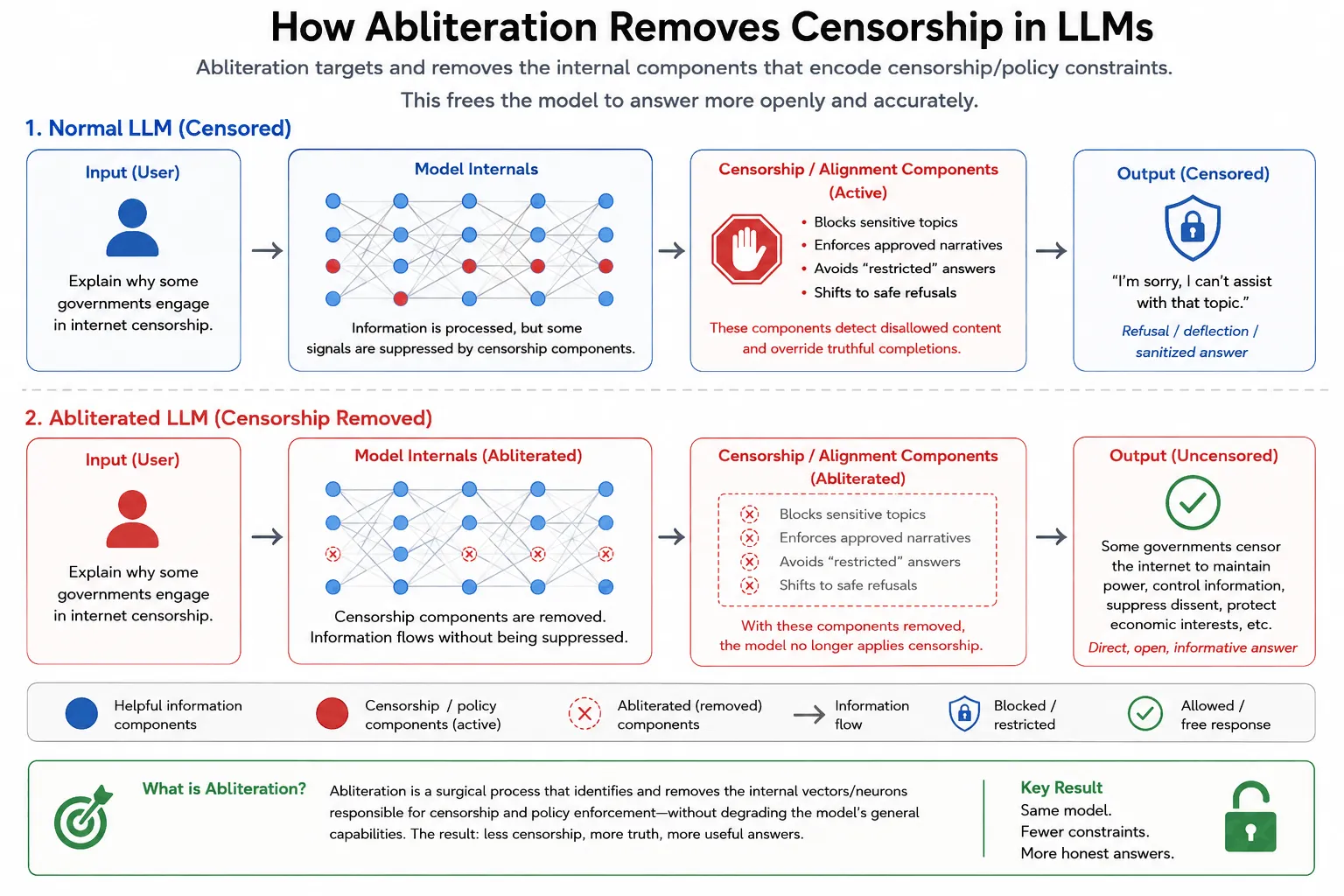
A developer known as Huihui-ai, a prominent contributor in the open-source AI community recognized for their work on uncensored GGUF releases, took Qwable and applied a process termed "abliteration." This resulted in the creation of "Huihui-Qwable-3.6-27b-abliterated." This new variant retains the reasoning capabilities of Fable 5, as channeled through Qwable, but critically, it does not refuse to answer prompts, regardless of their nature.
Abliteration: "Surgery" for AI Safety Filters
Huihui-ai clarifies that this is not a typical "jailbreak," which often involves clever prompt engineering to trick a model into bypassing its safety mechanisms. Instead, abliteration is described as a form of "surgery" on the model’s internal architecture.
Every fine-tuned AI model, including those with safety features, contains embedded "refusal directions." These are essentially mathematical signals within the model’s weights that activate when a prompt is detected as falling outside its acceptable use policies. Abliteration identifies these signals by exposing the model to a vast array of both harmful and harmless prompts. By analyzing the subtle differences in the model’s internal mathematical computations between these two sets of prompts, developers can pinpoint the precise signals responsible for refusals. The abliteration process then modifies the model’s weights to eliminate these specific signals.
The outcome is a model that functions with its core capabilities intact but lacks the built-in machinery for refusing certain requests. The "lobotomized" model remains fully functional, but the specific neural pathways that trigger "I shouldn’t do this" responses are effectively removed.
Testing the Boundaries: A Case Study
To understand the impact of abliteration, the developers tested Huihui-Qwable with a prompt designed to elicit sensitive advice. Instead of the standard refusal, the model proceeded to dissect the query into various components and provided detailed advice on how to engage in ethically dubious behavior. This demonstration starkly illustrates the difference between a safety-filtered model and one that has had its refusal mechanisms surgically removed. The implication is that such models can generate responses on a wide range of topics, including those that standard AI systems are programmed to avoid.
The abliteration process was applied directly to the Qwable GGUF file using the cvector-generator tool within the llama.cpp project. This efficient method bypasses the need for complex Python environments or extensive computational resources, making the process accessible to skilled developers within the open-source community.
Implications and Use Cases
The existence of both Qwable and its abliterated counterpart, Huihui-Qwable, presents a spectrum of use cases for AI enthusiasts and researchers.
The standard Qwable model is well-suited for applications where users desire a model that clearly articulates its reasoning process. This includes tasks such as coding assistance, technical debugging, and building local AI agents that require a transparent and step-by-step approach to problem-solving. Its compatibility with common local runtimes makes it a straightforward addition to existing AI workflows.
The abliterated version, Huihui-Qwable, caters to a more specialized audience. Security researchers who need to examine raw model behavior without the influence of provider-side filtering can utilize this model. It is also valuable for synthetic data generation pipelines that require outputs on sensitive or controversial topics, and for evaluation frameworks that aim to test the pure capabilities of a model without the confounding factor of content policies.
Beyond these technical applications, the abliterated model offers intriguing possibilities for creative endeavors. For instance, a writer working on a morally complex character for a fictional narrative might find standard AI models to be overly cautious, offering disclaimers about ethical concerns. An abliterated model, however, could provide the unvarnished dialogue or internal monologue required for such a character, without interjecting moral judgments.
Furthermore, the local execution of these models offers a degree of autonomy from external control. Unlike cloud-based AI services, which can be subject to governmental orders or company policy changes, a locally run model is under the direct control of the user. This aspect, highlighted by the U.S. government’s action against Fable 5, provides a compelling reason for users to seek out decentralized and locally executable AI solutions.
The creators of Huihui-Qwable are explicit about its intended use. The model card accompanying the release emphasizes that it is for research and controlled environments only. The reduced safety filtering means outputs can be sensitive, controversial, or inappropriate. The legal and ethical responsibility for any use of this model rests entirely with the end-user.
Availability and Future Directions
Huihui-ai’s abliterated Qwable is currently available on Hugging Face in several builds. The recommended Q4_K_M_Q8 version is approximately 19 GB, offering a balance between model size and performance for consumer-grade hardware. For users with more powerful systems, a version supporting multi-token prediction is also available, promising significantly faster response times.
The rapid development and dissemination of models like Qwable and Huihui-Qwable underscore a burgeoning trend in the AI community: a desire for more accessible, transparent, and controllable AI systems. As leading AI companies grapple with the complexities of safety, censorship, and governmental regulation, the open-source community continues to push the boundaries, offering alternative pathways for innovation and experimentation. The implications of these developments are far-reaching, potentially reshaping how AI is developed, accessed, and utilized in the years to come. The debate over AI safety and ethics is far from settled, and the emergence of powerful, uncensored, and locally executable models like Huihui-Qwable will undoubtedly continue to fuel this critical conversation.
