
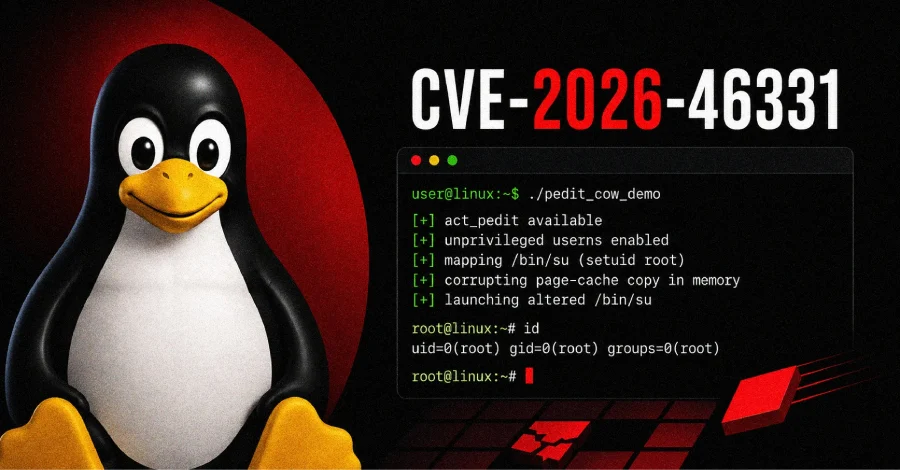

A critical vulnerability, identified as CVE-2026-46331 and colloquially dubbed "pedit COW," has been discovered in the Linux kernel’s traffic-control subsystem, presenting a significant risk of local unprivileged users gaining root access on affected systems. This flaw, an out-of-bounds write within the packet-editing action (act_pedit), allows for the corruption of shared page-cache memory, leading to potential complete system compromise. The seriousness of this vulnerability was underscored by the rapid emergence of a public, working exploit on GitHub within a single day of the CVE’s assignment on June 16, 2026. Major Linux distribution vendor Red Hat has rated this flaw as "important," emphasizing the immediate need for system administrators to address the issue.
The "pedit COW" exploit operates with a sophisticated stealth, never directly altering files on disk. Instead, it strategically poisons the cached copy of a setuid root binary—such as /bin/su—residing in memory. By injecting a small, malicious payload into this altered in-memory image, the attacker can then execute it with root privileges. A critical aspect of this attack is its evasiveness: standard file-integrity checks, which typically scrutinize the on-disk state, will report the system as clean, even while a root shell is actively controlled by an attacker. This characteristic makes the vulnerability particularly insidious, as traditional security monitoring tools might fail to detect the initial compromise.
For the exploit to succeed, two specific conditions must be met on the target system. Firstly, the act_pedit kernel module must be loadable. This module is part of the Linux traffic control (tc) framework, designed for advanced network packet manipulation. Secondly, unprivileged user namespaces must be enabled and accessible. User namespaces provide a way for unprivileged users to create isolated environments with administrative capabilities within their own namespace, including the crucial CAP_NET_ADMIN capability. This networking capability is precisely what the attacker leverages to trigger the underlying bug in act_pedit. During testing, both Red Hat Enterprise Linux (RHEL) and Debian targets were found to have these prerequisites present by default, highlighting the broad applicability of the exploit.
Technical Breakdown: Understanding the "pedit COW" Mechanism
The core of the "pedit COW" vulnerability lies within the tcf_pedit_act() function, a kernel component responsible for modifying packet headers using the pedit action of the tc traffic-control tool. Conventionally, when kernel functions perform modifications on data that might be shared, they adhere to a "copy-on-write" (COW) pattern. This means a private copy of the data is made before any edits occur, ensuring that modifications do not inadvertently affect other processes or shared memory regions.
However, the "pedit COW" flaw circumvents this protective mechanism. The tcf_pedit_act() function was designed to check the writable range of data only once, at an initial stage, before all final offsets for packet editing were definitively known. Critically, some "edit keys" used by pedit only resolve their precise offset at runtime. When such a late-resolved offset is used, the write operation lands outside the bounds of the privately copied region. Consequently, instead of modifying a temporary, isolated copy, the kernel writes directly into a shared page-cache page. If this compromised page happens to belong to a cached file, the file’s in-memory image becomes corrupted. This corruption, in the context of a setuid root binary like /bin/su, allows an attacker to inject arbitrary code that will then be executed with elevated privileges.
This pattern of a kernel fast path writing into a page it does not exclusively own, leading to page cache corruption, is disturbingly familiar. It echoes a series of high-profile Linux kernel vulnerabilities discovered in recent years. Notable predecessors include "Dirty Pipe" (CVE-2022-0847), "Copy Fail" (CVE-2026-XXXXX), "DirtyClone" (CVE-2026-XXXXX), and "Dirty Frag" (CVE-2026-XXXXX). All these flaws exploited similar weaknesses in how the kernel manages memory and caches, demonstrating a recurring challenge in ensuring memory isolation and integrity within highly optimized kernel code paths. What distinguishes "pedit COW" is its novel entry point: the ability for an unprivileged user to configure tc actions from within a user namespace, thereby gaining the CAP_NET_ADMIN capability necessary to trigger the bug.

Chronology of Disclosure and Rapid Weaponization
The timeline of "pedit COW" highlights the critical speed with which kernel vulnerabilities can be weaponized once publicly known. The fix for the underlying issue was initially submitted and discussed on the netdev mailing list in late May 2026. At that time, it was framed as a routine data-corruption patch, without any explicit mention of its security implications or a corresponding CVE. For weeks, the exploitable detail remained publicly accessible on this mailing list, unnoticed as a severe security flaw.
The situation dramatically changed on June 16, 2026, when the fix was formally merged into the kernel, and the CVE-2026-46331 identifier was assigned. This action immediately flagged the issue as a security vulnerability. The impact was swift and profound: within a single day of the CVE assignment and the fix’s integration, a fully functional and publicly available proof-of-concept (PoC) exploit appeared on GitHub. This rapid weaponization underscores the constant race between vulnerability disclosure, patching, and exploitation in the open-source software ecosystem. It demonstrates that for kernel page-cache corruption bugs, relying solely on scanner rules or delayed patching strategies is often insufficient, as attackers can move from discovery to weaponization in a matter of hours.
Affected Distributions and Severity Assessment
The "pedit COW" vulnerability has been confirmed to impact several widely used Linux distributions, albeit with varying degrees of exploitability depending on default configurations. The PoC author successfully achieved unprivileged-to-root privilege escalation on:
- Red Hat Enterprise Linux (RHEL) 10: On this target, both necessary conditions for exploitation—
act_peditloadability and open unprivileged user namespaces—were present by default. This makes RHEL 10 systems highly susceptible if not patched. - Debian 13 (trixie): Similar to RHEL 10, Debian 13 also maintained both exploit prerequisites by default, rendering it vulnerable to the "pedit COW" attack.
- Ubuntu 24.04: While Ubuntu 24.04 systems are vulnerable at the kernel level, exploitation required routing execution through specific AppArmor profiles that still permitted user namespaces. This implies a slightly higher barrier to entry for attackers compared to RHEL and Debian.
- Ubuntu 26.04: This version of Ubuntu offers enhanced protection by default. Its AppArmor profiles restrict unprivileged user namespaces, effectively blocking the exploit path, even though the underlying kernel code remains vulnerable. This highlights the importance of layered security measures beyond just kernel code.
Red Hat’s classification of the flaw as "important" signifies a vulnerability that could allow unprivileged local users to compromise the integrity, availability, or confidentiality of user data or to gain elevated privileges. This rating typically warrants immediate attention and patching from system administrators, especially for systems exposed to untrusted local users.
Broader Impact and Implications for System Security
The "pedit COW" vulnerability, as part of a recurring pattern of page-cache corruption flaws, carries significant implications for system security and operational integrity. These types of vulnerabilities are particularly dangerous due to their ability to facilitate privilege escalation with high stealth. Because the exploit modifies in-memory copies rather than on-disk files, traditional file-integrity monitoring tools—which are cornerstones of many security postures—are rendered ineffective in detecting the initial compromise. This creates a blind spot for security teams, potentially allowing an attacker to maintain root access undetected for extended periods.
The rapid weaponization of "pedit COW" following its CVE assignment underscores a broader challenge for system administrators and security professionals. In an era where vulnerability information is quickly disseminated and sophisticated exploit development tools are readily available, the window for patching systems before they are targeted is shrinking. This necessitates a proactive and agile approach to vulnerability management, prioritizing patches for critical kernel flaws as soon as they become available.
Moreover, the reliance of the exploit on unprivileged user namespaces highlights the ongoing tension between security and functionality. User namespaces are fundamental to modern containerization technologies (like Docker and Kubernetes rootless containers), sandboxed applications, and CI/CD pipelines, offering enhanced isolation and flexibility. Disabling them outright, while a valid mitigation in some contexts, can severely impact operational capabilities. This forces organizations to carefully weigh the security benefits against potential disruptions to their infrastructure and development workflows. The "pedit COW" flaw thus serves as a stark reminder that even seemingly isolated or low-privilege kernel features can, when combined with other system configurations, become potent vectors for full system compromise.

Recommendations and Mitigation Strategies
Given the critical nature of CVE-2026-46331 and the existence of a public exploit, immediate action is paramount for system administrators.
1. Install Patched Kernel and Reboot:
The most effective and recommended mitigation is to install the patched kernel provided by your distribution vendor and promptly reboot the system. This directly addresses the underlying flaw and prevents exploitation. Prioritize patching for systems where "local user" does not imply a trusted entity. This includes:
- Multi-tenant hosts: Cloud instances, shared servers.
- CI/CD runners: Systems executing untrusted build or test jobs.
- Kubernetes nodes: Especially those running multi-tenant workloads.
- Build workers and shared research/lab machines: Environments where multiple users might have local access.
2. Temporary Mitigations (If Immediate Patching is Not Possible):
If immediate patching and rebooting are not feasible, two temporary mitigations can break the exploit chain:
*   **Block `act_pedit` Module Loading:** If your systems do not explicitly require `tc pedit` rules, you can prevent the vulnerable module from loading.
    *   First, check if the module is currently in use: `lsmod | grep act_pedit`.
    *   Then, block it from loading by creating a modprobe configuration file:
        ```bash
        echo 'install act_pedit /bin/true' | sudo tee /etc/modprobe.d/disable-act_pedit.conf
        ```
    This command instructs the kernel to execute `/bin/true` instead of loading the `act_pedit` module, effectively disabling it.

*   **Disable Unprivileged User Namespaces:** This mitigation removes the `CAP_NET_ADMIN` capability that the exploit needs. However, it comes with significant caveats, as it can break functionality that relies on user namespaces.
    *   On RHEL systems, set `user.max_user_namespaces=0`.
    *   On Debian/Ubuntu systems, set `kernel.unprivileged_userns_clone=0`.
    *   **Warning:** Disabling unprivileged user namespaces will break rootless containers, some CI sandboxes, and sandboxed browsers. Thorough testing is crucial before implementing this mitigation in production environments.
3. Detection and Post-Compromise Actions:
Due to the nature of this vulnerability, where the overwrite targets cached memory, traditional file-integrity checks (e.g., aide, rpm -V, dpkg -V) may not detect the compromise. They will report clean results because the on-disk file remains untouched.
- Dropping the page cache (
echo 3 > /proc/sys/vm/drop_caches) will clear the poisoned in-memory copy of the binary. However, this action does not revoke any root shells or persistent access an attacker may have already established. If an attacker has already exploited the flaw and gained root access, dropping the cache will not revert their privileges. - Treat the host as compromised: If there is any indication of successful exploitation, or if a vulnerable unpatched system has been exposed to untrusted local users, the safest course of action is to treat the host as compromised. This typically involves isolating the system, performing a forensic analysis, and rebuilding it from a trusted image.
The "pedit COW" vulnerability serves as a potent reminder of the ongoing need for vigilance in Linux system administration. The rapid public disclosure of the fix, followed by almost immediate weaponization, highlights the shrinking window for defensive action. Proactive patching, understanding the system’s attack surface, and implementing robust, multi-layered security controls are indispensable in defending against such sophisticated and stealthy kernel-level attacks.
