
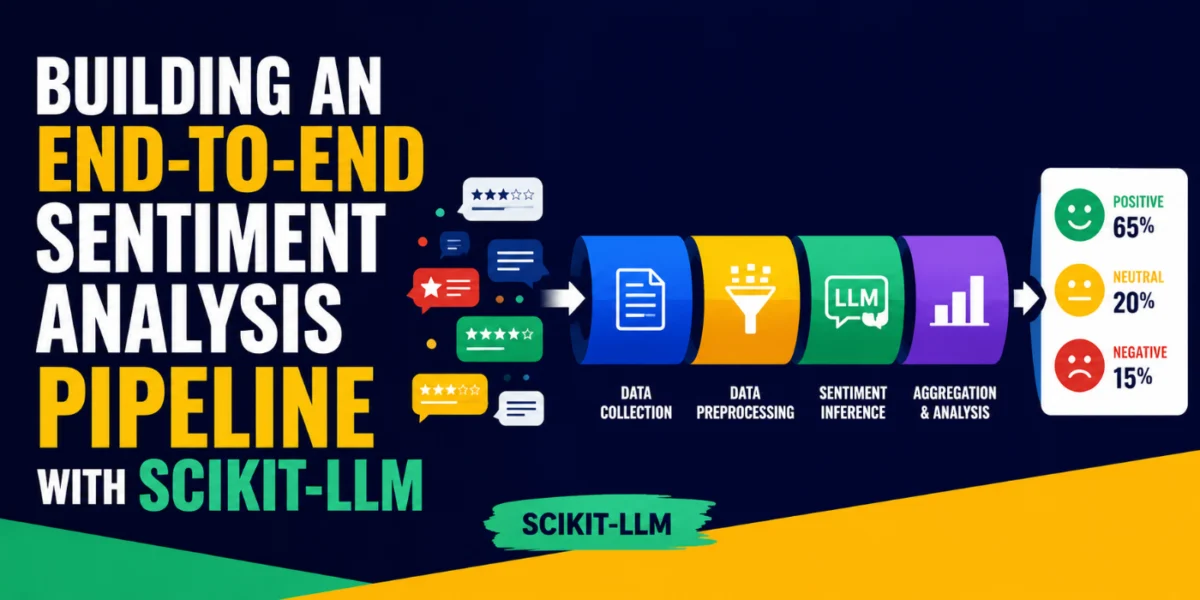

A significant advancement in natural language processing (NLP) workflow integration has been demonstrated through the successful construction of an end-to-end sentiment analysis pipeline. This pipeline leverages the Scikit-LLM library, designed to bridge traditional machine learning frameworks with modern large language models (LLMs), and utilizes open-source LLMs served via the high-speed Groq API. The methodology, validated on the extensive IMDB movie reviews dataset, showcases a robust and efficient approach to text classification, achieving an impressive 95% accuracy in distinguishing between positive and negative sentiments. This development signifies a critical step in democratizing access to powerful LLM capabilities for data scientists and developers already familiar with the Scikit-learn ecosystem, offering a pathway to deploy sophisticated AI solutions with enhanced speed and operational efficiency.
The Evolving Landscape of Natural Language Processing
For decades, predictive tasks in NLP, such as text classification, primarily relied on traditional machine learning pipelines. These typically involved meticulous feature engineering, where raw text was transformed into structured, numerical representations like TF-IDF frequencies or token embeddings. These features were then fed into classical models such as logistic regression, ensemble methods, or support vector machines. While effective, this approach often demanded considerable expertise in feature engineering, was computationally intensive for large datasets, and required retraining for domain-specific tasks, leading to slower development cycles and higher resource consumption.
The advent of large language models (LLMs) has fundamentally reshaped this paradigm. LLMs, with their vast pre-trained knowledge and transformer architectures, introduced capabilities like zero-shot and few-shot reasoning. This allows them to perform language tasks with minimal or no specific training data for a new task, by simply understanding the prompt. This shift has moved the focus from intricate feature engineering to effective prompt design and leveraging the inherent understanding of language embedded within these massive models. However, integrating these powerful, often API-driven LLMs into established machine learning workflows, particularly those built around popular libraries like Scikit-learn, presented a new challenge.
Scikit-LLM: Bridging the Gap
Enter Scikit-LLM, a Python library specifically designed to reconcile the robust, familiar API of Scikit-learn with the cutting-edge capabilities of LLM API calls. Scikit-LLM acts as an essential connector, enabling data scientists to integrate LLMs into their existing machine learning pipelines without having to abandon the structured, iterative development processes they are accustomed to. By adhering to Scikit-learn’s fit, predict, and transform conventions, Scikit-LLM allows for the seamless inclusion of LLM-powered components within pipelines, alongside traditional preprocessing steps. This integration facilitates a more streamlined workflow, reduces the learning curve for ML practitioners adopting LLMs, and allows for the application of well-established MLOps practices to LLM-driven solutions. Industry analysts suggest that tools like Scikit-LLM are crucial for accelerating the adoption of advanced AI in enterprise environments, making complex models more accessible and manageable.
Groq’s Contribution: High-Speed, Open-Source Inference
A pivotal component of this integrated pipeline is the utilization of the Groq API for serving open-source LLMs. Groq distinguishes itself by offering ultra-fast inference speeds, a critical factor for real-time applications and large-scale data processing. Unlike many conventional GPU-based LLM inference solutions, Groq’s unique Language Processor Unit (LPU) architecture is optimized for low-latency, high-throughput LLM operations. This capability is particularly significant when dealing with realistically-sized datasets, where the cumulative inference time can become a bottleneck.
For this sentiment analysis pipeline, Scikit-LLM was configured to route its internal requests to Groq’s OpenAI-compatible endpoint (https://api.groq.com/openai/v1). This compatibility ensures that developers can leverage Groq’s speed with minimal changes to their existing LLM integration code. The selection of Groq’s active Llama 3.1 8B model further underscores a commitment to open-source solutions, combining community-driven model development with a high-performance serving infrastructure. Obtaining an API key from the Groq console is a straightforward initial step, allowing users to quickly connect and begin leveraging this powerful backend. The blend of Scikit-LLM’s integration capabilities and Groq’s optimized inference provides a compelling argument for efficient and scalable LLM deployment.
Dataset Acquisition and Preparation: The IMDB Movie Reviews
The chosen dataset for demonstrating this pipeline was the IMDB Movie Reviews dataset, a widely recognized benchmark in text classification, comprising approximately 50,000 movie reviews, each labeled as either ‘positive’ or ‘negative’. This binary classification problem presents a realistic challenge due to the sheer volume of data and the inherent complexities of natural language, including the presence of informal language, slang, and structural noise.
For convenience and to ensure reproducibility, the dataset was sourced from a publicly available GitHub repository in CSV format. While the full dataset boasts 50,000 rows, a pragmatic decision was made to sample 500 rows for the demonstration. This sampling strategy was primarily driven by considerations for free-tier API usage and computational resources, as processing 50,000 requests through a free LLM API endpoint would likely trigger quota limits and incur substantial execution times. Developers with paid API access or more substantial computing resources can readily adjust the sample size to process larger portions or the entirety of the dataset. The IMDB dataset is particularly well-suited for demonstrating robust preprocessing, as it inherently contains HTML tags and varied formatting noise within the review texts, providing an ideal scenario for testing the cleaning components of the pipeline. The dataset was subsequently split into training and testing sets (80/20 split) to prepare for model fitting and evaluation.
Constructing the End-to-End Sentiment Analysis Pipeline
The core of this demonstration lies in the construction of a Scikit-learn compatible pipeline, orchestrating the entire process from raw text to sentiment prediction. This pipeline encapsulates both preprocessing and the LLM-based classification, reflecting best practices in machine learning engineering.
1. Data Preprocessing and Cleaning:
The initial step in any text-based pipeline is typically data cleaning and normalization. Raw text data often contains irrelevant characters, formatting, or noise that can hinder model performance. For the IMDB dataset, this specifically involved removing HTML tags (e.g., <br />) and normalizing whitespace. Scikit-learn’s FunctionTransformer provides an elegant mechanism to integrate custom Python functions directly into a pipeline. A clean_text_data function was defined to:
- Convert input texts to a pandas Series for efficient string operations.
- Utilize regular expressions (
r'<[^>]+>') to remove all HTML tags. - Strip leading/trailing whitespace and replace multiple internal spaces with single spaces (
r's+').
ThisFunctionTransformerinstance, namedtext_cleaner, became the first stage of the pipeline, ensuring that the LLM receives clean, standardized text inputs.
2. Integrating the Zero-Shot LLM Classifier:
The modern component of the pipeline is the LLM-based classifier. Scikit-LLM provides ZeroShotGPTClassifier, a class that allows for zero-shot text classification using various LLM backends. In a zero-shot setup, the LLM classifies text based on its pre-trained understanding of language and the provided labels, without requiring specific examples for each category. This means the model does not "learn" weights during the fit() phase in the traditional sense; instead, fit() serves to register the unique classification labels ('positive', 'negative') that the LLM will use in its reasoning process.
The ZeroShotGPTClassifier was instantiated with model="custom_url::llama-3.1-8b-instant", explicitly directing Scikit-LLM to use the specified Groq-served Llama 3.1 8B model. This strategic choice capitalizes on Groq’s high-speed inference for quick and efficient predictions.
3. Assembling the Pipeline:
The Scikit-learn Pipeline object seamlessly chains these components. The sentiment_pipeline was defined as a sequence:
("cleaner", text_cleaner) followed by
("llm_classifier", ZeroShotGPTClassifier(model="custom_url::llama-3.1-8b-instant")).
This structure ensures that raw text first passes through the text_cleaner and then the cleaned output is fed directly into the ZeroShotGPTClassifier. The fit() method was then called on sentiment_pipeline with the training data (X_train, y_train). As noted, for zero-shot classification, this step primarily informs the LLM classifier about the target labels. This integrated approach simplifies model management, prevents data leakage between preprocessing and modeling, and promotes a clean, reproducible development process.
Performance Evaluation and Practical Demonstrations
Following the fitting phase, the pipeline was invoked to make predictions on the unseen test set (X_test). The predict() method executed the entire chain, from cleaning the test reviews to generating sentiment labels using the Groq-powered LLM.
The performance of the pipeline was rigorously evaluated using sklearn.metrics.classification_report, a standard tool for assessing classification model accuracy. The results were highly encouraging:
--- Classification Report ---
              precision    recall  f1-score   support

    negative       0.95      0.97      0.96        60
    positive       0.95      0.93      0.94        40

    accuracy                           0.95       100
   macro avg       0.95      0.95      0.95       100
weighted avg       0.95      0.95      0.95       100
The pipeline achieved an overall accuracy of 95% on the test set. For ‘negative’ sentiment, the model demonstrated a precision of 0.95 and a recall of 0.97, indicating a strong ability to correctly identify negative reviews while minimizing false negatives. For ‘positive’ sentiment, precision stood at 0.95 and recall at 0.93, showing similar robust performance. These metrics underscore the effectiveness of combining Scikit-LLM’s integration capabilities with Groq’s high-performance LLM inference. The execution of these predictions, even for the sampled data, took a few minutes, highlighting the computational demands of LLM inference, even when optimized.
To provide a qualitative understanding of the pipeline’s performance, several sample predictions were displayed alongside their actual labels:
- Review: "I saw mommy…well, she wasn’t exactly kissing Santa Clause; he has his hand on her thigh and wicked…"
Actual: negative | Predicted: negative - Review: "This entry is certainly interesting for series fans (like myself), but yet it is mostly incomprehens…"
Actual: negative | Predicted: negative - Review: "Ingrid Bergman (Cleo Dulaine) has never been so beautiful. Gary Cooper as "Cleent" so perfectly cast…"
Actual: positive | Predicted: positive
These examples confirm the pipeline’s capability to accurately interpret the underlying sentiment even in truncated review texts, demonstrating a practical success in sentiment classification.
Strategic Implications and Future Outlook
The successful implementation of this sentiment analysis pipeline carries significant implications for the broader field of machine learning and AI development.
Efficiency in Development: For organizations and developers deeply invested in the Scikit-learn ecosystem, Scikit-LLM offers an intuitive and efficient pathway to integrate advanced LLM capabilities without a complete paradigm shift. This reduces development time and allows existing ML talent to quickly leverage the power of LLMs.
Cost-Effectiveness and Scalability: By utilizing open-source LLMs through optimized inference providers like Groq, businesses can achieve powerful NLP capabilities at potentially lower operational costs compared to proprietary, high-latency LLM services. Groq’s focus on speed also addresses the scalability challenge, making it feasible to process large volumes of text data in production environments.
Real-time Applications: The high-speed inference offered by Groq opens doors for real-time sentiment analysis in applications such as live customer service chat monitoring, immediate feedback analysis for marketing campaigns, or real-time content moderation. This was previously challenging with slower LLM inference speeds.
Democratization of Advanced NLP: This approach makes sophisticated LLM capabilities more accessible to a wider audience of data scientists and developers. It lowers the barrier to entry for integrating state-of-the-art AI into diverse applications, fostering innovation across various industries, from customer experience management to market research and beyond.
Future Considerations: While highly effective, future developments may focus on optimizing prompt engineering within Scikit-LLM for even finer-grained control over LLM behavior, exploring few-shot and fine-tuning options for highly specific domains, and integrating more robust explainability features for LLM decisions. The blend of classical ML frameworks with modern LLM capabilities, exemplified by Scikit-LLM and Groq, represents a robust and versatile approach to building intelligent systems.
In conclusion, the construction of this end-to-end sentiment analysis pipeline underscores the transformative potential of combining established machine learning practices with cutting-edge large language models. The integration of Scikit-LLM with Groq’s high-speed, open-source LLM inference capabilities provides a powerful, efficient, and accessible solution for sophisticated text classification tasks, setting a new benchmark for practical AI deployment.
