

New York City, NY – June 17, 2026 – Amazon Web Services (AWS) today announced a suite of transformative enhancements to its agentic AI offerings at the highly anticipated AWS Summit in New York City. The keynote address, delivered by Swami Sivasubramanian, AWS Vice President of Agentic AI, underscored the company’s strategic commitment to empowering enterprises with more intelligent, autonomous, and governable artificial intelligence solutions. These advancements, particularly within Amazon Bedrock AgentCore and the introduction of autonomous agents in Amazon Quick, are poised to redefine how businesses leverage AI for operational efficiency, problem-solving, and personalized productivity.
The AWS Summit New York City serves as a pivotal platform for the cloud giant to showcase its latest innovations, attracting thousands of developers, IT professionals, and business leaders keen to explore the cutting edge of cloud computing and artificial intelligence. Sivasubramanian’s presence at the keynote, specifically in his capacity overseeing Agentic AI, signals AWS’s intensified focus on developing AI systems capable of understanding, planning, and executing complex tasks with minimal human intervention. This direction aligns with the broader industry trend towards more sophisticated, goal-oriented AI applications that move beyond mere generative capabilities to active problem-solving.
Revolutionizing AI Agent Capabilities with Amazon Bedrock AgentCore
At the heart of today’s announcements are significant new capabilities introduced within Amazon Bedrock AgentCore, AWS’s foundational service for building, deploying, and managing generative AI applications. These enhancements directly address critical enterprise needs for broader knowledge integration, continuous learning, and robust governance for AI agents.
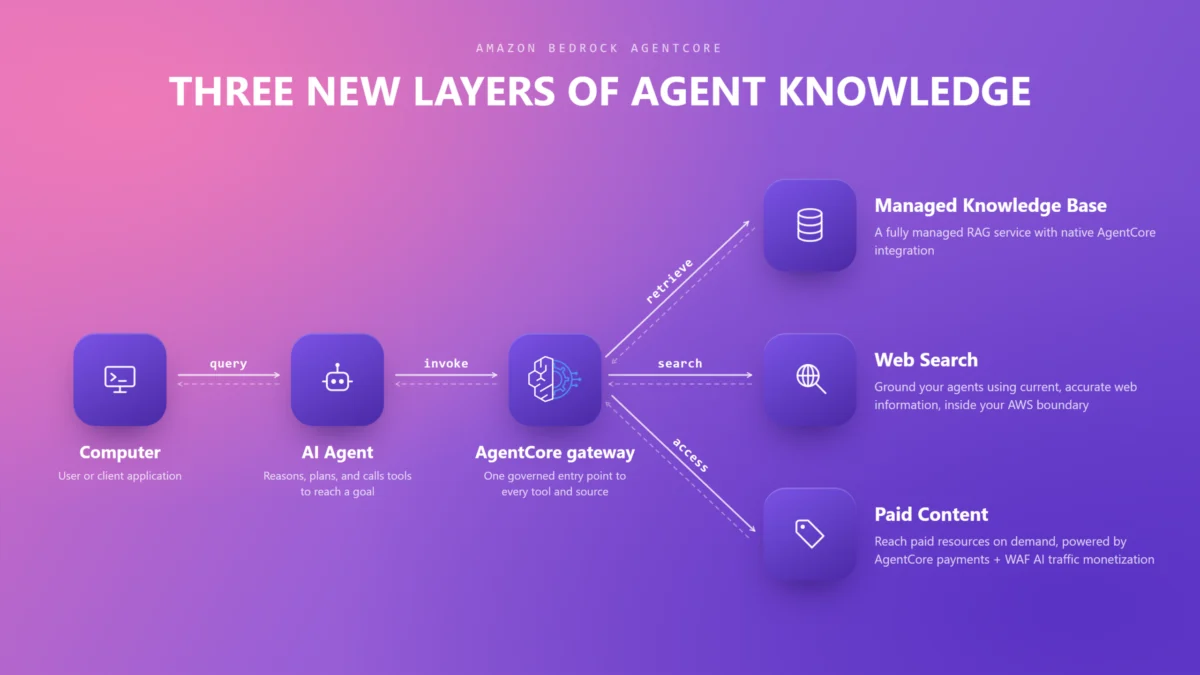
One of the most impactful updates allows AI agents built on Bedrock AgentCore to seamlessly connect with a vast array of knowledge sources. This includes intricate organizational data, dynamic web information, and even proprietary paid knowledge bases. For many enterprises, the true power of AI has been hampered by siloed information and the inability of AI models to access real-time, context-specific data. By enabling agents to tap into internal databases, CRM systems, ERP platforms, public web resources, and licensed datasets, AWS is breaking down these barriers. This expanded access ensures that AI agents can operate with a much richer understanding of their domain, leading to more accurate responses, more informed decisions, and more effective task execution. For instance, a customer service agent could instantly pull up specific product details from an internal knowledge base, cross-reference customer history from a CRM, and even check external regulatory compliance guidelines, all in real-time.
Furthermore, AWS is equipping AgentCore with advanced features designed to help teams proactively identify and rectify issues in production environments. This capability marks a significant leap towards self-healing and continuously improving AI systems. In complex enterprise settings, monitoring the performance of AI agents and diagnosing failures can be a resource-intensive task. The new AgentCore tools empower teams to gain deeper insights into agent behavior, detect anomalies, pinpoint root causes of errors, and even suggest or initiate corrective actions. This not only minimizes downtime and operational disruptions but also fosters a culture of continuous optimization, ensuring that AI agents evolve and become more reliable over time. Industry analysts have consistently highlighted operational reliability and error handling as critical challenges for enterprise-scale AI deployments, and these new features directly address those concerns.
Crucially, as AI agents become more autonomous and capable, the need for stringent governance and control mechanisms becomes paramount. AWS is responding to this imperative by introducing scalable enforcement controls within AgentCore. These controls are designed to grow in sophistication as agents develop, providing businesses with the confidence to deploy highly intelligent systems without compromising security, compliance, or ethical guidelines. This includes granular access controls, audit trails for agent actions, policy enforcement for data usage, and mechanisms to ensure agents operate within defined boundaries. The ability to govern agents effectively at scale is a non-negotiable requirement for enterprises, particularly in regulated industries, and AWS’s commitment to these controls is expected to accelerate broader adoption of agentic AI. These combined capabilities – broader knowledge integration, continuous learning, and scalable governance – form a robust framework for building, managing, and continuously enhancing AI agents that are not only powerful but also trustworthy and reliable.
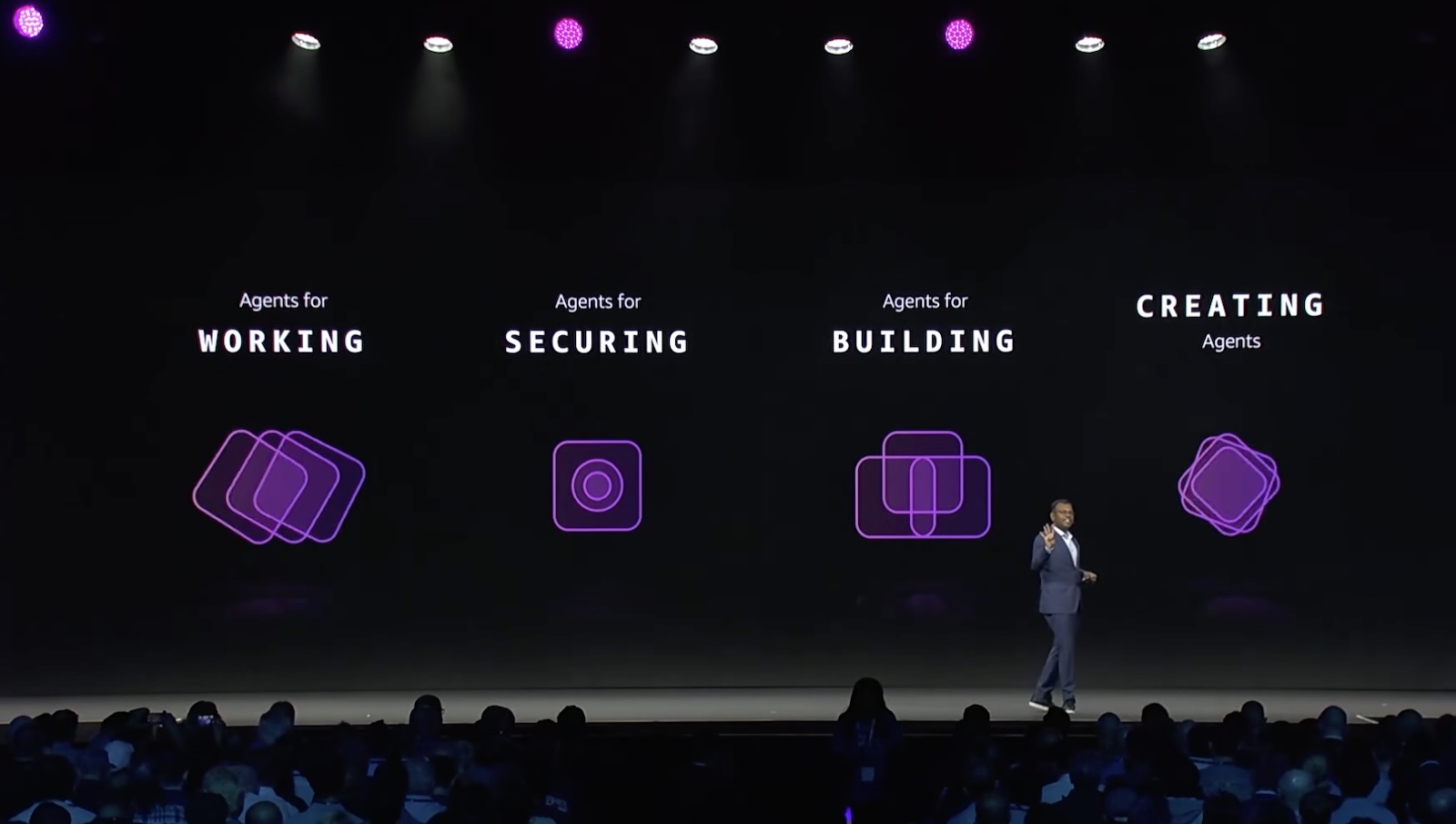
While specific details regarding "new in agents for securing" and "new in agents for building" were not extensively elaborated during the keynote, industry observers anticipate that these categories would encompass critical advancements. "New in agents for securing" likely refers to enhanced security protocols inherent to the agents themselves, including improved data encryption for information accessed or processed by agents, more robust identity and access management (IAM) policies tailored for agent interactions, and advanced threat detection capabilities to safeguard against malicious agent behavior or external attacks. The focus here would be on ensuring that as agents gain more autonomy and access to sensitive data, their operational security posture is uncompromised. Similarly, "new in agents for building" is expected to signify improvements in developer tooling, low-code/no-code interfaces, or perhaps new API integrations that streamline the creation, customization, and deployment of AI agents for a wider range of developers and business users. These advancements would collectively aim to lower the barrier to entry for agent development and foster a more vibrant ecosystem of specialized AI agents.
Transforming Workplace Productivity with Amazon Quick Autonomous Agents

Beyond Bedrock AgentCore, AWS also unveiled groundbreaking innovations within Amazon Quick, introducing new autonomous agents designed to fundamentally reshape individual and team productivity. Amazon Quick, AWS’s AI assistant, is expanding its capabilities to include specialized agents that operate intelligently in the background, equipped with specific expertise, predefined tones, and access to a suite of tools.
This development enables the creation of highly specialized "digital colleagues." For instance, a finance agent can be configured to autonomously process incoming orders, reconcile invoices, or flag discrepancies, integrating seamlessly with existing enterprise resource planning (ERP) systems. Similarly, a sales agent can be deployed to monitor interactions across various channels – CRM platforms, email communications, and collaborative tools like Slack – proactively drafting follow-up messages, identifying potential risks in deal progressions, or recommending strategic next steps to human sales representatives. These agents are not merely reactive chatbots; they are proactive, context-aware entities designed to offload repetitive, time-consuming tasks, thereby freeing up human employees to focus on higher-value, more strategic activities that require nuanced judgment and creativity.
A particularly innovative feature introduced alongside these autonomous agents is a new activity feed tailored to individual work styles. This intelligent feed goes beyond simple aggregation, consolidating emails, messaging app conversations, calendar events, and task lists into a single, prioritized view. What sets it apart is its ability to learn and adapt to user behavior. The feed intelligently identifies which messages a user typically responds to quickly, which threads are often skipped, and what topics consistently drive their weekly agenda. By leveraging this learned behavior, the activity feed dynamically prioritizes information, reduces cognitive overload, and ensures that critical tasks and communications are brought to the forefront. This personalized approach to information management represents a significant step towards combating the pervasive challenge of digital overwhelm, enabling professionals to navigate their daily responsibilities with greater clarity and efficiency.
The implications of Amazon Quick’s autonomous agents and intelligent activity feed are profound for the future of work. They herald a new era of hyper-personalized productivity, where AI acts as a sophisticated co-pilot, intelligently managing routine workflows and providing timely, relevant insights. This shift is expected to lead to substantial gains in operational efficiency, reduced human error in data processing, and an overall enhancement in employee engagement as tedious tasks are automated. For businesses, this translates into potential cost savings, faster execution of business processes, and improved decision-making capabilities.
Broader Impact and Strategic Implications
These announcements from the AWS Summit New York City are not just incremental updates; they represent a significant strategic push by AWS to solidify its leadership in the rapidly evolving landscape of generative AI and agentic systems. With enterprises increasingly seeking practical, deployable AI solutions that deliver tangible business value, AWS is positioning itself as a comprehensive provider, offering both the foundational models (via Amazon Bedrock) and the sophisticated orchestration layers (Bedrock AgentCore) required to build and manage highly capable AI agents.
The focus on governance, security, and continuous improvement for AI agents addresses key concerns that have historically slowed enterprise AI adoption. By providing robust controls and a framework for reliable operation, AWS is fostering greater trust and confidence in deploying autonomous AI. This strategy is critical in a competitive market where other cloud providers and AI companies are also vying for dominance. AWS’s approach emphasizes practical utility, scalability, and enterprise-readiness, distinguishing its offerings in a crowded field.
From an economic perspective, the ability to automate complex workflows and enhance individual productivity has immense potential. Industry reports consistently point to the multi-trillion-dollar potential of generative AI to boost global GDP. By enabling companies to build custom agents that integrate deeply with their specific operations and by providing intelligent personal assistants, AWS is empowering its customers to unlock a significant portion of this value. This includes optimizing supply chains, enhancing customer experiences, accelerating product development cycles, and improving financial management.
The timeline of these developments is also noteworthy. The keynote and subsequent announcements on June 17, 2026, followed by additional important launches updated on June 18, 2026, underscore the rapid pace of innovation within AWS. This continuous stream of updates reflects the dynamic nature of the AI field and AWS’s commitment to staying at the forefront, regularly introducing new features and improvements to meet evolving customer demands.
In conclusion, the AWS Summit New York City has served as a powerful showcase for the next generation of artificial intelligence. Swami Sivasubramanian’s keynote highlighted a clear vision for agentic AI – systems that are not just intelligent but also autonomous, governable, and deeply integrated into the fabric of enterprise operations. The enhancements to Amazon Bedrock AgentCore and the introduction of autonomous agents in Amazon Quick are set to empower businesses to build more capable AI assistants faster, govern them with confidence, and transform workplace productivity, ultimately driving a new era of innovation and efficiency across industries.
