

A Network Policy Server (NPS) serves as a cornerstone of robust network security and efficient management, empowering administrators to establish and enforce granular policies that govern access to critical network resources. At its core, NPS is Microsoft’s implementation of a Remote Authentication Dial-In User Service (RADIUS) server and proxy, integrated within Windows Server operating systems. This versatile tool is paramount for achieving centralized authentication, authorization, and accounting (AAA) for all users and devices seeking to connect to an organization’s network. Understanding NPS necessitates a foundational grasp of the RADIUS protocol, its operational principles, and the evolving landscape of network security that makes such solutions indispensable.
The escalating reliance on digital infrastructure for business operations, data exchange, and inter-organizational communication has positioned networks and their underlying servers as prime targets for an ever-evolving array of cyber threats. This heightened threat landscape underscores the critical importance of comprehensive network security strategies and meticulous policy management. The proactive defense against unauthorized access, data breaches, and operational disruptions hinges on the ability to control who can access what, when, and how. Without effective policy enforcement, organizations are vulnerable to insider threats, external attacks, and accidental misconfigurations that can have severe financial and reputational consequences.
At the heart of NPS functionality lies the RADIUS protocol, a widely adopted standard for AAA management. Established in 1991, RADIUS has become a de facto standard for network access servers, facilitating secure connections for users to network services. Its enduring relevance stems from its ability to centralize and standardize the processes of verifying user identities, granting appropriate permissions, and meticulously tracking network usage.
Understanding the Pillars of RADIUS: AAA
The RADIUS protocol operates on three fundamental principles, collectively known as AAA:
-
Authentication: This is the initial and most critical step, involving the verification of a user’s identity. When a user attempts to access a network resource, they are required to present credentials, typically a username and password, or sometimes more advanced forms of identification like certificates or multi-factor authentication tokens. The RADIUS server then cross-references these credentials against its authorized user database. Successful authentication confirms that the entity attempting access is indeed who they claim to be, thereby preventing unauthorized individuals from gaining entry. This process is fundamental to preventing credential stuffing attacks and ensuring that only legitimate users can initiate a connection.
-
Authorization: Once a user’s identity has been successfully authenticated, the next crucial phase is authorization. This process defines the specific privileges and access rights that the authenticated user is granted within the network. For instance, an IT administrator might possess extensive privileges to manage servers and configure network settings, while a standard employee may only have access to specific departmental resources and applications. RADIUS servers, through the NPS implementation, manage these permissions, ensuring that users can only interact with the network resources that are appropriate to their role and responsibilities. This principle of least privilege is a cornerstone of modern security, minimizing the potential damage an attacker could inflict even if they compromise a single user account.
-
Accounting: The final component of the AAA framework is accounting, which involves the meticulous tracking and logging of user activities and network resource consumption. This data can include the duration of user sessions, the specific services accessed, the volume of data transferred, and the times of access. The accounting information generated by RADIUS servers is invaluable for a multitude of purposes, including billing for metered services, conducting security audits, capacity planning, and forensic analysis in the event of a security incident. Understanding network usage patterns can also inform policy adjustments and identify potential inefficiencies or security vulnerabilities.
The Operational Framework of RADIUS Servers
RADIUS operates on a client-server architecture. In this model, the RADIUS client is typically a network access server (NAS), such as a wireless access point, a VPN concentrator, or a dial-up server. When a user attempts to connect through a NAS, the NAS acts as a RADIUS client by forwarding the user’s credentials and connection request to a RADIUS server. The RADIUS server then processes this request by consulting its user database and predefined policies to authenticate and authorize the user. Upon completion of this process, the RADIUS server sends a response back to the NAS, either granting or denying access, and potentially conveying specific session parameters.
Key features commonly associated with RADIUS servers include:
- Centralized AAA Management: Consolidating authentication, authorization, and accounting functions in a single location simplifies administration and enhances security.
- Scalability: RADIUS solutions can be scaled to accommodate networks of varying sizes, from small businesses to large enterprises.
- Protocol Support: RADIUS supports various authentication protocols, including PAP, CHAP, MS-CHAP, EAP, and PEAP, allowing for flexibility in choosing authentication methods.
- Policy Enforcement: The ability to define granular access policies based on user groups, time of day, and other criteria.
- Interoperability: RADIUS is an open standard, allowing for interoperability between different vendors’ equipment.
The Purpose and Functionality of Network Policy Server (NPS)
Within this context, the Network Policy Server (NPS) emerges as a pivotal component of an organization’s network infrastructure. As Microsoft’s robust implementation of a RADIUS server and proxy, NPS is engineered to centralize and streamline the AAA processes for all users and devices attempting to access the network. This centralization is not merely a matter of convenience; it is a fundamental security imperative that significantly enhances both overall network security and administrative efficiency.
Centralized Authentication and Authorization: The First Line of Defense
The primary function of NPS revolves around establishing a secure and controlled gateway to network resources. Centralized authentication ensures that every user and device attempting to connect undergoes a rigorous verification process before being granted any level of access. This proactive approach is crucial for preventing unauthorized access and mitigating the risk of compromised credentials being used to infiltrate the network.
Following successful authentication, NPS seamlessly transitions to authorization. This phase involves defining precisely what actions an authenticated entity is permitted to perform and which network resources they can access. By meticulously managing these permissions, NPS ensures that users operate within their designated boundaries, adhering to the principle of least privilege. For instance, a remote employee connecting via VPN might be authorized for access to specific shared drives and internal applications, while being denied access to sensitive server administration consoles.
NPS facilitates these critical functions through a sophisticated policy engine. Administrators can define a multitude of conditions and constraints that dictate access. These policies can be based on factors such as:
- User Group Membership: Granting or denying access based on an individual’s membership in Active Directory security groups.
- Time of Day: Restricting access during non-business hours or specific maintenance windows.
- Location: Allowing access only from specific IP address ranges or network segments.
- Device Health (via NAP integration): Ensuring that only devices meeting specific security requirements, such as having up-to-date antivirus software and patches, can connect.
- Connection Type: Differentiating access based on whether the connection is via Wi-Fi, VPN, or dial-up.
Accounting and Compliance: Ensuring Visibility and Accountability

Beyond controlling access, NPS plays a vital role in maintaining accountability and ensuring compliance with regulatory requirements. The accounting features of NPS meticulously track and log all user activities and resource utilization. This comprehensive audit trail is indispensable for several reasons:
- Auditing and Forensics: In the event of a security incident, the detailed logs provided by NPS are crucial for forensic investigations, helping to identify the source of the breach, the extent of the compromise, and the actions taken by attackers.
- Compliance: Many industry regulations and data privacy laws, such as HIPAA, GDPR, and PCI DSS, mandate strict controls over data access and require organizations to maintain detailed logs of user activity. NPS helps organizations meet these compliance obligations by providing the necessary audit trails. For example, a healthcare organization can use NPS logs to demonstrate that only authorized medical personnel accessed patient records.
- Resource Management and Capacity Planning: By analyzing usage patterns, organizations can gain insights into network demand, identify underutilized resources, and plan for future capacity needs. This can lead to cost savings and improved network performance.
- Troubleshooting: Accounting data can also be invaluable for diagnosing network connectivity issues or performance problems.
NPS aids in ensuring compliance through its robust logging capabilities. It can be configured to log a wide array of events, including connection attempts (successful and failed), session durations, data transfer volumes, and the specific policies applied. This granular data provides an irrefutable record of network activity, enabling organizations to demonstrate adherence to security policies and regulatory mandates.
Policy-Based Network Management: Tailoring Access to Organizational Needs
NPS empowers administrators with the capability of policy-based network management, allowing them to create and enforce precise access policies that align with an organization’s unique security posture and operational requirements. This is a significant departure from more simplistic, blanket access controls.
NPS facilitates the creation of these policies by offering a user-friendly interface where administrators can define rules based on a wide range of conditions. These policies can be structured to grant or deny access, or to apply specific restrictions or configurations to users and devices. The impact of these policies is far-reaching, influencing:
- Network Security: By precisely defining who can access what, NPS significantly reduces the attack surface and limits the potential for unauthorized data access or system manipulation.
- User Access: NPS ensures that users receive the appropriate level of access required for their job functions, promoting productivity without compromising security.
- Overall Network Management: The centralized nature of NPS simplifies the administration of access controls, reducing the burden on IT staff and minimizing the potential for human error.
Key Benefits of Implementing NPS
The adoption of NPS within an organization’s network infrastructure yields a multitude of benefits, significantly enhancing both security and operational efficiency:
- Enhanced Network Security: By enforcing centralized authentication and authorization, NPS acts as a robust gatekeeper, preventing unauthorized access and protecting sensitive data from cyber threats. This is particularly critical in today’s environment where sophisticated attacks are increasingly common.
- Improved Centralized Management: NPS consolidates AAA functions, simplifying the administration of network access policies and reducing the complexity of managing user credentials and permissions across various network devices.
- Increased Operational Efficiency: Streamlined authentication and authorization processes lead to faster connection times for legitimate users and reduced administrative overhead for IT staff.
- Greater Compliance: NPS provides the necessary tools and logging capabilities to meet stringent regulatory compliance requirements, such as those mandated by HIPAA, GDPR, and PCI DSS. This can significantly mitigate the risk of hefty fines and legal repercussions.
- Scalability and Flexibility: NPS can be scaled to accommodate the needs of organizations of all sizes, from small businesses to large enterprises, and can be configured to support a wide range of network access technologies, including VPNs, wireless networks, and dial-up connections.
- Support for Network Access Protection (NAP): NPS can integrate with Microsoft’s Network Access Protection (NAP) framework to enforce health policies for client computers, ensuring that only compliant devices can access the network. For instance, a policy could mandate that a device must have a valid antivirus signature before being allowed to connect to the corporate network.
- Reduced Risk of Data Breaches: By rigorously controlling access to network resources, NPS significantly minimizes the likelihood of unauthorized data exfiltration or compromise.
- Cost Savings: By improving security and operational efficiency, NPS can lead to reduced costs associated with security incidents, data recovery, and administrative overhead.
The Three Distinct Roles of NPS
NPS is designed to be a multifaceted tool, capable of fulfilling three primary roles within a network environment, each contributing to its comprehensive network management capabilities:
-
NPS as a RADIUS Server: In its most fundamental role, NPS acts as a RADIUS server, directly processing authentication and authorization requests originating from network access servers. When a user or device attempts to connect, NPS verifies their credentials against its configured user accounts and applies the relevant policies to determine the appropriate level of access. This role is critical for securing wireless networks, VPN connections, and other remote access scenarios. NPS can integrate seamlessly with Active Directory, allowing administrators to leverage existing user accounts and group memberships for authentication and authorization. Furthermore, its ability to work with a wide array of network access servers, from enterprise-grade wireless controllers to individual VPN gateways, makes it a versatile solution across diverse network architectures.
-
NPS as a RADIUS Proxy: In more complex or distributed network environments, NPS can function as a RADIUS proxy. In this capacity, NPS doesn’t directly authenticate users but rather forwards authentication and configuration requests to other RADIUS servers within the network. This is particularly useful for load balancing, where requests can be distributed across multiple RADIUS servers to prevent any single server from becoming a bottleneck. It also facilitates failover mechanisms, ensuring that if one RADIUS server becomes unavailable, requests can be seamlessly redirected to another, maintaining network availability. This proxy role enables NPS to manage authentication requests across different geographical locations or distinct network segments, providing a unified point of control for distributed AAA services.
-
NPS as a Network Policy Server: This role highlights NPS’s core functionality in defining and enforcing network access policies. NPS acts as the central authority for determining the conditions under which users and devices are granted or denied network access. This includes creating granular policies based on a multitude of criteria, such as user group affiliation, time of day, location, or even the health status of a device when integrated with NAP. This fine-grained control allows organizations to implement highly customized security measures, ensuring that network access is granted only to authorized entities under appropriate circumstances. For example, a policy could be implemented to restrict access to sensitive financial data to only members of the finance department during business hours.
Best Practices for Effective NPS Deployment and Management
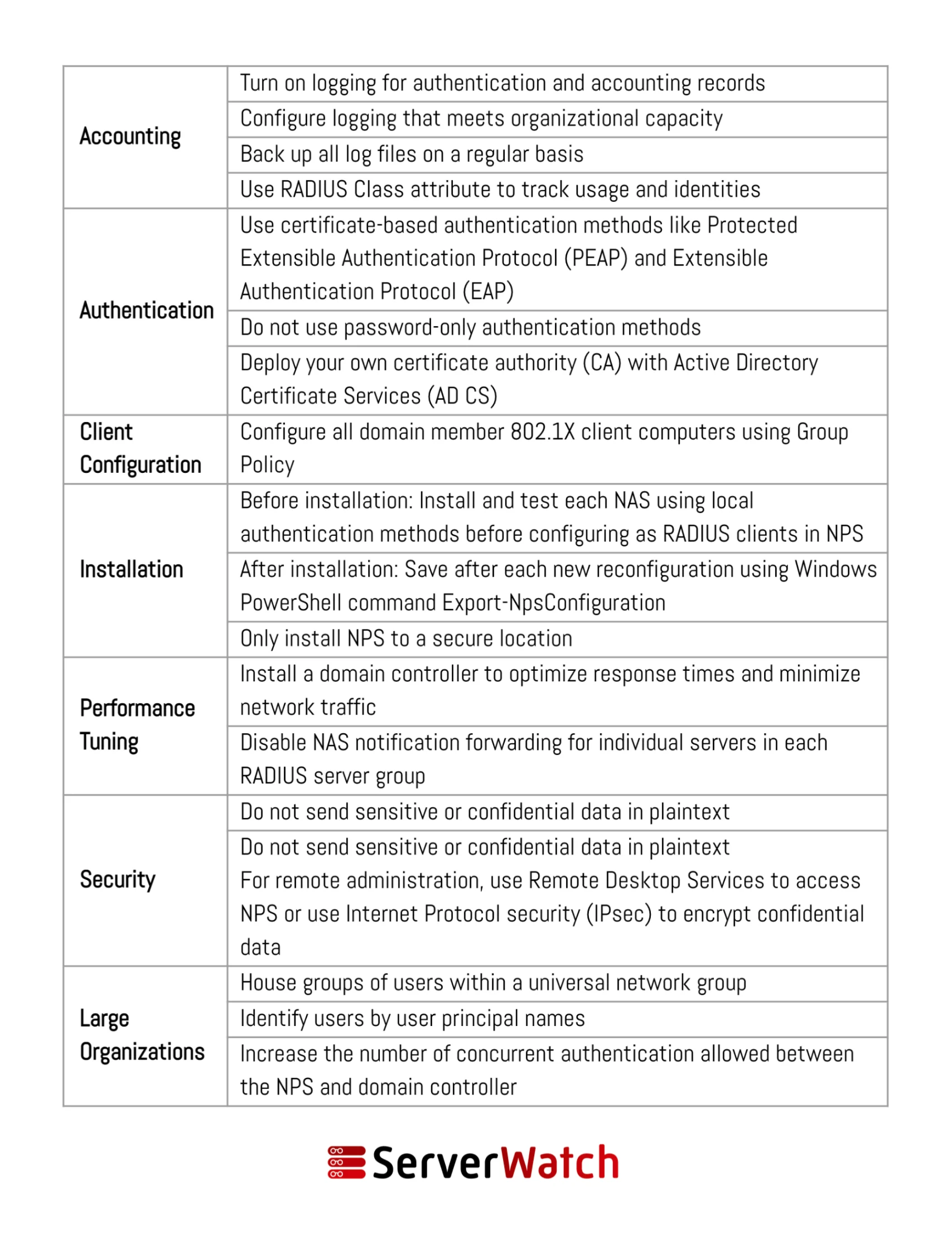
To maximize the effectiveness and security of an NPS deployment, organizations should adhere to a set of established best practices. These recommendations, often provided by Microsoft and security experts, aim to ensure that NPS operates efficiently, securely, and in alignment with the organization’s overall network management goals.
- Secure the NPS Server: The NPS server itself must be protected with robust security measures. This includes installing it on a dedicated server with limited roles, applying regular security patches and updates, and restricting physical and network access to the server.
- Use Strong Authentication Methods: Whenever possible, implement strong authentication methods beyond simple passwords, such as multi-factor authentication (MFA) or certificate-based authentication. This significantly reduces the risk of unauthorized access due to compromised credentials.
- Leverage Active Directory Integration: Integrate NPS with Active Directory to leverage existing user accounts, groups, and organizational units for authentication and authorization. This simplifies management and ensures consistency.
- Implement Least Privilege: Grant users and devices only the minimum level of access necessary to perform their intended functions. This principle of least privilege is a fundamental security best practice.
- Define Granular Policies: Create specific and detailed network access policies that address different user roles, device types, and access scenarios. Avoid overly broad policies that could inadvertently grant excessive access.
- Regularly Review Logs: Actively monitor and review NPS logs for suspicious activity, failed authentication attempts, or policy violations. Promptly investigate any anomalies.
- Backup NPS Configuration: Regularly back up the NPS configuration to facilitate quick restoration in case of hardware failure or accidental data loss.
- Use RADIUS Attributes Effectively: Understand and utilize RADIUS attributes to control session parameters, such as network access permissions, VLAN assignments, and bandwidth limitations.
- Isolate NPS Servers: In large or highly sensitive environments, consider isolating NPS servers on their own network segment to further enhance security.
- Test Policies Thoroughly: Before deploying new or modified policies to a production environment, thoroughly test them in a lab or staging environment to ensure they function as intended and do not cause unintended disruptions.
- Document NPS Configuration: Maintain comprehensive documentation of the NPS server configuration, including all policies, RADIUS attributes, and security settings. This documentation is invaluable for troubleshooting and for onboarding new administrators.
- Consider High Availability: For critical network services, implement a high-availability solution for NPS, such as a clustered configuration or a load-balanced array of NPS servers, to ensure continuous network access even in the event of server failure.
The Bottom Line: NPS as an Integral Component of Modern Network Management
The Network Policy Server (NPS) has firmly established itself as an indispensable tool in the arsenal of network administrators and security professionals. It offers a powerful, flexible, and scalable solution for ensuring secure and efficient network operations in today’s increasingly complex digital landscape. By integrating NPS thoughtfully within an organization’s network infrastructure, businesses can significantly fortify their defenses against cyber threats, enforce rigorous access policies, and streamline administrative tasks. This leads to a more robust, secure, and efficiently managed network environment.
Adherence to the best practices outlined for deploying and managing NPS is not merely a recommendation; it is a critical step in mitigating network security risks and ensuring the seamless operational flow of an organization’s digital assets. In an era where data breaches can have devastating consequences, the role of NPS in providing granular control over network access and maintaining comprehensive audit trails cannot be overstated.
To further enhance the functionality and performance of NPS, organizations can explore specialized RADIUS server testing and monitoring tools. These tools, often provided by third-party vendors, can offer advanced insights into network traffic, performance metrics, and security vulnerabilities, allowing for proactive identification and resolution of potential issues before they impact operations.
Sam Ingalls contributed to this article.
