

Amazon Elastic Container Service (ECS) has significantly upgraded its service auto scaling capabilities with the introduction of high-resolution (20-second) metrics and optimized metric publishing. This enhancement dramatically improves the responsiveness of containerized applications running on AWS, enabling ECS services to detect and react to fluctuating workload demands with unprecedented speed. Benchmarking tests conducted by AWS reveal that the time to trigger a scale-out event has been reduced by a remarkable 76%, dropping from 363 seconds to just 86 seconds. Furthermore, the total time required to scale and provision new tasks has seen a 72% improvement, decreasing from 386 seconds to 109 seconds. This update marks a pivotal advancement for businesses reliant on dynamic, high-performance container orchestration, ensuring applications can maintain optimal performance and availability even during sudden traffic surges.
The Evolving Landscape of Container Orchestration and Auto Scaling
The advent of cloud computing fundamentally reshaped how applications are built, deployed, and scaled. With the rise of microservices architectures and containerization, services like Amazon ECS became indispensable tools for managing complex application environments. ECS, a fully managed container orchestration service, simplifies the deployment, management, and scaling of Docker containers on AWS. Its core value lies in abstracting away much of the underlying infrastructure complexity, allowing developers to focus on application logic.
Auto scaling has been a cornerstone of cloud elasticity, allowing resources to automatically adjust to demand. Initially, auto scaling mechanisms often relied on standard resolution metrics, typically aggregated over 60-second intervals. While effective for gradual changes, this latency could prove challenging for workloads characterized by sharp, unpredictable spikes in traffic. E-commerce platforms during flash sales, live streaming services during major events, or news sites responding to breaking stories are prime examples of scenarios where every second in scaling response time can directly impact user experience and business outcomes.
Over the years, AWS has continuously evolved its auto scaling offerings. This included the introduction of various scaling policies designed to cater to different workload patterns. Predictive scaling, for instance, leverages machine learning algorithms to anticipate future demand based on historical data, proactively adjusting capacity. Scheduled scaling allows users to pre-configure capacity changes for known events, such as holiday promotions or recurring batch jobs. Target tracking, the focus of this recent enhancement, provides reactive scaling based on real-time metrics, adjusting capacity to maintain a specific utilization target (e.g., average CPU utilization or request count). The limitation, until now, was often the granularity of the metrics informing these real-time decisions.

A Deeper Dive into ECS Auto Scaling Mechanics
Amazon ECS service auto scaling works by adjusting the number of tasks in an ECS service based on metrics collected by Amazon CloudWatch. These metrics can range from standard indicators like average CPU or memory usage to more application-specific metrics such as request count per target or custom metrics like queue depth. The system employs advanced machine learning algorithms to process these data points and make informed scaling decisions, especially for predictive scaling.
The significance of the 20-second metric resolution cannot be overstated. Previously, auto scaling policies would evaluate metrics aggregated over 60-second intervals. This meant that a sudden, sharp increase in load might not be fully detected and acted upon for up to a minute or more, leading to potential performance bottlenecks, increased latency, or even service unavailability during the initial moments of a surge. By reducing the metric resolution to 20 seconds, ECS auto scaling can now collect data points three times more frequently. This provides the scaling algorithms with a much richer, more immediate understanding of the current workload, enabling them to initiate scaling actions much faster.
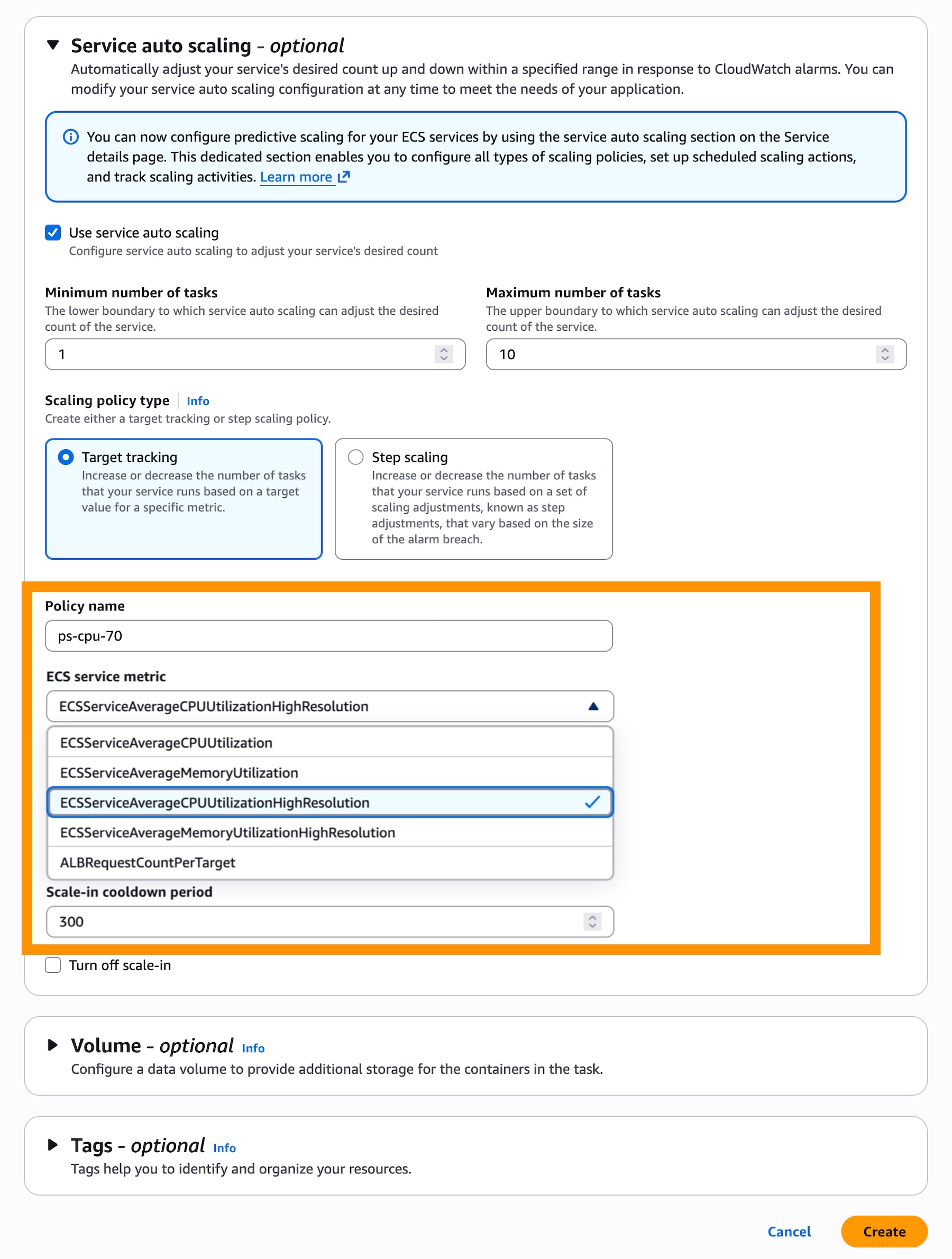
This improvement is particularly impactful for target tracking policies. With 20-second resolution for metrics like ECSServiceAverageCPUUtilizationHighResolution and ECSServiceAverageMemoryUtilizationHighResolution, the system can more quickly identify deviations from the desired target utilization. If CPU usage spikes unexpectedly, the auto scaling system will register this change within 20 seconds, rather than 60, and trigger a scale-out event sooner. This proactive reactivity minimizes the duration an application operates under duress, thereby maintaining service quality.
The enhanced auto scaling functionality is universally applicable across all ECS compute options: AWS Fargate, ECS Managed Instances, and Amazon Elastic Compute Cloud (EC2). This flexibility ensures that regardless of the underlying infrastructure choice – whether it’s the serverless convenience of Fargate, the managed nature of ECS instances, or the granular control of EC2 – users can benefit from faster, more efficient scaling.
Operationalizing Faster Auto Scaling

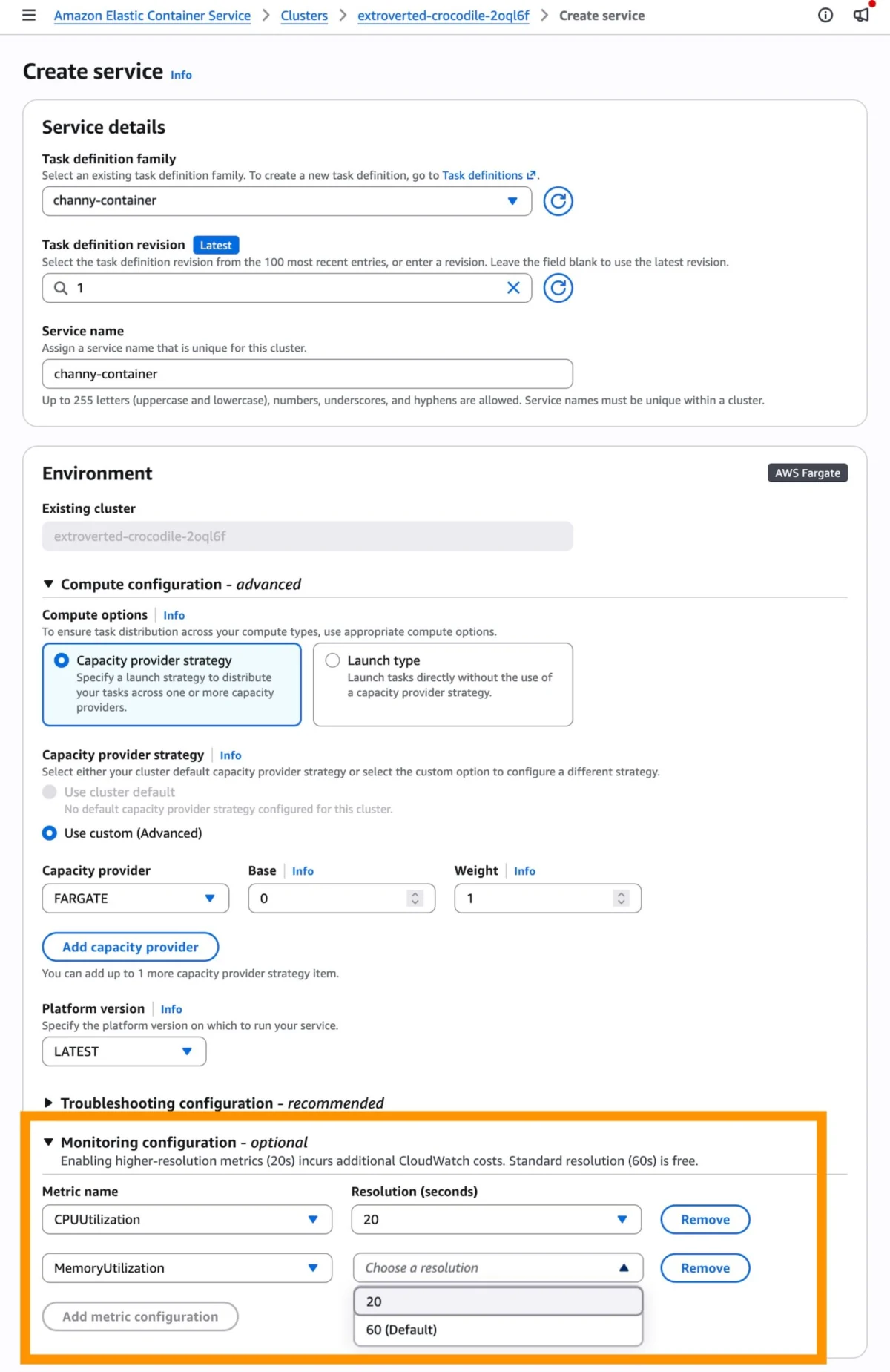
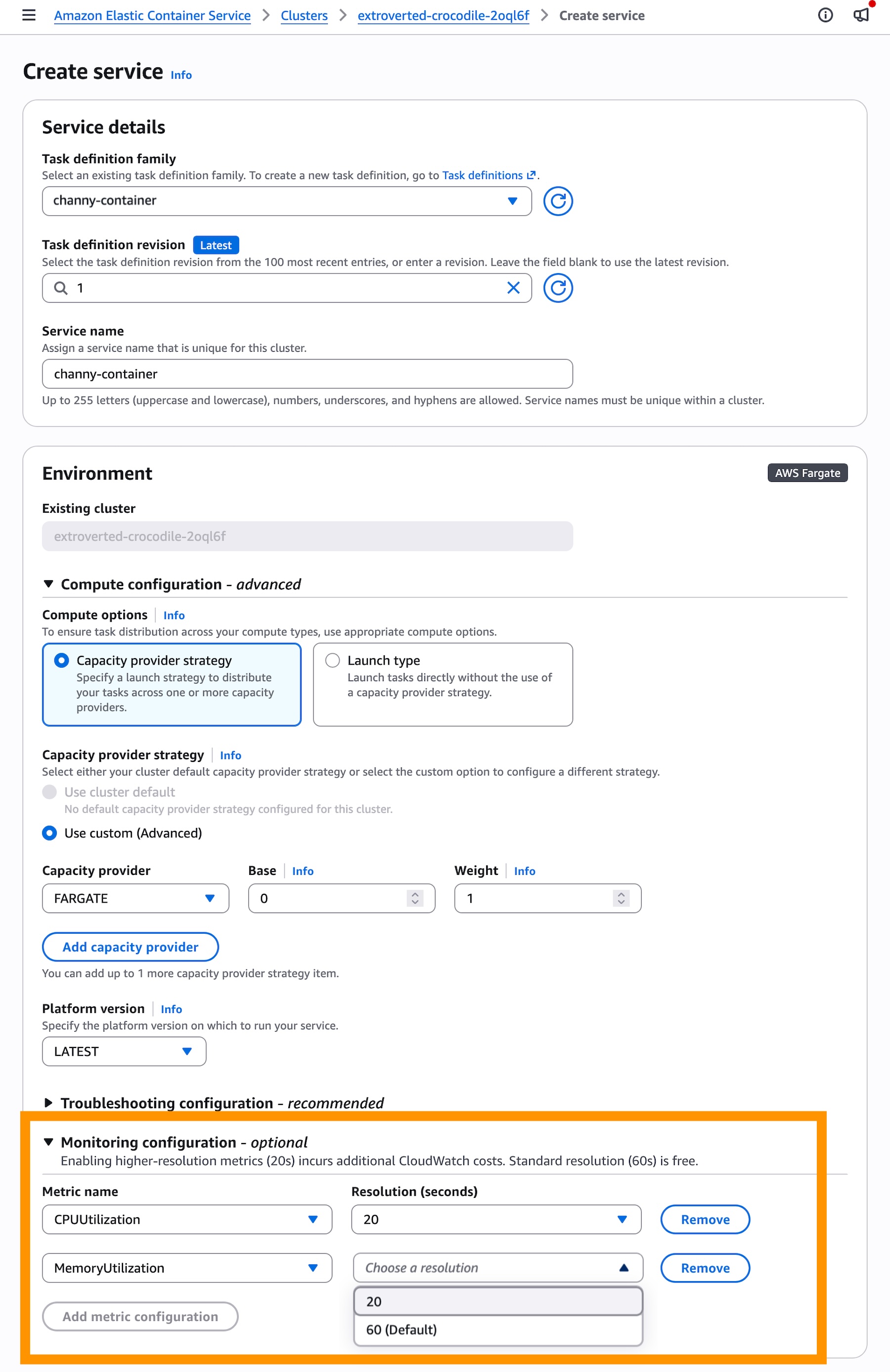
Enabling this faster service auto scaling is straightforward for both new and existing ECS services. When creating a new ECS service via the Amazon ECS console, users can configure high-resolution metrics within the "Monitoring configuration" section. This involves selecting the 20-second resolution option. Similarly, within the "Service auto scaling" section, users select "Target Tracking" as the scaling policy type and then choose the new high-resolution metrics, such as ECSServiceAverageCPUUtilizationHighResolution or ECSServiceAverageMemoryUtilizationHighResolution.
For existing services, the process involves updating the service configuration to enable high-resolution metrics. Once this deployment is complete and the service begins generating these finer-grained metrics, users can then update their scaling policies through the "Service and auto scaling" tab to utilize these higher resolution data points. Beyond the console, these configurations can also be managed programmatically using AWS SDKs and tools, AWS CloudFormation, or the AWS Command Line Interface (CLI), integrating seamlessly into existing CI/CD pipelines and infrastructure-as-code practices.
While the feature itself carries no additional cost, it is important to note that high-resolution CloudWatch metrics do incur a new pricing dimension. Standard resolution (60-second) metrics remain free, but the more frequent data collection of 20-second metrics contributes to CloudWatch costs. This is a common model for advanced monitoring services, where greater granularity provides more insight but requires more processing and storage. Organizations are advised to consult the CloudWatch pricing page for detailed cost information to plan their budgets accordingly.
Key Benefits and Strategic Implications
The introduction of high-resolution metrics for Amazon ECS service auto scaling delivers several critical benefits, reshaping how organizations manage their containerized applications and enhancing their operational posture:
-
Enhanced Application Responsiveness and User Experience: The most direct and impactful benefit is the significant reduction in response time to load changes. With scale-out triggers happening 76% faster and new tasks provisioning 72% quicker, applications can absorb sudden traffic surges more gracefully. This translates directly to reduced latency for end-users, fewer errors, and a more consistent and positive user experience, which is paramount in today’s competitive digital landscape. For businesses, this means fewer abandoned carts, higher customer satisfaction, and stronger brand loyalty.
-
Optimized Resource Utilization and Cost Efficiency: While high-resolution metrics incur a cost, the ability to scale more precisely and rapidly can lead to overall cost optimization. Faster scaling out means applications are adequately resourced during peak demand without prolonged periods of under-provisioning that could impact performance. Equally important, faster scaling in (though not explicitly detailed in the original benchmark, it’s an inherent capability of responsive auto scaling) means that excess capacity can be de-provisioned sooner once demand subsides. This dynamic adjustment minimizes the waste associated with over-provisioning for extended periods, ensuring that organizations pay only for the resources they actively use.
-
Improved Reliability and Resilience: Rapid auto scaling is a critical component of building resilient, highly available applications. By quickly responding to unexpected demand, ECS services are better equipped to withstand traffic spikes that might otherwise overwhelm fixed capacity, leading to service degradation or outages. This enhanced resilience reduces the risk of downtime, protecting revenue, reputation, and customer trust. For mission-critical applications, this capability is not just an advantage but a necessity.
-
Simplified Operations and Reduced Operational Overhead: For development and operations teams, the improved auto scaling capabilities mean less manual intervention and fewer late-night alerts during peak traffic events. Capacity planning becomes less about rigid forecasting and more about setting intelligent scaling policies. This automation reduces the operational burden, allowing engineers to focus on innovation and strategic projects rather than constant firefighting or manual scaling adjustments. It fosters greater confidence in the underlying infrastructure’s ability to self-manage, promoting a DevOps culture where reliability is built-in.
-
Competitive Advantage in Dynamic Markets: In an increasingly digital-first world, the ability to rapidly adapt to market conditions and customer demand is a key differentiator. Businesses leveraging this faster ECS auto scaling can deploy more agile, performant, and cost-effective applications. This operational excellence can translate into a tangible competitive advantage, enabling faster innovation, better customer service, and more efficient resource allocation compared to competitors relying on less responsive infrastructure.
Industry Context and Future Outlook
This enhancement aligns with broader industry trends emphasizing performance, automation, and operational efficiency in cloud computing. Analysts frequently highlight that while cloud adoption is widespread, the true value is unlocked through intelligent automation and services that abstract complexity while delivering high performance. AWS, as a market leader, consistently innovates to meet these evolving demands.
The continuous refinement of auto scaling capabilities, particularly for container orchestration services like ECS, underscores AWS’s commitment to empowering developers and operations teams. By providing tools that automatically manage the intricacies of capacity planning and resource allocation, AWS enables its customers to build more robust, scalable, and cost-effective applications. This move also reflects the increasing sophistication of machine learning integration into core infrastructure services, leveraging data to drive more intelligent and autonomous operations.
As organizations continue their journey towards cloud-native architectures, serverless computing, and event-driven patterns, the demand for instant, precise scalability will only grow. This update to Amazon ECS service auto scaling is a testament to AWS’s ongoing effort to stay ahead of these demands, providing the foundational capabilities necessary for the next generation of highly dynamic and resilient applications.
Conclusion
The launch of faster service auto scaling with high-resolution metrics for Amazon ECS is a significant development for the AWS ecosystem. By dramatically reducing the time to detect and respond to workload changes, AWS has provided its customers with a powerful tool to enhance application performance, optimize costs, and bolster reliability. This update reinforces AWS’s position as a leader in cloud innovation, continuously pushing the boundaries of what is possible in container orchestration. Organizations leveraging ECS can now build even more responsive and resilient applications, ensuring superior user experiences and operational excellence in an increasingly dynamic digital landscape. The immediate availability of this feature allows businesses to begin realizing these benefits today, further cementing ECS as a cornerstone for modern cloud deployments.
