

Seattle, WA – Amazon Web Services (AWS) has announced a significant enhancement to its Amazon Elastic Container Service (Amazon ECS) service auto scaling capabilities, delivering substantially faster detection and response to fluctuating workload demands. The update introduces support for high-resolution (20-second) metrics and optimized metric publishing, resulting in a dramatic reduction in the time required to scale out and provision new tasks. This development is poised to redefine how developers and organizations manage dynamic containerized applications on AWS, ensuring unparalleled agility and cost efficiency.
The core of this advancement lies in the ability of Amazon ECS service auto scaling to leverage metrics with a granular resolution of 20 seconds, a considerable improvement over the standard 60-second interval. This finer data granularity, coupled with internal metric publishing optimizations, empowers the auto scaling mechanism to react with unprecedented speed to real-time changes in application load. AWS benchmarking tests underscore the impact of these improvements: the time taken to trigger a scale-out event has been reduced from an average of 363 seconds to a mere 86 seconds, marking a 76% acceleration and a 4.2-fold improvement. Furthermore, the total time required to scale and provision new tasks has seen a similar boost, dropping from 386 seconds to 109 seconds, representing a 72% increase in speed and a 3.5-fold enhancement.
This pivotal upgrade addresses a critical demand from enterprises and developers running highly dynamic and latency-sensitive workloads. In environments where user experience and operational continuity are paramount, every second counts. Applications ranging from high-traffic e-commerce platforms and real-time gaming services to financial trading systems and media streaming applications often experience sudden, unpredictable spikes in demand. The previous scaling latency, while effective for many use cases, could sometimes lead to temporary performance degradation or resource over-provisioning during the ramp-up period, impacting end-user satisfaction and increasing operational costs.
Understanding the Evolution of Cloud Auto Scaling

Auto scaling has been a cornerstone of cloud computing since its early days, fundamentally changing how organizations manage infrastructure. Traditionally, scaling applications involved manual provisioning of servers, a time-consuming and often inefficient process that either led to over-provisioning (to handle peak loads, wasting resources during troughs) or under-provisioning (resulting in performance issues during surges). The advent of cloud platforms like AWS introduced the concept of elastic infrastructure, where resources could be scaled up or down dynamically.
AWS pioneered auto scaling services, initially with Amazon EC2 Auto Scaling, which allowed users to define policies to automatically adjust the number of EC2 instances based on demand. As cloud computing evolved, containerization emerged as a dominant paradigm for packaging and deploying applications, offering greater portability, efficiency, and resource isolation. Amazon ECS, launched in 2014, quickly became a popular choice for orchestrating Docker containers on AWS, providing a fully managed service that abstracts away much of the underlying infrastructure complexity.
The need for intelligent, application-aware scaling within containerized environments led to the development of Amazon ECS service auto scaling. This service goes beyond basic instance scaling, allowing users to adjust the number of tasks (container instances) within an ECS service. It offers a comprehensive suite of scaling policies:
- Predictive Scaling: Utilizes machine learning algorithms to forecast future traffic patterns based on historical data, proactively scaling resources before demand hits. This is ideal for recurring, predictable spikes.
- Scheduled Scaling: Enables users to define specific scaling actions to occur at predetermined times, perfect for planned events like marketing campaigns or batch processing windows.
- Target Tracking Scaling: The most common reactive scaling method, where users define a target value for a specific metric (e.g., average CPU utilization at 70%). The system then automatically adjusts task counts to maintain that target.
These policies rely heavily on Amazon CloudWatch, AWS’s monitoring and observability service, to collect and analyze application metrics. CloudWatch metrics, such as average CPU and memory utilization, request count per target, or custom metrics like queue depth, provide the crucial data points that drive scaling decisions. The challenge, however, has always been the inherent latency between a metric being observed, processed by CloudWatch, and then acted upon by the auto scaling service. This latest enhancement directly tackles this latency, making the target tracking policy, in particular, significantly more responsive.
The Mechanism Behind the Accelerated Scaling

The improved performance stems from two primary technical advancements:
- High-Resolution Metrics (20-second interval): Previously, the standard resolution for CloudWatch metrics used by ECS auto scaling was 60 seconds. By reducing this interval to 20 seconds, the system now receives three times as many data points within the same minute. This provides a much more immediate and accurate picture of the application’s current load and demand fluctuations, allowing the auto scaling service to detect changes earlier.
- Metric Publishing Optimizations: Beyond just collecting data faster, AWS has also optimized the internal processes by which these metrics are published and consumed by the Application Auto Scaling service. This includes enhancements in data pipeline efficiency and the decision-making logic within the scaling engine, ensuring that detected changes are acted upon without unnecessary delays.
When a target tracking policy is configured with high-resolution metrics, the auto scaling algorithm can evaluate scaling decisions at 20-second intervals. This rapid feedback loop drastically reduces the time between a load increase being observed and new tasks being launched to meet that demand. For example, if an application suddenly experiences a surge in requests, the 20-second metrics will register this change almost immediately, prompting the auto scaling service to initiate a scale-out much faster than with 60-second metrics.
Key Benefits and Strategic Implications
The implications of this faster auto scaling are far-reaching, offering tangible benefits across several dimensions:
- Enhanced User Experience: For end-users, this means fewer instances of slow loading times, reduced latency, and improved application responsiveness during peak traffic. Websites will remain snappy, real-time applications will perform consistently, and user satisfaction will increase, directly impacting business metrics like conversion rates and engagement.
- Optimized Resource Utilization and Cost Efficiency: Faster scale-out ensures that applications can handle sudden demand without over-provisioning resources "just in case." Equally important, faster scale-in capabilities, while not the primary focus of this announcement, are implicitly improved by the more granular metrics, allowing resources to be scaled down more quickly when demand subsides. This dynamic adjustment minimizes idle resources, leading to significant cost savings by ensuring customers only pay for the compute capacity they genuinely need.
- Simplified Operations and Developer Agility: Operations teams and developers can now rely more heavily on automation, reducing the need for manual intervention or complex custom scaling scripts. This frees up valuable engineering time, allowing teams to focus on innovation rather than infrastructure management. The increased confidence in auto scaling’s responsiveness also encourages the adoption of more dynamic, event-driven architectures.
- Robustness for Volatile Workloads: Industries such as e-commerce (during flash sales or holiday shopping events), media and entertainment (live streaming of major events), gaming (multiplayer game launches or peak hours), and financial technology (market data processing, trading platforms) are characterized by highly unpredictable and bursty traffic patterns. This enhancement provides a robust foundation for these workloads to maintain performance under extreme variability.
- Competitive Edge for AWS: This update further solidifies AWS’s position as a leader in container orchestration and cloud infrastructure. By continuously refining core services like ECS and its auto scaling capabilities, AWS empowers its customers to build and run highly performant, cost-effective, and resilient applications, maintaining a strong competitive advantage in the cloud market.
An AWS spokesperson, commenting on the launch, emphasized, "This significant enhancement to Amazon ECS service auto scaling directly addresses critical customer feedback for greater agility and cost-effectiveness in managing dynamic workloads. By leveraging high-resolution metrics and optimizing our scaling mechanisms, we are enabling our customers to deliver superior user experiences while simultaneously optimizing their cloud spend. This is a testament to our ongoing commitment to providing the most robust and performant container services in the industry." Another inferred statement from a product manager highlighted, "The ability to react 4.2 times faster to scale-out triggers is a game-changer for applications with spiky traffic. It means less over-provisioning, better resource allocation, and ultimately, more seamless operations for our customers, regardless of their compute choice – whether Fargate, ECS Managed Instances, or EC2."
Implementing Faster ECS Service Auto Scaling
Enabling this enhanced auto scaling is designed to be straightforward for both new and existing Amazon ECS services. It works seamlessly across all ECS compute options: AWS Fargate (the serverless compute engine for containers), ECS Managed Instances, and Amazon Elastic Compute Cloud (Amazon EC2) instances.
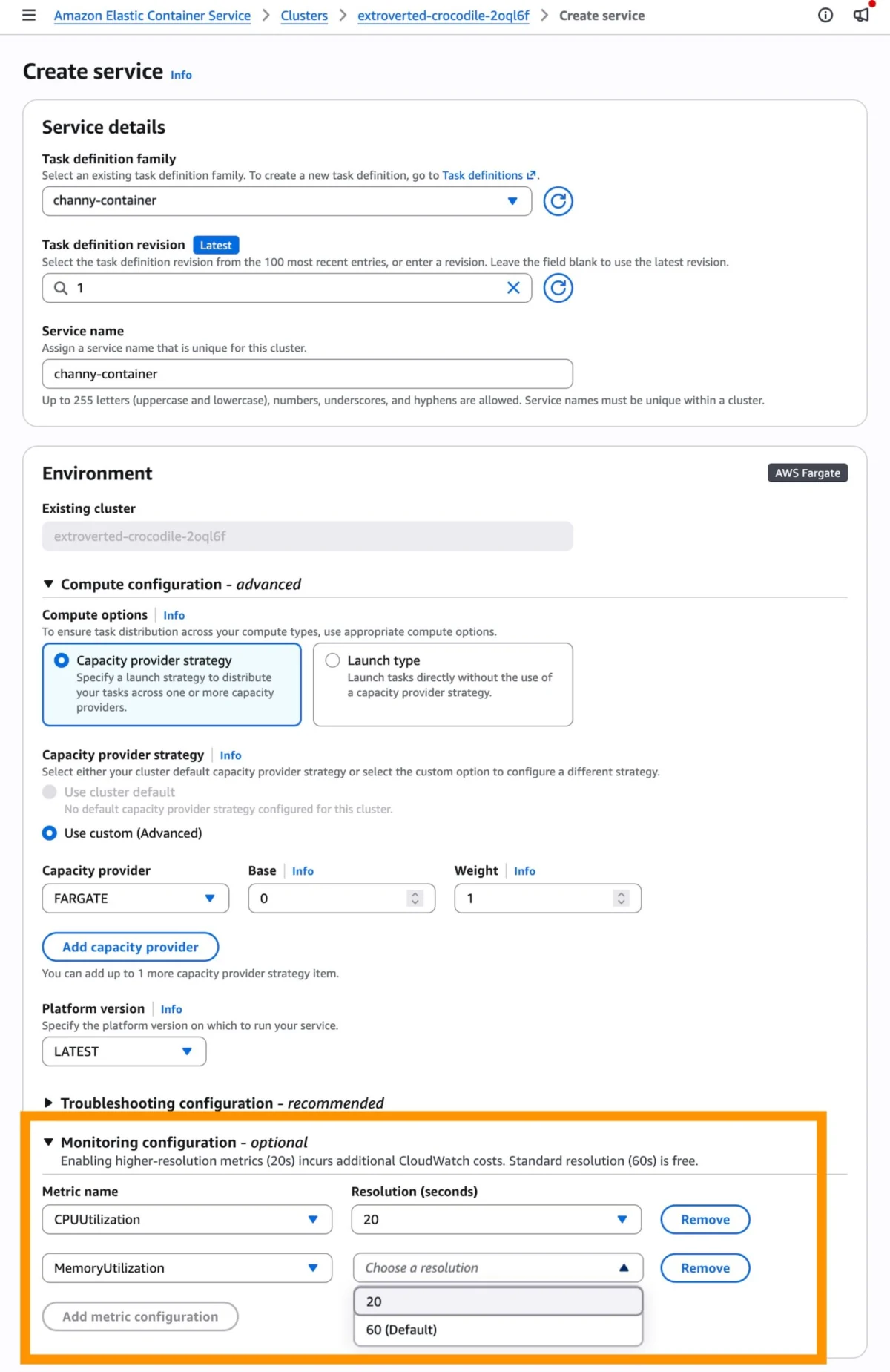
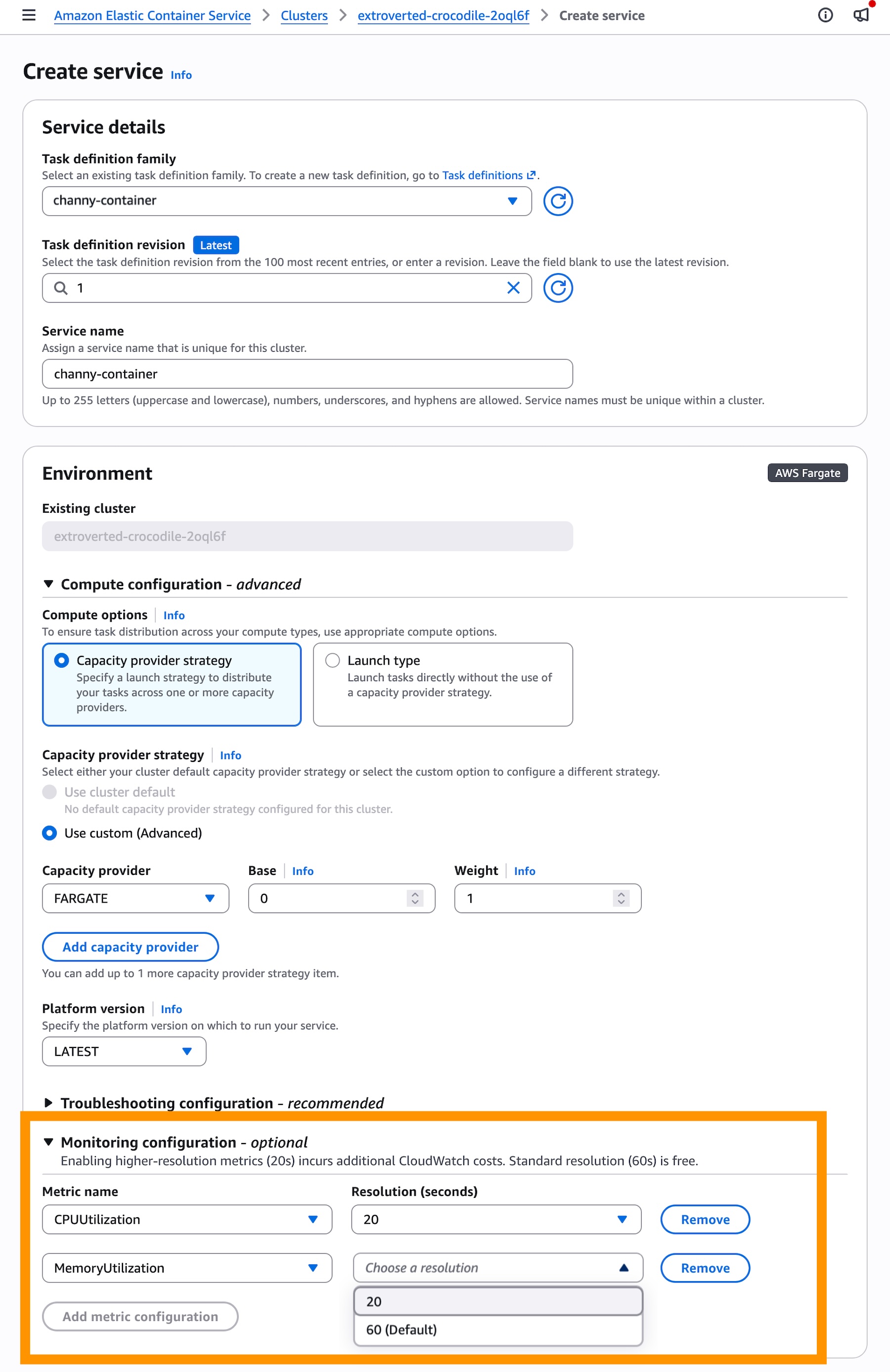
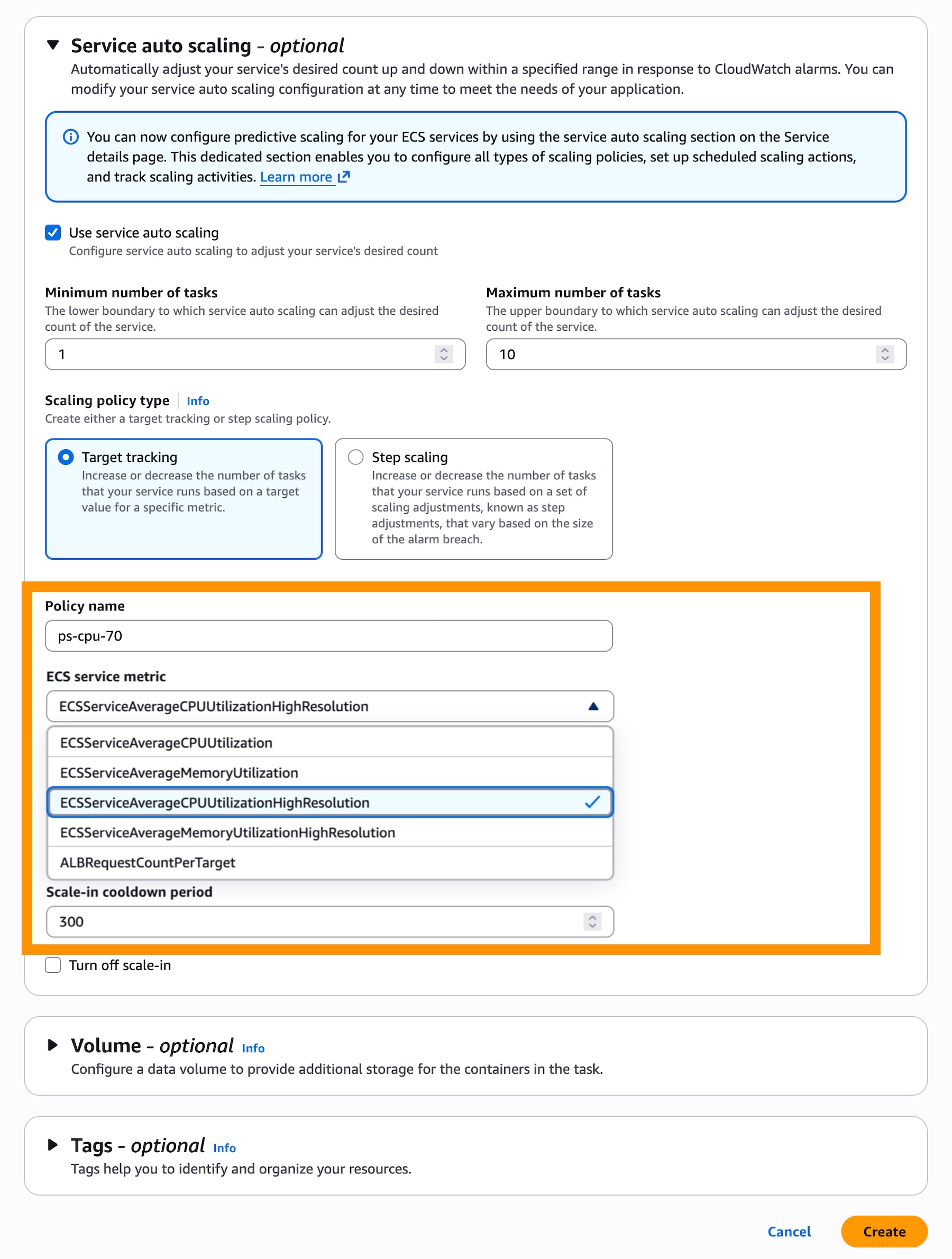
For new services, users can enable high-resolution metrics during the service creation process in the Amazon ECS console. Within the "Monitoring configuration" section, there will be an option to add 20-second resolution metrics. Subsequently, in the "Service auto scaling" section, users should select "Use service auto scaling" and choose "Target Tracking" as the scaling policy type. When defining the target tracking policy, new high-resolution metrics such as ECSServiceAverageCPUUtilizationHighResolution or ECSServiceAverageMemoryUtilizationHighResolution will be available for selection.
For existing ECS services, the process involves two steps: First, update the service to configure high-resolution metrics via the "Update Service" option. Once this deployment is complete and the service begins generating high-resolution metrics, users can then navigate to the "Service and auto scaling" tab from their service details to update their existing scaling policy to utilize these new higher-resolution metrics.
Beyond the console, these metrics can also be enabled and configured using AWS SDKs and tools, AWS CloudFormation for infrastructure as code deployments, and the AWS Command Line Interface (AWS CLI). The flexibility in deployment methods ensures that organizations can integrate this feature into their existing automation workflows. Detailed instructions are available in the updated faster auto scaling documentation.
Cost Considerations
It is important for users to note that while the faster service auto scaling feature itself incurs no additional cost, the high-resolution (20-second) CloudWatch metrics introduce a new pricing dimension. Standard resolution (60-second) CloudWatch metrics remain free of charge. Users should consult the CloudWatch pricing page for detailed information on the costs associated with high-resolution metrics to ensure proper cost management. The investment in these metrics is generally offset by the benefits of improved resource utilization and enhanced application performance, leading to overall cost savings by minimizing over-provisioning.
Availability and Future Outlook
Faster service auto scaling with high-resolution metrics for Amazon ECS is available immediately. This launch represents another significant step in AWS’s continuous effort to provide robust, scalable, and efficient services for modern cloud-native applications. As containerization continues to grow as a foundational technology for digital transformation, innovations that improve performance, reduce operational overhead, and optimize costs will remain paramount. AWS encourages users to explore this new capability, implement it in their containerized workloads, and provide feedback through AWS re:Post for ECS or their usual AWS Support contacts, fostering an iterative development cycle that continues to meet evolving customer needs. This commitment to continuous improvement underscores AWS’s dedication to empowering developers and organizations to build the next generation of cloud applications with confidence and agility.
