

Amazon Web Services (AWS) has announced the immediate availability of AWS CloudFormation Express mode, a significant enhancement designed to dramatically accelerate infrastructure deployments for developers and AI tools. This new deployment mode prioritizes speed by completing operations as soon as resource configurations are applied, rather than waiting for potentially lengthy stabilization checks to conclude. The innovation promises to reduce deployment times by up to four times, offering a crucial advantage for iterative development workflows and various production scenarios.
The Evolution of Infrastructure as Code and the Need for Speed
Infrastructure as Code (IaC) has become a cornerstone of modern cloud operations, enabling organizations to manage and provision their computing infrastructure through machine-readable definition files, rather than physical hardware configuration or interactive configuration tools. AWS CloudFormation stands as a primary IaC service within the AWS ecosystem, allowing users to define their AWS resources in templates, which CloudFormation then provisions and configures. This approach ensures consistency, repeatability, version control, and automation, drastically reducing manual errors and increasing operational efficiency. From simple S3 buckets to complex, multi-service architectures, CloudFormation has empowered developers and operations teams to build, deploy, and manage their cloud environments with unparalleled precision.
However, the inherent thoroughness of traditional IaC deployments, particularly those involving complex, interdependent cloud resources, often includes extensive stabilization checks. These checks confirm that newly provisioned or updated resources are not just configured, but fully operational and ready to serve traffic. While critical for high-availability production environments where immediate operational readiness is paramount, this meticulous process can introduce substantial latency into development cycles. Developers iterating rapidly on infrastructure configurations, testing individual components, or leveraging AI-assisted tools for infrastructure generation often face significant waiting times, impeding productivity and slowing down feedback loops. The growing demand for agility in software development, particularly with the rise of DevOps, GitOps, and AI/ML development, has amplified the need for faster, more responsive infrastructure provisioning mechanisms. CloudFormation Express mode directly addresses this challenge, offering a deployment paradigm optimized for speed and iteration.
How CloudFormation Express Mode Works: A Paradigm Shift in Deployment Completion
The fundamental difference between CloudFormation’s traditional "Standard" mode and the new Express mode lies in when a deployment is considered complete. In Standard mode, CloudFormation initiates resource provisioning and then proceeds to perform comprehensive stabilization checks. These checks verify that resources are fully healthy, accessible, and ready to handle workloads, often involving waiting for services to initialize, network interfaces to attach, or dependencies to become available. For example, a database instance might need to pass health checks, or a load balancer might need to confirm its target group is healthy before the deployment is marked as successful. While essential for ensuring robust, production-ready deployments, these checks can extend deployment durations significantly, especially for services with longer startup times or complex interdependencies.
Express mode, by contrast, completes deployments when CloudFormation confirms that the resource configuration has been successfully applied. This means the underlying AWS services have received and processed the configuration instructions, but CloudFormation does not wait for the resources to become fully operational or pass all stabilization checks. The resources continue their stabilization process in the background, independently of CloudFormation’s reported deployment status. This subtle but powerful distinction allows for a dramatic reduction in perceived deployment time, as the CloudFormation operation itself concludes much faster.
Crucially, Express mode does not compromise the fundamental provisioning process. Resources are still provisioned correctly and according to the template. Moreover, AWS has engineered Express mode with built-in resilience: CloudFormation automatically retries dependent resources that encounter transient failures during provisioning within the same stack. This intelligent retry mechanism helps mitigate timing issues that might arise when resources are stabilizing asynchronously, ensuring that the overall stack reaches its desired state without requiring manual intervention from the customer. The core message remains: Express mode changes when the deployment completes, not how resources are provisioned or their eventual operational state.
Targeted Use Cases and Tangible Performance Gains
The benefits of CloudFormation Express mode are particularly pronounced in scenarios where rapid iteration and quick feedback are paramount. Two primary use cases stand out:
-
Iterative Development Workflows: Developers frequently modify and redeploy infrastructure during the development and testing phases. Whether it’s adjusting an IAM policy, tweaking a Lambda function’s configuration, or experimenting with different database settings, the ability to see these changes reflected in the cloud environment almost instantaneously is invaluable. Express mode significantly shortens the waiting periods associated with these iterative cycles, allowing developers to experiment more freely, debug faster, and ultimately accelerate their development velocity. This is especially true when testing individual components of an application in isolation, where the full stabilization of an entire system might be overkill.
-
AI-Assisted Infrastructure Development: The burgeoning field of artificial intelligence and machine learning is increasingly leveraging automated tools for infrastructure generation. These AI tools, often designed to interpret natural language requests or optimize cloud resource allocation, thrive on sub-minute feedback loops. Express mode provides the rapid deployment capabilities necessary for these AI systems to quickly provision, test, and adjust infrastructure configurations, facilitating faster model training environments, data pipeline setups, and deployment of ML inference endpoints. The ability to iterate on infrastructure as quickly as one iterates on code is a game-changer for AI/ML engineers.
The performance improvements offered by Express mode are substantial and have been demonstrated through AWS’s own benchmarking tests. For instance, creating an Amazon Simple Queue Service (SQS) queue with a dead-letter queue (DLQ) in Standard mode typically takes around 64 seconds. With Express mode, this operation completes in as little as 10 seconds. Even more dramatically, deleting an AWS Lambda function with a network interface attachment, a process that could take 20 to 30 minutes in Standard mode due to the complexities of network interface detachment and cleanup, now completes in approximately 10 seconds using Express mode. These examples illustrate a reduction in deployment time by factors of 6x to 180x, underscoring the transformative impact of this new capability on developer productivity.
Seamless Integration and Flexible Configuration
Adopting CloudFormation Express mode has been designed for simplicity and flexibility across various AWS interfaces and tools.
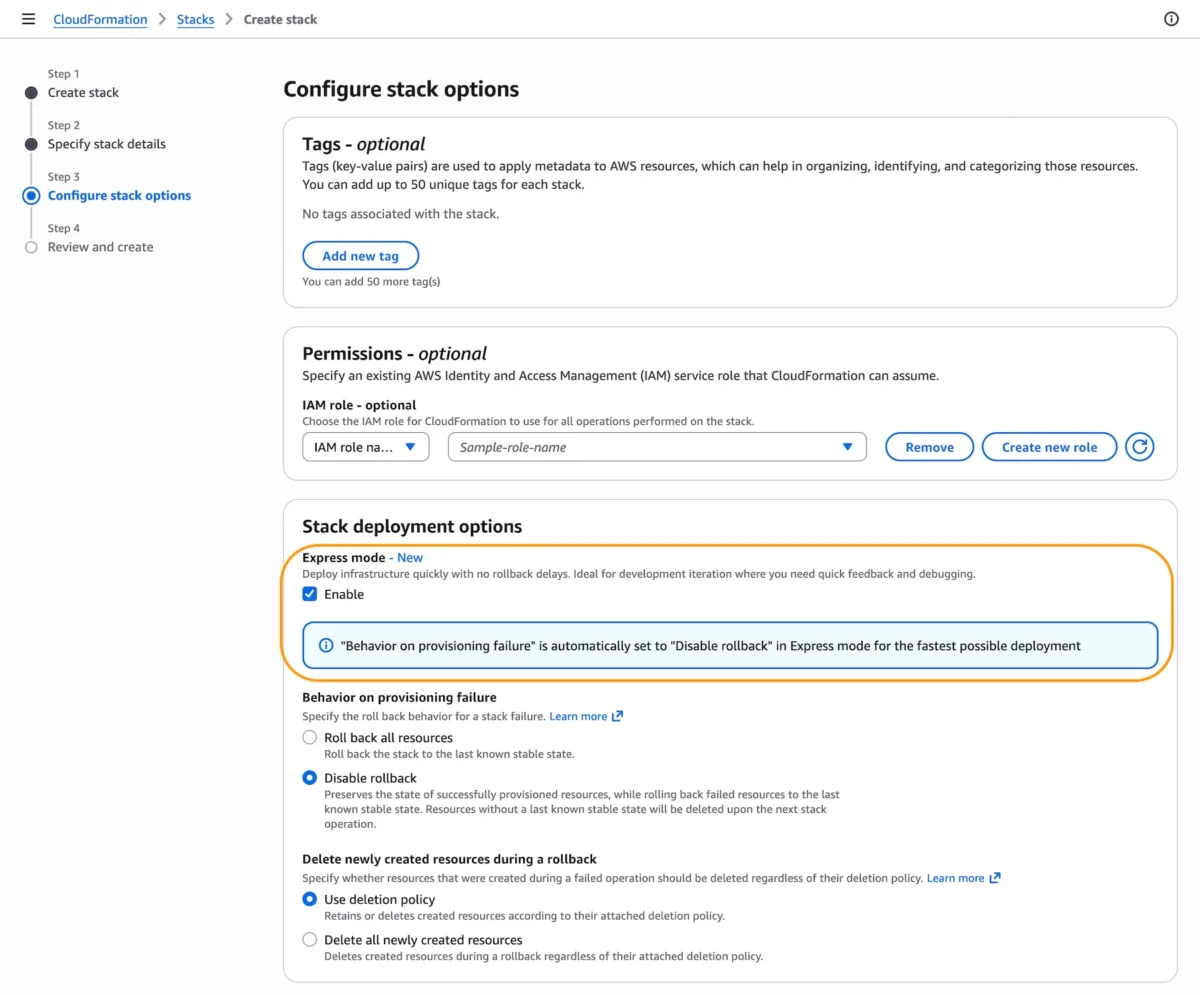
For users interacting with the AWS Management Console, activating Express mode is straightforward. When creating a new CloudFormation stack, a dedicated "Express mode" option is available under "Stack deployment options," requiring a simple click to enable.
For programmatic deployments, Express mode integrates seamlessly with the AWS Command Line Interface (AWS CLI), AWS SDKs, and popular IaC tools like the AWS Cloud Development Kit (CDK), as well as AI-powered tools such as Kiro. When using the AWS CLI, developers can activate Express mode by setting the --deployment-config parameter to EXPRESS during create-stack, update-stack, or delete-stack operations. No modifications to existing CloudFormation templates are required, ensuring backward compatibility and ease of adoption.
A key configuration aspect of Express mode is its default behavior regarding rollbacks. To maximize iteration speed, Express mode disables rollbacks by default. This means that if a deployment encounters an issue after configuration is applied, CloudFormation will not automatically revert the stack to its previous stable state. While ideal for rapid prototyping and testing where a clean-up and redeploy approach is acceptable, users deploying to production environments or those requiring robust failure recovery can re-enable rollbacks by setting disableRollback to false within the --deployment-config parameter. Alternatively, organizations can implement their own monitoring and cleanup mechanisms for failed Express mode deployments in production scenarios.
The provided CLI examples illustrate how developers can incrementally build infrastructure using Express mode. For a microservice, a developer might first deploy an IAM role, then update the stack to add a Lambda function, and finally add an SQS queue and event source mapping. Each of these steps, traditionally time-consuming, can now be executed with sub-minute feedback, fostering a truly agile development process. It is crucial, however, to ensure that IAM role templates adhere to the principle of least privilege, even in accelerated deployment environments, to maintain robust security postures.
For developers leveraging the AWS CDK, the process is even more streamlined. A simple cdk deploy --express command will deploy the CDK stack using CloudFormation Express mode, provisioning resources as part of a CloudFormation stack with the accelerated deployment behavior.
Furthermore, CloudFormation Express mode is fully compatible with all existing CloudFormation templates and supports advanced features such as change sets and nested stacks. When Express mode is enabled on a parent stack, all associated nested stacks automatically inherit and utilize Express mode, ensuring consistent acceleration across complex architectures. This broad compatibility means that organizations can immediately begin leveraging Express mode for their existing CloudFormation assets without extensive refactoring. However, for critical production deployments where resources must be guaranteed fully operational before any traffic shift or extensive testing, the default Standard mode, with its comprehensive stabilization checks, remains the recommended approach.
Broader Industry Impact and Strategic Implications
The introduction of CloudFormation Express mode is more than just a performance upgrade; it represents a strategic move by AWS to further enhance developer experience, accelerate innovation, and solidify its position as a leading cloud provider. Its implications ripple across several facets of cloud operations and software development:

Enhanced Developer Productivity: By drastically reducing waiting times, developers can maintain flow states, conduct more experiments, and iterate on infrastructure designs with unprecedented speed. This directly translates to higher productivity, fewer context switches, and a more engaging development experience. The ability to deploy and test changes in seconds rather than minutes or even hours can significantly shorten the development lifecycle of new features and applications.
Accelerated CI/CD Pipelines: Continuous Integration and Continuous Delivery (CI/CD) pipelines are the backbone of modern software delivery. Long deployment stages are often bottlenecks in these pipelines. Express mode offers the potential to significantly shorten the infrastructure provisioning steps within CI/CD workflows, enabling faster release cycles and more frequent deployments. This agility is crucial for organizations striving for rapid iteration and quick response to market demands.
Catalyst for AI-Driven Development: The rise of generative AI and intelligent automation tools is transforming how infrastructure is designed and managed. Express mode provides the necessary infrastructure provisioning speed to support these emerging paradigms. AI models can generate and deploy infrastructure configurations, receive rapid feedback, and self-correct or optimize with much greater efficiency. This integration of AI with infrastructure management could lead to entirely new ways of building and operating cloud environments.
Indirect Cost Efficiencies: While Express mode itself incurs no additional cost, its impact on developer productivity can lead to indirect cost efficiencies. Reduced waiting times mean developers spend less time idle, optimizing their billable hours. Faster iteration can also lead to more efficient resource utilization during development and testing, as temporary environments can be spun up and torn down more quickly.
Strengthening Cloud Agility: This innovation further underscores AWS’s commitment to providing tools that empower organizations to be more agile and responsive. In a rapidly evolving technological landscape, the ability to quickly adapt and deploy new capabilities is a significant competitive advantage. CloudFormation Express mode contributes directly to this agility, allowing businesses to bring their ideas to market faster.
Expert Commentary and Forward Outlook
Industry experts and the developer community are anticipated to welcome CloudFormation Express mode with enthusiasm. An AWS spokesperson, if quoted, might emphasize the company’s dedication to continuously improving the developer experience: "Our customers consistently tell us that speed and agility are paramount. CloudFormation Express mode is a direct response to that feedback, empowering developers and AI tools with the rapid iteration capabilities they need to innovate faster than ever before. This is about removing friction and letting builders focus on what they do best: creating."
Developers, particularly those working on microservices architectures or complex, frequently changing environments, are likely to express significant relief. "Waiting 20 minutes for a Lambda deletion used to break my concentration and workflow," a hypothetical lead developer might state. "Now, with Express mode, those operations complete almost instantly. It’s a game-changer for daily productivity and our ability to quickly prototype and test." AI/ML engineers would highlight its utility for rapid experimentation with infrastructure configurations that support machine learning models and data pipelines, allowing them to iterate on their underlying infrastructure as quickly as they iterate on their code.
AWS CloudFormation Express mode is now available in all AWS commercial Regions at no additional cost, making this powerful new capability accessible to a broad user base from day one. For detailed regional availability and a future roadmap, users can consult the AWS Capabilities by Region page. Further technical documentation is available in the CloudFormation user guide, and developers seeking to integrate with AI tools can leverage the AWS MCP Server and its plugins. AWS encourages users to provide feedback via AWS re:Post for AWS CloudFormation or through their usual AWS Support channels, ensuring continuous improvement of this critical new feature.
The launch of CloudFormation Express mode marks a pivotal moment for Infrastructure as Code on AWS. By intelligently addressing the trade-off between deployment thoroughness and speed, AWS is not only enhancing the efficiency of existing workflows but also paving the way for new paradigms in AI-driven infrastructure development and significantly boosting developer agility across the board. The ability to deploy and iterate on cloud resources with unprecedented speed will undoubtedly accelerate innovation and further cement the role of IaC as an indispensable practice in the cloud era.
