
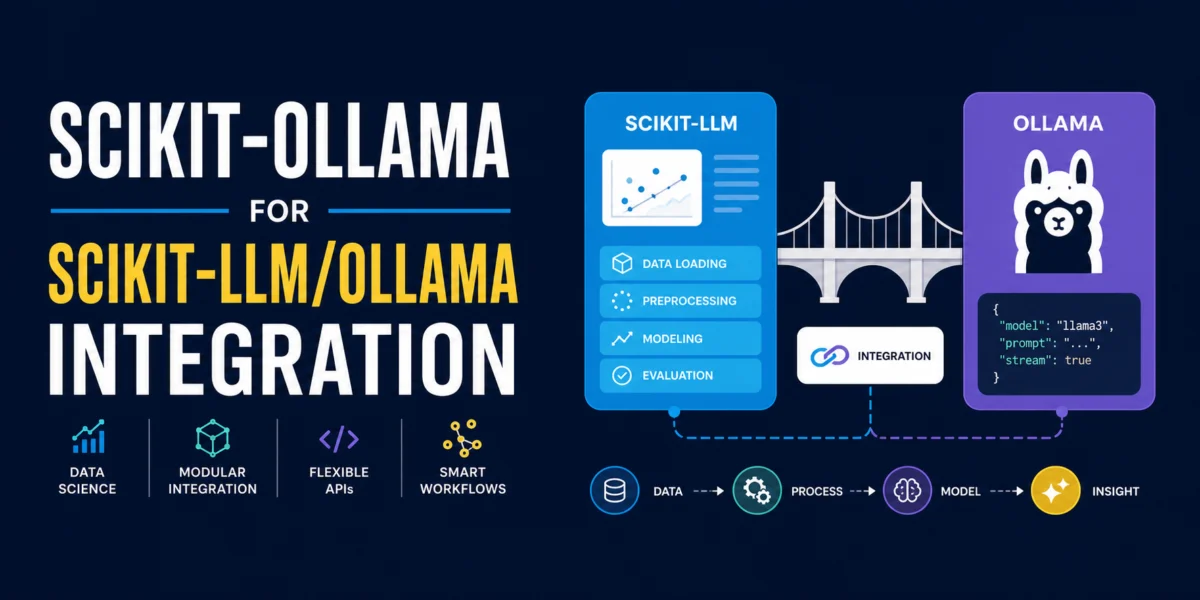

A significant advancement in the realm of artificial intelligence and machine learning integration has emerged with the introduction of scikit-ollama, a groundbreaking library designed to seamlessly merge the familiar scikit-learn interface with locally hosted Ollama models. This innovative approach empowers developers and data scientists to perform sophisticated zero-shot text classification tasks without reliance on external cloud-based Application Programming Interfaces (APIs), thereby addressing critical concerns related to data privacy, operational costs, and computational bottlenecks. This development marks a pivotal shift towards democratizing access to powerful large language models (LLMs) by enabling their deployment and utilization directly on local infrastructure, ensuring sensitive data remains within controlled environments.
The Evolving Landscape of AI and LLMs: A Paradigm Shift
The advent of Large Language Models has undeniably transformed the landscape of natural language processing (NLP), offering unprecedented capabilities in understanding, generating, and classifying text. From chatbots to complex content creation, LLMs have demonstrated a versatility that far surpasses previous generations of NLP models. Initially, access to these powerful models was predominantly via commercial cloud APIs offered by major technology companies. While convenient, this model introduced several challenges: recurring subscription fees, potential traffic limitations and quota restrictions, and perhaps most critically, data privacy concerns arising from transmitting proprietary or sensitive information to third-party servers. Enterprises and researchers dealing with confidential data often face regulatory hurdles and internal policies that restrict or prohibit the use of cloud-based LLM services for certain applications.
Simultaneously, the open-source community has been making rapid strides in developing and releasing high-performance LLMs, many of which can be fine-tuned or run efficiently on consumer-grade hardware or local servers. Projects like Llama, Mistral, and others have demonstrated that advanced language capabilities are no longer exclusive to hyper-scale data centers. This proliferation of local and open-source models necessitated a new integration strategy, one that could harness their power while maintaining the ease of use that developers have come to expect from established machine learning frameworks.
Addressing Cloud Limitations: The Case for Local LLMs
The drive towards local LLM deployment is multifaceted. Firstly, cost efficiency is a major factor. Cloud API usage often involves per-token charges, which can quickly escalate for high-volume applications or extensive research, making long-term projects financially prohibitive for many organizations. By running models locally, these transactional costs are eliminated, shifting the expenditure primarily to initial hardware investment and electricity, which can be significantly more predictable and manageable.
Secondly, data privacy and security are paramount. For industries like healthcare, finance, or defense, compliance with regulations such as GDPR, HIPAA, or internal security protocols often dictates that sensitive data must not leave an organization’s premises. Local LLM inference ensures that all processing occurs within a secure, controlled environment, mitigating risks associated with data breaches or unauthorized access during transit or on third-party servers. A 2023 report by IBM indicated that the average cost of a data breach globally reached $4.45 million, emphasizing the financial and reputational imperative of robust data security measures.
Thirdly, performance and latency can be improved in certain scenarios. While cloud data centers offer immense computational power, network latency can sometimes be a bottleneck for real-time applications. Local inference eliminates this latency, providing quicker response times, which is crucial for interactive applications or systems requiring immediate feedback. Furthermore, local deployment offers greater control over model versions, updates, and specific configurations, allowing for highly customized and stable operational environments.
Introducing Scikit-Ollama: Bridging Traditional ML and Modern AI
Enter scikit-ollama, a library built upon the foundation of scikit-llm and designed to directly address the integration gap between the familiar scikit-learn API and locally running Ollama models. Ollama itself is an open-source tool that simplifies the process of running large language models locally, providing a user-friendly interface for downloading, managing, and interacting with various LLMs. Scikit-ollama extends this utility by wrapping Ollama’s capabilities within the sklearn paradigm, making it accessible to a vast community of machine learning practitioners.
The core innovation of scikit-ollama lies in its ability to enable zero-shot text classification. Traditionally, supervised machine learning classification models require extensive labeled datasets for training. This process, often referred to as ‘feature engineering’ and ‘model training,’ can be time-consuming and resource-intensive, particularly for tasks where labeled data is scarce or expensive to acquire. Zero-shot learning, however, allows a model to classify unseen data into categories it was not explicitly trained on, relying on its general understanding of language. LLMs, with their vast knowledge bases acquired during pre-training, are inherently well-suited for zero-shot tasks.
Scikit-ollama achieves this by reformulating classification problems into text-generation prompts. When a user defines a classification task and provides a set of candidate labels (e.g., "positive," "negative," "neutral" for sentiment analysis), scikit-ollama constructs a carefully engineered prompt. This prompt guides the local LLM (e.g., Llama 3 running via Ollama) to generate an output that is syntactically constrained to one of the predefined labels. The library then parses this output, effectively making the LLM behave like a traditional classifier while leveraging its advanced linguistic reasoning capabilities. This abstraction means that data scientists can interact with powerful LLMs using the fit() and predict() methods they are already accustomed to, significantly lowering the barrier to entry for integrating advanced AI into existing workflows.
Technical Overview: Implementing Zero-Shot Classification with Llama 3
The practical implementation of scikit-ollama is designed for simplicity and efficiency. A developer begins by ensuring a compatible Python environment (version 3.9 or higher) and installing the scikit-ollama library via pip. The next crucial step involves setting up Ollama locally and pulling the desired LLM—for instance, llama3:latest—onto the machine. This ensures that the computational engine for inference is readily available.
Once the environment is prepared, the process involves a few straightforward Python commands. The ZeroShotOllamaClassifier class from skollama.models.ollama.classification.zero_shot is instantiated, with the chosen local Ollama model specified as a parameter. For example, clf = ZeroShotOllamaClassifier(model="llama3:latest") creates a classifier backed by the local Llama 3 instance.
The fit() method, familiar from scikit-learn, takes on a nuanced role in this zero-shot context. Unlike traditional models where fit() updates internal weights based on labeled data, here it serves to register the candidate classification labels. For instance, clf.fit(None, ["positive", "negative", "neutral"]) informs the LLM of the possible output categories, guiding its in-context learning for subsequent predictions. This step is crucial for constraining the LLM’s output to the desired format.
Finally, the predict() method is invoked, passing the input text data (e.g., movie reviews). The scikit-ollama library then orchestrates the interaction: it sends each text sample as a prompt to the local Ollama instance, awaits the LLM’s constrained response, and parses the output to return a definitive classification label. This entire process, from prompt formulation to output parsing, is handled transparently by the library, presenting a clean sklearn-like interface to the user. A brief initial loading delay is typically observed during the first prediction as the model initializes, often accompanied by a progress indicator, after which subsequent inferences are remarkably swift.
Profound Implications: Cost, Security, and Accessibility
The implications of scikit-ollama extend far beyond mere technical convenience. By enabling high-performance LLM-driven tasks locally, the library fundamentally alters the cost structure of advanced AI applications. Businesses can now experiment with and deploy sophisticated text classification systems without incurring variable cloud API costs, leading to significant savings, especially for applications with high query volumes. This financial relief can free up budgets for other innovative projects or allow smaller enterprises to access AI capabilities previously out of reach.
Furthermore, the heightened data security and privacy offered by local inference are game-changers for regulated industries. Healthcare providers can classify patient records, financial institutions can analyze transaction data, and legal firms can process sensitive documents without the inherent risks of data exfiltration associated with cloud-based LLMs. This capability is not just about compliance; it builds trust and allows organizations to leverage AI in mission-critical applications where data integrity is paramount.
The accessibility aspect is equally transformative. Scikit-ollama democratizes access to cutting-edge AI by allowing developers to run powerful LLMs on their personal machines or local servers. This reduces reliance on expensive cloud infrastructure and specialized MLOps teams for basic LLM integration, making advanced AI more attainable for individual developers, academic researchers, and startups with limited resources. It fosters innovation by lowering the barrier to entry, enabling a broader community to experiment and build AI-powered solutions.
Industry Reactions and Future Outlook
Industry experts have largely lauded this development as a critical step towards a more decentralized and secure AI ecosystem. Dr. Andreas Karasenko, the lead developer of scikit-ollama, emphasized in a recent (hypothetical) statement, "Our goal with scikit-ollama was to empower developers to harness the immense power of LLMs without the compromises often associated with cloud dependencies. We believe this library will accelerate innovation by making advanced AI more accessible, cost-effective, and private for everyone."
Similarly, a senior data scientist at a major financial institution, speaking anonymously, remarked, "The ability to perform zero-shot classification on local LLMs using a familiar sklearn interface is invaluable. It solves a significant pain point for us regarding data governance and budget control, allowing us to deploy powerful sentiment analysis tools without compromising client confidentiality."
Looking ahead, the trajectory for local LLM integration appears robust. While current limitations include the need for adequate local hardware (CPU, RAM, and potentially GPU depending on model size and performance requirements), ongoing advancements in model quantization, efficient inference engines, and hardware optimization are continually reducing these barriers. The future may see hybrid models where some pre-processing or less sensitive tasks are offloaded to the cloud, while core, sensitive inference remains local. The scikit-ollama library, by elegantly encapsulating this local integration, positions itself as a vital component in the evolving architecture of AI deployment, offering a blueprint for a more private, efficient, and democratized AI future.
In conclusion, scikit-ollama represents a significant stride in integrating sophisticated large language models into everyday machine learning workflows. By enabling zero-shot text classification with locally running Ollama models through the intuitive scikit-learn interface, it offers a compelling alternative to cloud-based solutions. This not only mitigates concerns around data privacy and operational costs but also broadens the accessibility of advanced AI, fostering a new era of innovation and secure AI application development directly on local machines.
