
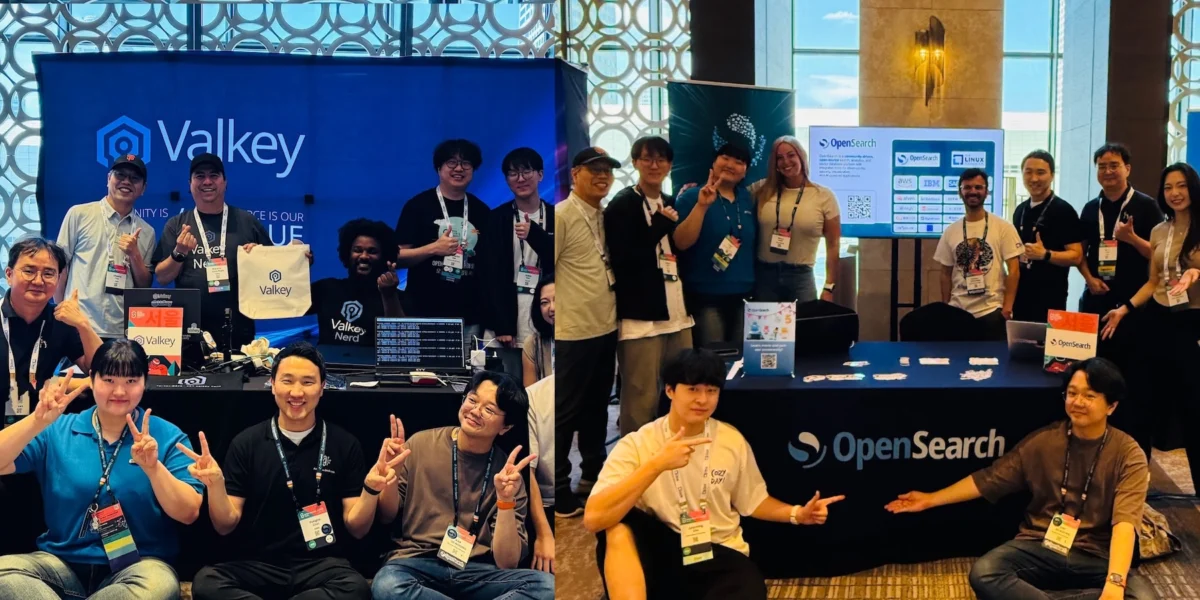

Amazon Web Services (AWS) engineering teams and open source contributors converged on the South Korean capital last week to participate in two of the region’s most prominent technology gatherings: the Open Source Summit Korea 2026 and the MCP DevSummit Seoul 2026. Over the course of four intensive days, industry leaders, core maintainers, and enterprise users from across the globe gathered to exchange technical knowledge, demonstrate collaborative software solutions, and chart the future trajectory of vital Linux Foundation projects. Central to the AWS delegation’s presence was a concerted focus on two core open source technologies that have transformed modern cloud architecture: OpenSearch and Valkey.
The four-day event served as an immersive hub for software developers, system architects, and technical project leaders. Alongside formal conference tracks, localized community involvement played a critical role in fostering engagement. Leaders from South Korea’s vibrant OpenSearch user groups stepped forward to volunteer at the dedicated community booths, facilitating direct interactions, answering technical queries, and hosting an independent user group meetup. These grassroots networking sessions allowed regional developers to connect directly with upstream contributors, share localized deployment challenges, and discuss best practices for scaling enterprise workloads using open source infrastructure.
The Evolution and Integration of OpenSearch 3.7
OpenSearch, recognized globally as a scalable, enterprise-grade search and observability suite, has become an indispensable tool for organizations looking to derive actionable intelligence from massive volumes of unstructured data. The momentum behind the project has accelerated following the mid-2026 rollout of OpenSearch 3.7. Released on June 9, 2026, version 3.7 introduced a suite of powerful capabilities designed to unify telemetry data—bringing logs, traces, and metrics together under a single, cohesive interface.
Among the standout architectural advancements in OpenSearch 3.7 is a redesigned querying and alerting engine that enables engineering teams to track Service Level Objectives (SLOs) with unprecedented precision. Furthermore, performance benchmarks highlighted during the summit underscored a dramatic improvement in vector search capabilities. OpenSearch 3.7 delivers vector retrieval speeds up to 5.5 times faster than its predecessors, directly addressing the soaring demands of modern generative artificial intelligence and semantic search applications.
Enterprise adopters have not had to wait long to leverage these capabilities in managed cloud environments. Since July 30, 2026, AWS has made OpenSearch version 3.7 generally available on Amazon OpenSearch Service. This managed integration provides customers with automated patch management, enhanced search relevance tuning, improved Query Insights tooling, and optimized vector search performance, allowing enterprises to scale AI-driven applications securely without the heavy lifting of underlying cluster maintenance.
Valkey 9.1: Performance, Efficiency, and Multi-Tenant Security
While OpenSearch addresses observability and search, Valkey has rapidly established itself as the open source answer for high-performance, ultra-low-latency key-value data storage. Supporting diverse use cases—ranging from high-speed in-memory caching and real-time message brokering to acting as a robust primary database—Valkey continues to capture market share within the open source community following its successful community-driven fork.
The technical community in Seoul spent considerable time analyzing the impact of Valkey 9.1, which debuted on May 19, 2026. This landmark release introduced a fundamental redesign of the I/O threading model, yielding up to a 17% increase in overall system throughput. Additionally, Valkey 9.1 tackled memory optimization head-on, reducing memory footprint requirements by up to 20% for string data structures under 128 bytes. These optimizations are particularly crucial for large-scale deployments handling millions of concurrent operations where memory density directly translates to infrastructure cost savings.
Building on this momentum, Amazon ElastiCache rolled out managed support for Valkey 9.1 on June 23, 2026. Designed specifically for node-based clusters, the managed service delivers the raw throughput and memory efficiency gains of the core project while layering on robust enterprise features, including stronger access control mechanisms tailored for complex, multi-tenant workloads.
Chronology of Recent Milestones
The convergence of AWS, OpenSearch, and Valkey at the Seoul summits represents the latest waypoint in a structured timeline of rapid technological advancement throughout 2026:

- May 19, 2026: The Valkey project officially launches Valkey 9.1, featuring a redesigned I/O threading model and enhanced memory efficiency for small strings.
- June 9, 2026: OpenSearch 3.7 is released, introducing unified observability tools and vector retrieval performance up to 5.5x faster.
- June 23, 2026: Amazon ElastiCache introduces managed support for Valkey 9.1, bringing improved throughput and multi-tenant security to cloud architectures.
- July 30, 2026: Amazon OpenSearch Service adds support for OpenSearch 3.7, empowering users with advanced Query Insights and optimized vector search relevance.
- Mid-August 2026: AWS contributors participate in Open Source Summit Korea and MCP DevSummit Seoul, engaging directly with regional developer ecosystems.
Industry Implications and Broader Impact
The active participation of major cloud providers like AWS in foundational open source projects signals a broader, maturation trend in software development. Enterprises are increasingly wary of vendor lock-in, preferring open-source-backed architectures that offer flexibility, community-driven governance, and transparent roadmaps. By aligning managed services closely with upstream releases—such as integrating Valkey 9.1 into ElastiCache and OpenSearch 3.7 into Amazon OpenSearch Service—cloud providers are bridging the gap between raw open source innovation and enterprise-grade operational reliability.
Furthermore, the focus on vector search performance and memory optimization reflects the overarching industry pivot toward artificial intelligence and machine learning workloads. As organizations build increasingly complex Retrieval-Augmented Generation (RAG) pipelines and real-time generative AI applications, the underlying data layers must process high-dimensional vectors and low-latency queries at unprecedented scales. The performance gains demonstrated in OpenSearch 3.7 and Valkey 9.1 directly address these operational bottlenecks, reducing compute costs while scaling capacity.
Looking Ahead
As the 2026 conference circuit continues, AWS contributors and open source maintainers show no signs of slowing down their community outreach. Additional developer-focused events, community days, and regional summits are scheduled across global markets throughout the year. Developers and enterprise architects interested in engaging directly with project maintainers can track upcoming regional gatherings via the official OpenSearch and Valkey community event calendars.
For organizations seeking to stay informed on the latest cloud infrastructure developments, managed service updates, and architectural best practices, monitoring official channels such as the AWS What’s New page and the AWS Blogs remains essential. As these open source projects mature, the collaborative synergy between global cloud providers and localized developer communities will undoubtedly continue to shape the future of enterprise software engineering.
