
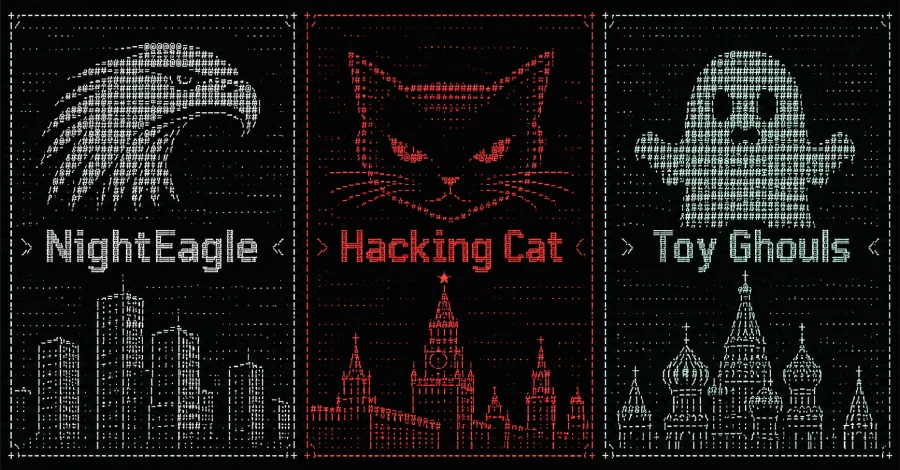

Russian corporate infrastructure has become the primary theater for a sophisticated campaign of cyberattacks, with three distinct threat actors—NightEagle, Hacking Cat, and Toy Ghouls—executing targeted operations. According to comprehensive technical analyses released by Kaspersky, these groups are employing a mix of advanced persistent threat (APT) techniques and increasingly destructive hacktivist methodologies to infiltrate, disrupt, and extort organizations within the Russian Federation. The campaigns underscore a significant evolution in the digital landscape of the region, where state-adjacent interests and ideologically motivated groups are converging to exploit vulnerabilities in enterprise-level software.
The landscape of these attacks is characterized by a high degree of technical sophistication, ranging from the deployment of modular backdoors that mimic legitimate server traffic to the use of AI-assisted, yet often flawed, ransomware strains. This surge in activity highlights a shift toward more persistent and clandestine methods of data exfiltration and network disruption.
The NightEagle APT: Strategic Persistence and Lateral Movement
NightEagle, identified by researchers as APT-Q-95, represents the most methodologically disciplined threat actor in this cluster. Active since at least 2023, the group has demonstrated a strategic focus on compromising Microsoft Exchange servers to establish a deep, long-term presence within corporate environments. The primary vector for these intrusions typically involves the exploitation of valid, albeit compromised, corporate credentials, which are then used to gain access to virtual private networks (VPNs).
In its investigation, Kaspersky noted that the attackers frequently route their malicious traffic through a complex infrastructure of proxies. VPN connections observed during these incidents often originate from Russian IP addresses integrated with Cloudflare WARP tunnels or European-based virtual infrastructure providers. This layering of traffic serves to obfuscate the origin of the attack, making rapid attribution and remediation difficult for internal security teams.
The hallmark of NightEagle’s operation is the deployment of the GhostContainer backdoor. This modular tool is specifically designed to bypass standard heuristic detection by masquerading as a legitimate Microsoft Exchange server component. Once embedded, GhostContainer provides operators with a full suite of administrative capabilities, including the ability to run arbitrary code, manipulate files, and load additional malicious modules. The technical composition of GhostContainer is notably reliant on open-source repositories, incorporating elements from the Neo-reGeorg tunneling tool and exploiting the well-documented CVE-2020-0688 vulnerability.
NightEagle’s progression within a network is equally deliberate. After achieving an initial foothold, the group utilizes tools such as rdp2tcp and Microsoft dev tunnels to facilitate lateral movement. By exploiting vulnerabilities within Active Directory, including the long-standing BlueKeep (CVE-2019-0708) flaw, the attackers secure local administrative privileges. Their ultimate objective is often the compromise of the domain controller, which allows them to harvest password hashes and utilize long-lived Kerberos tickets to maintain legitimate-looking access to the target’s most sensitive resources.

Hacking Cat: The Pivot to Destructive Hacktivism
In contrast to the espionage-focused operations of NightEagle, Hacking Cat has transitioned from standard website defacement and data theft toward high-impact destructive attacks. Since emerging in February 2024, the group has positioned itself as a pro-Ukrainian entity, frequently coordinating with other groups like the Cyber Anarchy Squad and the Ukrainian Cyber Alliance.
The group’s tactical evolution is marked by the deployment of the Gorilla RAT, a Go-based remote access trojan. Gorilla RAT functions by tunneling traffic through the victim’s internal network, allowing for real-time remote control. Beyond surveillance, Hacking Cat has aggressively moved into the ransomware space, utilizing a family of malware known as "Monkey." These ransomware variants are written in a diverse array of programming languages, including Rust, .NET, C++, and Golang, reflecting a broad, if somewhat experimental, approach to development.
The destructive potential of these attacks is significant. Kaspersky researchers identified that some variants of the Monkey ransomware, particularly the Rust-based iterations, perform ChaCha20-Poly1305 encryption on victim files. However, the lack of a reliable key storage mechanism in many instances suggests that these tools often function as "wipers"—data is destroyed permanently rather than held for ransom. This trend is further evidenced by the group’s collaboration on the "Nemo Wiper," which systematically overwrites disk space with random data to render forensic recovery impossible.
The potential use of generative AI in the development of these tools has been a subject of intense scrutiny. Researchers noted that the Golang variant of the Monkey ransomware included functions intended to clear shadow volume copies—a process entirely irrelevant to Linux or ESXi environments. This technical oversight suggests that the developers may have relied on AI assistance to write code without fully auditing the resulting scripts for cross-platform compatibility, pointing to a rapid, decentralized development cycle.
Toy Ghouls: Moving Toward Bespoke Backdoors
The third actor, Toy Ghouls—also known under aliases such as Bearlyfy and Feral Wolf—represents a financially motivated threat that has matured significantly over the past 18 months. Initially relying on leaked code from established ransomware groups like Babuk and LockBit, the group has recently pivoted to developing its own custom infrastructure.
In mid-2026, the group introduced "GenieLocker" and, more recently, a bespoke backdoor known as "Bird Agent." This tool represents a departure from the group’s previous reliance on off-the-shelf malware. Bird Agent is designed for stealth and high-level persistence, utilizing Windows Remote Management (WinRM) for deployment. The backdoor is highly modular, with its configuration bound to the specific MachineGuid of the infected system, preventing analysis in sandbox environments that do not replicate the target’s unique hardware identifier.
The most distinctive feature of the Bird Agent is its use of unconventional command-and-control (C2) channels. Rather than traditional dedicated servers, the backdoor communicates via the HiveMQ MQTT broker or the Element messenger’s Matrix-based architecture. By piggybacking on legitimate communication protocols and widely used enterprise software, Toy Ghouls effectively masks its traffic as mundane application data.

Chronology and Strategic Context
The surge in these attacks corresponds with a broader escalation in regional cyber warfare.
- 2023: NightEagle commences operations, focusing on the development of modular backdoors and the systematic exploitation of Microsoft Exchange vulnerabilities.
- February 2024: Hacking Cat surfaces, initially focusing on low-level hacktivism and data exfiltration.
- Summer 2025: The first appearances of Monkey ransomware occur, signaling a shift by Hacking Cat toward destructive cyber activities.
- July 2026: Toy Ghouls pivots from using third-party ransomware builders to deploying its custom Bird Agent backdoor, marking a significant increase in its operational security.
- Late 2026: Collaborative operations between hacktivist groups, including the joint use of the ClearWater RaaS and Nemo Wiper, become more frequent.
Analysis: Implications for Corporate Cybersecurity
The findings from these campaigns provide a grim snapshot of modern digital warfare. The primary implication is that even "hardened" enterprises are struggling to account for the dual threats of state-level APTs and increasingly capable, ideologically driven hacktivists. The reliance on common, publicly available tools—such as those found on GitHub—coupled with the integration of custom-built, bespoke backdoors, creates a hybrid threat model that is difficult for traditional signature-based security software to identify.
Furthermore, the "careless" coding observed in some hacktivist tools does not correlate to lower risk; rather, it often results in increased damage due to the permanent destruction of data. The potential for these groups to coordinate and share resources, as seen in the Hacking Cat and Cyber Anarchy Squad partnership, suggests that the barrier to entry for highly damaging cyber operations is lowering.
Official Responses and Defensive Posture
In the wake of these disclosures, security researchers have emphasized that the mitigation of such threats requires a defense-in-depth strategy. Organizations are advised to:
- Enforce Multi-Factor Authentication (MFA): Given that many of these attacks rely on stolen credentials to access VPNs, robust MFA is the first line of defense.
- Monitor WinRM and RDP Traffic: The use of WinRM and RDP for lateral movement is a common thread among these groups. Security teams should implement strict logging and alerting for any anomalous remote management activity.
- Patch Management: The continued exploitation of legacy vulnerabilities like BlueKeep and older Exchange flaws confirms that unpatched software remains a primary entry point.
- Endpoint Detection and Response (EDR): Because these actors use modular, in-memory payloads that avoid writing to the disk, behavioral-based EDR tools are essential for detecting suspicious command-line execution or unexpected C2 communication.
While the threat actors involved have, in some instances, disputed the attribution of specific tools, the persistence and impact of these operations remain clear. As these groups continue to refine their methods and integrate more sophisticated communication channels, the onus remains on the private sector to adapt to a landscape where the distinction between espionage, hacktivism, and cybercrime continues to blur.
