
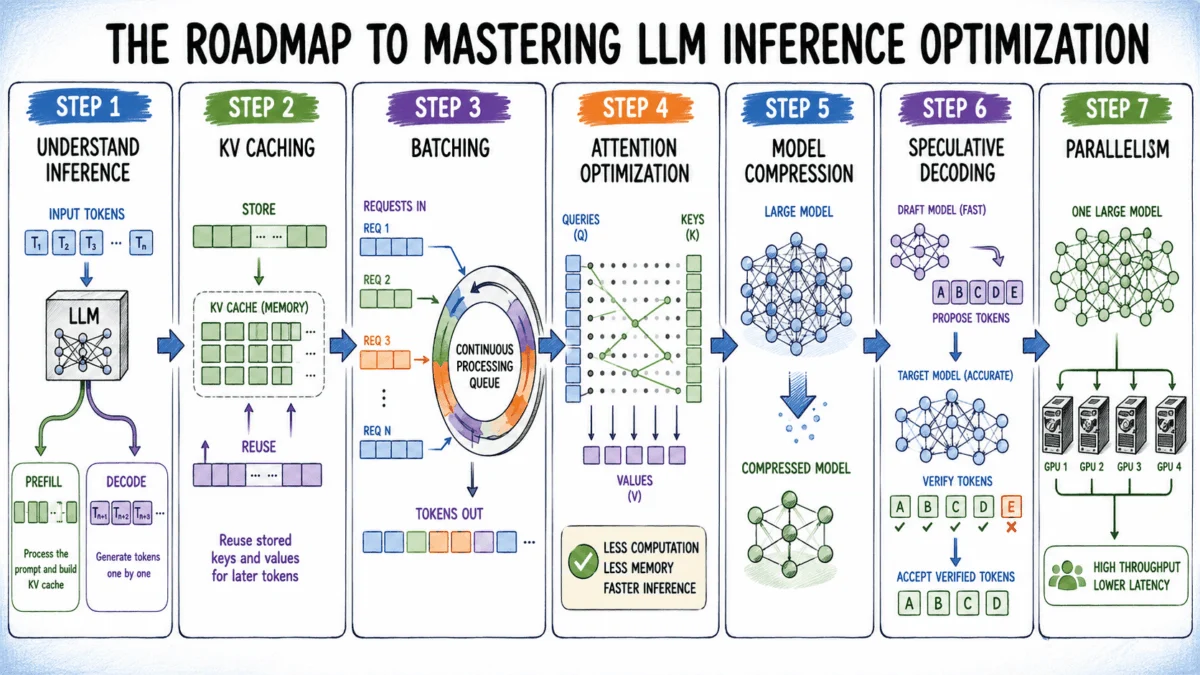

The rapid proliferation of Large Language Models (LLMs) has transitioned from a research novelty to a foundational infrastructure requirement for modern enterprise software. While the initial challenge of training these models has been mitigated by advancements in GPU clusters and distributed training frameworks, the operational challenge of deploying them—specifically achieving low-latency, cost-effective, and scalable inference—has become the new primary hurdle for engineering teams. As organizations attempt to integrate generative AI into production environments, they frequently encounter a "performance wall" where the computational demands of high-concurrency requests exceed hardware capacity, leading to prohibitive costs and unacceptable latency.
The Anatomy of the Inference Bottleneck
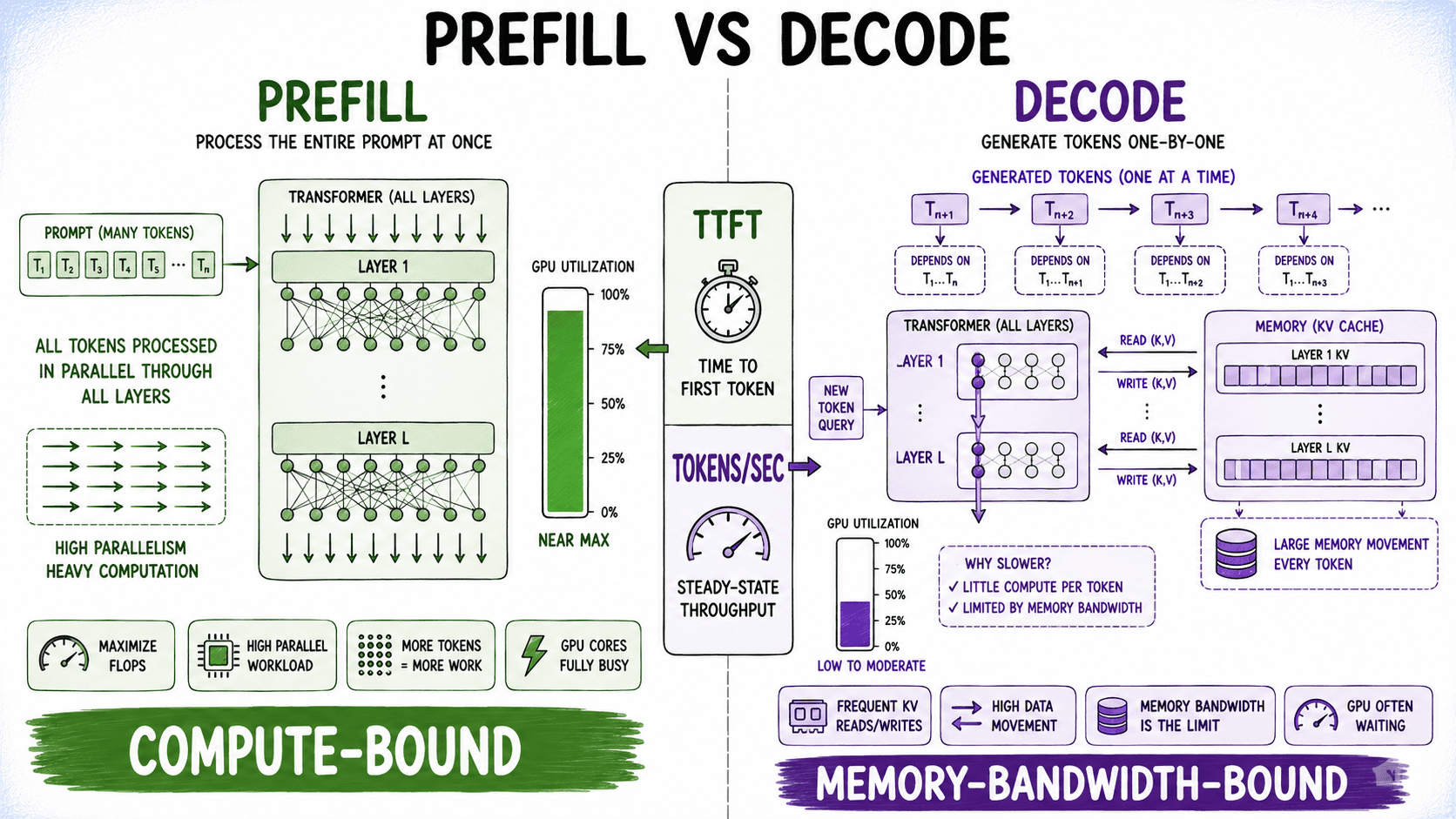
Understanding the physics of LLM inference is essential for any strategy aimed at optimization. Every forward pass through a transformer-based model is bifurcated into two distinct operational phases, each presenting unique resource constraints. The first, the prefill phase, involves processing the entirety of the input prompt. During this stage, the model computes the intermediate states known as Key and Value (KV) tensors. Because the input sequence is known in its entirety, this phase is highly parallelizable and is primarily compute-bound, meaning the limiting factor is the raw throughput of the GPU’s CUDA cores.
Following the prefill, the model enters the decode phase. This is an autoregressive process where the model generates output tokens one by one. Because each new token is dependent on all preceding tokens, parallelization within a single sequence is mathematically impossible. This stage shifts the bottleneck from compute to memory bandwidth. The GPU must constantly move massive weight matrices from high-bandwidth memory (HBM) to the processor to generate a single token, leaving the computational units underutilized. Consequently, most production systems are not limited by the raw teraflops of their GPUs, but by the speed at which data can be shuttled from memory to the compute engine.
Chronology of Optimization: From Naive to Intelligent Scheduling
In the early days of LLM deployment, engineers relied on static batching, a carry-over from traditional deep learning tasks. Under this model, the system would wait for a set number of requests to arrive, process them as a single block, and return results only when the longest sequence in the batch completed. This approach proved highly inefficient, as shorter sequences remained idle while waiting for longer ones to finish.
The industry landscape shifted significantly with the introduction of continuous, or "in-flight," batching. Popularized by open-source runtimes like vLLM, this method allows the system to treat each request independently within the batch. As soon as a single sequence generates its end-of-sequence token, that slot is immediately vacated and filled by a new, pending request. This scheduling innovation has enabled production systems to increase GPU utilization by several orders of magnitude, effectively smoothing out the performance variance inherent in unpredictable user prompts.
Technical Strategies for Memory Efficiency
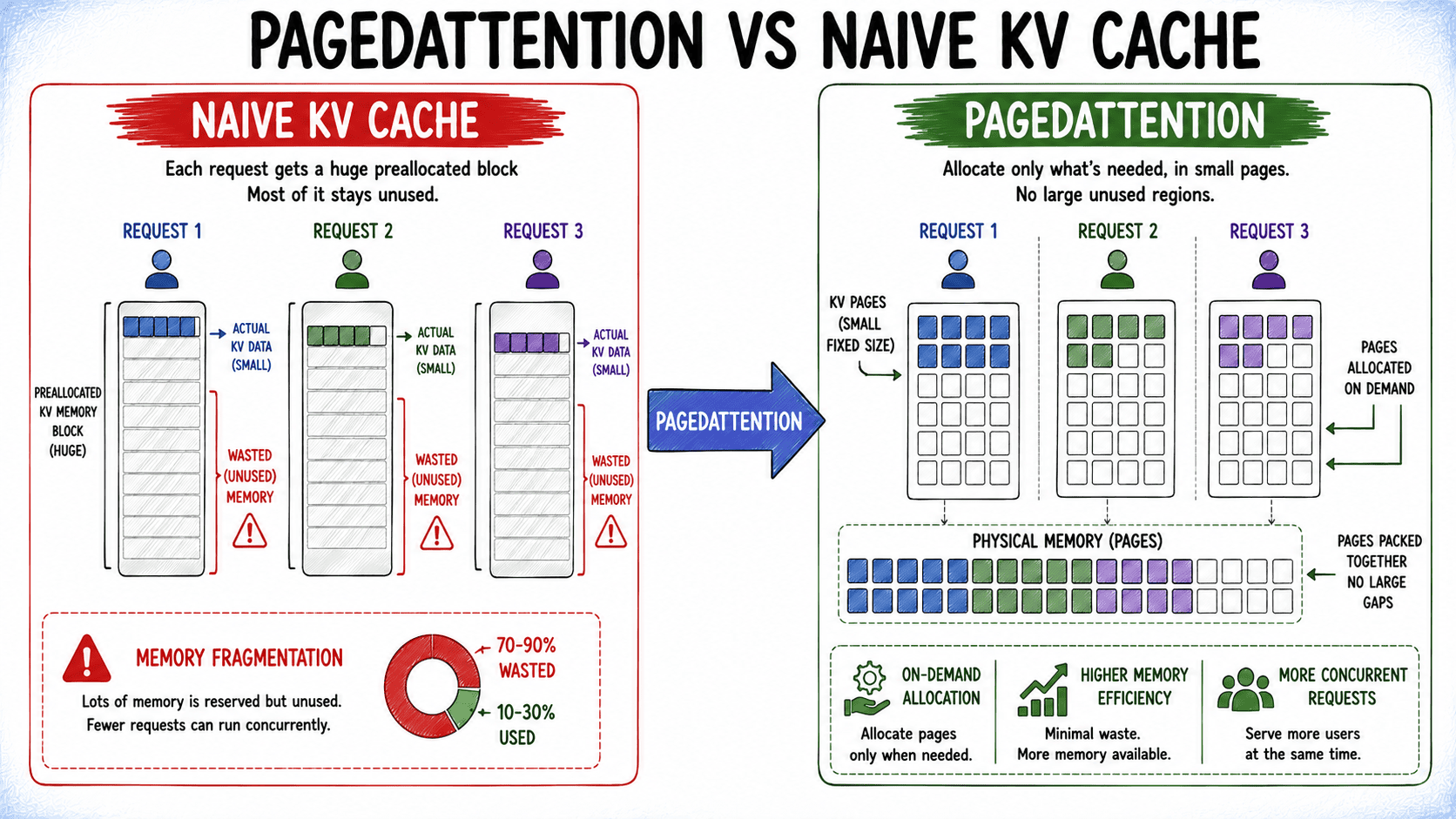
Memory management remains the most critical lever for scaling LLMs. The KV cache, which stores the intermediate states of previous tokens, can balloon to occupy gigabytes of VRAM for even mid-sized models, particularly as context windows expand to 128k tokens or more.
PagedAttention emerged as a seminal solution to this problem, drawing inspiration from virtual memory management in operating systems. By partitioning the KV cache into non-contiguous, fixed-size blocks, PagedAttention eliminates the "internal fragmentation" that previously plagued memory allocation. This ensures that VRAM is used only for active tokens, allowing for significantly larger batch sizes on identical hardware. Furthermore, prefix caching has emerged as a complementary technique, allowing systems to store and reuse the KV cache for common inputs—such as system prompts or frequently accessed documents—drastically reducing redundant computation in RAG (Retrieval-Augmented Generation) pipelines.
Architectural Optimizations and Model Compression
Beyond scheduling, architectural modifications have redefined the efficiency of the transformer block. Multi-Query Attention (MQA) and Grouped-Query Attention (GQA) have become industry standards for models like Llama 3 and Mistral. By sharing Key and Value heads across multiple Query heads, these architectures reduce the memory footprint of the attention mechanism without sacrificing significant model intelligence.
Model compression serves as the final frontier for hardware-constrained environments. Quantization—the process of reducing the precision of weights from 16-bit floating point to 8-bit or 4-bit integers—has become standard practice. Current benchmarking suggests that 4-bit quantization (such as AWQ or GPTQ) results in negligible quality loss while enabling models to fit onto smaller, more affordable consumer-grade or mid-tier enterprise GPUs. Structured sparsity, supported by NVIDIA’s Ampere architecture and beyond, further accelerates this by allowing the hardware to skip zeroed-out weights during computation, effectively doubling performance for specific matrix operations.
The Role of Speculative Decoding in Latency Reduction
For latency-critical applications, such as real-time voice assistants or interactive coding tools, speculative decoding provides a robust path forward. By deploying a "draft" model—a miniature version of the primary model—the system can predict the next several tokens in parallel. The primary, large-scale model then verifies these tokens in a single forward pass. If the draft model is accurate, the system gains a massive boost in tokens-per-second, as it effectively produces multiple tokens per verification step. This approach maintains the output quality of the larger model while significantly lowering the time-to-first-token (TTFT).
Industry Implications and Strategic Outlook
The shift toward optimized inference is not merely a technical trend; it is a prerequisite for the economic viability of AI. According to industry reports from firms like NVIDIA and various cloud service providers, inference optimization can reduce the total cost of ownership (TCO) for a model by 60% to 80%. This margin improvement allows companies to deploy larger, more capable models for use cases that were previously deemed too expensive.
From an engineering perspective, the trend is moving toward disaggregation. As hardware becomes more specialized, systems are increasingly separating the prefill and decode phases into different pools of compute. Prefill-optimized hardware handles the compute-heavy initial processing, while memory-optimized hardware manages the sequential token generation. This "disaggregated inference" pattern represents the current state-of-the-art in large-scale data center design.
Conclusion: Matching Techniques to Objectives
The selection of an inference optimization strategy must be dictated by the specific requirements of the application. For high-throughput offline processing, techniques like continuous batching and quantization are the primary drivers of success. For real-time, user-facing applications, speculative decoding and architectural variants like GQA are essential for meeting human-perceptible latency targets.
Ultimately, the goal of inference optimization is to decouple the capability of the model from the constraints of the hardware. By applying these layered strategies—from memory management and scheduling to compression and speculative execution—developers can ensure that their LLM deployments are not only functional but sustainable at scale. As the field matures, these practices will likely become embedded within the software stack, moving from manual tuning to automated, platform-level optimizations that enable the next generation of AI-native products.
