
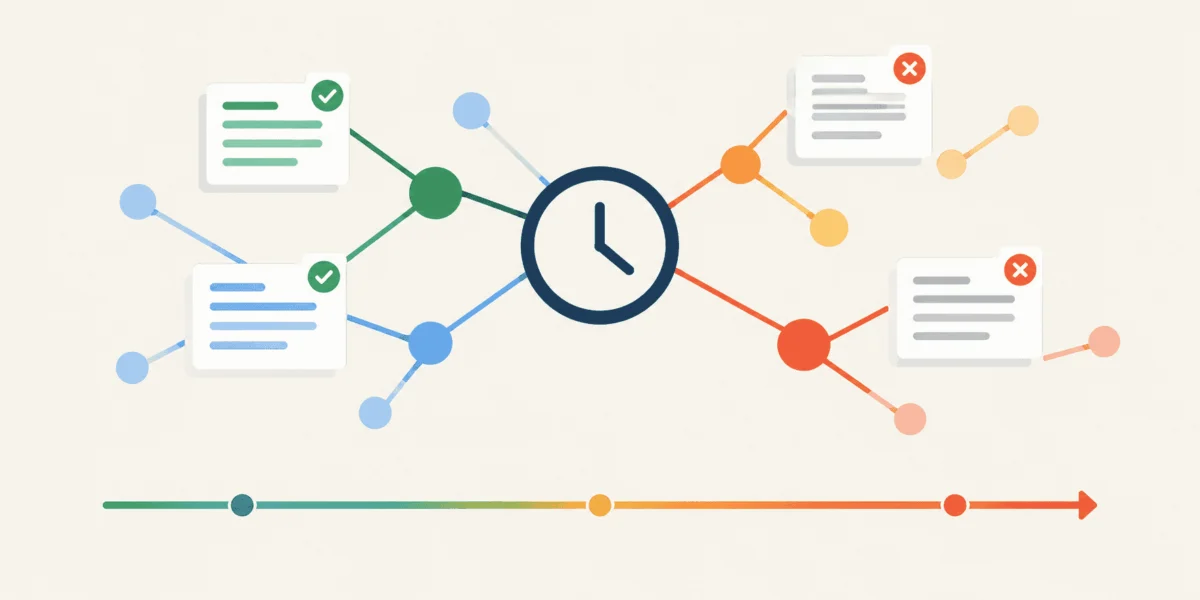

The rapid evolution of Large Language Models (LLMs) has fundamentally altered how organizations access and process information, yet a persistent vulnerability remains: the "timelessness" trap. Standard Retrieval-Augmented Generation (RAG) systems often treat knowledge as static, leading to hallucinations when facts—such as corporate leadership roles or regulatory statuses—shift over time. To address this, developers are increasingly turning to temporal reasoning layers that transition knowledge graphs from simple subject-predicate-object triples into dynamic, timestamped systems. By integrating an exponential decay function into Graph-RAG architectures, developers can now ensure that LLMs prioritize the most current data, significantly reducing the likelihood of outdated or contradictory outputs.
The Problem of Stale Information in RAG Architectures
Traditional RAG systems function by retrieving relevant chunks of text from a database and feeding them into an LLM to generate a coherent response. However, these retrieval engines often lack the sophistication to differentiate between a fact established three years ago and one established three minutes ago. In a business context, this is critical. If an LLM retrieves information that a company has three different CEOs—each from different periods—it may present all three as current, leading to severe factual inaccuracies.
This failure stems from the inherent design of knowledge graphs, which have historically been treated as monolithic, context-independent repositories. In real-world environments, data is fluid. When an LLM is tasked with synthesis, it often lacks the inherent mechanism to perform a temporal cross-reference, leading it to treat all retrieved nodes with equal weight. This creates a "hallucination engine" where the system inadvertently presents obsolete data as current truth.
Engineering a Temporal Reasoning Engine
To mitigate these risks, engineers are now adopting a four-dimensional approach to data structure, transforming triples into temporal quadruples: (Subject, Predicate, Object, Timestamp). By embedding a temporal dimension directly into the knowledge base, the system gains the ability to "time travel" through the history of a subject’s attributes.
The implementation involves creating a specialized class, such as TemporalGraph, which stores facts in a structured dictionary where each predicate maps to a list of objects and their associated dates. This allows the system to store a full audit trail of changes rather than overwriting previous entries. For example, in a corporate tracking scenario, a record for "TechCorp" might include multiple entries for the "HAS_CEO" predicate, each tagged with its specific date of entry.
import datetime
import math

class TemporalGraph:
    def __init__(self):
        # Data storage: Subject -> Predicate -> List of (Object, Date)
        self.knowledge_base =

    def add_fact(self, subject, predicate, obj, date_string):
        """Appends a time-stamped fact to the knowledge base."""
        fact_date = datetime.datetime.strptime(date_string, "%Y-%m-%d").date()
        if subject not in self.knowledge_base:
            self.knowledge_base[subject] =
        if predicate not in self.knowledge_base[subject]:
            self.knowledge_base[subject][predicate] = []
        self.knowledge_base[subject][predicate].append((obj, fact_date))
Chronology and Weighted Recency
The core of this temporal reasoning lies in the calculation of "recency weights." By applying an exponential decay formula, developers can programmatically diminish the influence of older facts while elevating the prominence of newer ones. The formula, weight = (0.5) ^ (age_in_days / half_life_days), provides a mathematically sound method for prioritizing truth.
For instance, if a system is configured with a 365-day half-life, a fact exactly one year old receives a confidence weight of 0.5. A fact recorded on the day of the query receives a weight of 1.0. This logic prevents the system from being overwhelmed by legacy data that is no longer relevant to the current operational state of the organization.
Practical Application: A Case Study in Corporate Dynamics
Consider a scenario where a corporation undergoes rapid leadership turnover. Within one week, a company might experience three changes in the CEO position. A standard retrieval system, lacking temporal logic, would retrieve all three individuals as "the CEO."
By contrast, a temporal-aware RAG system performs the following sequence:
- Filtering: The system excludes all facts with a timestamp later than the query date.
- Weighting: Each remaining fact is assigned a score based on the time elapsed between the event and the query date.
- Ranking: Results are sorted, ensuring the most recent, highest-weighted fact sits at the top of the context window provided to the LLM.
As demonstrated by test queries, this approach drastically improves output accuracy. When querying for the CEO as of November 18, 2023, the system identifies the most recent appointment preceding that date. When the query is moved to December 1, 2023, the system automatically shifts its priority to the most recent entry, successfully ignoring stale, older appointments that are no longer accurate.
Strategic Implications for Enterprise AI
The integration of temporal reasoning into Graph-RAG is not merely a technical refinement; it is a prerequisite for enterprise-grade AI. As companies deploy RAG systems to handle dynamic data—such as financial markets, supply chain logs, and legal document updates—the inability to handle time-sensitive data becomes a liability.
Data scientists and systems architects have noted that this approach significantly reduces the need for constant re-indexing of vector databases. In traditional RAG, updating a fact often requires a costly and time-consuming process of embedding and re-indexing the entire knowledge base. With a temporal graph, an organization can simply append a new quadruple to the graph. The reasoning layer handles the "truth" logic at query time, making the system far more agile and responsive to real-world volatility.
Limitations and Parameter Tuning
Despite its effectiveness, the temporal reasoning engine requires precise tuning. The half_life_days parameter acts as a sensitivity knob. In high-frequency environments—such as a trading floor or a chaotic newsroom—a long half-life (e.g., 365 days) may be too sluggish, causing the system to treat outdated information with undue importance. In such cases, shortening the half-life to 7 or 30 days is necessary to ensure the system reflects the "frenetic" nature of the data.
Furthermore, this method assumes that the input data contains reliable timestamps. In legacy systems where data is poorly dated or missing temporal markers, the implementation of a temporal graph requires a preliminary ETL (Extract, Transform, Load) phase to infer or assign dates to existing records. Without accurate source-of-truth timestamps, the recency weights lose their predictive power, potentially leading to a "garbage in, garbage out" scenario.
The Path Forward: Deterministic RAG
The broader implication of this advancement is the move toward "Deterministic RAG." By providing the LLM with a curated, ranked list of facts that the reasoning layer has already validated for freshness, we minimize the LLM’s role to that of a linguistic synthesizer rather than a truth-finder. This separation of concerns—where the graph manages the temporal truth and the LLM manages the natural language output—is likely to become the standard architectural pattern for mission-critical AI applications.
As developers continue to refine these layers, we can expect to see more sophisticated, multi-factor weighting systems that incorporate not just time, but source credibility and user-defined priority. For now, the transition to temporal quadruples marks a significant step toward making AI systems as reliable and context-aware as the human analysts they are designed to support. Organizations that adopt these temporal reasoning techniques today will be better positioned to navigate the complexities of data-driven decision-making in an increasingly fast-paced digital economy.
