
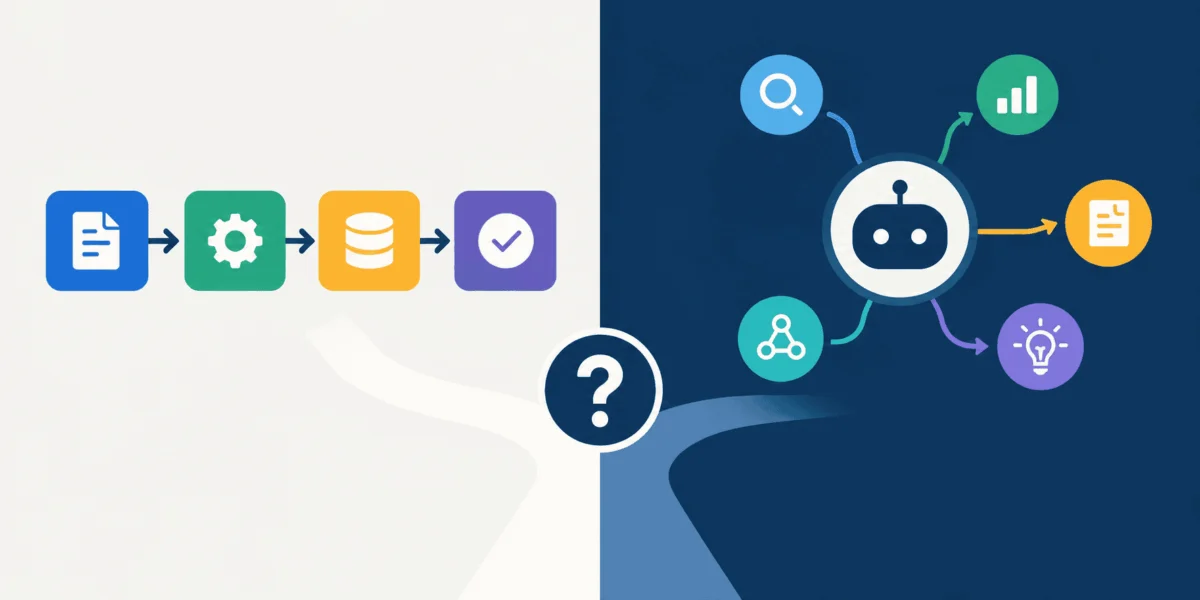

In the current landscape of rapid artificial intelligence adoption, the distinction between AI workflows and autonomous agents has become the most critical design decision for software architects and product managers. As businesses rush to integrate large language models (LLMs) into their core operations, a common misconception has emerged: that "agentic" systems are inherently superior to structured workflows. This confusion has led to the over-engineering of systems, resulting in increased operational costs, unpredictable outputs, and significant technical debt. To determine the appropriate technical architecture, organizations must look beyond the marketing hype and evaluate whether a task requires dynamic, self-directed reasoning or a deterministic, logic-driven pipeline.
The Evolution of AI Integration
The transition from simple prompt-based interactions to complex, multi-step systems began in earnest around 2023, following the release of advanced reasoning models. Initially, developers utilized LLMs for straightforward tasks like summarization or sentiment analysis. As capabilities expanded, the industry began experimenting with "chains"—sequences of automated tasks where the output of one step served as the input for the next.
By early 2024, the term "AI Agent" began to dominate technical discourse. An agent is defined by its ability to perform "looping" logic, where the model itself determines the next action based on previous observations. Unlike a workflow, where the developer dictates the path, an agent possesses the agency to backtrack, retry, or select tools from a suite based on its evaluation of the runtime environment. However, historical data from early enterprise deployments suggests that over 70% of projects labeled as "agents" could have been executed with 90% higher reliability using static workflows.
Defining the Architectural Divide
A workflow, often categorized as a pipeline or a directed acyclic graph (DAG), operates under a fixed control flow. In this architecture, the developer explicitly defines every branch, conditional logic gate, and stop condition. Even when an LLM is embedded within a workflow to perform specific tasks—such as extracting metadata from an invoice or classifying a support ticket—the overarching structure remains controlled by human-authored code.
Conversely, an agentic architecture offloads control flow to the model. At runtime, the agent receives a high-level goal and is given access to a library of tools (such as database query interfaces, web search functions, or API connectors). The model continuously evaluates its progress, deciding if a tool call was successful or if it needs to pivot its strategy. This capability is essential for "open-ended" tasks, such as incident response in a distributed server environment, where the sequence of failures cannot be predicted in advance.
Comparative Analysis: Efficiency and Cost
The economic implications of choosing between these architectures are significant. Supporting data from recent industry benchmarks indicates that agentic systems consume, on average, 3.5 to 5 times more tokens than equivalent workflows. This is due to the "thought" process—the chain-of-thought prompting and iterative tool-calling that occurs before a final answer is generated.
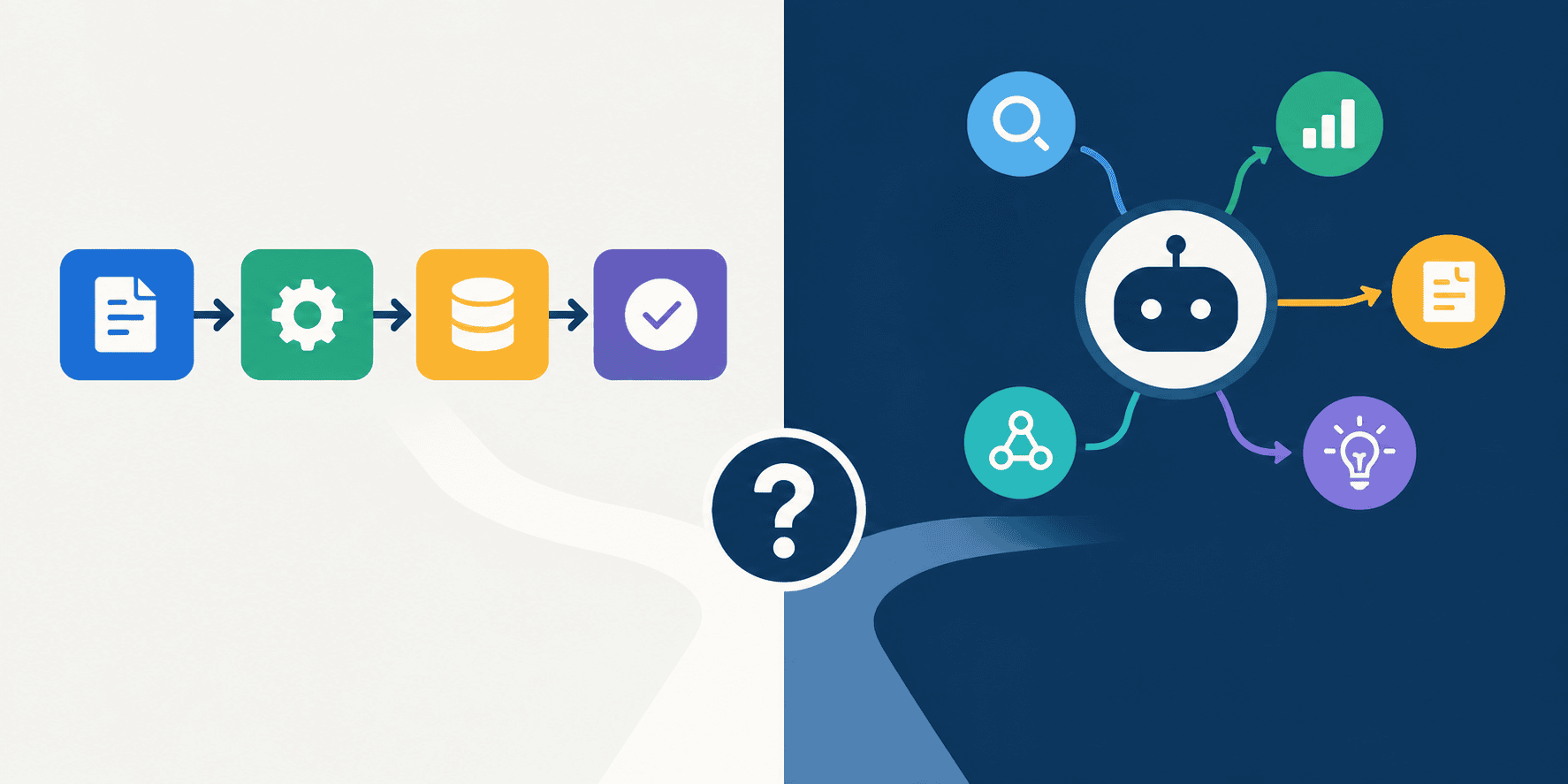
For high-volume operations, such as e-commerce customer support or automated document filing, the latency associated with agentic reasoning can degrade user experience. A workflow designed to process a refund, for example, can execute in milliseconds with predictable costs. An agent tasked with the same duty may engage in unnecessary "reflection" cycles, leading to higher latency and unpredictable billing, especially when using high-performance models like GPT-4o or Claude 3.5 Sonnet.
The Practical Test: A Decision Matrix
To assist engineering teams in avoiding unnecessary complexity, industry experts suggest a "Flowchart Test." Before committing to a development path, a lead engineer should attempt to map the entire process on a whiteboard.
- Deterministic Predictability: If a competent engineer can map the process with defined branches and stop conditions, a workflow is the optimal solution. The "agentic" flexibility is only necessary when the path is impossible to map.
- Compliance and Auditability: In regulated industries—such as finance, legal, and healthcare—deterministic workflows are non-negotiable. Auditors require an immutable record of the decision-making process. Agentic systems, which can take different paths to reach the same conclusion, present a "black box" challenge that complicates regulatory compliance.
- Volume and Scalability: When dealing with millions of requests, the overhead of an agent becomes a bottleneck. Workflows allow for caching and optimization at every step, whereas agents require active compute for every iteration.
Strategic Implications for Enterprises
The shift toward "Agentic Workflows"—a hybrid approach—is becoming the industry standard. In this model, developers construct a rigid, reliable workflow for the majority of the process, but inject "agentic" nodes only at specific points where complex, variable reasoning is required. This allows organizations to maintain the cost-efficiency and safety of a pipeline while leveraging the power of LLMs where they provide the most value.
Industry analysts suggest that companies should view agents as "specialist consultants" rather than general-purpose automators. An agent is a tool for exploration and complex investigation; a workflow is a tool for execution and reliability.
Conclusion: A Path Forward
As the hype surrounding AI agents begins to stabilize, the industry is returning to first principles: engineering reliability. The most successful AI implementations in the coming years will be those that treat autonomy as a scarce resource, to be used only when the problem space is too volatile for traditional logic.
Before initiating a new build, teams should adhere to a simple, three-part protocol:
- Draft the Flow: Attempt to write a manual sequence of operations.
- Identify the Bottleneck: Determine if the system fails because of a lack of logic (fixable via code) or a lack of reasoning (fixable via LLMs).
- Constrain the Agent: If an agent is necessary, wrap it within a strictly monitored workflow to ensure it operates within defined safety and budget guardrails.
By prioritizing clear, understandable architectures over the pursuit of total autonomy, businesses can build resilient AI systems that are not only easier to maintain but also provide a tangible, measurable return on investment. The future of AI is not just about intelligence—it is about the disciplined application of that intelligence within the boundaries of stable, scalable software design.
