

The rapid evolution of enterprise software development has fundamentally transformed how applications are designed, packaged, tested, and deployed across diverse computing environments. At the heart of this architectural shift is containerization, a lightweight virtualization method that encapsulates software code, runtime environments, system tools, libraries, and configuration settings into a single, standalone executable package known as a container. Unlike traditional software deployment models that rely heavily on monolithic configurations or resource-heavy virtual machines, modern container technology isolates application processes while sharing the underlying operating system kernel. This approach drastically minimizes overhead, accelerates deployment cycles, and ensures absolute consistency across localized developer workstations, staging servers, and complex cloud-native production clusters.
The origins of containerization trace back several decades through foundational Unix operating system features like chroot, FreeBSD jails, and Solaris Zones, which laid the conceptual groundwork for process isolation. However, the modern container revolution truly catalyzed in 2013 with the introduction of Docker. By standardizing container formats and providing an intuitive developer interface, Docker transformed niche kernel namespaces and control groups (cgroups) into an accessible, universal standard for application packaging. Following Docker’s market entry, the rapid proliferation of containerized workloads necessitated sophisticated management tools, leading to the creation of Kubernetes by Google in 2014. Open-sourced shortly thereafter and donated to the Cloud Native Computing Foundation (CNCF), Kubernetes established a new industry benchmark for automated deployment, scaling, and orchestration of container fleets.
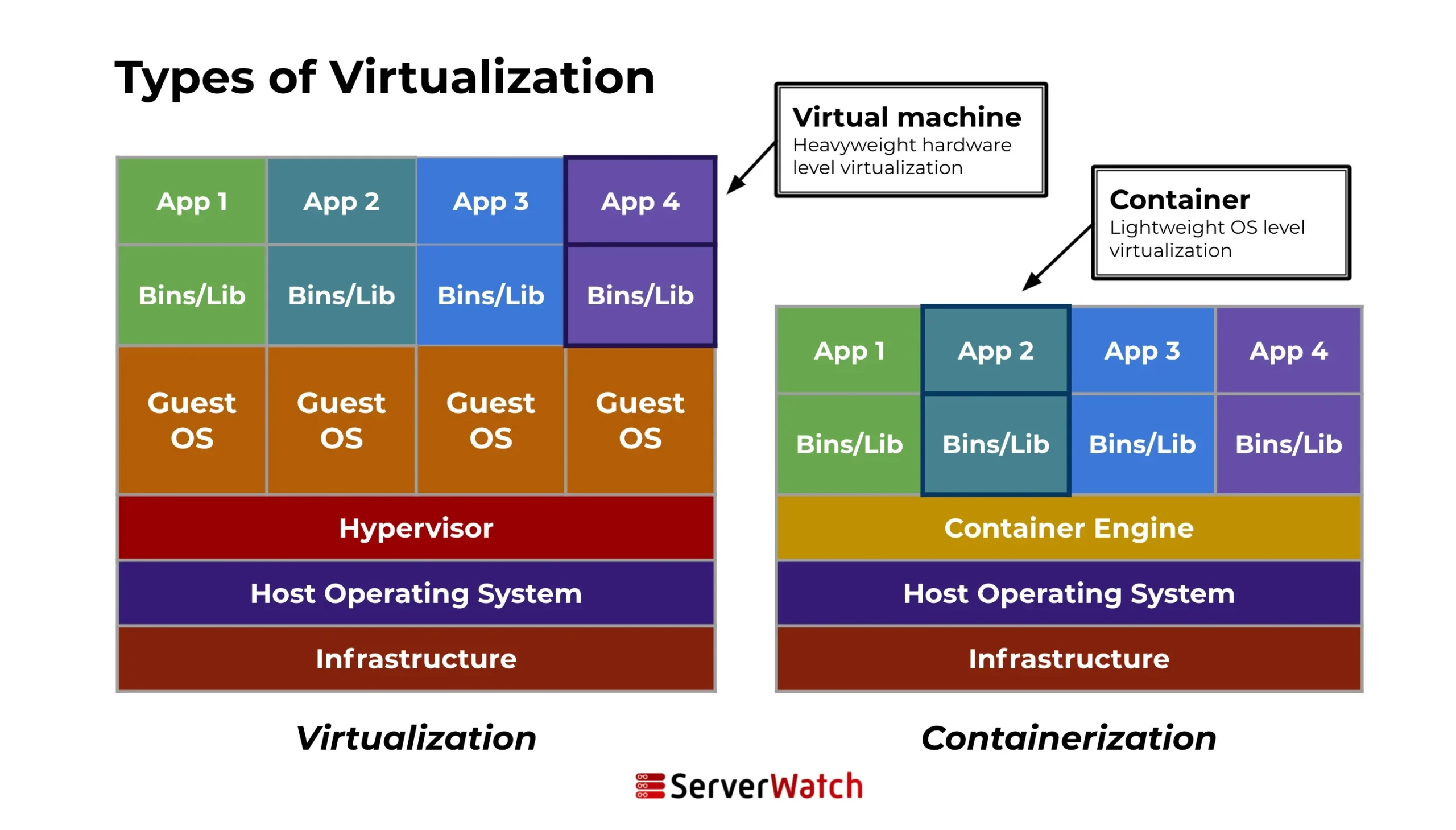
To fully comprehend the operational advantages of containerization, industry architects frequently evaluate containers against traditional virtual machines. While both technologies provide isolated execution environments, their underlying hardware interactions differ significantly. Virtual machines require a hypervisor—either Type 1 running directly on bare-metal hardware or Type 2 hosted atop an existing operating system—to provision virtualized hardware resources. Each virtual machine must run an entire guest operating system alongside the target application, resulting in substantial memory footprints, slower boot times, and increased licensing overhead. Conversely, containers bypass the need for a guest operating system entirely. By sharing the host system kernel and maintaining isolated user spaces, filesystems, and process trees, containers achieve near-instantaneous startup times and optimal hardware utilization density. Industry benchmarks consistently indicate that physical servers can host significantly more container instances than virtual machine instances, translating directly into reduced data center footprint and lower cloud infrastructure expenditure.
The practical applications of containerization span across multiple operational domains within software engineering, most notably supporting microservices architectures and continuous integration and continuous deployment pipelines. Microservices design patterns decompose monolithic applications into small, independently deployable services that communicate via lightweight network protocols. Containers serve as the ideal vehicle for microservices because each service can be packaged with its specific dependencies, programming language runtimes, and libraries without risking dependency conflicts with neighboring services. Furthermore, container images streamline the CI/CD lifecycle. Development, quality assurance, and production environments can be harmonized identically through containerized artifacts, effectively eliminating the persistent enterprise software troubleshooting dilemma where an application functions flawlessly on a developer’s laptop but fails in production due to environmental discrepancies.

Adopting container technologies yields extensive operational and financial benefits for modern IT organizations. Foremost among these advantages is unprecedented application portability. Because a container encapsulates all required execution components, developers can build an image once and run it seamlessly across on-premises data centers, private clouds, and public cloud providers such as Amazon Web Services, Microsoft Azure, and Google Cloud Platform without code modifications. Resource efficiency represents another critical benefit; because containers consume only the system resources necessary to execute the application process, organizations experience higher compute consolidation ratios. Additional advantages include accelerated deployment velocity, enhanced developer productivity, simplified horizontal scaling, automated fault recovery, and robust version control through container registries that store immutable image histories and facilitate instant rollbacks when deployment anomalies occur.
Despite these transformative benefits, enterprise adoption of containerization introduces notable security, management, and integration challenges. Security remains a paramount concern, as shared kernel architectures mean that a vulnerability exploiting the host kernel could theoretically compromise all running containers on that host. Container security strategies must therefore incorporate rigorous vulnerability scanning of base images, runtime monitoring, principle-of-least-privilege access controls, and strict network segmentation. Management complexity also escalates rapidly as organizations scale from a handful of containers to thousands distributed across hybrid cloud environments. Orchestrating these vast ecosystems requires specialized expertise in platforms like Kubernetes, leading to a high learning curve and increased demand for certified cloud-native professionals. Furthermore, integrating modern container platforms with legacy enterprise systems—such as older relational databases, proprietary authentication mechanisms, and traditional storage area networks—requires careful architectural planning and intermediary bridging layers.
The broader container technology ecosystem has expanded far beyond foundational Docker tools and Kubernetes orchestration engines. Alternative container runtimes, such as containerd and CRI-O, have gained widespread industry adoption for their lightweight design and compliance with Open Container Initiative (OCI) standards. Security-focused container technologies, including Kata Containers and Firecracker microVMs, have emerged to provide hardware-level isolation for multi-tenant environments by combining the security posture of virtual machines with the speed and agility of containers. Meanwhile, specialized storage controllers, service meshes like Istio and Linkerd, and serverless container services such as AWS Fargate continue to mature, abstracting underlying infrastructure management and allowing developers to focus exclusively on application logic.
Looking toward the future, containerization is positioned to intersect deeply with emerging technological frontiers, most notably artificial intelligence, machine learning, and the Internet of Things. As organizations increasingly deploy complex AI models and large language models at scale, containers provide the reproducible environments required to manage heavy computational workloads, GPU acceleration dependencies, and distributed training pipelines. In the IoT sector, lightweight container engines enable edge computing devices to execute localized data processing and firmware updates reliably, even with limited bandwidth and constrained hardware resources. Regulatory and standardization bodies are also actively refining compliance frameworks for containerized infrastructure, focusing on cryptographic software bills of materials (SBOMs) to verify supply chain integrity and provenance.
Ultimately, the trajectory of modern software engineering indicates that containers will remain a foundational pillar of digital transformation strategies for the foreseeable future. By bridging the gap between development agility and operational stability, containerization empowers enterprises to innovate rapidly while maintaining resilient, scalable infrastructure. As cloud-native ecosystems continue to mature and integrate with advanced computational paradigms, organizations that master container deployment and orchestration will secure a distinct competitive advantage in an increasingly digitized global economy.
