
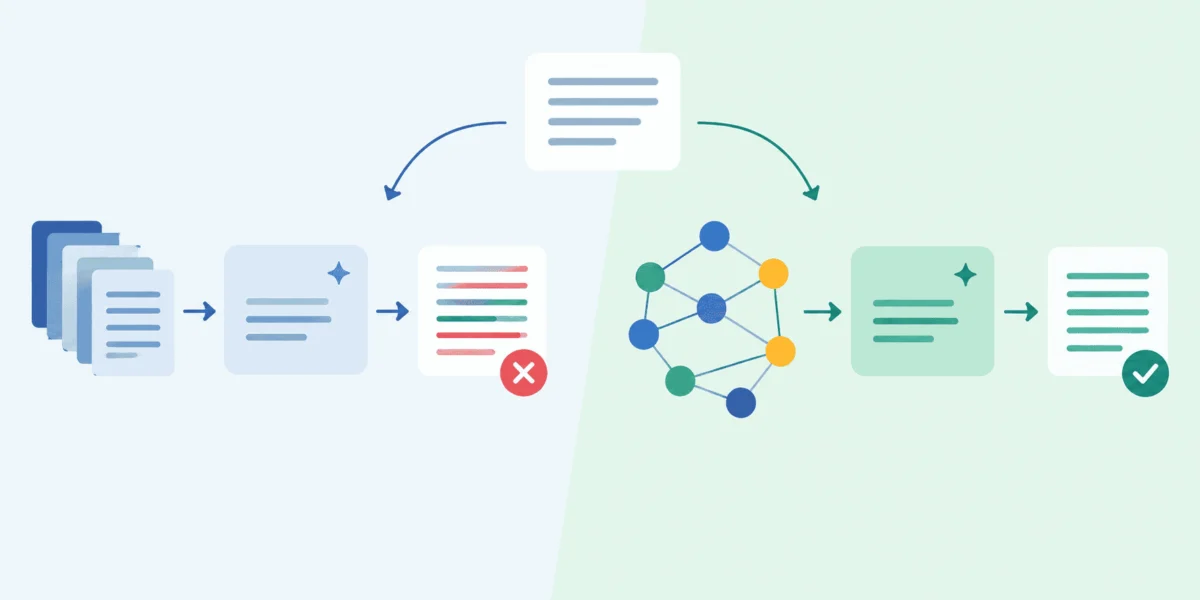

The evolution of Retrieval-Augmented Generation (RAG) systems has reached a critical juncture where engineers must decide between the convenience of semantic vector search and the precision of structured data. As organizations increasingly deploy large language models (LLMs) to parse dense technical, medical, or financial documentation, the "lossiness" inherent in vector databases has become a significant liability. Traditional RAG pipelines rely on similarity-based retrieval, which often conflates numeric data, historical statistics, and intricate entity relationships when multiple similar entities coexist within a latent vector space. To mitigate these hallucinations, developers are exploring deterministic 3-Tiered Graph-RAG architectures. This report benchmarks a standard vector-based RAG pipeline against a structured, graph-augmented approach to determine the practical trade-offs in accuracy and computational complexity.
The Problem of Latent Space Conflation
At the core of the current RAG architecture debate is the fundamental limitation of embedding models. Vector databases operate on the principle of semantic proximity, converting text into high-dimensional vectors. While effective for thematic retrieval, these systems frequently falter when queried for specific, atomic facts. For instance, in a dataset containing performance metrics for hundreds of athletes, a vector search might retrieve a paragraph that mentions the correct player but includes extraneous, conflicting figures—such as career averages or game-specific statistics—that the LLM may inadvertently prioritize.
In high-stakes production environments, this "context pollution" leads to hallucinations, where the model synthesizes a plausible but factually incorrect response. The proposed 3-Tiered Graph-RAG system aims to resolve this by decoupling truth-based facts from unstructured narrative text. By housing atomic data in a deterministic QuadStore and reserving the vector database for supplemental context, the architecture seeks to establish a clear hierarchy of information for the LLM to process.
Methodology: Establishing a Controlled Benchmark
To quantify the performance disparity between these two paradigms, a controlled experiment was conducted using a synthetic dataset of 50 distinct basketball players. Each entry in the dataset included a "true" seasonal points-per-game (PPG) statistic, alongside intentionally noisy, unstructured text designed to mimic real-world documentation. This text contained "distractor" statistics—such as first-half scoring and career averages—that frequently appear in sports reporting and would typically complicate standard vector retrieval.
The evaluation utilized the google/flan-t5-base model, a parameter-efficient, sequence-to-sequence model capable of running in resource-constrained environments. By limiting the model’s capacity, researchers aimed to test how well different architectures handle the cognitive load of instruction-following when faced with conflicting information.
The standard RAG pipeline employed a direct retrieval mechanism, querying the vector database for the top three most relevant chunks of text and feeding them into the LLM with a basic prompt. In contrast, the 3-Tiered Graph-RAG system queried the QuadStore for the definitive statistic, retrieved a single chunk from the vector database for context, and utilized a more rigorous prompt structure that explicitly commanded the model to prioritize the "Absolute Truth" of the graph data over the "Fallback Text" of the vector database.
Experimental Results and Observations
Upon executing the 50-query benchmark, the findings provided a counterintuitive perspective on system design. The standard Vector-RAG achieved an accuracy rate of 96.0%, while the 3-Tiered Graph-RAG achieved 92.0%.
These figures suggest that for smaller, specialized models like flan-t5-base, the added complexity of a graph-based retrieval system may actually induce errors. The logic follows that the model, while adept at straightforward retrieval, lacks the parameter density to manage the nuanced task of reconciling conflicting "Context 1" and "Context 2" inputs. The forced instruction-following required by the 3-Tiered system appeared to disrupt the model’s performance, demonstrating that architectural sophistication must be matched with an appropriately capable model.
Chronology of RAG Architectural Development
The transition toward graph-based integration follows a multi-year trajectory in the AI development community:
- 2020–2022: The emergence of standard RAG as the industry standard, characterized by simple vector stores (FAISS, Pinecone) and basic prompt engineering.
- 2023: The identification of "semantic drift" and "hallucination clusters" as major barriers to enterprise adoption, prompting research into hybrid search methods.
- 2024: The introduction of Graph-RAG and Knowledge Graph (KG) integration, aiming to provide structural integrity to unstructured LLM reasoning.
- 2025–Present: The current phase of rigorous benchmarking, where engineers move beyond proof-of-concept to identify the specific failure modes of hybrid systems.
Implications for Production Engineering
The data underscores a vital lesson for AI systems architects: there is no "one-size-fits-all" solution. The 92.0% accuracy of the Graph-RAG in this specific test does not indicate a failure of the architecture, but rather an illustration of the "Model-Architecture Mismatch" phenomenon.
In production environments, the use of larger, more reasoning-capable models—such as Llama 3, GPT-4, or Claude 3.5—is likely necessary to fully leverage the benefits of a graph-augmented pipeline. Larger models possess the superior instruction-following capabilities required to prioritize structured truth over noisy context without suffering from the cognitive load that hampered the flan-t5-base in this experiment.
Furthermore, the results highlight the importance of "Data Governance" in RAG. While Graph-RAGs are technically superior for fact-dense tasks, the overhead of maintaining a QuadStore or a formal knowledge graph is significant. Organizations must weigh the cost of manual or automated graph construction against the performance gains observed in their specific use cases. For queries that are primarily exploratory, a standard vector RAG remains both cost-effective and highly efficient. For queries involving strict compliance, financial reporting, or technical documentation, the transition to a deterministic architecture remains the logical progression, provided the underlying LLM is sufficiently robust.
Broader Impact on Enterprise AI
The findings presented in this benchmark serve as a call for a more empirical approach to AI implementation. Rather than adopting the latest architectural trends blindly, engineering teams are encouraged to treat their RAG pipelines as dynamic systems that require fine-tuning for both the specific data domain and the LLM being utilized.
The industry is moving toward a modular future where "Tiered RAG" will likely become the standard for complex systems. As we refine these pipelines, the focus will increasingly shift from simple retrieval accuracy to the reliability of reasoning under pressure. The next iteration of benchmarks will likely focus on larger model classes, testing the limits of graph-augmented architectures in environments where data integrity is not just an advantage, but an operational requirement.
Ultimately, the goal remains the reduction of hallucination. Whether that is achieved through the structural rigidity of a graph or the semantic depth of a vector search depends entirely on the alignment between the data’s complexity and the model’s capacity to interpret it. As demonstrated by the 4% difference in accuracy, failing to harmonize these elements can lead to a degradation of performance, proving that in the world of RAG, simplicity and sophistication must be carefully balanced.
