
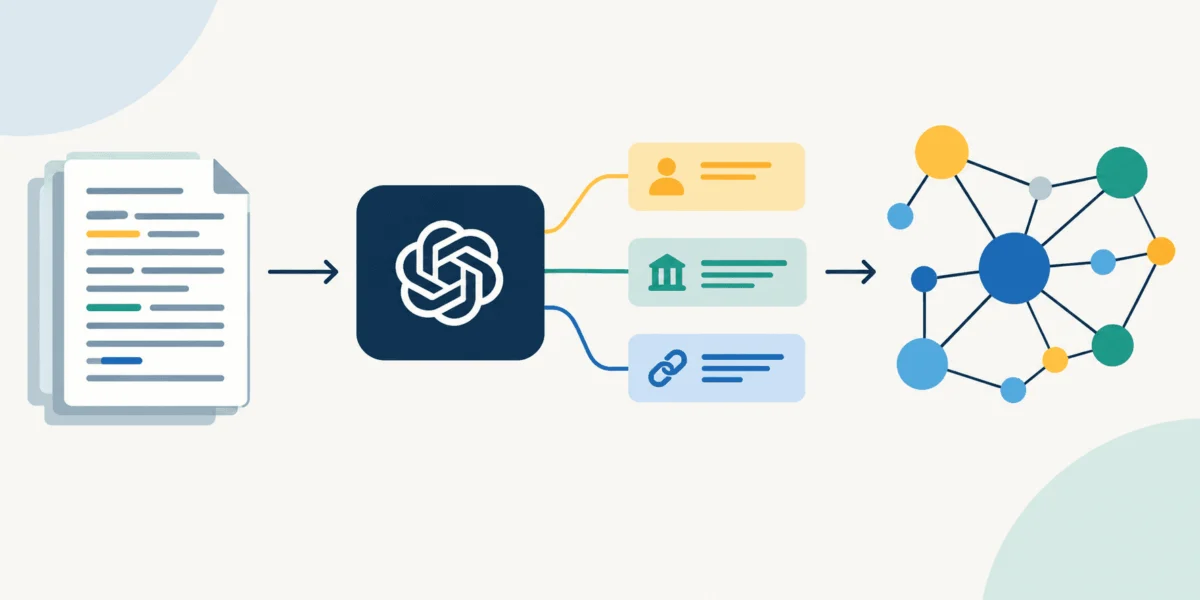

In the rapidly evolving landscape of artificial intelligence, the transition from unstructured data to structured, machine-interpretable knowledge remains a primary bottleneck for enterprise-grade Retrieval-Augmented Generation (RAG) systems. While large language models (LLMs) have demonstrated an uncanny ability to process natural language, their propensity for "hallucinations"—generating plausible but factually incorrect information—poses a significant challenge for mission-critical applications. By shifting from traditional vector-based search to a deterministic, graph-based architecture, developers can enforce a "ground truth" layer that constrains LLM output. This article explores the mechanics of automating the population of a knowledge graph using local LLMs and the SPOC (Subject-Predicate-Object-Context) quad format, effectively bridging the gap between raw, noisy text and high-fidelity structured data.
The Evolution of Graph-Based Information Retrieval
Traditional information retrieval systems, primarily based on semantic vector embeddings, operate on the principle of cosine similarity. While effective at finding conceptually related documents, these systems lack an explicit understanding of factual relationships. For example, a vector search might retrieve a paragraph about "LeBron James" and "The Lakers," but it does not inherently understand the nature of their relationship.
The introduction of Graph-RAG architectures represents a paradigm shift. By modeling information as a network of nodes and edges, systems can perform deterministic traversals, ensuring that the retrieved context is anchored in verified triples. The addition of "Context" as a fourth dimension in the SPOC model allows developers to track the provenance of a fact, facilitating conflict resolution when multiple, potentially contradictory sources are present in a dataset.
Technical Prerequisites and Environment Configuration
Implementing this automation requires a robust, local compute environment to ensure data privacy and operational cost efficiency. The integration of Ollama—a framework for running LLMs locally—provides the necessary interface to leverage models like Llama 3.2 without relying on external API calls, which can be both costly and subject to latency.
For developers operating in either a local integrated development environment (IDE) or a cloud-based sandbox like Google Colab, the setup process is streamlined through standardized library management. The requirement for the Wikipedia library facilitates the ingestion of large corpora of human-verified knowledge, while the requests library manages the communication with the local Ollama server instance.
By configuring the LLM to operate in a strict JSON output mode, developers can ensure the output is programmatically parsable. This is critical for downstream applications; a single malformed character in the extraction process can break the entire pipeline. The deployment of the Llama 3.2 model, a lightweight yet highly capable architecture, allows for rapid inference, making the extraction process viable even on modest hardware configurations.
Constructing the QuadStore Engine
At the heart of this architecture lies the QuadStore, a lightweight database implementation designed to manage the SPOC structure. Unlike complex graph databases such as Neo4j or ArangoDB, which may be overkill for prototyping or specific RAG applications, a Python-based QuadStore allows for rapid integration and testing of the graph logic.
The structure of the QuadStore hinges on a simple class definition that stores quad tuples. The add method ensures data integrity by preventing the duplication of identical facts, while the query method provides a flexible interface to filter the graph by any combination of subject, predicate, object, or context. This design mimics the hierarchical, graph-based architecture recently popularized in deterministic 3-tiered Graph-RAG systems, allowing for a seamless transition from experimental scripts to production-ready modules.
The Extraction Pipeline: Turning Text into Logic
The process of extracting factual quads from unstructured narrative text is a three-stage pipeline: ingestion, tokenization, and structured transformation.
- Ingestion: Raw text is pulled from external sources—in this case, Wikipedia articles. The use of
auto_suggest=Falseduring the API call is a vital safeguard, preventing the library from performing erroneous auto-corrections that could result in the extraction of facts related to the wrong entity. - Inference: The LLM is provided with a prompt specifically designed to force the extraction of atomic facts. The prompt instructs the model to adhere to a rigid JSON schema, ensuring that every piece of text processed is transformed into an array of objects.
- Normalization: The raw output from the LLM is often noisy. The pipeline includes a normalization layer that standardizes keys (e.g., converting "Subject" to "subject") and strips whitespace. This ensures that when the data is finally loaded into the
QuadStore, it is uniform and queryable.
Empirical Results and Performance Analysis
In a test case involving the Wikipedia summary of Alan Turing, the system successfully parsed two paragraphs of text into 11 discrete, verified facts. The extracted quads—such as ("Alan Mathison Turing", "was born", "in London", "Wikipedia_Alan_Turing")—demonstrate the model’s ability to identify key entities and the predicates linking them.
The time taken for this extraction on a standard GPU-accelerated environment is measured in seconds, showcasing the efficiency of this approach. While non-deterministic behavior inherent in LLMs means that the exact number of extracted facts may fluctuate, the implementation of a consistent context tag ("Wikipedia_Alan_Turing") provides a clear audit trail. This allows users to trace the origin of every triple in their knowledge graph, a feature that is essential for compliance and accuracy in enterprise environments.
Broader Implications for AI Architecture
The implications of automating knowledge graph population are profound. For sectors such as healthcare, law, and finance—where factual accuracy is non-negotiable—the ability to ground an LLM in a structured, verified knowledge base is a major competitive advantage.
- Hallucination Mitigation: By forcing the model to query the
QuadStorebefore generating a response, the system ensures that the AI’s output is limited to the facts contained within the graph. - Explainability: When an LLM retrieves information from a graph, it can cite the exact context of the fact, providing users with a verifiable source rather than a "black box" hallucination.
- Scalability: As the graph grows, the system becomes increasingly robust. Organizations can curate their graphs, adding context from proprietary documents, manuals, and internal databases, thereby creating a "corporate memory" that is both accessible and intelligent.
Future Directions and Challenges
While the current workflow is highly effective, several challenges remain. The primary concern is the scalability of the extraction process when dealing with massive datasets. Processing millions of pages requires a distributed pipeline, potentially involving pre-filtering of text to focus on high-value documents. Furthermore, the quality of the extraction is entirely dependent on the prompting strategy. Developing more sophisticated, few-shot prompting techniques could improve the accuracy of the predicate identification, ensuring that the relations extracted are as meaningful as possible.
Additionally, as the QuadStore grows, the search performance will eventually require optimization. Moving from a simple Python list to an indexed, persistent storage solution like SQLite or a dedicated graph database will be the natural evolution for this project.
Conclusion
The convergence of local LLM inference and structured graph databases represents a pivotal moment in the development of reliable AI systems. By closing the loop between raw, unstructured text and a deterministic SPOC-based knowledge graph, developers can build RAG systems that are not only smarter but also more trustworthy. As tools like Ollama and lightweight database frameworks continue to mature, the barrier to entry for building these sophisticated architectures will continue to drop, empowering a new generation of developers to create AI solutions that prioritize accuracy, provenance, and structured intelligence. This automated approach ensures that the knowledge of the future is not just vast, but also deeply organized and fundamentally reliable.
