
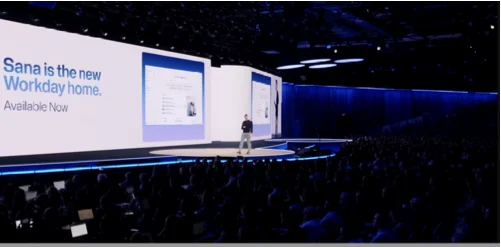

The enterprise software landscape gathered in full force as Workday Rising 2026 commenced its inaugural full day of sessions, setting a definitive tone against industry fears of a broader software market contraction. Rejecting notions of an impending SaaSpocalypse, Workday executives took to the stage in high-confidence mode to articulate a sweeping vision for the reinvention of corporate workflows through advanced, agentic artificial intelligence. Backed by a robust financial and operational footprint, the company positioned its multi-SaaS application architecture and unified data model not as legacy constraints, but as essential foundations for deploying secure, trustworthy AI agents capable of executing autonomous enterprise operations.
The backdrop of this year’s conference is defined by a significant maturation in how cloud providers approach generative and agentic AI. Having moved past the initial hype cycle of conversational chatbots, enterprise technology leaders are now grappling with the operational reality of deploying software agents that can reliably execute multi-step business processes. Workday enters this arena with a reported 6,000 enterprise customers actively running live agents on its platform. This traction is underpinned by a massive operational scale: the company processes over 1.4 trillion transactions annually and supports more than 80 million users worldwide. This vast volume of normalized data forms the bedrock of what leadership terms the Workday Data Cloud and the Agentic System of Record, providing the deep contextual awareness required to minimize errors and hallucinations in high-stakes corporate environments.
Chronology of Strategic Announcements and Acquisitions
The opening sequence of Workday Rising 2026 was marked by a rapid succession of strategic announcements designed to solidify the company’s position in the evolving agentic ecosystem. Among the most prominent developments is Workday’s official move to acquire C1.ai, a leading identity and access management platform specifically built for human workers and digital agents. Announced concurrently with the conference kickoff, the acquisition targets one of the most critical vulnerabilities in modern enterprise computing: the secure provisioning and just-in-time permission management of autonomous software agents.
According to executive statements delivered during the opening keynote, the integration of C1.ai addresses the growing demand for rigorous runtime enforcement layers. As enterprises scale their deployment of autonomous software, the risk of unmonitored or unauthorized system access has emerged as a primary concern for chief information security officers. By embedding C1.ai’s identity orchestration directly into its architecture, Workday aims to establish a robust governance framework that separates "lawful" corporate agents from unmanaged tools, thereby neutralizing regulatory and operational risks.
In tandem with the C1.ai integration, Workday used the event to unveil an expansive headless user experience strategy anchored by Sana, which the company has designated as a new dynamic agentic home. Rather than attempting to force all users into a proprietary interface, Workday’s updated product roadmap enables its domain-specific AI agents to operate natively within the daily communication and productivity tools employees already utilize, including Microsoft Copilot, Microsoft Teams, Slack, Google Gemini Enterprise, and Anthropic’s Claude.
The Context Imperative in Enterprise AI
Central to Workday’s messaging at the 2026 conference is the concept of deep organizational context. Industry analysts and enterprise architects have increasingly pointed out that large language models (LLMs), while powerful in general reasoning, consistently fall short in enterprise applications due to a lack of real-time operational truth. Without precise contextual data delivered at the exact point of inference, AI agents risk generating tone-deaf proposals, violating internal compliance policies, or executing unauthorized business transactions.
During the pre-conference press briefings and the main opening keynote, Chief Executive Officer Aneel Bhusri emphasized that twenty years of platform development have yielded a distinct competitive advantage. Unlike standalone AI startups or horizontal technology providers that must stitch together disparate data repositories, Workday’s architecture relies on a single, normalized data model spanning human resources, financial management, and operational planning.
Company executives argue that this unified schema allows AI agents to understand complex organizational relationships—such as reporting lines, budget constraints, approval hierarchies, and compensation structures—without requiring extensive custom integration work. By ensuring that the underlying models draw exclusively from verified corporate data stores and adhere to strict role-based access controls, the platform attempts to bridge the gap between autonomous execution and regulatory compliance.
The Evolution of Agentic Governance and Enterprise Rails
The introduction of rigorous governance structures, frequently referred to in the industry as agentic harnesses or enterprise rails, dominated the technical discussions on the first day of the conference. As corporate buyers move from experimental AI proofs-of-concept to production deployments affecting core business functions, the demand for accountability, audit logging, and deterministic process execution has intensified.
Gerrit Kazmaier, President of Product and Technology at Workday, addressed these architectural requirements during press sessions, stressing the necessity of combining frontier AI models with deterministic software workflows. According to Kazmaier, the primary objective of the company’s technical strategy is to provide a trusted environment where enterprise customers can build and deploy custom extensions without compromising corporate security or exposing sensitive financial and personnel records.
The integration of C1.ai plays a pivotal role in this governance model. Alex Bovee, Chief Executive Officer of C1.ai, highlighted during the keynote presentation that traditional enterprise provisioning relies heavily on manual ticketing systems and static administrative workflows. In contrast, the combined platform automates the granting of temporary, scoped permissions to AI agents precisely when a task requires cross-system intervention, subsequently revoking access upon task completion. This dynamic lifecycle management forms a critical component of the enterprise rails required to satisfy corporate legal, risk, and compliance departments.
Redefining the User Experience Through Headless Integrations
The strategic pivot toward a headless user experience represents a significant philosophical shift for enterprise software vendors. Historically, major enterprise resource planning and human capital management providers sought to retain absolute control over the user interface, viewing proprietary UI ownership as a primary driver of customer lock-in. However, the proliferation of generative AI interfaces has fundamentally altered user behavior, with employees increasingly favoring conversational, prompt-based workspaces over traditional form-driven navigation.
By positioning Sana as an omnipresent conversational layer that bridges enterprise domains with external productivity platforms, Workday is acknowledging that the future of enterprise software is distributed rather than monolithic. Joel Hellermark, Chief Officer of Artificial Intelligence at Workday, noted during conference presentations that employees should not be forced to context-switch between disparate applications to execute routine administrative or analytical tasks.
Under the newly announced architecture, an executive utilizing Microsoft Copilot or Slack can prompt Sana to model a complex organizational restructuring or financial forecast. Sana performs the necessary cross-system calculations, verifies user permissions against Workday’s data model, drafts the corresponding operational plan, and logs a comprehensive audit trail—all within the native chat interface of the third-party application. Furthermore, the incorporation of advanced dynamic UI generation tools enables the system to construct contextual graphical interfaces on the fly, tailoring the presentation of data to the specific requirements of the interaction.
Navigating AI Pricing Models and Return on Investment
Economic considerations surrounding AI consumption models and return on investment remain a central point of inquiry for corporate buyers attending Workday Rising. As enterprises scale their utilization of LLM-backed agents, traditional software licensing metrics are increasingly strained by the variable computational costs associated with token consumption and continuous background processing.
During executive Q&A sessions, leadership addressed the complexities of structuring sustainable, predictable pricing frameworks for agentic capabilities. Acknowledging that consumption-based pricing models popularized by hyperscale cloud providers can occasionally lead to unpredictable operational expenditures, executives outlined efforts to decouple internal computational token costs from customer-facing agent pricing. The overarching goal, as articulated by executive leadership, is to align software expenditures directly with measurable business outcomes and productivity gains rather than raw computational volume.
While formal ROI metrics vary significantly across industries and deployment scales, early adopter feedback presented during breakout sessions indicates that well-integrated agents driving automated workflows frequently surpass initial cost projections in terms of administrative time saved and error reduction. Nevertheless, enterprise buyers continue to press vendors for greater transparency regarding the long-term total cost of ownership for autonomous agent ecosystems.
Broader Industry Implications and Future Outlook
As Workday Rising 2026 continues, the proceedings highlight a critical transitional phase for the enterprise software sector. The rapid operationalization of agentic AI is no longer a futuristic projection but a present-day reality characterized by deep data integration, automated identity governance, and distributed user experiences.
While industry observers continue to debate the long-term impact of autonomous agents on traditional enterprise application business models, events on the ground in 2026 suggest that established cloud platforms are successfully embedding themselves as indispensable systems of record and governance. By addressing foundational challenges related to data context, security harnesses, and multi-platform accessibility, major software vendors are attempting to establish the infrastructural standards that will govern corporate computing for the next decade.
The success of these initiatives will ultimately be measured by sustained customer adoption and the ability of enterprises to scale automated workflows without compromising security or regulatory compliance. With several days of keynotes, technical sessions, and customer panels remaining on the conference agenda, attention will turn toward empirical evidence from live deployments and the ongoing refinement of enterprise AI governance frameworks.
