
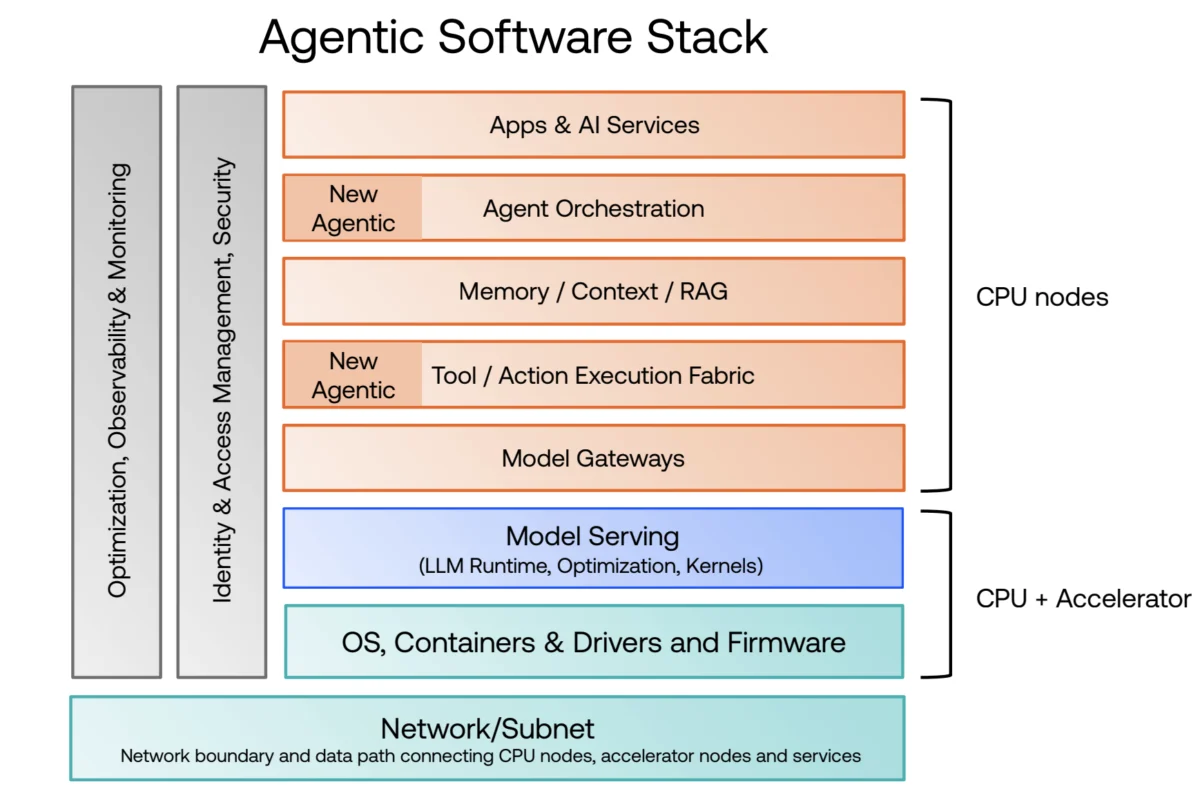

The rapid evolution of artificial intelligence from static large language models (LLMs) to dynamic, goal-oriented agentic systems has fundamentally altered the computational requirements of modern data centers and edge devices. While the industry has spent the last several years hyper-focused on GPU and NPU acceleration for model inference, a new performance bottleneck is emerging: the central processing unit. As agentic AI systems become more autonomous, their ability to deliver results depends less on the speed of a single model pass and more on the efficiency of the surrounding software infrastructure—the orchestrators, retrieval engines, and tool-execution environments that bridge the gap between human intent and machine execution.
The Shift from Model-Centric to System-Centric AI
Historically, the performance of AI has been measured by tokens per second or latency per parameter update. However, agentic AI introduces a non-linear workload. A single task—such as an automated software bug fix or a complex financial analysis—may involve dozens of iterative model calls, real-time retrieval from vector databases, strict policy validation, and external API interactions.
In this paradigm, accelerators (GPUs/NPUs) remain the engines for model execution, but the CPU acts as the "chief operating officer" of the AI stack. It manages memory state, handles interrupt-driven tool execution, manages context windows, and ensures that the software stack remains responsive under heavy concurrent loads. Arm, in its latest technical assessment, highlights that failing to optimize the CPU and software stack for these agentic functions will inevitably lead to systemic latency that even the most powerful accelerators cannot overcome.
Chronology of the Agentic Infrastructure Evolution
The progression toward agentic AI has moved at a breakneck pace, significantly outpacing the development of standardized benchmarking tools.
- 2022–2023 (The LLM Era): The industry focused on "chat" interfaces. The primary computational challenge was optimizing the transformer architecture for high-throughput inference on GPUs.
- 2024 (The Tool-Use Pivot): AI agents began integrating with external tools (e.g., search engines, calculators). This required improved CPU-to-GPU interconnects and more robust serialization of tool outputs.
- 2025 (The Autonomy Shift): Agent frameworks like LangChain, CrewAI, and AutoGen matured. Systems started performing autonomous, multi-step reasoning, moving the bottleneck from compute-bound inference to memory-bound orchestration.
- October 2026 (The Standardization Push): With the release of its latest white paper, Arm has initiated a call to action for the semiconductor and software industries to define standardized metrics for agentic performance, recognizing that the "Wild West" era of ad-hoc AI implementation is reaching its limit.
Component Benchmarking vs. End-to-End Analysis
A critical challenge in modern AI system design is the "black box" nature of agentic workflows. When an agent fails or experiences latency, it is often difficult to determine whether the delay originated in the model’s reasoning phase, the retrieval layer, or the underlying CPU kernel scheduling.

To address this, the current proposal suggests a dual-track methodology. Component benchmarking allows developers to isolate specific stressors. By measuring the efficiency of common framework functions—such as state management and serialization—engineers can identify micro-bottlenecks that exist within the software stack, independent of model performance.
Conversely, end-to-end benchmarking focuses on the "user intent to result" timeline. This is arguably more important for commercial deployments. By utilizing "replayable agent trajectories," the industry can create deterministic test cases. In a non-deterministic environment, an agent might choose a different path every time it is run, making it impossible to establish a reliable baseline for performance. Replayable trajectories allow for the isolation of CPU and software efficiency by ensuring that the AI performs the same sequence of actions across multiple hardware configurations.
Supporting Data and Workload Archetypes
The industry currently lacks a unified framework for characterizing how different AI tasks stress the CPU. To bridge this gap, technical architects are categorizing agentic workloads into five representative archetypes. These archetypes are designed to simulate distinct deployment venues, ranging from low-power edge devices to massive cloud-based orchestration clusters:
- Orchestration-Heavy Tasks: Workloads that focus on complex decision-making and multi-agent coordination, heavily taxing CPU thread scheduling and inter-process communication.
- I/O and Retrieval-Bound Tasks: Applications that rely on massive RAG (Retrieval-Augmented Generation) pipelines, stressing the CPU’s ability to manage high-speed data movement between memory and accelerators.
- Tool-Execution and API-Heavy Tasks: Workloads involving frequent calls to external services, highlighting the efficiency of the networking stack and asynchronous execution models.
- Validation and Policy-Enforcement Tasks: Systems that require constant "guardrail" checks, where CPU cycles are consumed by real-time safety and security filtering.
- State-Management-Intensive Tasks: Long-running agents that must maintain persistent states, stressing memory management and caching efficiency.
By mapping these archetypes, companies like Arm, Intel, and AMD can begin to optimize instruction sets and system-on-chip (SoC) architectures specifically for the "agentic tax"—the additional compute overhead required to manage an AI agent beyond the model execution itself.
Analysis of Implications for the Semiconductor Industry
The implications of this shift are profound for the semiconductor sector. If the bottleneck for agentic AI shifts from the GPU to the CPU, it necessitates a change in how chips are designed. We are likely to see an increase in heterogeneous computing, where the CPU is bolstered by specialized AI-accelerated management cores.
Furthermore, the software stack must evolve. Currently, much of the AI software ecosystem is built on top of high-level languages like Python, which, while flexible, introduce overhead that can be prohibitive in high-frequency agentic tasks. We may see a push toward more efficient runtime environments, such as compiled AI frameworks or C++/Rust-based execution layers that can handle the high-concurrency requirements of multi-agent systems.

Industry experts suggest that as AI agents begin to handle more critical tasks—from supply chain management to autonomous software development—the "non-deterministic behavior" of these models will become a significant regulatory concern. Being able to measure and audit the performance of an agent’s reasoning path is not just a technical requirement for speed, but a foundational requirement for safety and accountability.
Looking Toward Industry Consensus
The current initiative by Arm is not intended to be a finalized, static benchmark suite. Instead, it serves as a foundational "measurement boundary." The goal is to establish a common language for performance, allowing hardware manufacturers, cloud service providers, and software developers to align on what actually constitutes a "high-performance" agentic system.
Without this consensus, the industry risks a fragmentation where benchmarks are skewed to favor specific hardware or software architectures, potentially masking the true costs of deploying agentic AI. As we move toward 2027, the focus must transition from "how fast can the model think" to "how efficiently can the system execute the agent’s intent."
The shift represents a maturation of the AI market. As these systems move from academic curiosities and chat-based prototypes into the backbone of industrial infrastructure, the "plumbing"—the CPU, the software stack, and the orchestration layer—will define the winners and losers of the next decade of AI deployment. The call for standardized measurement is the first step toward building an ecosystem that is not only powerful but also predictable, efficient, and scalable. By addressing these methodological gaps today, the industry is laying the groundwork for a more stable and high-performing future for agentic AI.
