

The landscape of software development and IT infrastructure has undergone a profound transformation over the past decade, driven largely by the advent of containerization. As organizations increasingly migrate toward cloud-native architectures, containers have emerged as a foundational technology for packaging, distributing, and executing software applications. Unlike traditional deployment models that tie applications to specific physical servers or resource-heavy virtual machines, containerization isolates software within lightweight, standalone executable packages. This architectural shift addresses long-standing challenges in software engineering—namely, environmental discrepancies between development and production, inefficient resource utilization, and complex deployment pipelines. Industry data highlights this rapid adoption, with market research indicating that the global container market size, valued at over several billion dollars, continues to expand at a compound annual growth rate exceeding 25%. This article examines the core mechanics of containers, contrasts them with traditional virtualization, outlines primary enterprise use cases, analyzes implementation challenges, and explores the trajectory of container standards in modern computing.
The historical evolution of software deployment provides vital context for understanding the rise of containers. In the early days of enterprise computing, applications were deployed directly onto physical hardware, leading to hardware bottlenecks, resource contention, and arduous maintenance cycles. The introduction of hardware virtualization and hypervisors in the late 1990s and 2000s—pioneered heavily by companies like VMware—allowed multiple virtual machines to run on a single physical server by abstracting the underlying hardware. While virtual machines revolutionized data center efficiency, each VM required a complete guest operating system, consuming significant CPU, memory, and storage overhead.
The turning point for containerization arrived with the popularization of Linux kernel namespaces and control groups (cgroups), coupled with the launch of Docker in 2013. By standardizing container tooling and introducing a user-friendly ecosystem, Docker bridged the gap between complex kernel-level isolation and everyday developer workflows. Over the subsequent decade, the industry moved from isolated tooling to automated orchestration. The establishment of the Cloud Native Computing Foundation (CNCF) in 2015 and the subsequent dominance of Kubernetes marked a shift from manual container management to hyper-scalable, automated cloud architectures. According to recent cloud adoption surveys by organizations like the CNCF, over 85% of enterprises now utilize containers in production environments, a stark contrast to single-digit adoption rates a decade prior.
At its core, a container is a standardized unit of software that packages up code and all its dependencies so the application runs quickly and reliably from one computing environment to another. A container image is a lightweight, standalone, executable package of software that includes everything needed to run an application: code, runtime, system tools, system libraries, and settings.
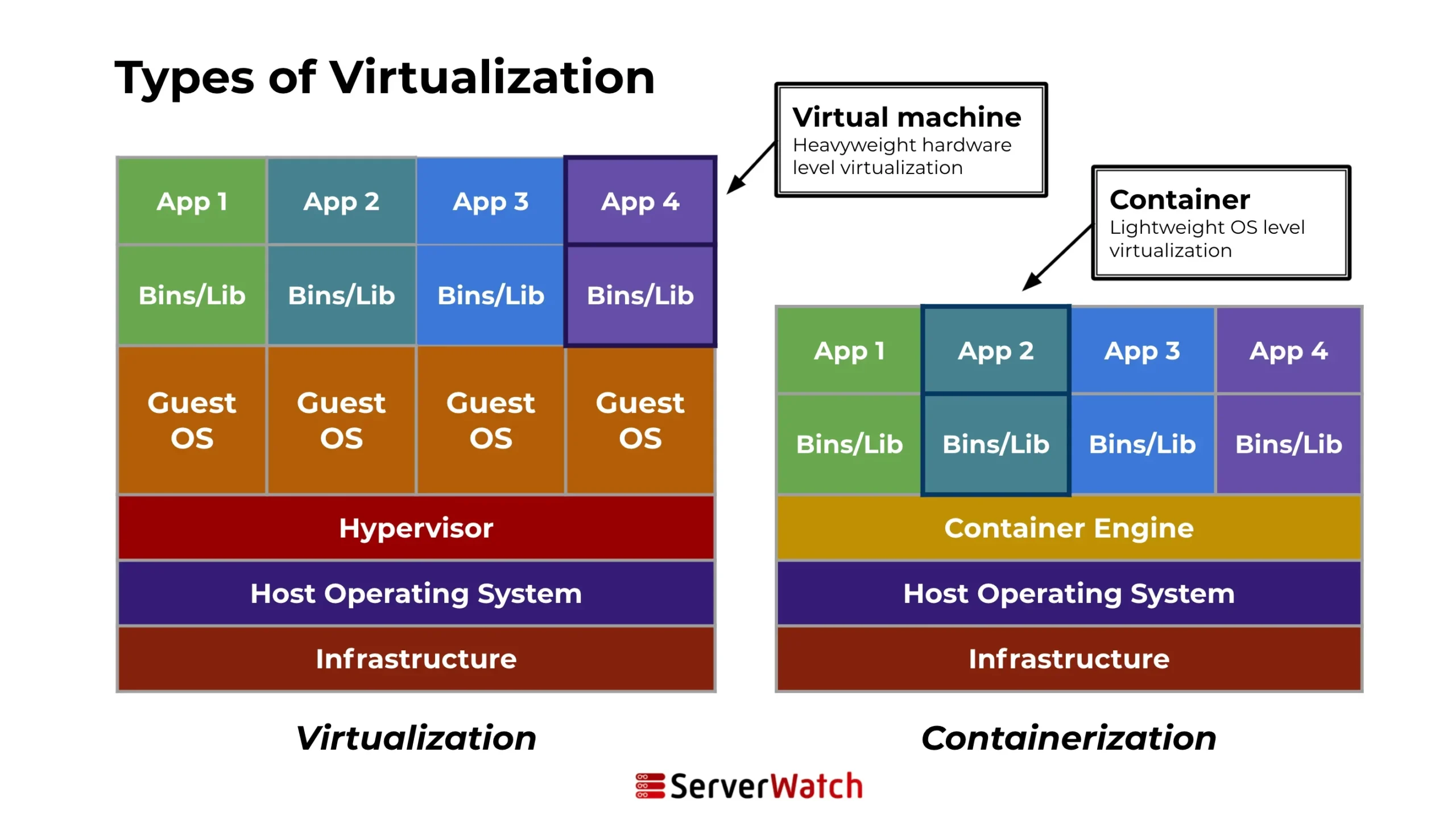
The operational mechanism of containerization relies on sharing the host system’s kernel while maintaining strict process and filesystem isolation. When a container starts, the container engine creates a private namespace and resource boundaries using cgroups. Consequently, unlike virtual machines that emulate virtual hardware and run a dedicated guest operating system, containers bypass this overhead. This fundamental architectural difference yields substantial performance advantages.
A comparative analysis between containers and virtual machines underscores why modern developers favor containerized workflows. Virtual machines operate via a hypervisor—either Type 1 (bare-metal) or Type 2 (hosted)—which allocates virtualized hardware resources to distinct guest operating systems. Each virtual machine demands gigabytes of storage for its operating system image and significant memory allocations just to remain idle. Conversely, containers share the host operating system’s kernel, requiring only the application binaries and application-specific libraries.
This structural disparity translates directly into resource management metrics. While virtual machines typically take minutes to boot up due to the initialization of a full operating system kernel, containers launch in milliseconds. Furthermore, hardware utilization density increases exponentially; physical servers that might comfortably host ten to fifteen resource-intensive virtual machines can often support hundreds of individual containers, drastically reducing data center capital expenditures and power consumption for enterprise organizations.
Containers are deployed across a diverse spectrum of modern software engineering paradigms, most notably in microservices architectures and continuous integration/continuous deployment (CI/CD) pipelines.
In a microservices architecture, monolithic applications are decomposed into a collection of loosely coupled, independently deployable services. Each microservice handles a specific business capability and communicates via lightweight protocols, often HTTP/REST or gRPC. Encapsulating each microservice within its own container ensures strict environment isolation, preventing dependency conflicts between services written in different programming languages or utilizing distinct library versions. If a single microservice experiences a memory leak or crashes, the isolation provided by the container prevents systemic failure across the broader application ecosystem.
Within CI/CD pipelines, containers provide immutable, reproducible environments that eradicate the infamous "it works on my machine" dilemma. Automated testing suites execute within containers that mirror production specifications precisely. Every code commit triggers automated build processes that package the application into a container image, which is then scanned for vulnerabilities, deployed to staging environments, and promoted to production with minimal human intervention. This standardized packaging and distribution mechanism simplifies multi-cloud strategies, enabling enterprises to build an application locally and run it seamlessly across Amazon Web Services, Microsoft Azure, Google Cloud Platform, or on-premises data centers without modification.
Despite their widespread utility, the adoption of containerization introduces unique architectural and operational challenges that engineering teams must navigate carefully.

Security remains a paramount concern in containerized environments. Because containers share the host operating system kernel, a kernel-level vulnerability or exploit within one container can potentially compromise the entire host system and neighboring containers. Additionally, container images pulled from public registries may contain outdated software libraries, unpatched Common Vulnerabilities and Exposures (CVEs), or embedded malware. Organizations must implement rigorous automated security scanning throughout the CI/CD pipeline, enforce the principle of least privilege regarding user permissions within containers, and utilize runtime security monitoring tools to detect anomalous behavioral patterns.
Management complexity is another critical hurdle. As organizations scale their container deployments from a handful of instances to thousands distributed across hybrid cloud environments, manual management becomes impossible. This complexity necessitates the adoption of orchestration platforms like Kubernetes. However, Kubernetes itself has a notoriously steep learning curve, requiring specialized operational expertise in cluster configuration, networking policies, storage provisioning, and ingress management. Misconfigurations in container orchestration can lead to cascading service outages, resource starvation, and severe networking bottlenecks.
Integrating container technologies with legacy enterprise systems presents organizational and technical friction. Many legacy applications rely on tightly coupled architectures, persistent state dependencies, or proprietary operating system environments that resist containerization. Refactoring these legacy assets requires substantial time, capital investment, and cultural shifts within enterprise development teams, often necessitating a phased migration strategy that combines refactored microservices with legacy virtual machine workloads.
The container technology ecosystem is anchored by foundational tools that have achieved near-universal enterprise adoption.
Docker remains the preeminent platform for container creation and local development. By introducing a streamlined command-line interface and the Dockerfile format, Docker democratized containerization, making it accessible to developers without deep kernel-level expertise. Docker Hub, its public registry platform, hosts millions of pre-built container images, accelerating development velocity across the software industry.
Kubernetes, originally developed by Google and subsequently open-sourced to the CNCF, serves as the de facto standard for container orchestration. Kubernetes automates the operational rigors of container management, offering automated rollouts and rollbacks, service discovery, load balancing, storage orchestration, and self-healing capabilities—such as restarting failed containers or replacing nodes that fail health checks.
Beyond Docker and Kubernetes, the ecosystem includes specialized runtimes and alternative orchestration tools. Containerd and CRI-O provide lightweight, industry-standard container runtimes optimized for integration with Kubernetes. Platforms like HashiCorp Nomad offer alternative orchestration engines valued for their simplicity and flexibility in handling both containerized and non-containerized workloads.
Looking toward the future, containerization is intersecting rapidly with emerging technological frontiers, including artificial intelligence, machine learning, and edge computing.
In the realm of artificial intelligence and large language models (LLMs), containers are increasingly utilized to package complex machine learning pipelines, GPU-accelerated runtimes, and inference engines. Containerization ensures that data scientists can develop models in isolated, reproducible environments and deploy them seamlessly from local research stations to scalable cloud GPU clusters. Similarly, in edge computing—where processing occurs on decentralized hardware located close to data sources, such as IoT devices and 5G cellular towers—lightweight container architectures provide the agility and minimal footprint required to manage applications across resource-constrained edge nodes.
Simultaneously, container standards and regulatory frameworks are maturing. Standard bodies and open-source foundations continue to refine specifications governed by the Open Container Initiative (OCI) to ensure interoperability and security compliance across diverse hardware architectures and cloud providers. Regulatory compliance frameworks, such as SOC 2, HIPAA, and ISO/IEC 27001, are increasingly expanding their security baselines to encompass container runtime environments, image provenance verification through cryptographic signing, and strict network segmentation policies.
Ultimately, containers have fundamentally redefined the trajectory of software engineering, establishing a new baseline for operational efficiency, deployment consistency, and cloud scalability. As digital transformation initiatives accelerate across global enterprises, the role of containerization will only expand, serving as the connective tissue between disparate computing environments and emerging technological innovations. Organizations that master container architecture and embrace robust orchestration and security practices will remain well-positioned to navigate the complexities of the modern digital economy, driving sustained agility and competitive advantage in an increasingly software-defined world.
