

For platform engineering teams operating large-scale containerized applications on the cloud, managing ingress networking has historically been a complex and error-prone operational hurdle. Every time a new microservice is introduced, engineers are required to manually provision, configure, and maintain an array of underlying infrastructure components. This includes setting up Application Load Balancers (ALBs), issuing and binding AWS Certificate Manager (ACM) SSL/TLS certificates, configuring AWS WAF web access control lists, and meticulously maintaining security groups. As services scale, undergo rolling updates, or sunset, keeping these disparate networking resources in perfect synchronization often results in configuration drift, compromised deployment velocity, and significant overhead for technical staff.
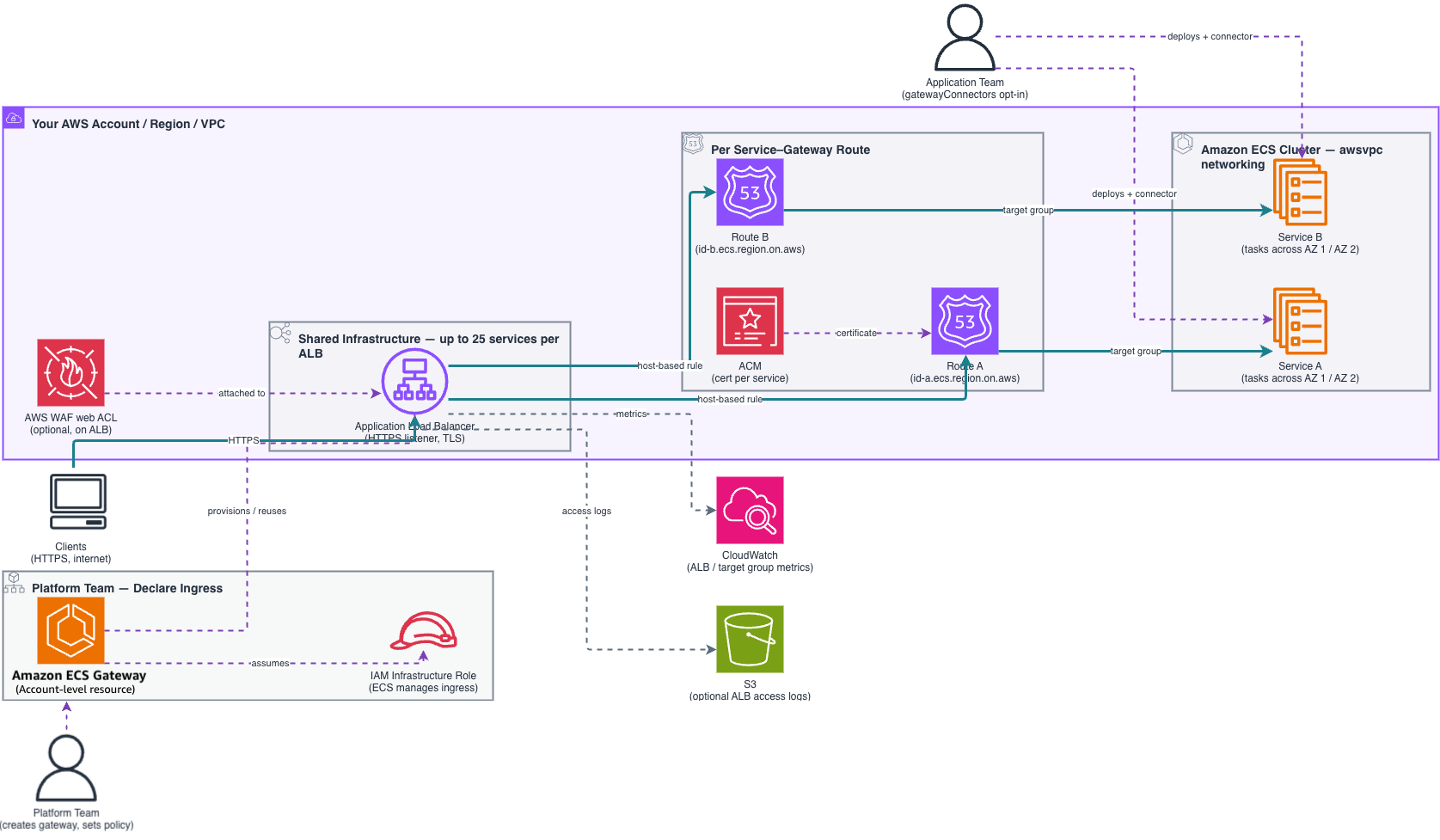
To address these systemic challenges, Amazon Web Services has officially announced the launch of Amazon ECS Gateway, a powerful new account-level resource designed to streamline and automate ingress networking for containerized workloads. By shifting the burden of infrastructure provisioning and lifecycle management directly to the platform, Amazon Elastic Container Service (ECS) now dynamically handles the creation and coordination of necessary routing components within the user’s AWS account. This innovation establishes a clean separation of duties between centralized platform teams—who govern network parameters, security guardrails, and cluster accessibility—and application developers, who can immediately attach their services to pre-configured gateways without touching low-level networking constructs.

Core Architecture and Operational Mechanics
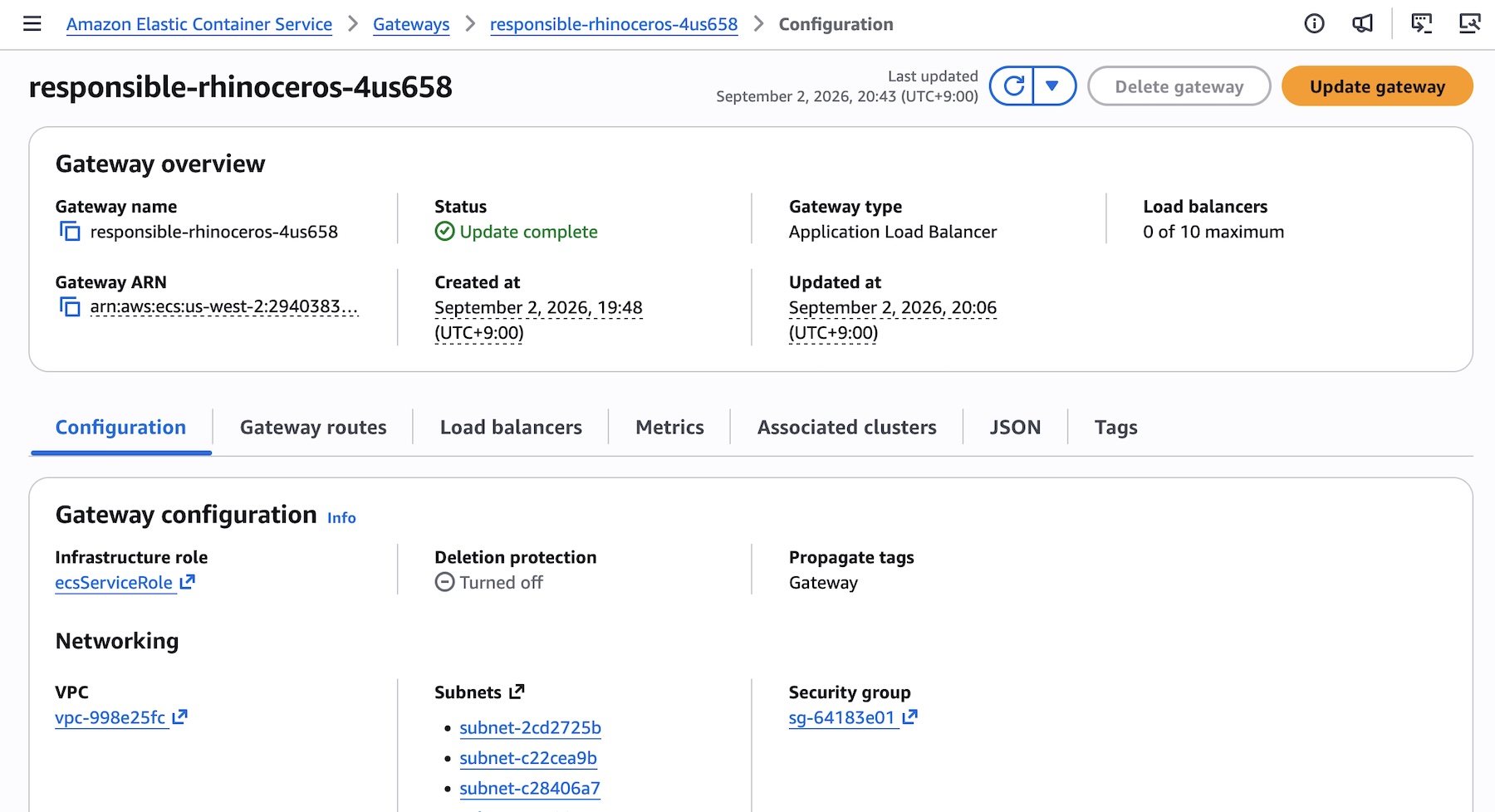
At its technical foundation, Amazon ECS Gateway introduces a flexible, many-to-many relationship model between gateways, clusters, and services. A single gateway can be associated with up to 10,000 individual ECS clusters, while a single cluster can support up to five distinct gateway associations. This architectural flexibility empowers organizations to segregate traffic effectively, maintaining separate public-facing and VPC-internal gateways for the same underlying cluster environments.
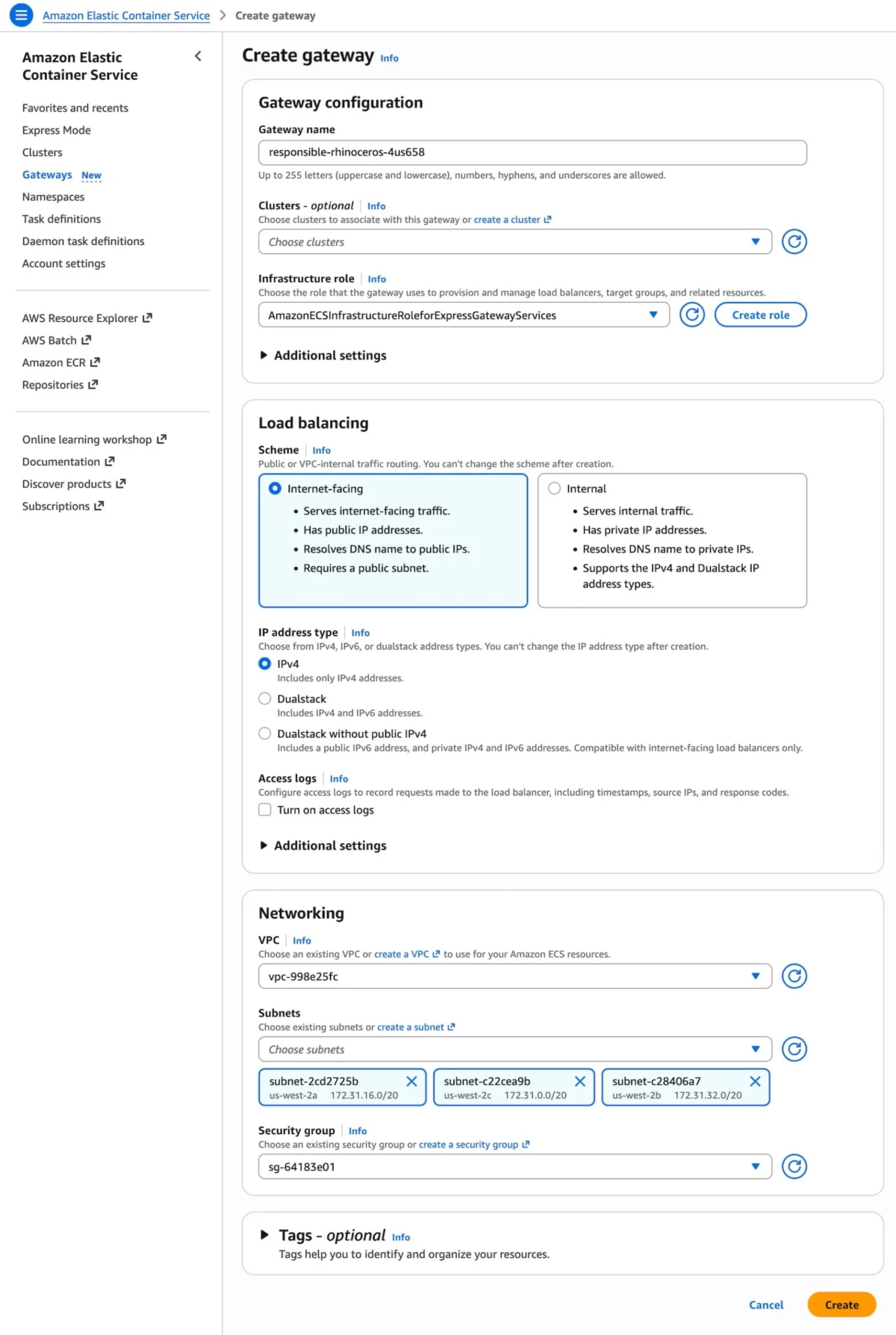
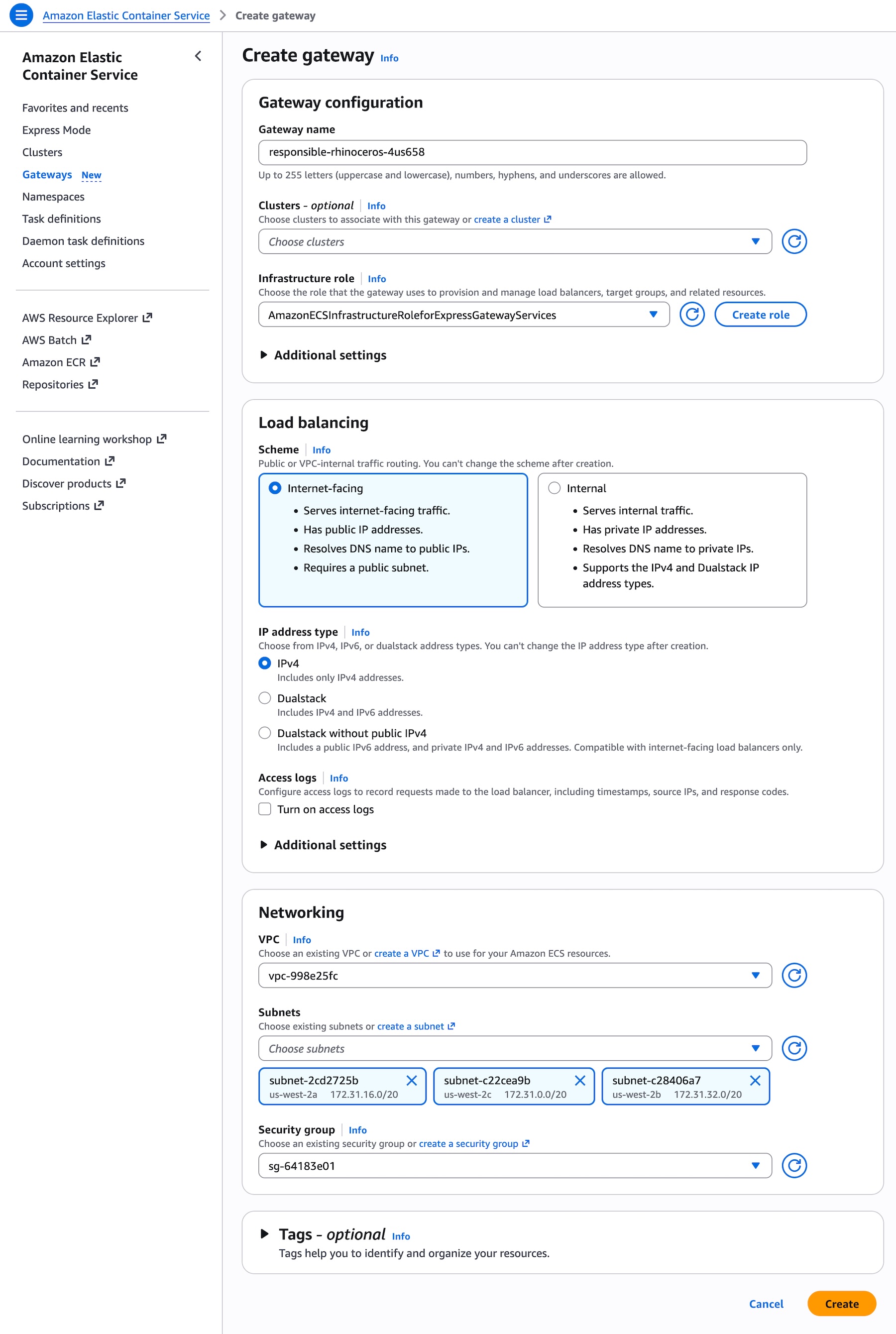
When configuring a gateway, platform administrators designate an AWS Identity and Access Management (IAM) infrastructure role. This role grants ECS the necessary permissions to provision and manage networking assets—such as ALBs, target groups, and security groups—transparently within the account. During setup, administrators define core parameters such as the load-balancing scheme (internet-facing or internal VPC), designated subnets, IP address types, listener protocols, and optional AWS WAF web ACLs for robust application protection. Once established, application teams can connect their services to the gateway by declaring gateway connectors in their service definitions using either the AWS Command Line Interface (CLI) or the AWS Management Console.
To maximize resource efficiency and contain cloud expenditure, Amazon ECS Gateway implements host-based routing via ALBs, allowing up to 25 unique services to securely share a single Application Load Balancer. ECS automatically orchestrates the scaling lifecycle of these load balancers. When the first service connects, the initial ALB is provisioned. As the service density increases and capacity thresholds are reached, additional ALBs are dynamically added up to a user-defined maximum limit (maxAlbCount). Conversely, when services are decommissioned and capacity requirements recede, unused load balancers are automatically scaled down and removed.

Upon successful connection, ECS handles the heavy lifting of provisioning per-service resources. This includes generating a unique DNS hostname that provides developers with an instant, ready-to-use endpoint, issuing an ACM certificate for secure communication, establishing listener rules that route traffic from the hostname to the appropriate target group, and configuring service-specific security groups that restrict inbound traffic exclusively to the associated ALB. Furthermore, adopting the gateway does not require disruptive migrations; organizations running legacy services with existing load balancers can incrementally transition by adding a gateway connector via an update operation, validating the new routing path side-by-side before deprecating older configurations.
Chronology and Development Timeline
The release of Amazon ECS Gateway is the culmination of years of continuous feedback from enterprise customers running mission-critical workloads on AWS container infrastructure.
Pre-2024: The Rise of Ingress Complexity
As container adoption matured across global enterprises, microservice architectures expanded from dozens of endpoints to thousands. Platform teams found themselves spending an unsustainable amount of time writing custom automation scripts, infrastructure-as-code (IaC) modules using Terraform or AWS CloudFormation, and custom controllers to bridge the gap between ECS task scheduling and Application Load Balancer target group registration. These custom solutions frequently suffered from maintenance debt, slow synchronization times during auto-scaling events, and auditing vulnerabilities.
Mid-2025: Architectural Prototyping and Private Previews
Recognizing the acute operational friction caused by per-service ingress management, AWS engineering teams began developing a native, platform-level abstraction layer within Amazon ECS. Internal testing focused on decoupling the lifecycle of load balancers from individual task definitions, shifting toward an abstracted gateway model capable of handling shared multi-tenancy at the ALB layer without sacrificing network isolation or security boundaries.
Late 2026: General Availability Launch
AWS officially rolled out Amazon ECS Gateway as a generally available feature across all commercial regions where Amazon ECS is supported. The launch included comprehensive integration with the AWS Command Line Interface (CLI), the AWS Management Console, and modern AI-assisted development frameworks via the AWS Model Context Protocol (MCP) Server, allowing developers to query API specifications and provision resources seamlessly through natural language coding assistants.
Industry Implications and Technical Analysis
The introduction of Amazon ECS Gateway carries significant implications for enterprise IT governance, financial optimization, and developer productivity within container-centric organizations.
From an operational perspective, the feature directly addresses the cognitive load placed on platform engineers. In traditional cloud architectures, managing ingress for hundreds of independent microservices often required tightly coupled CI/CD pipelines where application developers had to coordinate with network administrators to open ports, request DNS entries, and allocate load balancer listeners. By centralizing ingress policy enforcement into an ECS Gateway, platform teams retain strict governance over subnets, security baselines, and traffic schemes while granting developers autonomous, self-service publishing capabilities.
From an economic standpoint, the density optimization introduced by host-based routing offers substantial cost-saving potential. Provisioning a dedicated Application Load Balancer for every single microservice can introduce prohibitive fixed infrastructure costs, particularly for smaller staging environments, background workers, or low-traffic APIs. By enabling up to 25 services to multiplex over a single shared ALB—while dynamically scaling infrastructure only when utilization warrants it—organizations can drastically reduce idle cloud expenditures. Users are not charged any additional platform fee for utilizing ECS Gateway itself; billing is strictly consumption-based, applying only to the underlying resources provisioned within the account, such as active ALB hours, CloudWatch logs, ACM certificates, and standard data transfer rates.
Security posture is similarly enhanced through automation. Configuration drift remains one of the primary vectors for cloud security vulnerabilities, often occurring when manual updates to security groups or SSL certificates fall out of sync with rapidly scaling container fleets. Because Amazon ECS Gateway programmatically manages the lifecycle of certificates, security group rules, and WAF associations in lockstep with service deployments, the window for human error is substantially narrowed. Inbound traffic is strictly restricted to authorized load balancer endpoints, and automated health checks continuously monitor target group integrity to ensure high availability without manual intervention.
Getting Started and Next Steps
Amazon ECS Gateway is available immediately at no extra charge in all commercial AWS Regions where Amazon Elastic Container Service operates. Engineering organizations can begin utilizing the feature today through the AWS Management Console, the AWS CLI, or integrated developer tooling.
To facilitate adoption, AWS has published extensive technical documentation and developer guides detailing gateway creation syntax, cluster association patterns, and incremental migration strategies. Platform teams are encouraged to evaluate the feature in non-production environments to establish standard baseline gateways—such as a default public internet-facing gateway and an internal VPC gateway—before rolling out self-service connectors to broader application engineering cohorts. Feedback and operational queries can be directed to the AWS re:Post community for Amazon ECS or through standard enterprise AWS Support channels.
