

The escalating sophistication of modern cyber threats and the rapid decentralization of corporate workforces have fundamentally transformed enterprise network security. As organizations increasingly depend on cloud infrastructure, remote access, and interconnected corporate environments, securing the perimeter is no longer sufficient. Network administrators must meticulously control access at the foundational level, ensuring that only authenticated, authorized, and compliant users and devices interact with sensitive corporate resources. Within the Windows Server ecosystem, Microsoft Network Policy Server (NPS) serves as a critical mechanism for achieving this objective, functioning as a robust implementation of the Remote Authentication Dial-In User Service (RADIUS) protocol. By centralizing Authentication, Authorization, and Accounting—collectively known as AAA—NPS allows system administrators to enforce rigorous security policies across complex, multi-layered infrastructures.
The Evolution of RADIUS and Centralized Access Control
To fully appreciate the operational significance of Network Policy Server, one must examine the foundational technology upon which it is built: the RADIUS protocol. Developed initially in 1991 by Livingston Enterprises under a contract for a network access server, RADIUS was subsequently standardized by the Internet Engineering Task Force (IETF) through a series of Requests for Comments (RFCs), most notably RFC 2865 and RFC 2866 in the year 2000. Before the advent of centralized AAA frameworks, network administrators faced the arduous task of configuring user credentials locally on individual routers, switches, and remote access servers. This decentralized approach created severe administrative bottlenecks, compromised consistency, and drastically increased the window of vulnerability for unauthorized access.
The introduction of RADIUS revolutionized network management by establishing a client-server architecture. In this model, network access servers—acting as RADIUS clients, such as Virtual Private Network (VPN) gateways, wireless access points, and 802.1X-enabled network switches—intercept user connection requests. These devices forward the credentials to a centralized RADIUS server, which cross-references the data against a secure directory service, such as Microsoft’s Active Directory. Once verified, the RADIUS server communicates the decision back to the client device, granting or denying network access in milliseconds. This separation of concerns streamlined administrative oversight and provided a standardized framework that has endured for over three decades, remaining a cornerstone of enterprise networking despite the emergence of newer protocols like TACACS+ or cloud-native identity providers.
Core Functions of Network Policy Server: Authentication, Authorization, and Accounting
Within Windows Server environments, Microsoft integrated and expanded upon the standard RADIUS architecture by introducing the Network Policy Server. NPS acts as a comprehensive policy engine and proxy service, operationalizing the AAA triad to maintain network integrity and regulatory compliance.
The first pillar of this architecture, Authentication, represents the rigorous verification of a user or device’s identity. When an entity attempts to connect to a protected corporate network, NPS intercepts the authentication payload. Utilizing extensible authentication protocols—such as Protected Extensible Authentication Protocol (PEAP) or Transport Layer Security (TLS)—NPS securely evaluates the presented credentials against domain controllers. This process ensures that malicious actors employing credential-stuffing or brute-force techniques cannot easily impersonate legitimate corporate users.
Following successful authentication, Authorization takes precedence. Authentication merely proves who a user is; authorization dictates what that user is permitted to do within the network architecture. Network Policy Server evaluates a matrix of predefined conditions and constraints established by network administrators. For instance, a systems administrator may enjoy unfettered access to core infrastructure subnets, whereas a third-party vendor connecting via VPN might be strictly compartmentalized to a single designated application server. NPS evaluates group memberships, time-of-day restrictions, connection methods, and cryptographic requirements before issuing a tailored authorization response.
The final pillar, Accounting, provides the foundational data necessary for continuous security monitoring, auditing, and resource tracking. NPS records detailed session data, including connection start and stop times, bytes transferred, IP address allocations, and termination causes. In modern enterprise environments governed by stringent regulatory frameworks—such as the Health Insurance Portability and Accountability Act (HIPAA), the Payment Card Industry Data Security Standard (PCI-DSS), and the European Union’s General Data Protection Regulation (GDPR)—these accounting logs are indispensable. They provide the forensic trail required during internal investigations, security audits, and compliance reviews, ensuring that organizations maintain operational transparency.
The Triple Role of NPS: Server, Proxy, and Policy Engine
Network Policy Server derives its enterprise versatility from its ability to fulfill three distinct operational roles within a network infrastructure: acting as a standard RADIUS server, operating as a RADIUS proxy, and functioning as a dedicated network policy engine.
When operating as a RADIUS server, NPS directly handles inbound authentication and authorization queries from network access points. It validates credentials, processes connection requests, and communicates decisions directly to the initiating hardware. This capability is deeply integrated with Microsoft Active Directory Domain Services (AD DS), allowing administrators to leverage existing user accounts, security groups, and Group Policy Objects (GPOs) without maintaining a separate, isolated user database.
In complex, multi-site, or multi-tenant organizational architectures, NPS frequently transitions into its second role: a RADIUS proxy. In this capacity, NPS does not necessarily process the authentication request locally. Instead, it acts as an intermediary routing agent, forwarding connection requests to designated remote RADIUS servers based on pre-configured realms or user attributes. This functionality is crucial for organizations managing cross-organizational resource sharing, outsourced contractor access, or sprawling enterprise networks separated by wide-area network (WAN) links. Furthermore, RADIUS proxy configurations provide vital high-availability features, including automatic load balancing across multiple backend servers and seamless failover mechanisms that guarantee uninterrupted network access even in the event of primary server degradation.

As a dedicated network policy server, the platform empowers administrators to write granular, context-aware access rules. Unlike static security rules, NPS policies can adapt dynamically to operational parameters. Administrators can construct conditional access rules that evaluate device health, operating system versions, and domain membership status before permitting network attachment. By integrating with health evaluation systems, NPS can quarantine non-compliant or potentially infected endpoints, preventing lateral movement of malware across the corporate LAN or WLAN.
Strategic Advantages of Deploying NPS in Enterprise Infrastructure
The integration of Network Policy Server into a corporate IT architecture yields substantial operational and security dividends. By centralizing the management of network access, organizations eliminate the administrative overhead associated with managing access control lists (ACLs) and local credentials across hundreds of disparate network devices. Security updates or policy modifications made at the NPS console propagate instantly across the entire enterprise ecosystem, ensuring consistent security posture enforcement.
From a financial perspective, NPS represents a cost-effective solution for organizations already invested in the Microsoft Windows Server ecosystem. Because the service is built directly into the operating system licensing, enterprises avoid the significant capital expenditures typically associated with procuring, deploying, and maintaining third-party commercial RADIUS appliances. This native integration also reduces the learning curve for system administrators who are already familiar with Active Directory management and Windows Server administration tools.
Security analysts note that centralized auditing capabilities drastically reduce the mean time to detect (MTTD) unauthorized access attempts. When security information and event management (SIEM) systems ingest NPS accounting and event logs, security operations center (SOC) analysts can establish baseline behavioral analytics and rapidly identify anomalous login patterns, such as impossible travel scenarios or concurrent logins from disparate geographical locations.
Industry Best Practices for Managing and Securing NPS Deployments
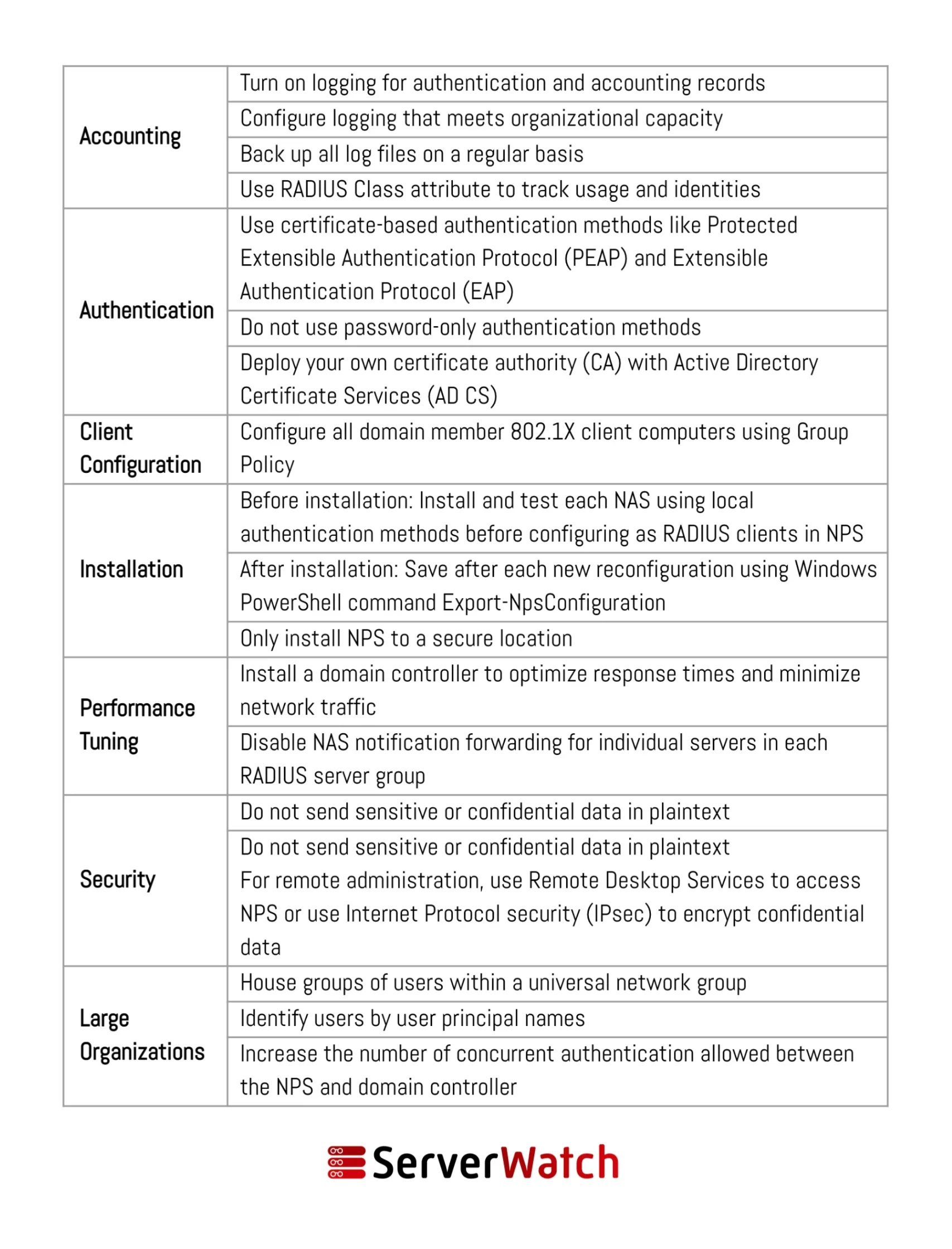
Deploying and maintaining Network Policy Server requires adherence to stringent industry standards and Microsoft-recommended hardening guidelines. Because NPS handles sensitive credential exchanges and plays a gatekeeping role for corporate infrastructure, misconfigurations can introduce severe security vulnerabilities.
First, administrators must prioritize redundancy and high availability. Relying on a single NPS instance creates a critical single point of failure; if the server goes offline, legitimate users may be locked out of the network entirely. Deploying secondary or tertiary NPS nodes configured with synchronized database configurations ensures operational continuity. Furthermore, administrators should regularly back up NPS registry settings and network policy configurations to facilitate rapid disaster recovery.
Network segmentation and firewall hardening represent another critical best practice. RADIUS traditionally relies on UDP ports 1812 (for authentication) and 1813 (for accounting)—or legacy ports 1645 and 1646. These ports must be strictly protected via host-based firewalls and enterprise routing ACLs, ensuring that only authorized network access clients can communicate with the NPS servers. Communication between RADIUS clients and the NPS server should ideally be secured using strong cryptographic secrets, and where supported by modern hardware, transitioning to RadSec (RADIUS over TLS) is increasingly recommended to encrypt authentication traffic over IP networks.
Finally, continuous log monitoring and auditing are imperative. Organizations must establish automated log retention and review policies, ensuring that authentication failures, administrative configuration changes, and system warnings are actively scrutinized for indicators of compromise.
Broader Implications and the Future of Network Access Control
As corporate networks continue to evolve past traditional physical perimeters toward software-defined perimeters (SDP), Zero Trust Architecture (ZTA), and cloud-hosted identity providers like Microsoft Entra ID, the role of traditional on-premises RADIUS servers is undergoing a strategic evolution. While cloud-first organizations increasingly adopt cloud-native authentication services, millions of enterprise environments still rely heavily on legacy hardware, on-premises wireless controllers, manufacturing equipment, and specialized VPN gateways that depend natively on RADIUS for 802.1X authentication.
In this transitional landscape, Network Policy Server bridges the gap between traditional physical infrastructure and modern identity management frameworks. By maintaining strict control over network admission while integrating with hybrid cloud directories, NPS ensures that organizations can secure their remaining on-premises assets without halting their broader digital transformation initiatives.
Ultimately, Network Policy Server remains an indispensable instrument in the modern IT administrator’s toolkit. Through its balanced execution of centralized authentication, granular authorization, and comprehensive accounting, NPS provides the structural backbone necessary to maintain a secure, resilient, and compliant enterprise network in an increasingly hostile digital environment.
