
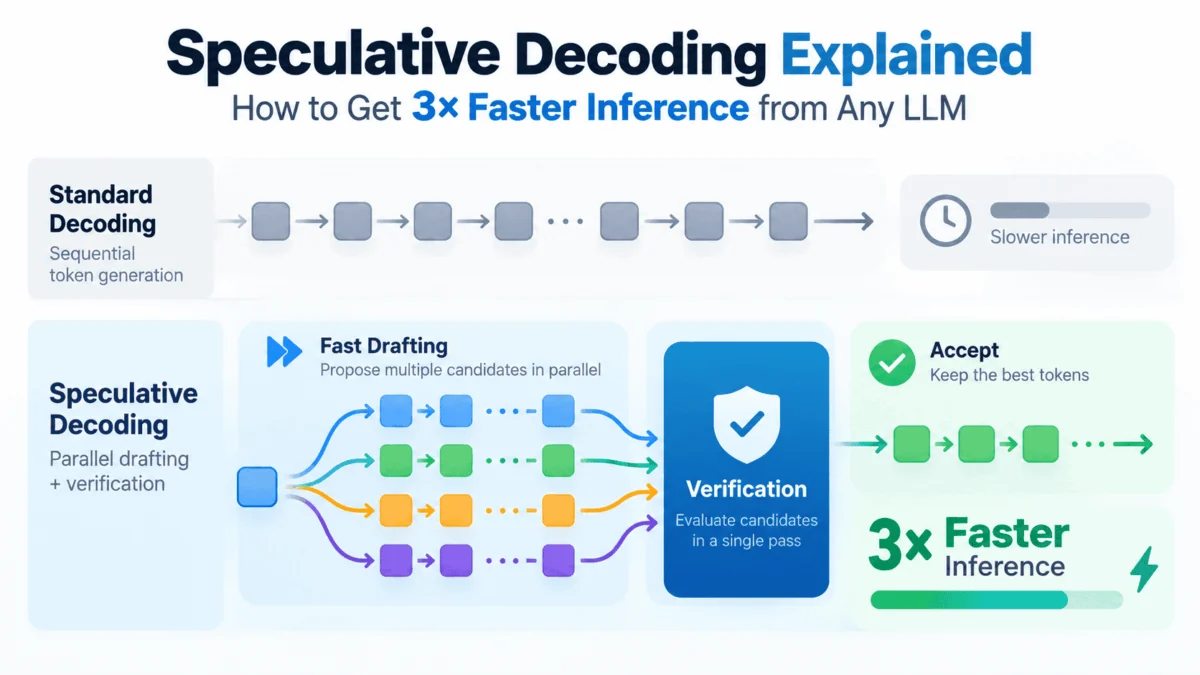

The deployment of large language models (LLMs) has revolutionized artificial intelligence, yet the technology faces a persistent technical hurdle: the "autoregressive bottleneck." Because LLMs generate text one token at a time, the process is inherently sequential. Every single word produced requires a full pass through billions of model parameters, creating significant latency that hinders real-time applications such as coding assistants, live translation services, and autonomous agents. Speculative decoding has emerged as the industry-standard solution to this latency, allowing for 2x to 3x speed improvements without sacrificing the accuracy or quality of the output.
The Anatomy of the Inference Bottleneck
To understand the necessity of speculative decoding, one must first examine the mechanics of standard LLM inference. Modern transformer-based models—ranging from GPT-4 to Llama 3—function through autoregressive generation. When a user submits a prompt, the model processes the input and generates a probability distribution for the next token. Once selected, that token is appended to the sequence, and the entire process repeats.
The primary constraint in this workflow is not computational throughput, but memory bandwidth. High-performance hardware, such as the NVIDIA H100 GPU, possesses massive parallel processing capabilities, yet these compute units are frequently left idle. Before a single token can be predicted, the entirety of the model’s weights must be fetched from the GPU’s high-bandwidth memory (HBM) and loaded into the arithmetic logic units. This process is repeated for every individual token, effectively tethering the model’s performance to the speed of data movement rather than the speed of raw calculation. In engineering terms, LLM inference is "memory-bound," meaning the processor spends the vast majority of its clock cycles waiting for the next set of weights to arrive rather than performing actual mathematical operations.
Chronology and Development of the Technique
The concept of speculative decoding was formalized in early 2023 through two landmark research papers: Fast Inference from Transformers via Speculative Decoding (Chen et al.) and Speculative Decoding: A Method for Faster LLM Inference (Leviathan et al.). Researchers sought to bypass the serial nature of inference by separating the process into two distinct phases: a rapid "drafting" phase and a precise "verification" phase.
The timeline of implementation moved quickly from theoretical research to production-grade utility. By mid-2023, major inference engines began integrating these principles. In early 2024, the field saw an evolution beyond the "two-model" requirement. Innovations like Medusa, which allows a single model to act as both drafter and target by adding specialized prediction heads, and Eagle, which leverages internal hidden states, marked a shift toward self-contained acceleration. These developments have been rapidly adopted by open-source projects, including vLLM and llama.cpp, which are now standard in enterprise AI deployments.
The Mechanics: Drafting and Verification
Speculative decoding operates on a statistical framework that ensures mathematical equivalence to the target model. The process involves a two-model system:
- The Draft Model: A smaller, computationally inexpensive model (often 1/10th or 1/100th the size of the target) is used to predict a short sequence of tokens—typically four to eight. Because this model is smaller, it requires less time to load into memory, allowing it to generate a "speculative" sequence almost instantly.
- The Target Model: The high-capacity model then reviews these candidates in a single, parallel forward pass. Because modern GPUs excel at batch processing, verifying four tokens simultaneously takes nearly the same amount of time as processing one.
- The Statistical Check: The target model compares its own probability distribution against the draft model’s suggestions. If the target model agrees with the draft, the tokens are accepted. If not, the target model rejects the erroneous tokens and replaces them with the correct ones.
This mechanism is mathematically rigorous; the final output is guaranteed to be identical to what the target model would have produced on its own. The "draft" is essentially a highly educated guess that, when correct, bypasses the need for the large model to perform redundant sequential passes.
Performance Data and Industry Implications
Empirical evidence indicates that the efficiency of speculative decoding is primarily dictated by the "acceptance rate"—the percentage of draft tokens that are successfully verified by the target model. Research indicates that when a well-matched draft model is paired with a target model, acceptance rates frequently hover between 70% and 80%.
In real-world deployment scenarios, this translates to a tangible reduction in time-to-first-token and improved tokens-per-second (TPS). For instance, in text-heavy tasks such as document summarization or long-form report generation, organizations have reported speedups of 2.5x compared to standard greedy decoding. However, industry analysts note that this technique is most effective in low-to-medium traffic environments. In scenarios involving massive, multi-tenant batching—where a server is handling hundreds of concurrent requests—the memory overhead of running a secondary draft model can occasionally lead to diminishing returns, as the compute resources might be better utilized by simply running more concurrent instances of the target model.
Emerging Alternatives: Beyond Two Models
The research community is currently focused on optimizing the drafting process to remove the need for external secondary models, which can be cumbersome to manage in production pipelines.
- Medusa (Multi-head Decoding): This approach adds specialized "heads" to the final layer of the target model. During inference, these heads predict multiple future tokens simultaneously. Since these heads are trained alongside the main model, they capture the model’s internal logic with high fidelity, often achieving higher acceptance rates than a separate, smaller model.
- Prompt Lookup Decoding: This is perhaps the most minimalist approach. It assumes that many outputs share common phrases found in the input prompt or context window. By simply scanning the prompt for n-grams that appear to be a logical follow-up to the current sequence, the system can "draft" tokens without running any model at all. This has proven particularly effective in code completion tasks, where specific variable names and syntax structures recur frequently.
Broader Impact on AI Deployment
The proliferation of speculative decoding has significant implications for the economics of AI. By increasing the speed of inference by a factor of three, businesses can effectively triple the utility of their existing GPU clusters without purchasing additional hardware. This reduces the total cost of ownership (TCO) for AI services and makes latency-sensitive applications—such as real-time voice assistants or high-speed coding tools—viable in production environments.
Furthermore, the shift towards these techniques reflects a broader maturity in the field of Large Language Models. Initially, the focus was entirely on training bigger models with more parameters to maximize "intelligence." Now, the focus has shifted toward efficiency and "inference-time compute." By optimizing how models interact with hardware, researchers are discovering that they can achieve superior performance without the environmental and financial cost of training larger, more power-hungry models.
Conclusion: A New Standard for Inference
Speculative decoding has moved from a novel academic concept to a fundamental component of the AI infrastructure stack. By addressing the memory-bandwidth bottleneck, it allows developers to maintain the high intelligence of massive models while achieving the speed required for modern, interactive applications. As frameworks like vLLM and Hugging Face’s TGI continue to bake these optimizations into their core, the technique will likely become a standard "knob" that developers turn on by default.
For the enterprise, the message is clear: the path to faster AI does not always require more compute power. Instead, it requires smarter orchestration of the compute power that is already available. As the industry looks toward the next generation of LLM deployment, speculative decoding stands as a primary example of how algorithmic ingenuity can unlock the full potential of high-performance hardware.
