

In the modern data-driven enterprise, the ability to process massive datasets without exhausting system resources is a critical competency for software engineers. While many developers rely on high-level libraries like Pandas or Apache Spark to manage large-scale data, a significant portion of production outages stems from the inefficient use of standard Python structures. When a standard script designed for small log files encounters a 9 GB file due to routine log rotation, the resulting MemoryError serves as a stark reminder of the limitations of eager evaluation. By leveraging Python’s iterator protocol and generator functions, developers can build robust, memory-efficient pipelines that process data in a streaming fashion, ensuring stability regardless of the input size.
The Anatomy of the Memory Crisis
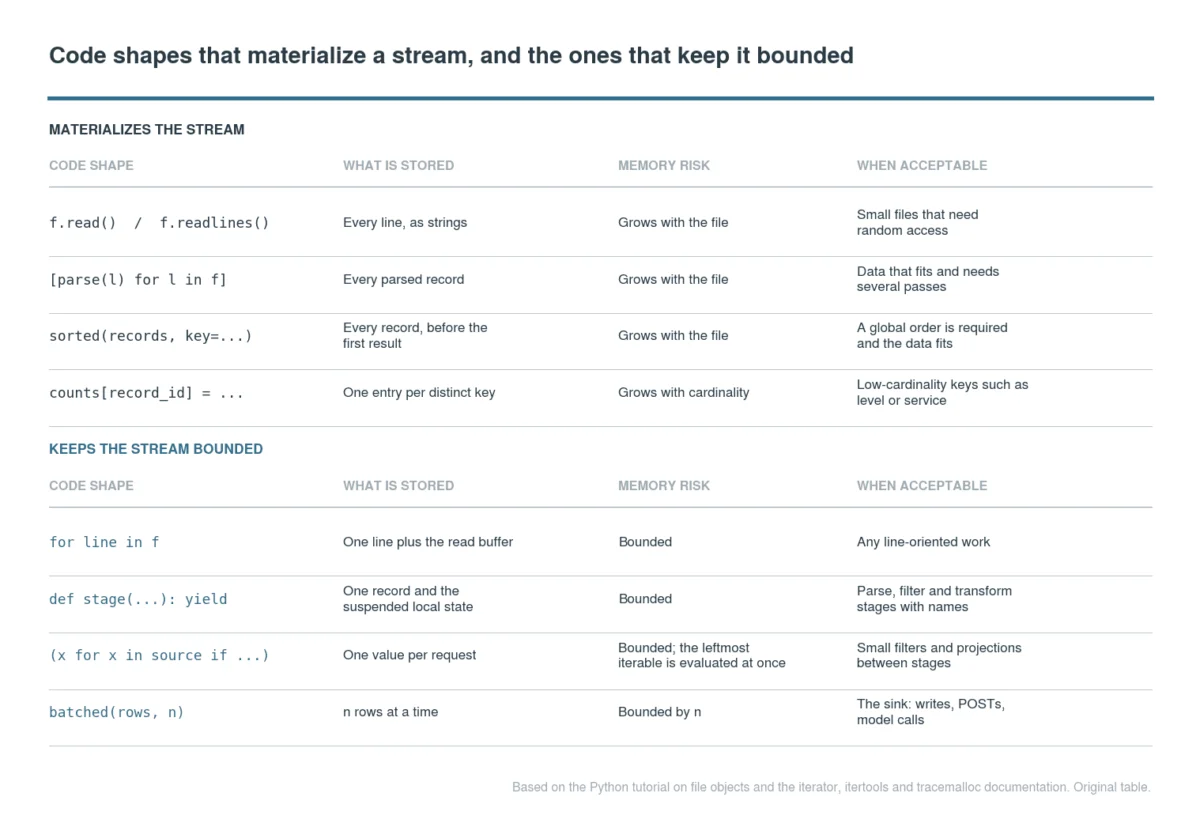
The typical "eager" processing model involves reading an entire file into memory, storing it as a list, and then applying filtering or transformation logic. For years, this approach works seamlessly. A script might open a file, parse lines into a list of dictionaries, filter for "ERROR" levels, and finally isolate records with high latency. This sequence of operations, while functionally correct, forces the Python interpreter to hold every record in RAM simultaneously.
The problem manifests when the volume of data exceeds the available heap space. If each log entry consumes approximately 1 KB of memory, a 9 GB log file requires roughly 9 GB of raw RAM, plus significant overhead for the Python objects created during the parsing process. In a production environment with limited container memory, this inevitably leads to an Out-Of-Memory (OOM) event. The root cause is not the complexity of the data, but the architectural choice to materialize the entire dataset before processing begins.
Understanding the Iterator Protocol
The shift from eager to lazy processing relies on the Python iterator protocol, a fundamental contract established within the language. At its core, an iterable—such as a file object, list, or generator—provides an iterator when requested. This iterator maintains a stateful cursor that keeps track of the current position in the data sequence.
When a for loop executes, Python implicitly calls iter() on the source and next() repeatedly until a StopIteration exception is raised. This protocol is the backbone of streaming. Unlike a list, which occupies a contiguous block of memory, an iterator only requires memory for the current item being processed. This allows a system to traverse terabytes of data while keeping only a few bytes in RAM at any given moment. Developers must be aware, however, that iterators are "forward-only" structures; once exhausted, they cannot be rewound, necessitating careful management of the data stream.
Transitioning to Generator Functions
To avoid the pitfalls of monolithic, memory-intensive code, developers should decompose their logic into modular generator functions. A function utilizing the yield keyword pauses its execution and preserves its local state, including variable bindings and the internal stack. When the caller requests the next value, the generator resumes precisely where it left off.
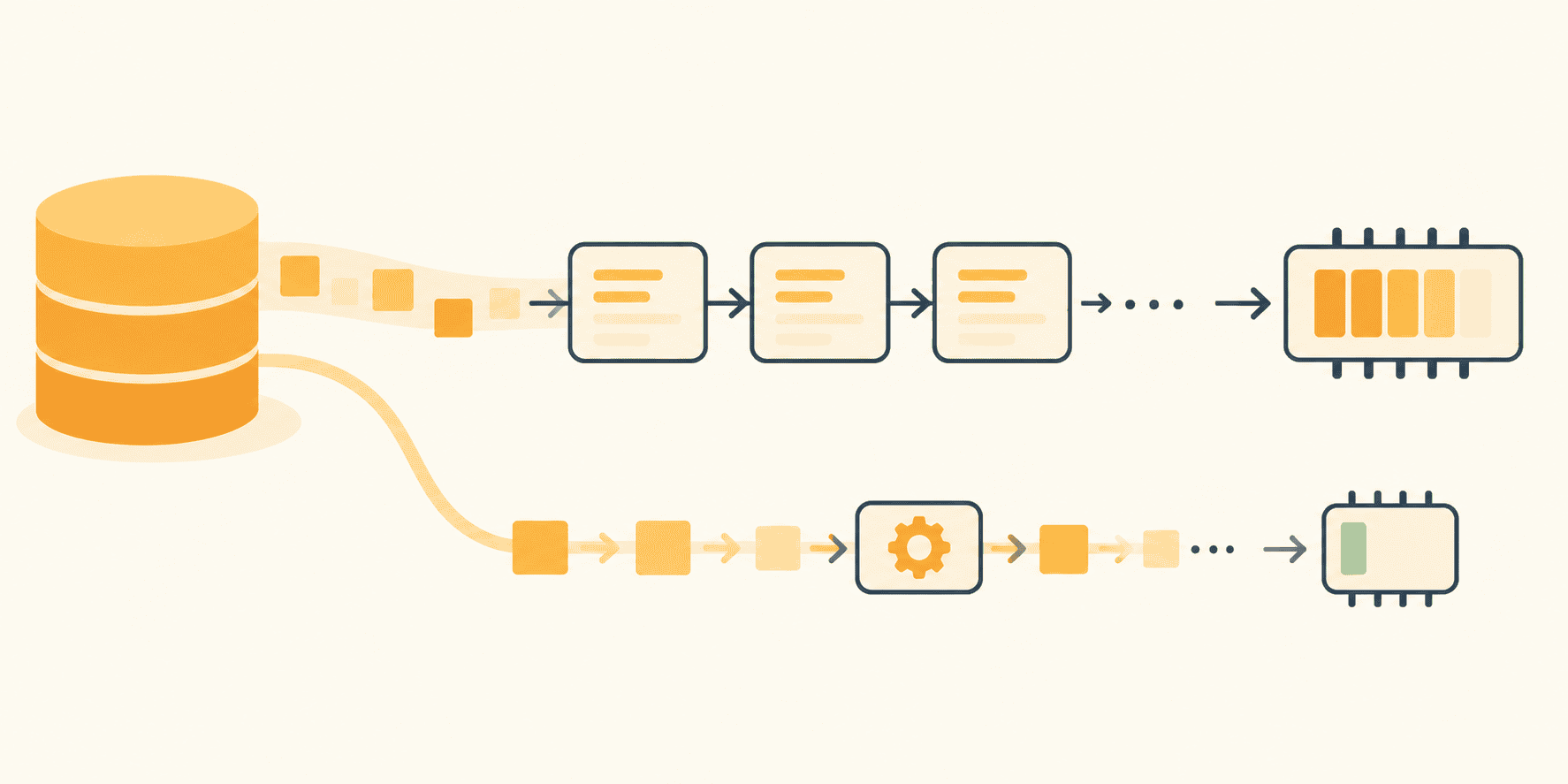
Consider a pipeline consisting of three stages: file reading, record parsing, and level filtering. By using yield, each stage functions as an independent, lazy-evaluated unit. The read_lines function can utilize yield from to process multiple rotated log files sequentially, closing each file handle before opening the next. This ensures that the file system remains clean and that the pipeline never attempts to hold more than a single line in memory at any time.
Strategic Implementation of Generator Expressions
Beyond full generator functions, generator expressions offer a concise way to implement lazy transformations. Enclosed in parentheses, these expressions act as the "glue" between named generator stages. It is crucial to note that the leftmost iterable in a generator expression is evaluated immediately. Consequently, developers should ensure that the source of their pipeline is already a generator to maintain the desired laziness.
The integration of the itertools module further enhances this architecture. Tools such as islice allow for "look-ahead" operations or sanity checks without consuming the entire stream. For instance, running a five-row test on a 9 GB file provides an instantaneous validation of the pipeline’s logic without loading more than a few kilobytes of data.
Managing the Boundary: The Role of Batching
While laziness is the ideal state for internal processing, data must eventually be committed to a destination—a database, an API, or a storage file. This is where "batching" becomes necessary. Since Python 3.12, the itertools.batched() function provides a standardized way to group stream elements into manageable chunks.
Batching is not a contradiction of lazy processing; it is a controlled materialization. By selecting a specific batch size, such as 1,000 records, the developer limits the memory footprint to a predictable, configurable threshold. This approach ensures that the application remains performant even when the total number of records reaches into the billions.

Validating Memory Efficiency with Tracemalloc
The effectiveness of a streaming pipeline should never be assumed; it must be measured. The standard library’s tracemalloc module is the industry-standard tool for monitoring memory usage in Python applications. By recording the "peak" memory usage, developers can distinguish between a pipeline that streams and one that merely masks an eager allocation.
In comparative tests, an eager script processing 200,000 lines might peak at nearly 200 MB of RAM, whereas an optimized streaming pipeline typically peaks at less than 1 MB. This delta grows exponentially as the input size increases. If peak memory does not drop after refactoring, it is a clear indicator that a reference is escaping the stream or a library call is forcing materialization, such as calling list() or sorted() on the generator output.
Broader Implications and Best Practices
The transition to streaming pipelines is not merely a technical fix; it is a shift toward more maintainable and testable code. By isolating parsing, filtering, and transformation into distinct, named generator functions, developers create a codebase that is easier to debug and extend. Each stage can be unit-tested in isolation, significantly reducing the surface area for logic errors.
Furthermore, this methodology is highly applicable to the evolving demands of artificial intelligence and machine learning. As datasets for model fine-tuning and preprocessing grow, the "in-memory" model is increasingly untenable. Streaming records directly from disk or message queues into preprocessing pipelines allows data scientists to work with datasets that far exceed the physical capacity of their hardware.
Ultimately, the goal of memory-efficient processing is to create a predictable system. A well-designed pipeline is transparent: one can easily identify the entry point, the transformation stages, and the deliberate point of materialization. When a system is built with these principles, it gains the resilience required to handle modern data loads, moving from a fragile script that crashes under pressure to a robust, scalable component of the enterprise data infrastructure. By respecting the iterator protocol and keeping the middle of the pipeline strictly lazy, developers ensure that their applications are prepared for the scale of tomorrow’s data challenges.
