
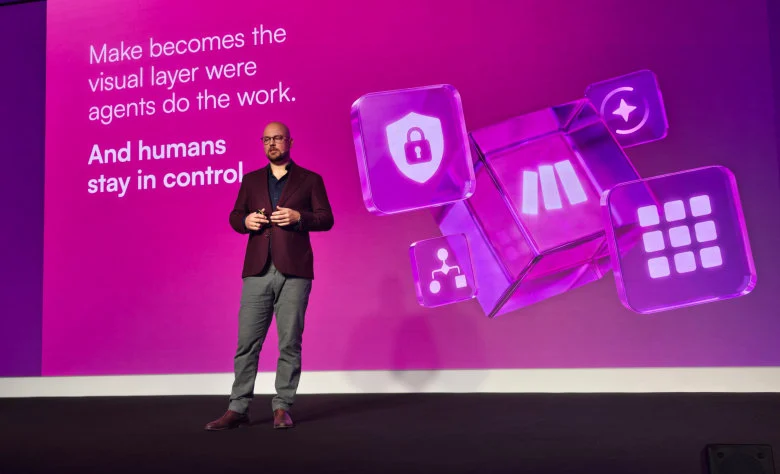

The enterprise technology landscape has reached an inflection point where the widespread availability of artificial intelligence tools has decoupled personal productivity from comprehensive organizational transformation. Addressing this critical gap at the annual Waves 2026 conference in Prague, automation and orchestration platform Make introduced its overarching enterprise strategy: the "glass box." Led by Chief Executive Officer Fabian Veit, the initiative is designed to provide businesses with the visibility, governance, and control mechanisms necessary to safely manage large-scale agentic operations.
While enterprise AI adoption has surged due to the proliferation of accessible chat interfaces and personal productivity assistants, deep structural transformation has largely stalled. Core business processes, operational systems, and approval hierarchies continue to mirror their pre-AI baselines. According to Make leadership, the primary barrier preventing organizations from integrating probabilistic AI into critical workflows is not a lack of capability, but an absence of operational trust. Unlike personal productivity tools characterized by low risk and direct human control, enterprise-wide AI deployment remains opaque, unpredictable, and potentially high-stakes.
Make’s glass box concept is engineered to replace the traditional black box paradigm—wherein organizations rely blindly on probabilistic systems—with a transparent operational layer. This architectural vision aims to position Make as the visual orchestration medium that allows human operators to maintain executive authority while autonomous agents execute complex workflows at scale.
Evolution of Enterprise Automation and the Waves 2026 Timeline
The unveiling of the glass box framework at Waves 2026 marks a strategic evolution for Make, a company recognized for over a decade as a pioneer in visual scenario building and digital orchestration. The conference served as the primary venue for outlining a comprehensive product roadmap intended to bridge the chasm between individual AI use and enterprise-wide deployment.
The strategic timeline presented by Make executives spans four core pillars of the operational lifecycle: discovering automation opportunities, building agentic solutions, governing agent behavior, and observing collective enterprise performance.
The initial phase relies heavily on the integration of process intelligence technology inherited from Make’s parent company, Celonis. By combining process mining and task mining methodologies, the "Discover" capability scans operational workflows to identify manual bottlenecks and recurring tasks suitable for automation. While integration efforts between Make and Celonis remain in a transitional phase—reflecting the structural complexities of merging distinct data architectures—the capability signals a concerted push toward data-driven automation identification.
Transitioning from Drag-and-Drop to Natural Language Guidance
During the "Build" phase of the product lifecycle, Make outlined a fundamental shift in how automation solutions are conceptualized and deployed. Veit noted that natural language is increasingly replacing traditional visual modeling as the primary medium for translating human intent into operational systems.
Despite predicting the eventual decline of conventional drag-and-drop development—a notable statement given the company’s history—Make emphasized that visual models will assume a more vital role than ever. As the volume and complexity of agent-driven changes accelerate, visual models will function as a refraction layer, allowing human supervisors to evaluate and approve high-level intent without managing every line of implementation.
To operationalize this approach, Make highlighted its proprietary AI assistant, Maia, which collaborates with users to design solutions, gather requirements, and present structured implementation strategies for approval. Furthermore, maintaining its commitment to interoperability, Make integrated Model Context Protocol (MCP) support into its platform. This enables users to incorporate external large language models and assistant frameworks, such as Anthropic’s Claude and OpenAI’s ChatGPT, while preserving centralized visibility across the Make canvas.
Implementing Strict Runtime Governance and Constraint Frameworks
As autonomous agents transition from planning phases to active runtime execution, the challenge of organizational oversight intensifies. Anastasia Horáková, Make’s Head of Product for Governance, addressed the systemic vulnerabilities associated with decentralized AI deployments, including shared team credentials, unrestricted administrative privileges, and unmonitored model selection.
In response to these risks, Make detailed a robust governance framework designed to establish explicit boundaries around agentic autonomy. Under the updated architecture, agents utilizing MCP inherit the specific roles and permissions of their human supervisors. Additionally, the platform employs isolated private spaces and restricted MCP toolboxes to limit agent access to designated data sources, application connections, and execution scenarios.
For high-consequence decisions that exceed predefined operational parameters, Make introduced built-in human-approval checkpoints. These capabilities ensure that workflows automatically pause and route decisions to authorized personnel whenever an agent encounters a scenario requiring human judgment, mitigating the risks associated with unchecked probabilistic execution.
Moving from Isolated Visibility to Collective Coherence
A central thesis of the Waves 2026 presentations, articulated by Head of Product Peter Trenkner, is that the local visibility of individual automated processes does not automatically equate to enterprise-wide legibility. Thousands of discrete, functional integrations do not inherently form a coherent operating model.
To achieve genuine enterprise transparency, organizations require tools that map the complex relationships, dependencies, and data flows connecting disparate digital assets. Make is addressing this requirement through enhancements to Grid, its landscape visualization technology. Grid provides a comprehensive structural mapping of digital assets within a customer environment and is being expanded to incorporate agents and workloads operating on external platforms.
By granting both internal and external agents access to Grid’s underlying structural data, Make aims to establish a shared operational context between human supervisors and autonomous systems. Additional updates demonstrated during the conference include advanced tracing tools for multi-system executions and granular visualization of operational costs mapped directly against the enterprise landscape.
Industry Implications and Market Analysis
The strategic roadmap presented at Waves 2026 highlights a broader industry trend: the transition of integration platform-as-a-service (iPaaS) providers into sophisticated orchestration layers for agentic enterprises. As organizations grapple with the operational complexity of deploying thousands of autonomous agents, traditional software lifecycle management models face severe strain.
The introduction of Celonis-backed process intelligence alongside Make’s visualization and governance architecture positions the combined entity to capture significant market share in enterprise automation. However, analysts note that the long-term success of the glass box strategy will depend on the platform’s ability to seamlessly harmonize diverse data structures, process mining engines, and visualization methodologies.
Ultimately, Make’s vision points toward a future where human operators cede direct execution tasks to autonomous agents while retaining strategic control through high-level abstraction surfaces. By prioritizing transparency, modular governance, and comprehensive landscape visualization, the company is attempting to establish a viable blueprint for trust-based enterprise AI adoption.
